Wiser Web Wednesday

Wiser Web Wednesday – a semi-regular link to posts of interest from around the web, by those far wiser than myself:


Handground
Taking my workplace as a microcosm of society (a tenuous example at best), it would seem many AeroPress converts begin with a French Press or “plunger”.

Worth the change? I say yes, however perhaps this comparison may provide a little more clarity if you are on the fence:
The Ultimate Brew Down: AeroPress vs. French Press


SF Gate
Doom and gloom seems to await every exploration into our future at times, and climate change and the effects of same are often at the heart.

Agriculture, and of course coffee, is squarely in the firing line — particularly the larger growing areas in South and Central America which have a large influence on international supply. At the current rate, by 2050, we will see a significant decline in coffee production if climate change trends continue:

Internationally, that decline is estimated to be 50 percent, resulting in a spike in prices and a drop in production.

Food for thought:
Research: Coffee bean shortage predicted due to climate change


Pendora’s Box
As I write this I am staring at the very same pen sitting on my desk, calling to be inked and given a run.

The OMAS Ogiva Alba series came in violet, green and orange. I chose the orange pen. The pen colours are inspired from the lights of the Aurora Borealis (Alba in Italian).

It’s certainly a beautiful pen in the flesh:
Pen Review: OMAS Ogiva Alba Orange


The Finer Point
A nicely balanced view by Jenny on the limited edition nature of some stationery items, and the excitement and pull of “getting in” on such a purchase.

I am not writing off the limited edition and nor am I saying I won’t buy a limited edition item in the future. What I am concluding is that I will not be buying these items without fully considering them first. In the past I have fallen for the lure of the limited edition without considering if I would actually use the products I was buying and I have found that my enjoyment of stationery items comes in the use, not in the acquisition.

I’d have to agree, and also add: not only is there a certain pressure in maintaining the “collection” once you start, this is only heightened by everyone else posting their new Field Notes, limited edition inks, pens and the like.

We’re all different, though personally, I’d rather reorder another notebook when I’m coming to the end of the current one than have a stack sitting unused on my shelf. Same result, just different timing. Do I ever miss out? Of course — on something that looks a little different. Strangely, a limited edition notebook does the same thing as a standard one — go figure.

If you love the lure of the limited edition? I say go for it — and yes, I enjoy seeing those Instagram posts and early reviews.

It just won’t be me racing you to the front of the queue:
The Lure of the Limited Edition


The Pencilcase Blog
My Nock Co. cases have always done the job with transporting and storing my pens, as the Kickstarter campaign coincided with a reinvigoration of both my interest in pens and the size of my collection (and of course the fact they are great cases).

A great review here by Dries after a pretty decent trial period on a six pen leather case:

About eight months later, and I’m still using the Dreamtouch case daily to protect and transport my ‘finer’ pens!

I’ve tended to avoid the finer leather type cases as they are a little bulky for my tastes. That said, this one by Visconti is an attractive option:
Visconti Dreamtouch 6 Pen Hardcase Review


Justin Jackson
No doubt many of us have been a little obsessed with our site designs at times, and when it comes down to it, the following probably sum up what we should be most concerned with:

We’ve become obsessed with fancy designs, responsive layouts, and scripts that do magical things.

But the most powerful tool on the web is still words.

True enough, however a lagging, unresponsive site might affect your rate of returning traffic I’d expect:
Words


Colin Walker
Although Ulysses is quite capable of, and recommended by many as the total solution for all text, including short notes – I remain a diehard Drafts user for the smaller stuff.

Being text editors that excel when using Markdown, Drafts and Ulysses might seem to be very similar — there is a good amount of overlap between them — but they take different approaches to similar problems

I guess it all comes down to the right tools for your jobs:
Drafts and Ulysses: a (very) quick comparison


Tools and Toys
Josh Ginter reviews the Knomo Envelope Sleeve which is an attractive protective and carrying option for both the 11” MacBook Air and newer MacBook.

I’ve had this leather sleeve for five years, and although that’s not five years of extended use, that’s still five years of bumps. You can hardly see any scars on the Knomo’s face.

A great looking option if you are in the market. Also I’d like to add to the Knomo suggestion box that a navy or blue leather model would be a great option as well:
A Review of the Knomo Envelope Sleeve for MacBook and 11″ MacBook Air


The Newsprint
Reading the above Tools & Toys review by Josh reminded me of this recent piece on his own site about the new MacBook.

With so many recommendations going around about moving to the iPad Pro, this was a refreshing, and quite objective view on moving in the other direction — even for a firm lover of the iPad Pro, as Josh states in opening the post.

I enjoyed this one:
The MacBook (2016)


Great Drams
Practice, practice, and yes…more practice. It’s really the only way.

Taking notes can also help at this point. Don’t read any tasting notes until after you’ve done your own tasting. Then, when your finished, you can compare and see how your own nose measures up against the greats!

There are no shortcuts worth taking in this endeavour:
How to Develop Your Whisky Taste Buds


Scotch Whisky
An edge over competitors or merely semantics? Either way, a rise in “single estate” distilleries apparently may lead whisky down the same path as coffee.

The same confusion exists over single origin coffee and single estate. Unless you’re a hipster or coffee buff you probably won’t know the difference, which is why some Scotch whisky producers’ recent adoption of the latter term could be a dangerous move.

I malt elsewhere — do I still qualify?

One might argue that malting is the first step in the whisky production process and if it’s conducted elsewhere then how can a distillery claim to be single estate?

Are we as consumers confused: wow that tastes great – its single what? Oh right…umm…ok – did I mention that it really tastes great? — or is it the industry?:
Confusion over ‘single estate’ whisky


Fortune
Change the world? Maybe, maybe not.

Every 10 minutes, all the transactions conducted are verified, cleared, and stored in a block that is linked to the preceding block, creating a chain. Each block must refer to the preceding block to be valid. This structure permanently time-stamps and stores exchanges of value, preventing anyone from altering the ledger. If you wanted to steal a Bitcoin, you’d have to rewrite the coin’s entire history on the blockchain in broad daylight. That’s practically impossible

Surely I’m not the only one who feels uncomfortable when the concepts of hacking and the words “practically impossible” are in the same train of thought:
Here’s Why Blockchains Will Change the World


Wiser Web Wednesday

Wiser Web Wednesday – a semi-regular link to posts of interest from around the web, by those far wiser than myself:


Think Business
The Waterford Distillery in Ireland continues the march towards eventual release, continuing to work extremely closely with the farmers growing barley for the spirit.

The relationship between the distillery and its farmers is a close one, thanks in part to an app from farm technology company Farmflo. “All our farmers have it on their mobile phones, and they use it to record everything they do on their field, all of which we get to see. Over time, we build up the complete story of every step, which consumers will be able to see too.”

With improvements in technology occurring at a rapid pace, it’s exciting to think of the developments being put in place to assist relationships such as these:
Waterford Distillery’s soul searching


WhiskyCast
There seems no end to the spread of whisky distilleries across the globe, and although Rampur isn’t the first, India certainly isn’t bursting at the seams with them either.

Rampur Distillery is located in northern India near New Delhi, hundreds of miles north of Amrut’s Bangalore distillery and Paul John’s distillery in Goa. While it shares some of the same climate conditions that lead to rapid maturation for those whiskies, Rampur’s location in the foothills of the Himalayas create more significant temperature extremes that affect maturation.

More choices for the whisky lover (depending on which markets receive distribution of course) can only be a good thing:
Radico Khaitan Enters Growing Indian Single Malt Whisky Market


MacSparky
Although I don’t recall specifics, the “For You” recommendations which popped up during my trial of Apple Music in its early days also seemed to suffer from the combined family library syndrome.

At the very least, if I tell Apple Music I don’t like the One Direction playlist (again, not that there is anything wrong with that), Apple Music should not throw it at me again … every day … for the rest of my life.

Irrespective of years worth of repeated plays, I would have thought telling Apple you don’t like a certain artist (which I myself never bothered to do incidentally) might at least have some effect.

Apparently not:
Apple Music Recommendations. Not “For Me”


PC Authority
As someone who works in the insurance injury, we are indeed seeing more and more dashcam footage – all with varying quality. For best results, Anthony Agius with a little of what to look for.

It’s 2016, so don’t waste your money on anything lower than a 21:9, 1080p dashcam.

From a quick search you’re looking at around A$200 – $300 for a model with features similar to those described in this article, though you will find some aggressive pricing around on sale items if you shop around:
Buyer’s Guide: Dashcams are becoming the must-have driving accessory – so pick the right one


The Clicky Post
For many years now Mike Dudek has made quality wooden pen storage, and it is always great to see new collaborations from time to time.

This one is a beauty, though limited to twenty numbered pieces – best to get in quick if you are a fan:
Announcing The Morse by Dudek Modern Goods – Limited Edition


Nib & Ink
The other half of the collaboration mentioned above – Matthew Morse.

It’s your perfect hand-lettering workstation.

Indeed it is:
Special Project: The Morse by Dudek Modern Goods


The Pen Addict
Dave Rea, the man behind Indxd, discusses the very real problem some pen reviewers face in the form of overly aggressive detractors who are all too happy to comment.

To the content creators of the pen community there’s plenty of “noise”, and precious little “signal”: those times when the audience actively engages.

Speaking of audience engagement – I’m the first to admit I probably don’t share the enthusiasm as openly as I should, which is something I am certainly aware of. My attempts to change this are somewhat sporadic, though I’d like to think these Wednesday link posts do show at least a little appreciation.

There are some excellent suggestions in this post, though as always, it’s a pity they need to be made in the first place:
Signal and Noise – on Trolling Pen Reviewers


The Guardian
Further to the link above, a former moderator of The Guardian news website, on what many might consider “the worst job in the world” — particularly given the number of comments can exceed 70,000 per day.

But there are limits. The anonymous free-for-all of the online world can be damaging. It is easy to misinterpret, to overplay your hand, or become desensitised to the real people behind the screen.

In posting the links about this topic I’d also like to put in a positive spin. I have developed two very valuable friendships through my blog — neither of which would have ever come about were it not for the comments and contact form providing access for those particular readers (one of whom sent me this article — cut from the newspaper).

I value the discussion, advice, opinion, and interaction through regular correspondence with each of them very highly, and have no hesitation in saying my life is richer for it.

It is such a pity so much negativity exists out there, for there are some truly great people in the world — some of which will hopefully comment or contact you through your blog:
They called it ‘the worst job in the world’ – my life as a Guardian moderator


The Gentleman Stationer
A combination of colours that speak for themselves:

This particular celluloid might be the most beautiful material I’ve ever owned.  It’s a mixture of black, graphite, and gray pearl intermixed with veins of bright blue (think “Bung Box Sapphire” blue).

A great post as always from Joe – you’d best go take a look:
Pen Review: Edison Menlo in Tibaldi Impero Celluloid


Fast Company
Two pen community favourites bring their A-game to educate a wider audience, providing expert advice for Fast Company readers on notebook buying.

A better strategy is to learn about different types of notebooks, so that you are best informed to make your own decision while avoiding the obvious clunkers.

Even if – as an enthusiast – you know this stuff, Ian and Ana have done a fantastic job on what is essentially a pretty broad topic based on the options available out there:
How To Buy A Paper Notebook That Brings You Joy


The Specialty Coffee Chronicle
It would be hard to find an agriculturally-based industry immune to the effects of climate change across the world, and coffee is no different.

It’s clear that climate change is already impacting coffee growing communities across the globe in significant ways. Climate smart agriculture and adaptation practices for farmers developed for the local context are critical for the future viability of specialty coffee.

There is some important work being done to counteract the devastating effects on such an important crop:
Climate Change: Adapting to a Changing Environment


The Age
Could this really be happening? Australia Post are planning to charge for later collection of items undeliverable. Although not the sole domain of Australia Post, we’ve all been victim of the mysterious undeliverable card received after we’ve been home at the supposed time of the attempt.

Fahour’s “introductory offering” to his new “pick up” service will top out at $9 a parcel, if you miss the postie because you’re at work or you simply don’t hear them as they tippie-toe up the steps to knock ever so lightly on the door before running like crazy for the van, yelling at the getaway driver to put the pedal to the metal.

A courier company’s delight:
John Birmingham: Australia Post’s $9 pick-up service enough to make me go postal


The DanDa Stationery Aisle – cheap, cheerful and useful

danda_post_add

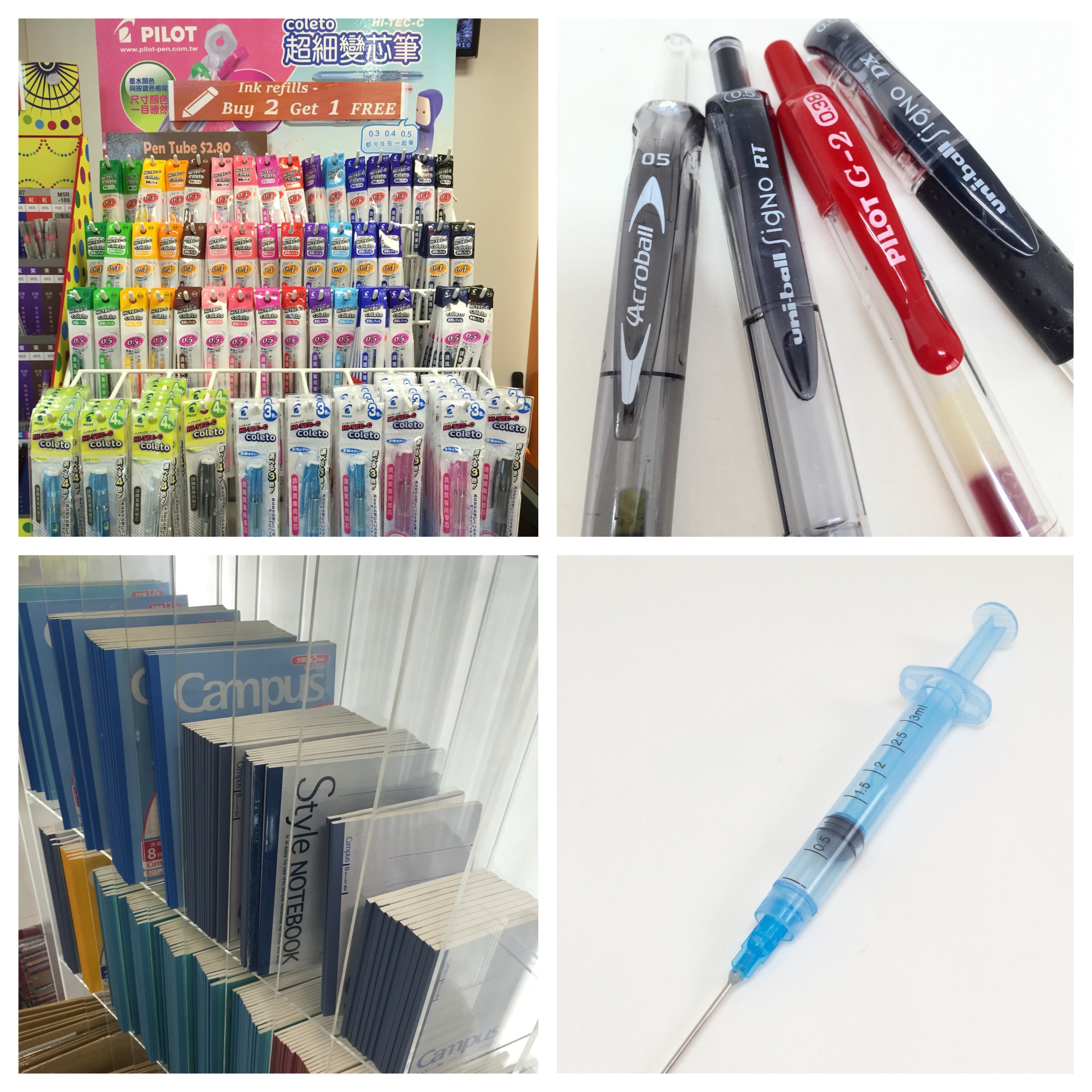
Although not likely to replace your favourite online stationery supplier, nor is it Officeworks, Japanese discount store DanDa has a few options which might be handy to those interested in pen and paper. Cheap, locally available, and carrying some items not found in other brick and mortar stores in town all make for a place worth visiting next time you find yourself in the Brisbane’s CBD.

Located in Adelaide Street (opposite City Hall), it’s an easy walk from most places you may be visiting should you find yourself in the CBD.

What might you find here which may be of interest? Quite a few gel pens for starters, including Uniball’s Signo DX, some Zebra’s Sarasa, Pilot’s G-2, and Pentel’s Energel among many others. The predominant tip size is medium and finer, although for those who prefer a wider line you will likely find something for your preference as well.

IMG_5928danda_post

DanDa has been my go to supplier for Pilot Hi-Tec-C Coleto multi-pen refills for some time now, and if you buy three refills, you only pay for two. Speaking of payment — it is of course one of those stores where everything is a universal price (apart from the occasional item marked otherwise – though this is rare). Everything you pick up is A$2.80.

For the fountain pen user? Here, there is probably a little less (read zero) as far as pens are concerned, however I have picked up the fountain pen friendly Campus notebooks by Kokuyo (in multiple sizes); a 3 ml syringe for cartridge refills (you’ll find this in the cosmetics aisle); and a couple of magnifying glasses (albeit not the most powerful) for peering a little more closely at some nibs. Again all at a cost of A$2.80 a piece.

IMG_5929danda_post

As I said, DanDa probably won’t become your go-to stationery store, however there are a couple of aisles of pen and paper well worth checking out — and it certainly won’t do your credit card too much damage in the process.


Wiser Web Wednesday

Wiser Web Wednesday – a semi-regular link to posts of interest from around the web, by those far wiser than myself:


Stratechery
A great piece by Ben Thompson on the position Apple finds itself in regarding its services (i.e. App Store, iCloud, Apple Music).

Apple will not fix the services it already has, or deliver on the promise of the services its hardware might yet enable, unless a new kind of organization is built around these services that has a fundamentally different structure, different incentives, and different rhythms from Apple’s device teams. You don’t make great products because you want to make great products; you make great products by creating the conditions where great products can be produced

A sound rationale put forward here on the need for change:
Apple’s Organizational Crossroads


John Scullen
Even if you have a solid system in place for processing the multitude of sources we gather information from each and every day, it never hurts to review that system for possible tweaks to improve it.

Do I process everything in all my inboxes every day? No chance! Not all your inboxes are created equal. While I usually clear my task manager inbox at least once per day, I’m comfortable processing my email inbox and notebook entries less often. Once or twice per week is enough for my physical in-trays and camera roll.

John never fails to get you thinking with these types of posts, Well worth reading, and then genuinely asking yourself the question:
Are you absolutely sure you’ve processed all your inboxes?


The Pelikan’s Perch
An interesting post on the back story behind Pelikan’s 4001 Blue-Black ink, which I was unaware is not available in the US.

While today’s packaging omits such phrases, Pelikan’s own published literature does indeed confirm the presence of at least a small amount of iron gall in their Blue-Black ink.  The iron gall allows it to be more light resistant than any of the other inks in the 4001 line (though less than Scribtol or Fount India)

Although I don’t own any myself, it’s always interesting to learn a little more about the tools we may come across in the pen and ink realm:
The Story Behind Pelikan 4001 Blue-Black


The Pen Addict
Great tips and a look at some possible tools for fountain pen photography by Susan M. Pigott writing at The Pen Addict.

I’ve never really been a photographer by any definition, with the first half-decent camera I’ve really used being the Canon DSLR we purchased second-hand for my daughter’s senior school art projects. Even now, the photos for this blog are still taken on my trusty iPhone 6 with the stock standard lens.

One thing I would add, for just A$4.49 from the App Store, the iPhone app Camera+ has a macro mode, which captures pretty decent close up images (such as this one from a recent post), without having to resort to an expensive add on lens.

Clearly my photography and image processing are not up to the standard of many, though I think it’s worth pointing out you can achieve a lot (and perhaps enough for what you need) before outlaying a significant amount of money on additional equipment.

Mind you, there are some great and very well styled images here, and there is a lot to be said for natural light:
The Art of Fountain Pen Photography


From the Pen Cup
Certainly not the usual Pilot-Namiki post, given those are traditionally pen-containing pieces. Not this one, with Mary bringing a couple of mechanical pencils into the fold.

These look and feel like heirloom quality pencils, and came with price tags that seemed more than fair.

At first glance they look like pens, however provide a great option for a beautiful looking mechanical pencil:
Namiki What?


Pens! Paper! Pencils!
Ian takes a look at the recently released Pelikan M120 fountain pen, which probably has a certain appeal to many given the “old school” looks.

I think it looks great: very Mad Men, which is a good thing, although of course I don’t suppose that lot would have used a pen with a steel nib.

As noted in the review, Ian had a few issues with the nib skipping when writing, incidentally not found by two other reviewers using the same pen:
Pelikan M120 Fountain Pen Review


The Well Appointed Desk
Such a shame to see things like this, which I guess is always a risk when having work done on any pen – vintage or otherwise.

In other words, my pen was returned to me more damaged than when I left it with him and I only received a cursory apology and a “these things sometimes happen”.

Sound advice here which may not prevent such occurrences from ever happening, however might at least limit the damage or expense if they do:
When Bad Repairs Happen To Good Pens


Nib & Ink
Matthew Morse with a great review of the Visconti Rembrandt. A lovely blue, though perhaps not to everyone’s tastes as far as overall styling is concerned.

The Rembrandt collection is offered in a few colors, all of which are made from a variegated resin, giving them a visual texture reminiscent of the chiaroscuro technique so popular with the pen’s namesake

I must admit I don’t mind the overall style seen in the images, however you can only be certain when seeing the pen in the flesh (or variegated resin as it were). If you agree, click the link to check out the post, and enter the giveaway running through to the end of the week:
Review & Giveaway: Visconti Rembrandt


Fountain Pen Quest
Not a bad ink and pen combination by any stretch. Ray describes an interesting occurrence with the nib appearing to loosen of its own accord. I had a similar experience with a Pelikan M205, however put it down to somehow loosening the thing myself. That was some time ago and I’ve not had any problems since.

From the sounds of it, perhaps this nib’s days are numbered in its current form anyway:
Ink and Pen Notes: Pelikan M805 Stresemann with Pelikan Blue-Black


Pen Economics
Jonathon puts forward the valid suggestion that any list of beginner pens could well do with one of the vintage variety.

Most bloggers have a list of five beginner pens which they feel are good value, but I worry sometimes those lists are more about the five best pens which could be your very first one. My feeling is that the first five you buy should offer you a nice range of experiences so you can help to figure out what suits you: long/short pens, thick/thin sections or barrels, East/West nibs. And those lists should probably include a vintage pen as well.

Upon thinking a little on that, personally, my hesitation centres around two points: my own lack of experience with vintage pens, and additionally, the possibility that if the first pen was a dud (which of course is possible with any pen), the other four wouldn’t even matter.

Still – a good point, and one well worth putting some thought towards:
Why aren’t vintage pens more popular?


Scrively
I’m not the biggest fan of the standard Whitelines paper, however expected this collaboration with Leuchtturm would perform better on that front.

Apart from being a bound notebook and Leuchtturm paper, the major difference between ‘regular’ Whitelines paper and the Whitelines Link-thing is that the latter comes with a designated App to scan in the Whitelines Link paper.

Although upon reading the post it does sound like an improvement, I’ll most likely not be racing out to buy one, even though it does do a pretty good job of scanning the results:
Review: Leuchtturm 1917 “Whitelines Link” notebook


Five Senses Coffee
Exclusive Australian importer Five Senses with a brief rundown on the new Sette grinder from Baratza.

The Sette is a complete overhaul on its predecessor models with not only a new look but also an innovative approach to the internal mechanics.

Also without doubt on of the best looking consumer level grinders out there (check out this video).

Expected at Five Senses around June:
Introducing the Baratza Sette


Barista Hustle
Recently, some professional coffee folk banded together on a project to do with coffee grinding – it turned out pretty well.

So interesting, that we decided to turn it all into a paper; subjecting our methods to peer review and the rigorous process of publication. Last week, this paper was published in a Nature sub-journal -Scientific Reports- as open access.

There are some interesting findings on origin, processing, fines, and temperature, all in relation to grinding. Without resorting to reading the full, in-depth paper – a nice overview by Matt Perger – one of the authors:
The Grinder Paper: Explained


Sprudge
At SL28, a members only coffee bar in London.

Of course, due to the nature of the co-working space being accessible only by members, you have to belong to access the cafe. Luckily there is a membership tier available just for the intrepid coffee drinker: for £10 a month, you get access to the delicious coffees of SL28, with three free cups included in your monthly dues.

All that remains is to check the entry criteria.

“What! Are you serious? Sorry buddy – not in those shoes.”
Inside London’s First, And Most Exclusive, Members-Only Coffee Bar


Coffee: A Natural Processing Experiment Part 3 – Results and Conclusion

Welcome to the third and final post in a three-part series on a small-scale coffee processing experiment I undertook in my back yard. The first two posts can be found here:

Coffee: A Natural Processing Experiment Part 1- Processing Methods

Coffee: A Natural Processing Experiment Part 2 – Methods and a little madness

A quick recap:

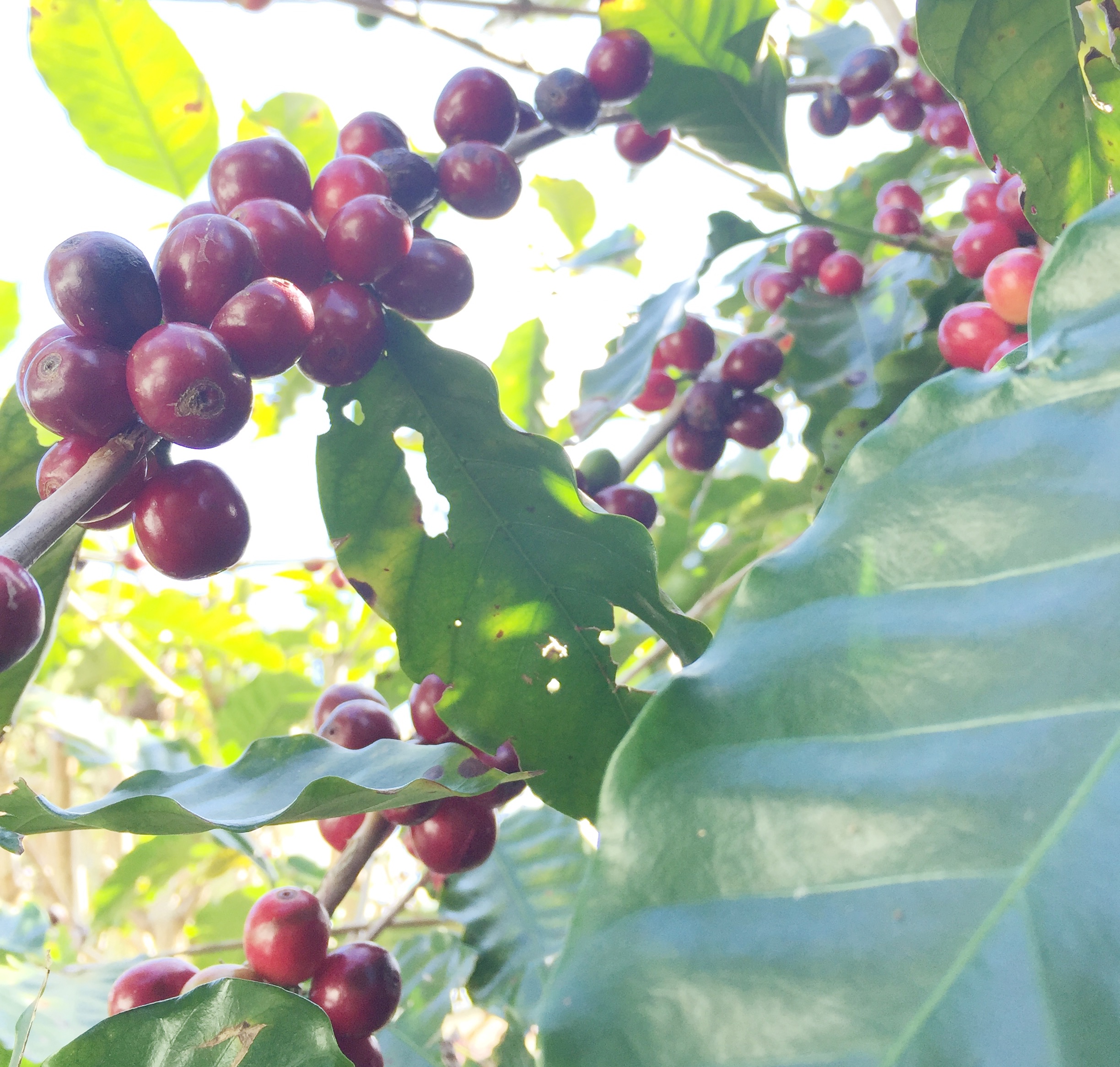
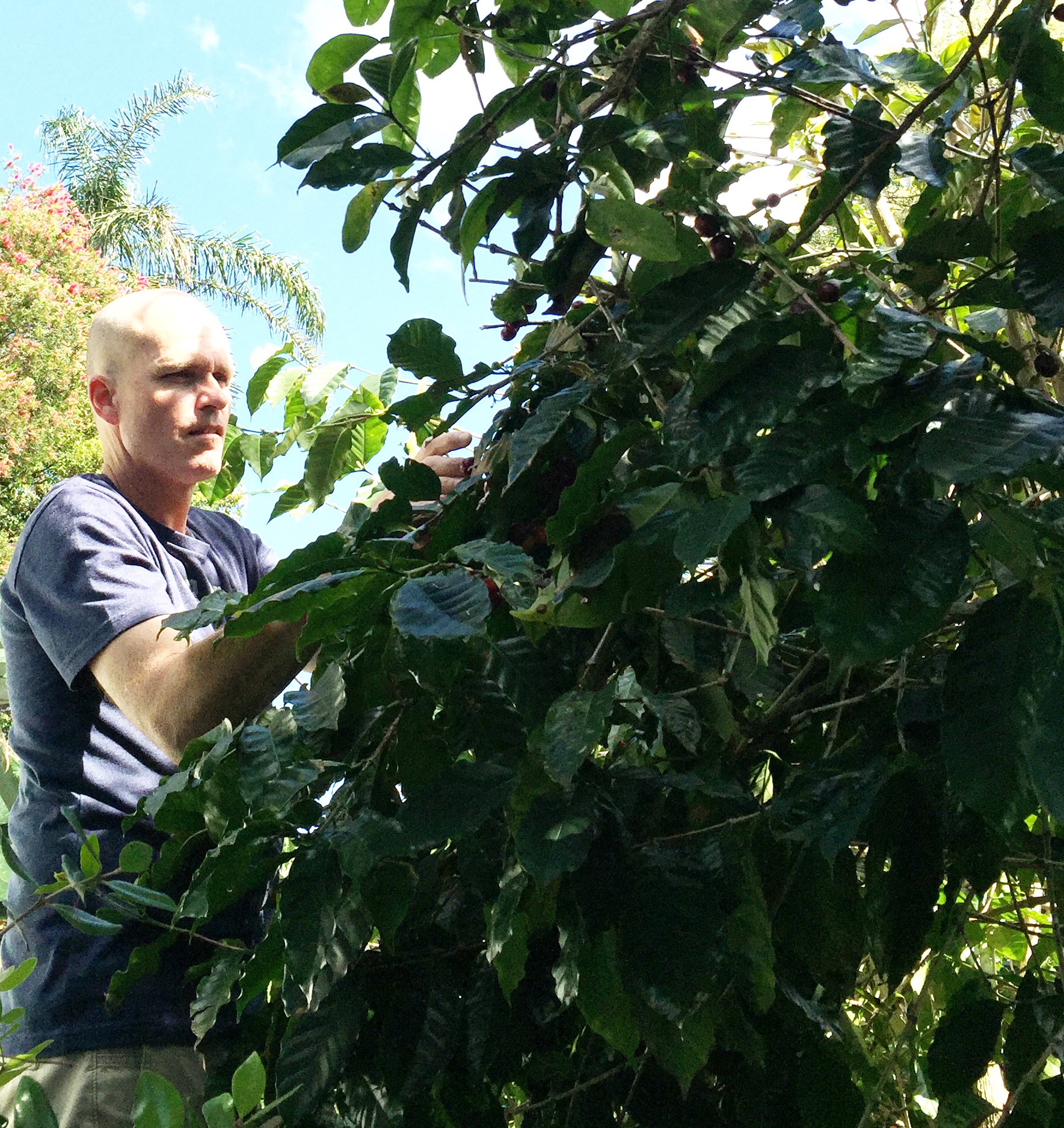
Late last year I picked a small crop from the coffee trees which are thriving at my parents house in northern New South Wales. Having processed a batch of the same coffee using a washed method a couple of years ago, I decided to try my hand at natural methods. The previous two posts and what follows below describe how things went for two separate batches: one “honey” processed, and the other a “natural” processed batch.

Part of the crop

Part of the crop

Results are in

In summary, the natural processed lot dried really well, however as I alluded to in Part Two of this series, the honey processing wasn’t quite as straightforward. I’ve broken things down a little further on each below.

Natural process

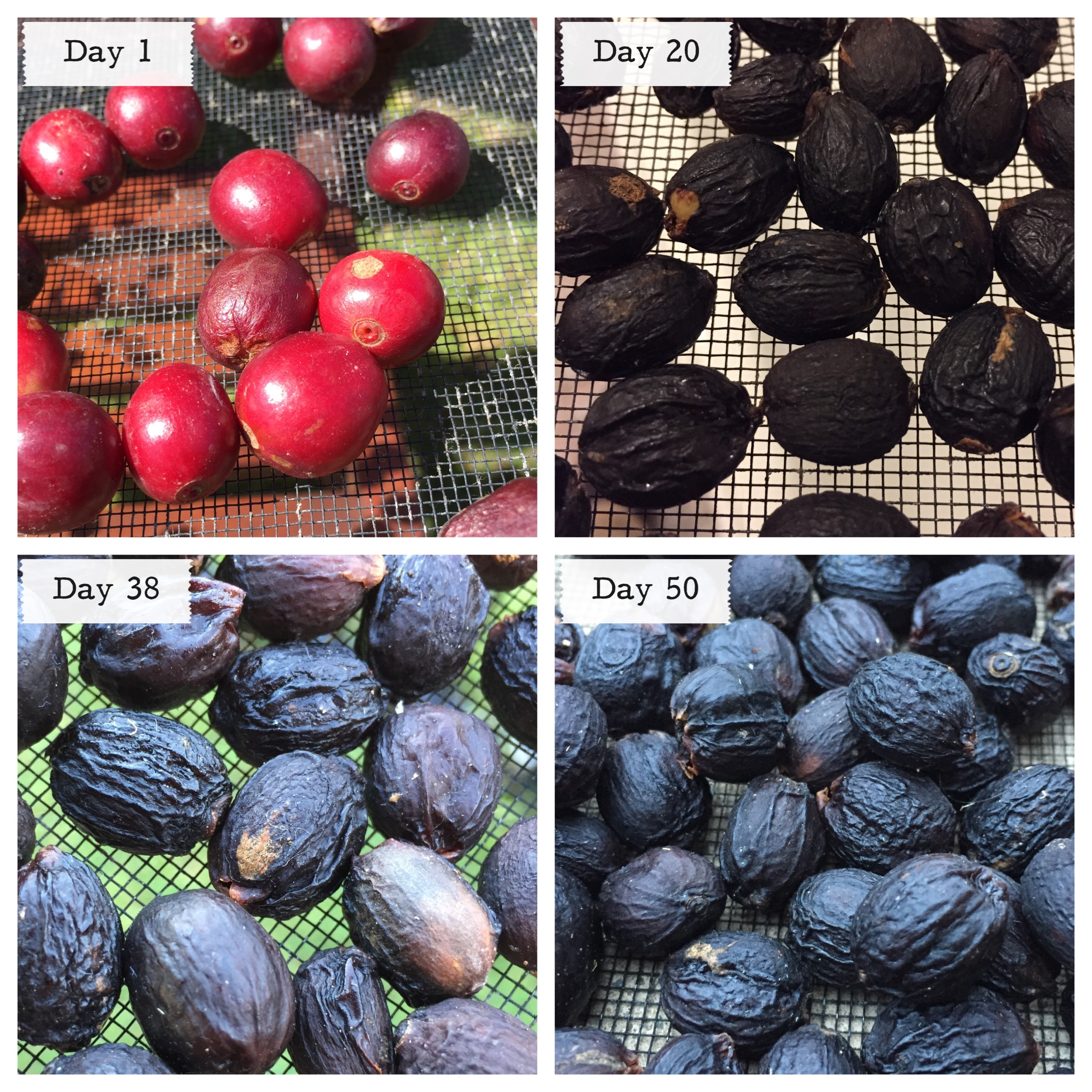
The naturals were a breeze to manage, and appeared to move fairly quickly in the early days of drying. It was fairly apparent early on some of the beans most likely commenced the process with less moisture content than others, as the darkening and progression from red to almost black which occurred within the first 7-10 days proceeded at different rates.

Once this first week or so had passed, the entire batch of naturals were mostly a uniform black colour, and the outer skins began to shrink and harden further. Looking back on some of the guidelines from the Part One post in this series — from Sweet Maria’s on climate suitability:

If a farm can dry coffee from ripe cherry to hard, dried pod in 20 days, it is probably well-suited to DP (dry processing) methods.

If I look at the naturals after 20 days, I think they would have been almost ready to go, and probably could have been removed from drying, hulled, and the bean then dried a little further at that point, resulting in a total drying time of around 30 days.

Natural processed batch across four time points.

Four time points: natural processing.

This is exactly what I should have done, however with a lot of my focus on the honey processed batch, it didn’t really occur to me to just pull the naturals from the drying bed and proceed with the next stage of processing. As I write this it sounds ridiculous not to have done this, however also in retrospect, I at least know what the longer end of the drying scale produces, and I’d rather have that knowledge in the bank and work on a shorter time period in future. Have I ever mentioned before I do these things to learn? I think I may have somewhere along the line.

In any event, the naturally processed batch had dried well, and it was onto hulling – or removing the outer skin, pulp and parchment layer. This was a fairly straightforward process, however with anything more than a very small batch becomes very time intensive. Piercing the skin with my finger nail, opening the dried pulp and pulling away all of the layers together left the just the green been, with a little silver skin which often clings, and is blown off during roasting.

Hulled and ready for roasting

Hulled and ready for roasting

In comparison with the washed processing method (of the DIY kind), if we are talking total effort and time, I found the removal of these outer layers all at once to be easier than the separate steps of pulping followed by removal of the dry parchment post-drying.

Honey process

It was with the honey processed batch that things were held up a little. I’ve mentioned in Part Two about the sticky outer coating of mucilage on the beans — and when I say sticky, I mean really, really sticky.

I had assumed after a week or so this would begin to dry out, which did occur as a warm dry day progressed, however as each day drew to a close and the air temperature fell, the stickiness returned. I even tried bringing them inside at night (stopping short of tucking them in after turning down the bed and laying a chocolate on their pillow) for a number of days however this really had no effect.

At the time I simply pushed on, assuming perhaps after a few weeks I’d have a dry batch, however this wasn’t so. Of course my error here was assuming an outer dry layer correlated with drying of the inner bean. I’ve yet to work out an exact relationship between the two, however I’d they are in some way related.

At around day 16 or 17 the first signs of dark spots began to appear on the outer surface of some beans. I proceeded on the basis I would either end up with a batch of beautiful “black honey” processed beans, or a heap of mould. I had my hopes on the former, however fully expected the latter. Remember at this stage things were still quite sticky, so I thought I had a way to go before they might be ready. In reality, it took another 10-12 days before the black spots began to increase. After around 38 days, it had well and truly taken hold of many of the beans.

Four time points: honey processing

Four time points: honey processing

So, by that stage I was indeed left with what appeared to be a pile of mould. The evenness in appearance of a true black honey processing method was replaced by what definitely appeared to be groups of black spores enveloping each bean. It was time to cut my losses and proceed only with the naturally processed batch.

A few lessons

First, I’d pull up stumps earlier on both batches of beans if I’d had my time again. Waiting for the honey processed batch to dry further was probably an exercise in futility. In doing so, I inadvertently left the naturals a good deal longer than planned (at least a coupe of weeks longer).

Also, plan on life getting in the way a little. By the time I had really decided the drying time was probably done, it was another week to remove the hulls from the naturals, and a further two until roasting. Not the end of the world, however when most things are limited to weekends, it’s not hard to blow out a scheduled timeline by weeks at a time. That said, I’d rather have that happen than not try this at all.

After all was said and done, I did actually venture back into the shed and remove the parchment layer from a couple of beans in the mouldy honey processed batch. Surprisingly, the bean appearance was reasonably good, however by that time I had already decided to abandon them — probably the wisest choice given the amount of mould on those outer layers.

If you are considering processing your own coffee at home, my advice would be to stick with a fully washed process, or if you are looking to dabble in some dry methods, perhaps go with a straight “natural” process.

Also, having now tried both wet and dry processing methods, I can offer the perspective that in a backyard DIY situation there is a little more work at the “front end” of the washed processing, however after that first week of pulping and washing, there only remains the hulling — or removal of the parchment layer once the beans have dried out.

By comparison, in a natural processed batch, there really is minimal effort required at the front end of the process, and come the time when the dried cherry is pulped and hulled, all layers come away pretty easily, and all you have left is the bean — ready to roast. On balance, looking at the total effort involved with each, I’d come down in favour of the natural processing method. Remember, the issues I had with turning the coffee during the drying process were all related to the honey processed batch. The naturals? As simple as running your hand over them or giving the drying frame a bit of a shake.

Concluding the processing

Reading through what I have written above, you may get the impression getting the coffee this far was all a little too hard, and perhaps not worth the time overall.

Nothing could be further from the truth, and I will definitely be processing more coffee naturally in future. Honey processing? Probably not — I’ll leave that to the experts in Costa Rica, and many other countries now processing this way.

For future batches though I’ll probably begin by limiting the drying time to around 20 days or so and see how the roast and taste compares with the current batch of 50 days duration. From there it’s only a matter of altering the time frames for further experimentation. I’m definitely looking forward to pursuing this further in future.

The remainder of this post will focus on the naturally processed batch, given the outcome of the honey processed lot detailed above.

Roasting

Once processing was complete, it was time to turn to roasting. Something which would be a fairly delicate task given the size of the batch remaining.

Remember, I began with 210 grams of coffee cherries in the each group. After the drying, the Natural crop had reduced in weight to 100 grams, and after de-pulping: 46 grams — a fairly small batch to roast. However, roast we must — otherwise everything to this point becomes fairly irrelevant.

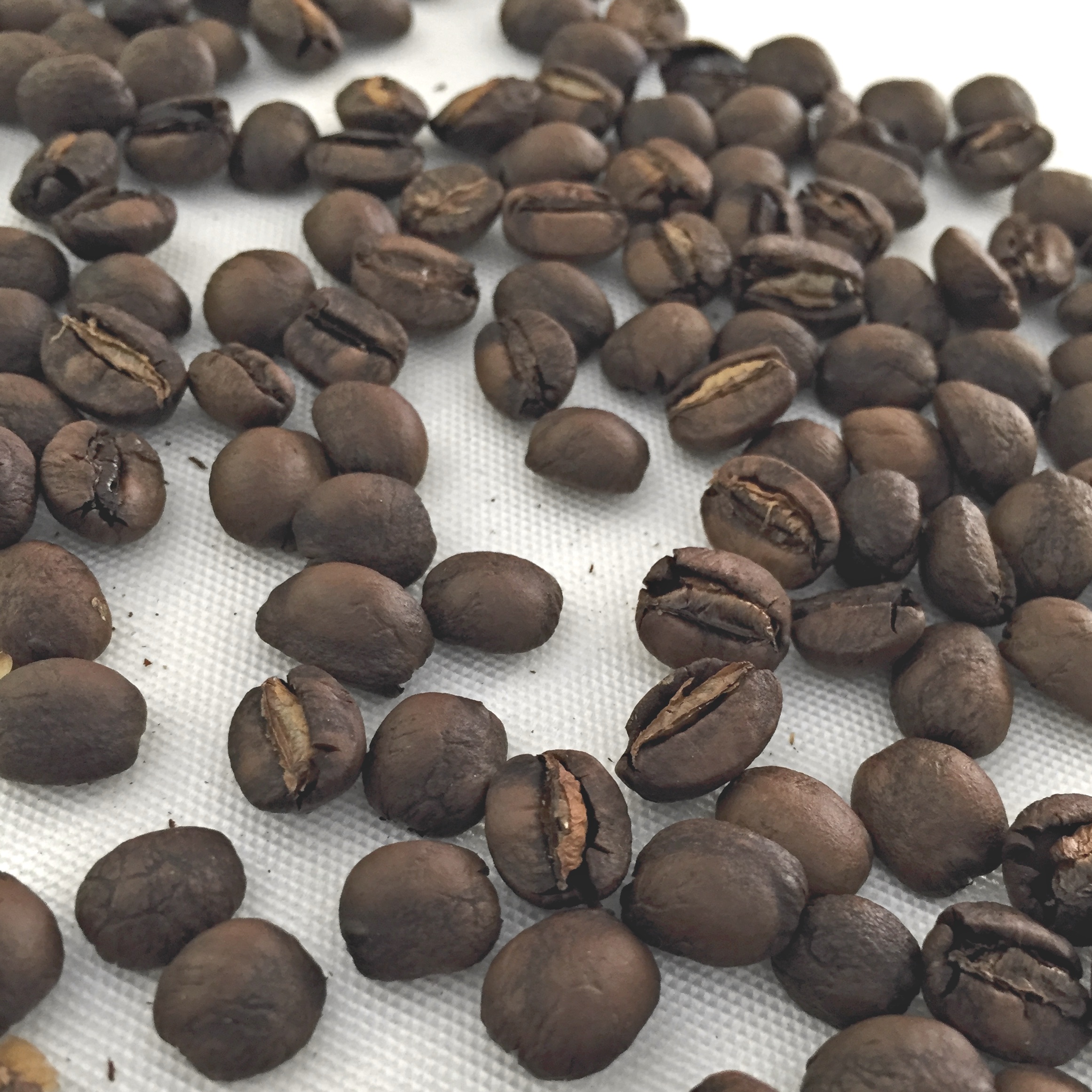
A successful roast

A successful roast of the naturally processed batch

The plan was to brew the resulting roast by filter, so a light to medium roast was in order. For those who may be interested, checking back on my roasting notes, the total roast time was 11 minutes, with a development of 19%.

Drinking

Having climbed the mountain, we were now at the summit, and the amount remaining to brew? A healthy 37.5 grams of roasted coffee, which had rested for seven days post roast and was now ready to go. Given I had a few tasters (family members) around the table, we had one shot at it, so with the hope my grind setting and brew recipe were somewhat close to the mark, away we went.

  • Coffee: Nine South Estate 2015 Natural
  • Region: Alstonville1 NSW, Australia
  • Grower: L & J Denison
  • Elevation: 140 m
  • Processing: Sun-dried Natural
  • Crop year: 2015

So how did it taste?

The result: shared with those who produced it

The result: shared with those who produced it

In all honesty, better than I expected. Sure, it wasn’t the pinnacle of fruity naturally processed greatness, however overall I would describe it as very well-balanced, with medium to light body, mild citrus acidity, with the predominant flavours woody spice and a hint of chocolate. Although not overpowering, there certainly some of those earthy flavours which can be apparent in naturally processed coffee, and these were also evident in the dry aroma after grinding.

A very enjoyable brew, for which I admit to being quite thankful for given the process leading up to actually tasting the stuff. My group of tasters around the table? In summary, I’d say there was general acknowledgement the whole process had been a success, given what was now being consumed. Mostly, the “actually that’s not too bad/pretty good” comments you expect when taste testing something you may be a little dubious about initially.

Of course it would have been sensible at this point to have on hand a sample of the same coffee processed by the fully washed method wouldn’t it? It’s probably a little late to think of that when pouring the brew into the cups. Another for the “in retrospect – this is what I will do next time” file.

In conclusion

I began this natural processing experiment in the knowledge at some point in the next few years I will need to be processing the fruit produced on the coffee tree now growing so well in my back yard.

Where it all began

Where it all began

Having previously managed to process a batch using the wet or washed method successfully, I was keen to see how a naturally processed lot turned out in comparison. In summary, I’d say I have a way to go with both methods, with some experimentation still required as to the length of the drying time with my naturals; and more efficient methods associated with the wet processing. Of course the joy in all of this is the amount of taste testing required to assess the results from tweaks in my processes.

After completing my first foray into natural processing, I think I’ll leave the “honey” methods to the experts, having found this more difficult every step of the way, however I certainly plan to be using the power of the local sunshine for some more natural process drying in future.

I hope you’ve enjoyed reading this series of posts, and perhaps learned something from them — I know I certainly have. Signing off with a special message from the honey processed batch: ”thanks for sticking with me”.


  1. The town I grew up in before moving to Brisbane in 1990. ↩︎