The Handwritten Draft

2016-06-26 handwritten_post

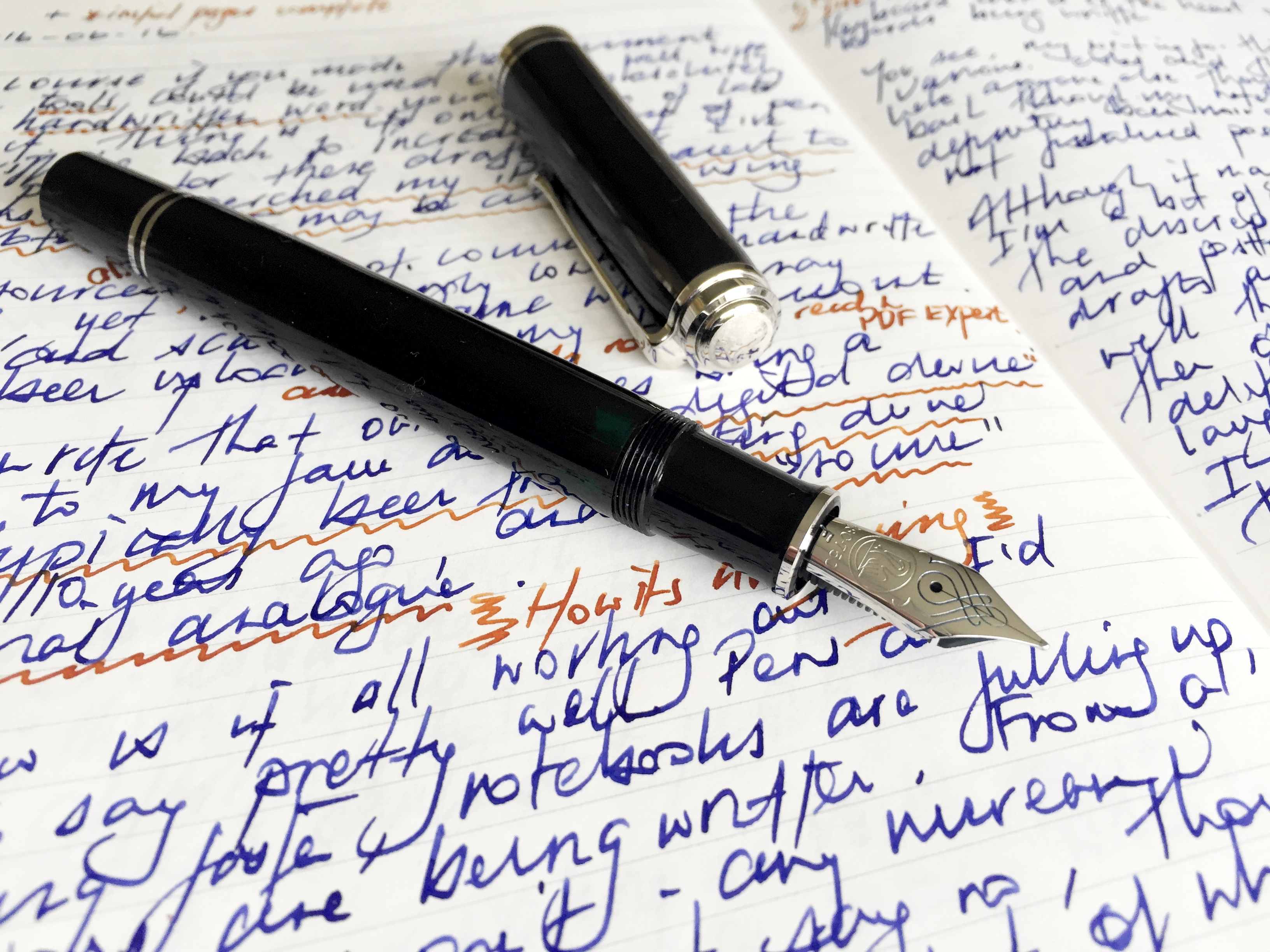
With so many digital tools at our disposal these days, handwriting often seems so far behind us. Of course many of the individuals whose work I read online are more likely to keep the faith than others, however when the words generally end up as pixels, perhaps it can be hard to justify transferring them from one to the other.

Some time ago I posted a picture on Twitter containing a page of handwritten words with a caption noting the (blog) post was now complete. In response, one commenter stated there was no way they had the time to perform such an undertaking. Another was surprised the proportion of posts I wrote this way was not higher (which I believe I estimated at around 30% at the time).

At the time I considered this for a little while and then didn’t really pay much attention to the thought — until more recently, when I realised the number is now reversed, with around 70-80% of posts you read here written longhand in their draft form1. A complete reversal of that proportion is a significant change, and for such a change to occur without a conscious plan to do so, suggests there are factors at play which perhaps warrant a little more thought.

My typical digital writing workflow

Looking back to the first couple of years of writing here, it is not hard to remember how things went. Ideas were kept in Evernote (often appended to the one note via a Drafts app extension); stimulus and/or reference material gathered online was largely stored in Pocket; and occasional post outlines created as mind maps using MindNode.

Sure, some handwritten notes were made in various pocket notebooks or slightly larger variants, however things were largely digital, and as I think back on it, the proportion was perhaps even higher than the estimated 70% of my original estimation. Even those handwritten ideas soon became text in Drafts or Evernote.

So the digital basis for a post was created, and all that remained was perhaps for some from of outlining and a first draft to follow. As I mentioned above, planning (on the rare times it occurred) was generally undertaken as a mind map, followed by writing — initially in Byword, and since 2014’s NaNoWriMo: Ulysses.

This process seemed to work for a good while, and I was happy enough for it to continue.

Why the change?

Well, in many respects, the following from Steven Pressfield which I linked to in last week’s Wiser Web Wednesday rings true:

For years I dove in on Page One, put my head down and started hammering keys. That’s not always a bad idea. Sometimes it works. But what usually happened for me was I’d get halfway through before it hit me that I was totally lost. Or I’d finish completely only to realize that I basically had to tear the whole house down and start over.

I’ve alluded above to the “rare times” post outlines occurred for good reason. If we take, say, 70% as a reasonable estimate again — that is about the proportion of posts which were written by sitting in front of the keyboard and writing. No real plan or outline other than a few random notes perhaps. That is not to say these posts were necessarily of high quality having been written this way, simply to say I may not have necessarily completed them all with a different approach.

As time has passed, I’ve found this an increasingly difficult way of getting words down on these pages at an acceptable quality and rate. On the surface I am not entirely sure why that is, however suspect (and hope) my writing has at least improved to some degree since commencing this blogging endeavour in the first half of 2013. Like many (I assume) — I don’t tend to go back and read many of my previous posts, however there is probably immeasurable value in doing so. If we then assume I would like my writing here to continue improving, a little more structure was needed.

Part of that structure began with increasing my use of those mind maps, and more recently, outlining in Workflowy. Perhaps there is something in the outlining versus mind mapping debate as far as which suits my style of planning best, however that is a post for another day.

Additionally, a gradual increase in the use of pen and paper to jot down some thoughts, turn them into an outline, and expand into the first draft seemed to improve the process immensely — and certainly did not go unnoticed. In considering how this change had come to be, and whether I should throw more effort into handwriting these posts, I received an article from a friend on this very topic — by author William Boyd, writing in The Guardian:

One great advantage of a longhand draft is that, in transferring it to the computer, every single word is written at least twice. Then the computer draft can be endlessly revised.

When you write in longhand you’re unconsciously aware of aspects of your prose – such as sentence length, cadence, rhythm, repetition, prolixity – that I find keyboard writing doesn’t alert you to in the same way. Also you can see all the litter of the progress you’ve made that day – the scorings-out; the arrows; the insertions; the bubbles; the second, third, fourth choices. The page reflects the mental effort that the screen doesn’t. It’s a toiling, messy business writing a novel.

Now of course I am not talking of novels here, and am always loathe to make comparisons with those who are actually writers (even though I’ve now done it twice in this post already), however the above quotes state quite succinctly what I believe to be occurring here — particularly the thought on every word being written twice, and the possible advantage to that type of approach.

So, in changing how I approach my writing here, where have I now ended up?

My writing process now: analogue first, digital later

For all of the words you’ll read in this post, here is where things are decidedly uncomplicated — probably a very telling point in itself I believe.

There is a pen. There is paper. They have a simple job in getting words on a page, and typically perform it admirably without interruption, syncing, charging or crashing. Save for a few ink refills, once I’m up and away, I’m well…up and away.

That said, I always think it is a little disingenuous to compare pen and paper directly to the digital tools at our disposal these days. After all, there is a heck of a lot those digital tools can do — and do extremely well, that our humble analogue favourites cannot. Once those words are transferred into the digital realm, they are available to me everywhere; are searchable; editable; and eventually exported and published.

As I mentioned earlier, a post starts as an idea, is expanded into an outline (which may equally occur in digital form), then written as a longhand first draft – all very simple.

Sure, those original source containers remain, in places such as Pocket, Safari, Notes, or even web-captured PDF’s, however you’ll find a good many more on scraps of paper or in pocket notebooks as well. Put an outline in Workflowy into the mix, displayed on my iPad beside me, and the handwritten words simply flow.

For those who perhaps may be interested in the specific tools, let’s just say it is a team effort — with many of the fountain pens, inks and notebooks I own all playing their part. You may have previously read about some of them — or may indeed do so in the future.

Of course, some of you reading this will have no doubt been writing this way for a long, long time — particularly pen bloggers and the handwritten review, to which none of this is particularly ground breaking — a fact I readily acknowledge.

Advantages of writing in longhand

Now, I’m sure we’ve all seen various articles around the web reporting on the benefits of taking notes by hand as far as retention and learning, however that is not what I’m talking about here.

In slowly transitioning to writing a larger proportion of posts this way, you would be correct in thinking there must be some underlying benefit. For me, the benefits are two-fold: more enjoyable writing, and more effective writing.

As far as more enjoyable writing is concerned, there would hardly be a pen lover amongst us that would not enjoy using their favourite pens and inks on a more consistent and frequent basis. Fountain pens are drained, more inks are sampled and notebooks filled. Contrasting inks are used for editing and revision. It is not so hard to see the benefits here.

I’m a little suspicious that somewhere in the recesses of my mind I seek to continue this cycle of more pens, more inks and more notebooks — though I am hoping for perhaps a more noble conclusion about this improved writing process.

How about more effective work?

Explaining the benefits I see in this aspect of my writing is perhaps a slightly more difficult proposition to those heavily invested in digital workflows for such a thing. The fact I have written many more drafts this way which remain unpublished is a victory in itself — for the more I write, the more I’ll eventually publish. As I’ve written about before, unpublished posts remain so often due to topic rather than process or quality, though of course not publishing garbage is also an ongoing aim.

So just how is writing in longhand more effective for me? Quite simply in the flow words onto the page. I’m a bit of a tweaker really, and when writing digitally at a keyboard, tend to stop, think and edit a little as I go, which on a first draft, ends up taking an eternity, given the amount of editing and rewriting which occurs. When drafting in longhand, I stop, think, and then continue writing — saving the editing and revisions for a few inserted notes, highlights or strikethroughs later, followed by an automatic editing stage as the handwritten words are transcribed digitally the first time.

I find I am far more effective at actually getting from start to finish, and by the time the first digital draft appears in Ulysses, it has been reviewed and has been rewritten as it is transcribed.

A final read through and revision is (usually) all that is then required before publishing. Conversely, with all the stop start editing, a post beginning its life in digital form may see a two-fold increase in the number of edits and revisions made prior to posting, for I believe no great improvement in content or quality. Even the “just jump in start writing” approach was in the past more effective than the constant “write and tweak” which tends to occur the longer I have a post in my Ulysses drafts folder.

Put simply — drafting in longhand sees more writing and less endless tweaking. A win for me by any measure.

Pitfalls of this approach

With any approach to something like writing, things will never be perfect, and yes — of course there are some disadvantages to writing this way.

One such disadvantage I’ve found is in covering some of the same ground twice. At times I don’t always have the same notebook with me, and in picking up where I left off (or at least thinking I am), I’ll occasionally rewrite a section.

Why I do that is anyone’s guess, and you could validly argue why on earth wouldn’t I remember where I was up to — and to be honest I cannot really answer that. Of course this is simply a process fault which could be easily rectified by ensuring I do have a specific notebook dedicated to this process which is always available when I need it. The reason that perhaps won’t happen is that I’m often trying out different notebooks and enjoy a little variety what I am using. In any event, yes it may be wasted time in some respects, however on the plus side I do get to then choose from the better draft, and I’d also refer you to the more enjoyable writing paragraph above.

To a lesser extent, even when I do use the same notebook, given these drafts often occur in fits and starts over a number of days, most sections of the posts have other material interspersed on pages between them, so there is a little flipping backwards and forwards at times through the actual notebook. Not a big deal, and assisted by reasonably consistent indexing and notations of page numbers.

Finally, and probably most obvious to many who write digitally — time. Yes, this approach would of course take far longer than an exclusively digital form of writing, with syncing across multiple devices and ease of editing, rearranging and rewriting those words. If that is how you write, you’ll hear no argument from me, and I’m certainly not advocating throwing away your keyboard.

Things have simply changed a little in how I approach my writing, and I am finding it far more enjoyable these days, so thought I’d share a little about the changes, and my thoughts around these processes.

Signing off

There is nothing like sitting down and outlining, drafting and revising a post such as this one, to point yourself in the direction of possible improvements in some of these processes — and this one is no different.

It looks as though I may need another notebook or two, some more ink, and maybe even another pen. Such a shame. If my new-found longhand writing process requires a few more tools and a broader experience in using them — I’m all for it.

While you may not end up reading them all, I can guarantee there will be plenty of writing going on, and for that I couldn’t be happier.


  1. Of course here I exclude the Wiser Web Wednesday link posts, which are generally put together via the iOS share sheet extension and sent straight to Ulysses ↩︎

Faber-Castell Ambition OpArt Fountain Pen

IMG_1192fc_ambition

Upon first seeing this pen and turning it over in my hand as all pen enthusiasts tend to do, I wasn’t sure exactly how much use it would see in the grand scheme of my pen usage. It soon became clear the answer to that question was a lot more than I’d envisaged on that first impression.

I have a certain fondness for uniformly cylindrical or straight-barrelled pens, the origin of which I’m a little unclear on, though it is present nonetheless. Perhaps it is the variety in appearance from the usual tapered, cigar-shaped form, or perhaps there is some suitability to my grip and writing style. Further consideration and rumination about such things in preparing this post brings me to the conclusion both are relevant, however I suspect it is more likely form rather than function.

The Faber-Castell Ambition OpArt is another addition to this subset of pens, and became regularly inked over the subsequent months.

Look and Feel

I’ve touched on the form factor a little above, however it bears repeating here. Of course I do enjoy the aesthetics and feel of my tapered pens as well, however find those uniform in diameter end to end pleasing to look at, and comfortable enough during use. As you can see from the images, the Ambition carries such a form factor, as does the Lamy Pur, which I wrote about a little while ago.

FullSizeRender 2fc_ambition

In the case of the Ambition, to accommodate the cap within this style creates both a substantial step down to the grip section, and a very short section once there. In this particular case the step transition is low enough on the pen (due to the very short section) not to worry me. If your particular grip style results in finger placement further down the barrel, there may be an issue. Alternatively, and again depending on your preference, this may provide a means of grip stability or a balance point, which I find occurs with the step on the section of a Pilot Metropolitan.

The overall diameter of the pen is not overly large, giving the impression of more length than there probably is, which incidentally measures 12 centimetres when uncapped, and almost 14 with the cap on (an identical length to a capped Lamy Safari for reference). The overall feel in the hand is one of lightness and even balance, which is unlikely to lead to any undue hand fatigue. Post the cap however and that is another story — more on this below.

The chrome-plated cap and bridge-shaped clip are certainly sturdy enough, and being on the shorter end of the spectrum suit the overall look of the pen. The cap fits flush with the barrel to create the appearance of one smooth form, contrasted only by the colour and texture of the barrel.

FullSizeRender 7fc_ambition


Speaking of which, it is in the guilloche texturing of the barrel which really gives this pen its character. The green colour you see here is listed on the Faber-Castell Australian site as the OpArt Curry edition. Though understandable, in the context of the some of the other colour names like Blue Ocean and Black Sand — it is a somewhat curious choice.

FullSizeRender 4fc_ambitionThe design of the pen gives the appearance the chrome-plated posting knob and section run continuously through the centre of the pen, however of course these are merely fixed to either end of the resin barrel, which ensures the overall weight remains low. In the case of the section, a threaded attachment allows access to the cartridge or converter.

Uncapped, the barrel is bookended by the chrome-plated posting knob and very small section — both of which are proportional in size. With the cap posted, you have a perfect mirror of the capped symmetry of the pen, with the exception of the exposed nib ready for use. The section flows on to the stainless steel nib, which has an attractive pinhole dot patterning, and although not overly elaborate — suits me fine.

Specifications

The following specifications courtesy Cult Pens:

  • Model: Faber-Castell OpArt Ambition Fountain Pen
  • Material: Metal and matt engraved guilloche resin
  • Cap: snap on, chrome-plated (very secure posting)
  • Clip: chrome-plated spring-loaded
  • Weight: 28g
  • Length: 138mm capped, 120mm uncapped, 156mm posted.
  • Stainless-steel nib.
  • Filling mechanism: Standard International Cartridge; Converter
  • Nib: Stainless Steel

As noted above, the Ambition uses a standard international cartridge, or Faber-Castell converter. As is often the case, other converters are likely to fit, however I haven’t specifically tested this.

As far as cost and availability are concerned, the Ambition can be found in variants of colour and barrel design/material at various online retailers:

My local pen stores Pen & Ink (AU$145.00) and The Pen Shoppe (AU$135.00) also have some listings. I would note the quoted prices here are for slightly different finishes, and can approach AU$300.00 for the Coconut Wood model for example.

Writing

The Ambition comes with a stainless steel nib, and it is a beauty. Equal to any of the other steel nibs in my collection, and better than many.

FullSizeRenderfc_ambitionBeing stainless steel, you expect a reasonably firm nib, and is certainly what you find here. A little pressure will provide some give, however a good deal of pressure is required for a minimal amount of line variation, and of course if that is what you are after this pen wouldn’t be high on your shopping list anyway.

The medium nib on the model I own is as smooth as they come, and I don’t believe I’ve seen a single line of a single letter ever skip — from the first stroke onward. Depending on your individual style, the firmness of the nib may dig in a little on softer paper, however with the medium nib I’ve not had any problems across a broad range from office copy paper through to Rhodia or Tomoe River.

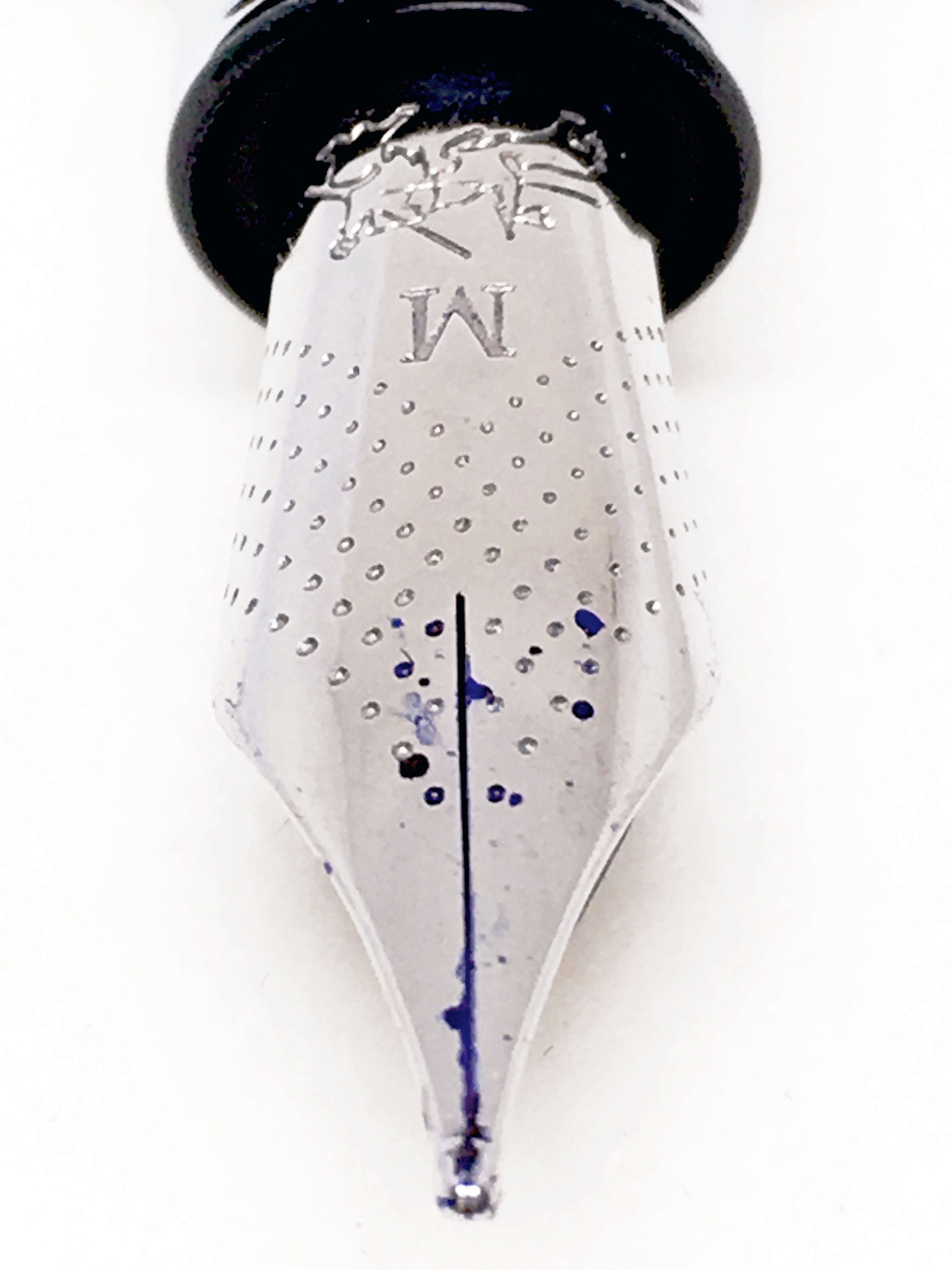
The nib is not what you’d call spectacular in appearance, sporting a very small Faber-Castell two jousting knights logo and series of pinholes patterned in V-shaped alignment with the nib, rather than a single breather hole. Finishing things off is the M nib width designation.

Although not a large nib, it is a little longer for its size than some of my others, which suits the overall balance of the pen when writing. As I’ve mentioned, the very short section on the pen will, for many, necessitate a grip above this point a little further up the barrel. The length of the nib assists the balance of this arrangement by providing a little extra reach towards the page.

I do not typically post many of my pens, and I would think the weight of the cap will likely prevent that with the Ambition, even if posting was your usual preference. Once posted, the pen’s centre of gravity is shifted to the join between the cap and the barrel, which is very high, and well above the webspace of your hand. Upon writing this way it almost feels as though the nib constantly wants to lift off the page.

Comparing the weight of the cap in one hand and the pen in the other, the two feel reasonably similar, and upon checking, the cap itself weighs in at over 14 grams. Perhaps not astounding in itself, however if we refer back to the specifications above, the entire pen is listed as 28 grams (I make it 27 however you get the idea)! That is over 50% of the entire weight in the cap alone (many of my other pens are around 30-40%). Although considerable, it is not surprising given the dramatic change in balance when posted — which I would not really think is an option unless you have fairly large hands.

FullSizeRender


Over longer writing sessions, the Ambition is probably not quite as comfortable as some larger diameter pens with a tapered form, however here I am referring to a three or four A4 pages before I began to have those thoughts. As a result, I found most use occurred with tasks such as outlining a post over two or three A5 pages, or using a coloured ink to mark up printed documents and the like. For longer conference call note taking or handwritten first drafts, the level of hand fatigue I’d say was probably a little higher than some of my other pens. Of course that is exactly why I have more than one — and I’m happy this is one of them.

Signing Off

How to sum things up with the Faber-Castell Ambition?

FullSizeRender 3fc_ambitionOverall, it is a well-balanced (sans posting) pen with one of the smoothest stainless steel nibs I own, housed in an unusual and eye-catching finish. I’m quite find of the uniformity in the cylindrical form of the pen, and have no problem with the shortness of the section when it comes to writing. If you are perhaps hesitant to spend in the mid one hundreds, I wouldn’t be concerned in relation to the nib. If the design suits your taste, I’m sure you’ll find the nib an absolute bargain given its performance.

A great combination of attractive form and superb function, though as always, particularly if you have concerns about that section — always best to try before you buy (often difficult I know). I personally found it better for short to medium length writing sessions, and will be happy to pick it up often for such occasions in the future.

Now, I’m off to do other things — I have ambition you know.


The DanDa Stationery Aisle – cheap, cheerful and useful

danda_post_add

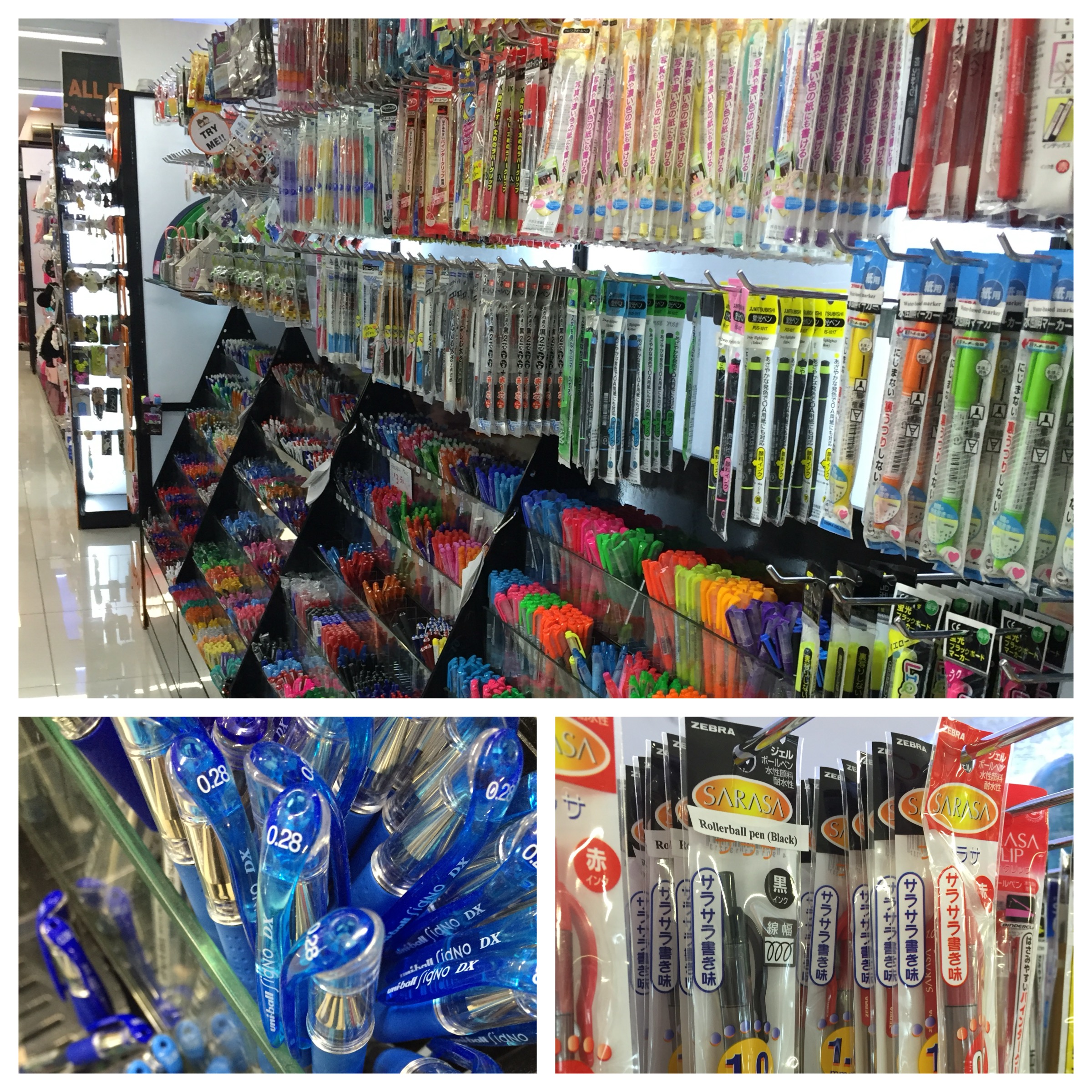
Although not likely to replace your favourite online stationery supplier, nor is it Officeworks, Japanese discount store DanDa has a few options which might be handy to those interested in pen and paper. Cheap, locally available, and carrying some items not found in other brick and mortar stores in town all make for a place worth visiting next time you find yourself in the Brisbane’s CBD.

Located in Adelaide Street (opposite City Hall), it’s an easy walk from most places you may be visiting should you find yourself in the CBD.

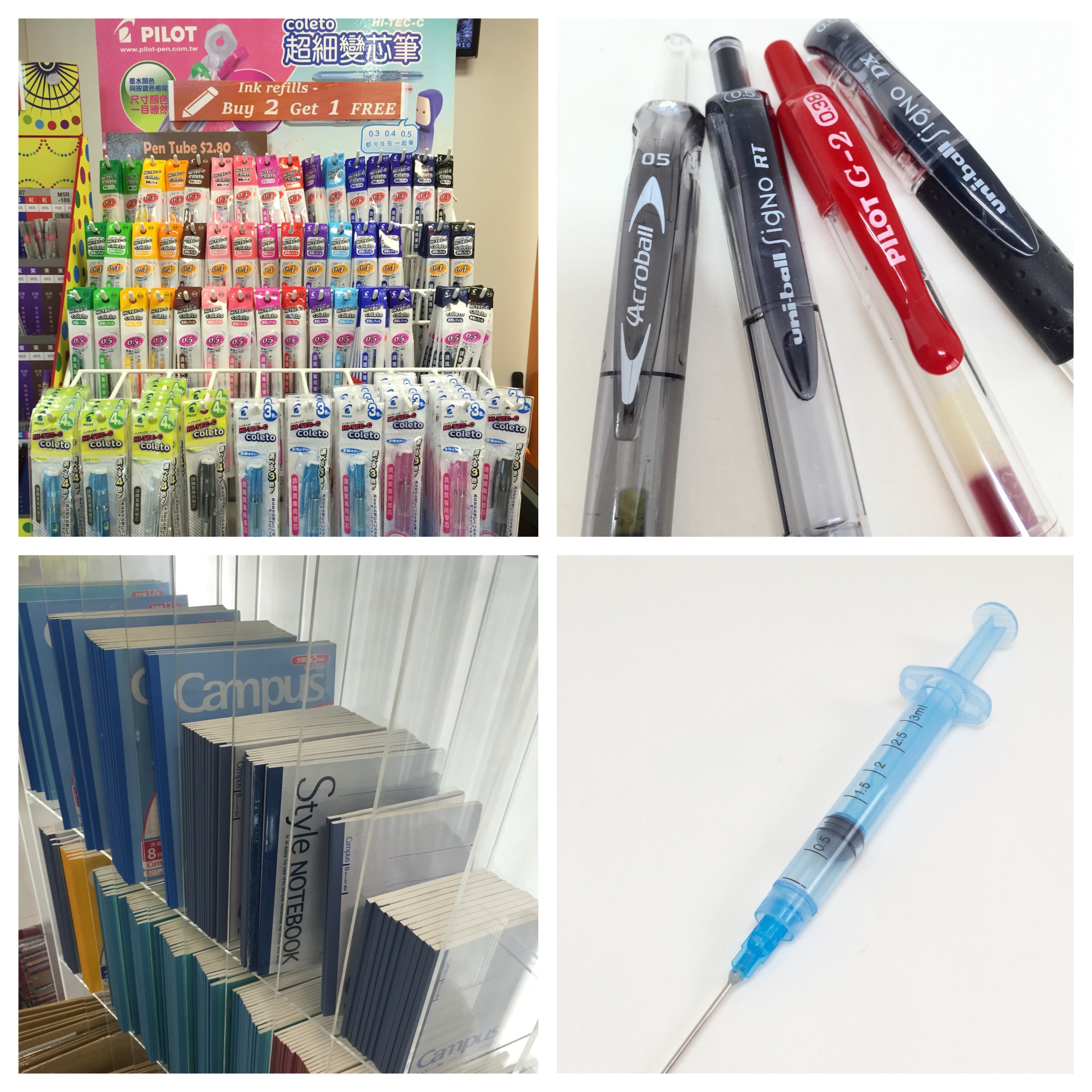
What might you find here which may be of interest? Quite a few gel pens for starters, including Uniball’s Signo DX, some Zebra’s Sarasa, Pilot’s G-2, and Pentel’s Energel among many others. The predominant tip size is medium and finer, although for those who prefer a wider line you will likely find something for your preference as well.

IMG_5928danda_post

DanDa has been my go to supplier for Pilot Hi-Tec-C Coleto multi-pen refills for some time now, and if you buy three refills, you only pay for two. Speaking of payment — it is of course one of those stores where everything is a universal price (apart from the occasional item marked otherwise – though this is rare). Everything you pick up is A$2.80.

For the fountain pen user? Here, there is probably a little less (read zero) as far as pens are concerned, however I have picked up the fountain pen friendly Campus notebooks by Kokuyo (in multiple sizes); a 3 ml syringe for cartridge refills (you’ll find this in the cosmetics aisle); and a couple of magnifying glasses (albeit not the most powerful) for peering a little more closely at some nibs. Again all at a cost of A$2.80 a piece.

IMG_5929danda_post

As I said, DanDa probably won’t become your go-to stationery store, however there are a couple of aisles of pen and paper well worth checking out — and it certainly won’t do your credit card too much damage in the process.


A Small Tale of Pen Grail

For quite a long time I have been a little uncertain about the “grail” pen thing. No doubt the concept is a valid one — what I am referring to is just how it might relate to my particular thinking on the subject, and perhaps what my grail pen might actually be. Further, given I have often struggled with that very question — whether I even have one at all.

Occasionally I think about the where I might start in search of such a pen, and it is usually when reading others thoughts on the topic. For example, the post published earlier this year by Dr Jonathon Deans at Pen Economics on this very topic, in which a fairly clear conclusion is reached about the author’s grail pen — a pen which subsequently has been added to said author’s collection. Another more recent post by Thomas R Hall on Penucopia, describes the amazing and lengthy process of coming up with the design of, and having manufactured, a custom designed grail pen from scratch.

If you have not done so, I would highly recommend reading both posts, which are quite different in nature, yet together in many ways encapsulate the concept of a grail pen, in that the technical and emotional aspects may carry equal weight — yet we all are no doubt influenced differently by each.

The notion of grail

In times gone by, when the question arose (podcasts, discussions, or blog posts) as to what my grail pen might be, truth be known I could never really come up with an answer.

The first possibility of course is that my journey of discovery in the pen world, though I’ve logged a few miles — has not gone far enough to uncover a suitable candidate. The more I think about the concept though, the more I lean towards a second possible scenario: in the truest sense of what a grail pen means to me — I already own it.

Although most have a good idea of what we are referring to in speaking of a “grail” pen, the online Oxford Dictionary offers two meanings for grail. The first, a reference to the cup or platter used by Christ at the last supper, and a second, more relevant one to the topic at hand:

A thing which is eagerly pursued or sought after

Simple — but accurate. It’s the pen we so very much want, the one that draws us towards it — the one calling our name. The pen we will go to great lengths in seeking out and acquiring — dare we call it a quest?

In considering the grail pen, I wonder what particular criteria need to be fulfilled for inclusion in this much sought after group. Clearly this will (and should) be different for everyone, and any list of check boxes relating simply to pen specific criteria, will likely not be enough — however for some it might.

There is something else. Some other significance, meaning, or purpose. Again you will find evidence of this in both the posts I’ve mentioned above.

For me?

Writing a post like this one can sometimes pose new questions of yourself, or perhaps expose some new realisations. In doing so, my thinking has been clarified somewhat on the notion of a grail pen, and what it represents most clearly to me.

Are there are any pens out there I’ve always wanted or dreamed of owning? One out there calling my name that I simply have to seek out, plan for, and buy? A pen I am constantly coming back to, over and over?

At the current time the answer to those questions is no, however there is one pen which repeatedly springs to mind in considering them.

I still vividly remember the feeling of how badly I needed to have this particular pen. Of repeatedly entering the pen shop and fawning over it in the display case, then going home to come up with a strategy to save and eventually make a purchase. Whether the pen was worth the price1 was never in question.

In some strange twist to all this, the only pen that has ever engendered these sorts of feelings in me is already in my collection. I’ve written a little about it before: my Montblanc Meisterstück Classique. It was a gift from my now wife of 18 years on our wedding day. It was also my very first fountain pen.

To those who would suggest there is a difference between “sentimental value” and “grail pen”, I certainly don’t disagree with you, however prior to having that pen in my hand, let me tell you, it was a quest, and a pretty obsessive one. For a number of years I had wanted a great fountain pen, and it always had to be a Montblanc.

In the many years since, my preferences and experience with fountain pens have certainly evolved, and granted, there are better performing and more attractive pens both “out there” — and for that matter, in my own collection as well. However I know how much it meant to obtain that pen, how much it means to me today, and what it will continue to mean in the future.

Not that I’m saying there will never be another, although at the current time I would still struggle to answer you if asked what pen I might buy were price and availability unlimited. Personally, my search for a grail pen is certainly more Monty Python than spiritual at the current time. That said, the search only needs to go as far as my pen storage drawer to find at least one that I know of.

To those who are yearning for, planning a strategy to acquire, and actively searching for their grail pen, I wish you every success in finding it. I consider myself pretty lucky to conclude in all likelihood I already own mine.


  1. A$435.00 circa 1997 ↩︎

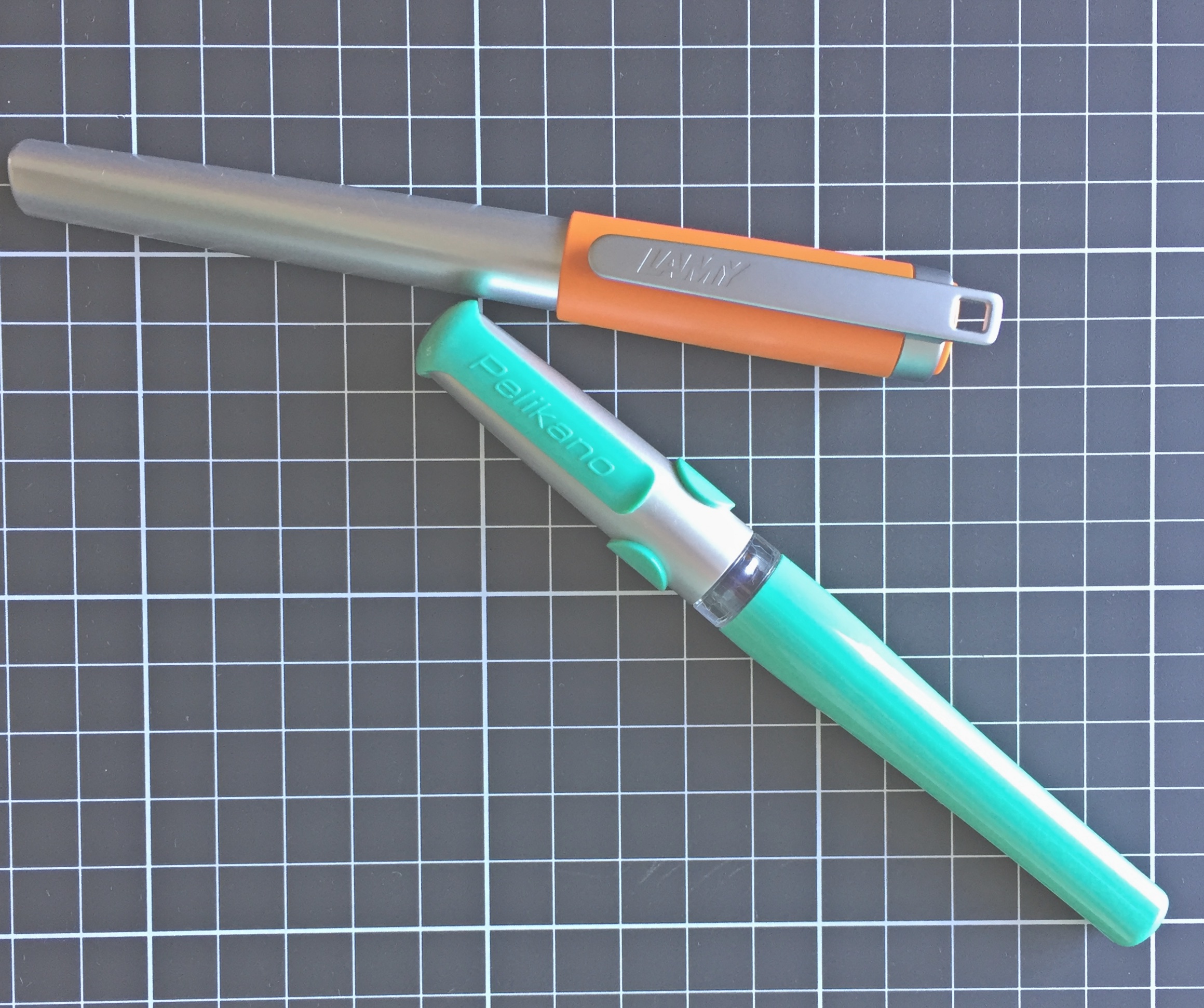
Possible Starters: Lamy Nexx and Pelikan Pelikano Fountain Pens

2016-04-09 pelikano_v_nexx_2

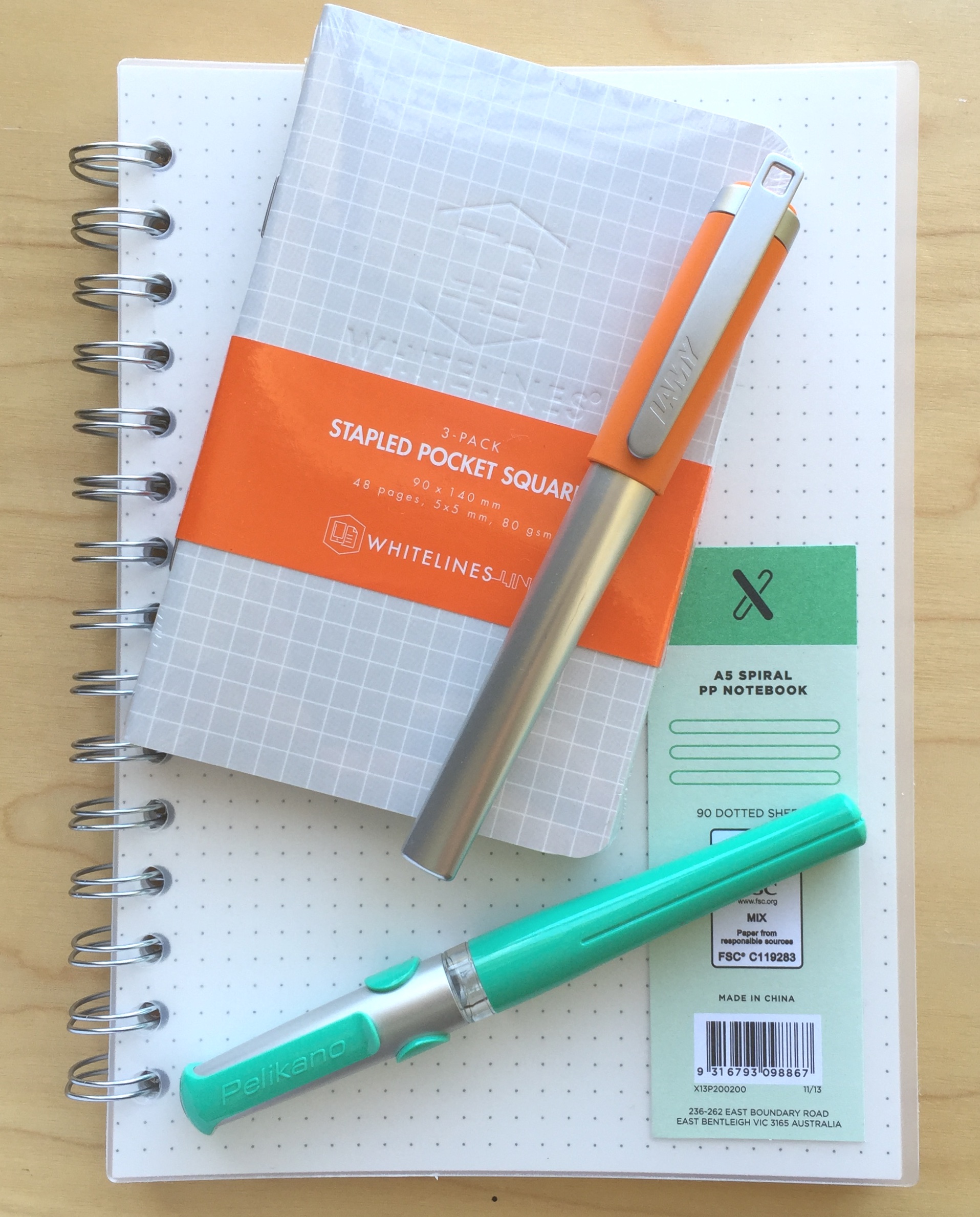
Call them what you will: low-end; entry-level; beginner; learners. Perhaps all true, however these two fountain pens are both pretty solid performers in their own right — for any purpose. They may look a little cheap and cheerful, and although not being for every collection certainly have their place, regardless of your level of fountain pen experience.

The Lamy Nexx and Pelikan Pelikano fountain pens can be found in the “Young Writer” and “Kids/World of School” sections on their respective manufacturer’s websites. Although you won’t see any in schools in this country (I am not sure of the current status regarding other schools around the world), the pens are clearly designed for an early or younger generation entry into the world of writing with fountain pens. That said, I’m certainly no whipper snapper, and I’ve enjoyed using these pens increasingly in recent times when gathering my thoughts for this post.

Those of us who use fountain pens on a regular basis are often the ones who introduce another generation into the habit. Would I use either of these pens with that aim? I’m not sure, and there are perhaps other options I may recommend for that purpose, however I can see these two being great options to offer as possibilities — particularly if a few different options were being considered based on the tastes of the prospective user.

Forced to choose either the Pelikano or the Nexx? A somewhat challenging question, and the answer surprised me a little, though as you’d expect, the ideal pen when comparing two or more generally produces a Frankenstein result — that is, a combination of the best aspects of each. Of course in the absence of that being possible, read on and my final choice will become clear, but really — either of these pens wouldn’t disappoint in their target market.

Look and feel

A point to note here: the current models of both pens have undergone a cosmetic makeover compared with what you see in the photos, which are the pens from my own collection. As far as I can tell, all other aspects of the specifications are essentially the same.

It’s probably in the “feel” more than the “look” that I was most surprised as I used both pens on a more regular basis. I have mentioned in the past I am not a huge fan of the traditional Lamy triangular grip section found on the Safari and AL-Star ranges.

2016-04-09 pelikano_v_nexx_7

Upon uncapping the Lamy Nexx, the first thing I see is another triangular section, this time covered in a rubberised, cushioned coating — somewhat reminiscent of the grip guides of similar material often slipped onto to pens and pencils for younger users. Despite this, I found the section on the Nexx to be far more comfortable to write with than the Safari in my collection. I don’t really have a valid reason for this given the sections are both quite similar in size and shape — the only difference being the rubber coating on the Nexx.

According to Lamy:

The LAMY nexx fountain pen has a soft non-slip grip which makes for extended fatigue-free writing. Its polished stainless steel nib makes writing super easy

All I can really put it down to is the fact that the rubberised overlay softens the edges a little, creating a slightly “rounder” and well… softer feel than the plastic of the Safari.

I would say however the junction of the section and nib looks a little untidy, with the increased diameter of the “stops” on the grip meeting the black plastic collar around the nib and feed. It is the same plastic collar which you also see on the Safari and AL-Star ranges, however on the former it is matched to the barrel colour, and the on the latter matches the darker section a little better. Certainly not a big issue here, and only noticeable as I sit here and review the overall look and form of the pen.

2016-04-09 pelikano_v_nexx_1

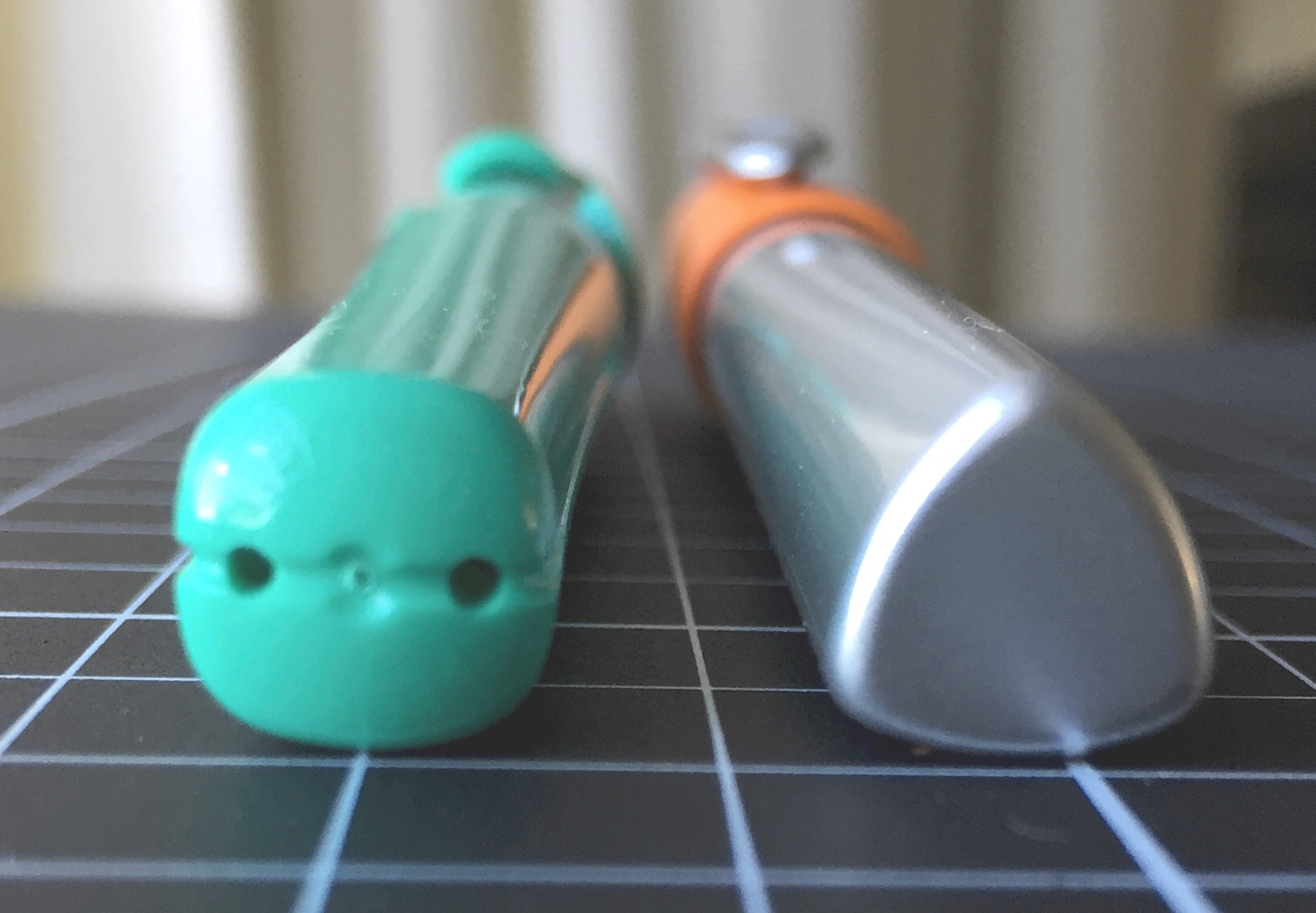
The top end of the Nexx barrel begins in a distinctly triangular form factor, rounding out as the barrel increases in diameter and moves towards the section, before returning to the triangular form and tapering slightly at the grip. Uncapped, it carries nice clean lines and I quite like the overall look and shape, however as I mentioned, it is perhaps spoiled a little where it meets the feed.

Capped, the Nexx demonstrates a smooth but steady increase in diameter from end to cap, reaching a maximum at the clip ring. This probably fits the overall funky aesthetic of the colourful cap which also contrasts nicely with the silver aluminium finish of the body. The top of the springy clip sits proud of the actual cap, and while it suits the overall form of the pen, the cap and clip “live a little large” for my taste.

The Nexx appears to be going for a fun, funky and cool aesthetic, rather than portraying itself as the “beginner’s” pen. To that end, I’d say Lamy have probably achieved their goal.

The virtually clipless Pelikano, aside from the cap, carries a certain similarity in shape to the Nexx, and again avoids too much of the “beginner” aesthetic, however I believe it does carry just a little more of that style. This time, the end of the barrel begins in square form, before a similar increase in diameter as it rounds out, before tapering into… wwhaaaaat?? A triangular grip section! I must admit it is more trianguar-ish, than triangular, though the similarity to the Nexx is not lost on me.

2016-04-09 pelikano_v_nexx_3

Again the section has a rubberised coating, however in this instance adds little thickness to the grip. Of the three flattened sides to the grip, the index finger third also has rubberised ridges which run perpendicular to the barrel, I assume to assist with grip and guidance of the nib when writing. A couple of things on this: firstly, they are probably not necessary, as the rubberised coating on the section is more than enough for gripping, and though I didn’t find it noticeable — it may annoy some. Secondly, this could also be used as a baseline grip point of reference in someone learning to write (“index finger here”).

This rubberised overlay sits on a clear section, and therefore prevents any decent view of ink colour or level inside the pen. In contrast to the Nexx, with the Pelikano the nib is held by black plastic “shoulders” at each of its sides. In pointing out above the look of the Nexx at the junction of the nib and section, I’m not really sure this one is an improvement. Personal taste plays a factor with any of the pen designs we prefer, and perhaps I’ve made a bigger deal out of it than it really is. I cannot say when I’ve picked up either pen I have even given it a second thought.

Overall, I marginally prefer the Pelikano’s grip section, though it is the centre of the barrel which raises a few questions for me. Both pens increase in diameter through the middle of the barrel, with the Pelikano doing so just a little more in comparison (1.4 mm more at its maximum, as you can see from the specifications below). This throws the comfort of my grip ever so slightly off, and I’ve found I cannot write for extended periods quite as comfortably as I can with the Nexx.

Aesthetically, the styling of the Pelikano is quite different to that of the Nexx, and to be honest I really have no preference here. The cap of the Pelikano reminds me of a helmet on the Lego Knights I used to have as a child — if you had them you know what I mean. While I enjoyed playing with those knights, I prefer the design as a helmet rather than a pen cap.

I’ve described it as “virtually clipless” above as the moulded plastic forms part of an exoskeleton or … yes, there it is: “helmet” over the cap. This forms a sort of pseudo-clip, however the functional section is very short, and I’d hesitate to use it regularly, being reasonably fearful it might snap as the plastic fatigues through repeated bending.

Although both pens are not what you’d call expensive — both feel sturdy enough to stand up to the usual level of wear and tear. The aluminium barrel of the Nexx may provide a little extra reassurance in this area, however with even a little care in the daily use and carry of, I doubt you’d have trouble with either.

As I’ve mentioned, the clip extending past the end of the cap on the Nexx may provide a snag point, however again I would not anticipate any major problems.

Specifications

Notwithstanding the cosmetic changes I mentioned earlier, following are the specifications in the current available line up from both manufacturers.

Manufacturer Pelikan Lamy
Model Pelikano Nexx
Body Plastic Aluminium
Cap Plastic Snap On Plastic Snap On
Clip Plastic Metal
Fill Cartridge/Converter Cartridge/Converter
Weight 23 g 31 g
Diameter max 14.5 mm 13.1 mm
Diameter grip 12.5 mm 12.2 mm
Length capped 13.6 cm 13.4 cm
Length uncapped 12.5 cm 12.7 cm
Nib type Steel Steel
Price A$ $26-$30 + int postage $54.95

Check the manufacturer’s websites for colours available.

As far as the price is concerned, Australian supplier LarryPost stocks the Lamy Nexx, at the price quoted above. I have not been able to find a local supplier online for the Pelikano, however this of course does not rule out any local brick and mortar stores perhaps stocking them. Fishpond lists the Pelikan at AUD $39.97, however it does state the pen ships from a UK supplier. The price I have quoted above is a conversion from both Jet Pens in the US and Cult Pens in the UK, however you would need to add international postage costs to these of course.

Also worth mentioning is the option of a left-handed nib on the Pelikano, as well as the slightly cheaper Pelikano Junior model.

As far as filling is concerned, I have been using the Nexx with a Lamy Z24 converter (with no issues), and the Pelikan with standard international cartridges, noting the recommended converter here is the C499 from Pelikan.

Writing Performance

I’ve had these pens for about 6 months or so now, intermittently using them in my rotation of pens, and have written more extensively with each over the past few weeks taking notes for this post.

As far as the nibs are concerned, I’ve been happy with both. The stainless steel medium nibs are smooth writers, with the Pelikano having a slightly softer feel in terms of a little give, however there also appears to be a marginally smaller sweet spot than what exists on the Nexx — at least with this particular pen anyway. Overall, both nibs have that firm, steel nib feel — one that I quite like and is not meant as a criticism in any way.

2016-04-09 pelikano_v_nexx_5

The Nexx comes as expected out of the box — the same Lamy nib you’d find in a Safari: firm, reliable and consistent. I say consistent because in mentioning the Pelican’s sweet-spot, the Lamy nib performs well at all points of minor grip and alignment adjustment — however when compared line for line, doesn’t quite match the smoothness and comfort of the Pelikano.

Both lay down a consistent, wet line, and with a little pressure applied, (despite the softer overall feel of the Pelikan) the Lamy nib will give a slightly broader one, though neither of these pens are what you’d be using for any sort of line variation lettering.

2016-04-09 pelikano_v_nexx_6

Overall, as far as the nibs go, points to the Pelikano, as it is a much smoother and more comfortable nib to be using for writing, and the sweet-spot is really not hard to find and then sit comfortably in like your favourite lounge chair.

Both pens I have used without posting the cap, however if you were to do so, the Pelikano retains its overall balance more so than the Nexx, which becomes very top-heavy and cumbersome.

Both pens handle a variety of paper types equally well, which is probably important given what they might be used for, and I’ve not found either wanting on the first stroke when uncapped, nor with extended periods uncapped, for example in writing intermittent notes while researching online and the like.

Only young writer?

Indeed, the young writer aspect of these pens is not to be dismissed, however I don’t believe either necessarily perform this role any better than the Pilot Kakuno, which is far cheaper to buy. The Kakuno also sports the triangular grip section, however the overall balance and feel make it — in my opinion at least — a better buy for this segment of the market.

2016-04-09 pelikano_v_nexx_4

Do either of these pens appeal to the non-young or non-early writers? That of course is a matter of personal opinion. As I’ve hinted at above, I think the Nexx is more likely to fulfil a more universal role across beginner and more experienced users alike, whereas the Pelikano based on looks alone I feel is perhaps relegated to the beginners end of the market.

Given its bright and funky sort of look, the Nexx to me is a pen you might use with a clipboard or reporter style notebook: marking off attendees at a summer camp, scoring a tennis match or perhaps even recording your backyard coffee roasting data — assuming suitable paper was in use of course. At then end of the day, if a pen (which both are), are solid performers, it really is down to personal taste, and that is really where we end up here.

Conclusion

In summing up, both of these pens are pleasant to use and perform as intended. If I had to choose one? Probably the Nexx, simply because I find the overall shape of the body a little more comfortable to use than the Pelikano, which becomes a little too broad in the middle for my grip.

The Frankenstein result if I could? The Pelikano nib in the Nexx body with a smaller version of the Nexx cap and clip. Because that isn’t going to happen any time soon, I’d go with the Nexx simply because of the Lamy nib options you have at your disposal, though with a pen like this, I’d assume you’d have be looking for something specific, otherwise a Safari might be a better choice — particularly at a slightly lower price point.

In any event, either the Lamy Nexx or Pelikan Pelikano won’t fail you as a notetaker, however for the “young writer” I am most likely sticking with the Pilot Kakuno as my go to recommendation.