Having An Absolute Rollerball

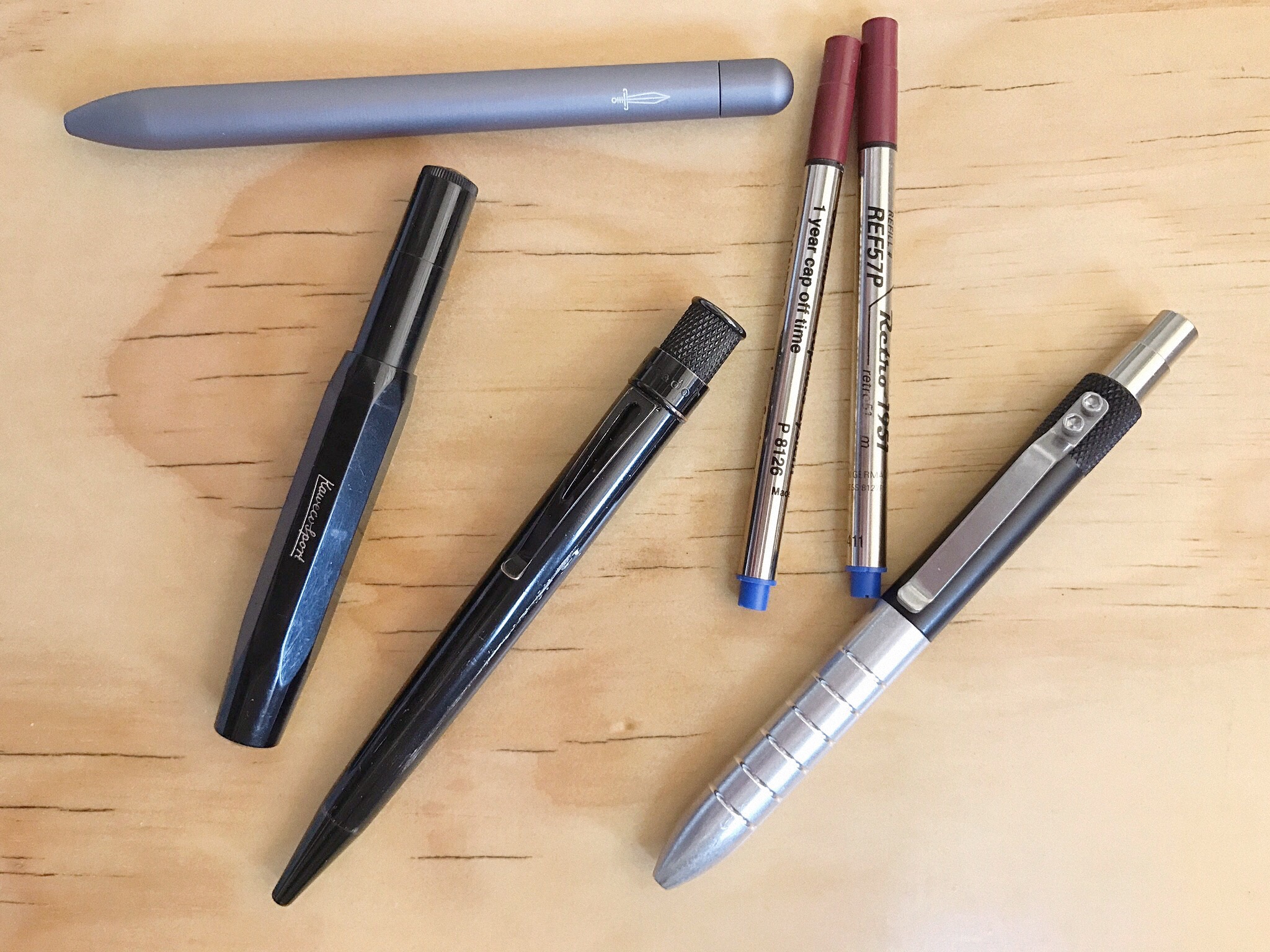
Clockwise from top: Baron Fig Squire, P8126 & Retro 51 refills, Karas Kustoms EDK, Retro 51 Stealth Tornado, Kaweco Classic Sport

Clockwise from top: Baron Fig Squire, P8126 & Retro 51 refills, Karas Kustoms EDK, Retro 51 Stealth Tornado, Kaweco Classic Sport

The nature of intermittent pen-related posts appearing on this blog would lead you to believe my pen-life is mostly fountain and little else. Inherently there would be nothing wrong with that, however in reality it’s not all nibs and pistons. There is quite some variety in the writing instruments I use on a day-to-day basis, and on that score I’m sure I’m not alone.

Retro 51 or 8127 refill - 0.7mm

Retro 51 or P8127 refill – 0.7mm

A big part of that variety is the rollerball, or if you prefer — liquid ink pen (for consistency and convenience we’ll go with the term rollerball from here on in). Although the specifics of my rollerball history are varied in themselves (more on this below), in recent times my usage has largely revolved around the “capless” rollerball refills of both the Retro 51 (at times stamped with the P8127 designation), and Schmidt P8126 variety.

The refills

The Schmidt P8126 refill - 0.6mm

The Schmidt P8126 refill – 0.6mm

Like many before me, and no doubt many after — my initiation into said refills came through The Pen Addict podcast, although the exact episode number is not known to me. I’m sure there is an enthusiast or two out there able to pinpoint the actual number, however given Retro 51 pens are mentioned at least every few episodes, specifics are probably not relevant. With a little trepidation (the hype surely couldn’t be matched by reality) I ordered a Retro 51 Tornado pen (the all black Stealth model), and upon receipt was pleasantly surprised. This was a fine-looking and equally stellar-performing pen, and that refill? Yes – it’s a beauty, and has been a regular purchase of mine ever since.

The 0.6mm P8126 refill (l); and 0.7mm Retro 51 (r)

The 0.6mm P8126 refill (left); and 0.7mm Retro 51 (right)

Although you may find interchanging use of the Retro 51/P8127 and Schmidt P8126 designations when searching online, they definitely are different beasts when talking line widths. If I had to pick my favourite? Probably the ever so slightly thinner line of the 0.6mm P8126, however to be honest I’m happy with either, and my local pen store (Brisbane’s Pen and Paper) which I often visit when refills are required, stock the Retro 51 branded P8127 (0.7mm) version.

A description of the P8126 refill from Jet Pens tells us the following:

  • the refills use a ceramic ball in the tip
  • they are available in black, blue, green and red (the Retro 51 refills in black and blue only)
  • “capless” means a one year cap off time without drying out
  • the P8126 refill is 3.9″ (10 cm) long. It is not the same as the Schmidt 8126 refill, which is 4.3″ (11 cm) long.

Probably worth noting that last point as far as ordering the correct refill size when the time comes. Speaking of which, when it comes to refills and options for them, you could do no better than to consult an epic guide on such matters, aptly titled The Epic Refill Reference Guide: Rollerball, Gel and Ballpoints by Ana Reinert of The Well-Appointed Desk.

Once you’ve taken a look at Ana’s post, the realisation dawns of the multitude of options out there — many of which I have yet to explore myself. Just prior to finalising this post today, I came across Joe’s review of the Steel and Flint Kickstarter pen on The Gentleman Stationer, which contained the following:

For some reason, I’ve never had the opportunity to use the Schmidt Easyflow 9000 ballpoint refill, and that’s a shame. After using this pen for a few days, I ordered a pack of six, and have since swapped out all my Retro 51 / Schmidt liquid ink rollerball refills for the EasyFlow. It’s that good…

Stay tuned for my future ”Having an absolute ballpoint” post perhaps…

Some current pens

Anyway, the rollerball refills in question are known to many within the pen enthusiast world, and are accommodated by an array of pen housings, with Kickstarter often fertile ground for additions to the list. There are quite a few pen options to choose from really, a couple of which I have previously written about (links below), and the others in the list I’ll no doubt look at in future posts as well.

Again, certainly not an exhaustive list, however the pens I commonly rotate these refills through, provide a good example of the variety at your disposal in terms of overall design, weight and feel in the hand. The writing experience however is of course consistent and familiar.

My pens themselves, in no particular order:

The Nova Minimal pen by Namisu - a recent Kickstarter arrival

The Nova Minimal pen by Namisu – a recent Kickstarter arrival

Rollerballs past

As with many in this hobby, the memories of where specific points of interest or phases began are quite vivid. I distinctly remember dabbling in a few different types of pens through high school, and in my university years beyond that (student budget permitting). There were no fountain pens to be seen at that time, with the first to come almost a decade later, however you would definitely have found a rollerball or two on my desk.

Although it’s a bit of a stretch to remember exactly what they all were, I do recall sampling a good few of your disposable varieties, like the Uni-Ball Eye Rollerball, and I believe some Pentel variants of whatever specific moniker they carried at the time. In attempting to become a little classier (I guess), the Parker Vector made an appearance, along with a Diplomat (the model escapes me), creating my most distinctive memory of them all — it ran out so quickly I was driven back to ballpoints for a while.

Clearly unfazed, over the next two decades (yes, its been that long) I dabbled here and there, however in recent years with a renewed vigour and enthusiasm for writing instruments in general, the rollerball has made a somewhat triumphant return.

Why the attraction?

There are probably two main reasons I attribute my fondness for rollerballs: my writing style primarily; and the saturation and vibrancy of the liquid ink a rollerball produces.

My writing style does not lend itself well to ballpoints or gel inks below about 0.5mm in tip size. At times depending on what I’m specifically doing, even 0.5mm is a stretch. Of course your average ballpoint or gel ink pen will typically write drier than say an EF fountain pen nib. The angle and stroke of my natural writing provides a very scratchy experience with finer non-fountain pens (and certain very fine fountain pen nibs as well), however a rollerball in the usual 0.7mm or 0.6mm is just about perfect.

As for the saturation and vibrancy of the ink, this speaks for itself really. A good rollerball will often provide output (once on the page at least) not dissimilar to what you might see with a fountain pen. The blues are deep, saturated and hold their colour over time, the reds and blacks are generally the same.

Quite a vibrant blue on the page (Rhodia No. 16 Dot Pad)

Quite a vibrant blue on the page (Rhodia No. 16 Dot Pad)

Of course it goes without saying that your colour choices are generally somewhat limited, unless you look further afield to something like the J. Herbin rollerball pen, which I’ve not personally tried, and accepts standard international ink cartridges. Personally, for the uses mine see, I’ve no real need for a vast selection of ink colours, and the basics do just fine.

Typical usage

Here the immediate thought of: “well for lots of things where fountain pens dare not tread” is probably not 100% accurate. As you probably know, rollerballs — while perhaps more versatile in some ways than fountain pens — still do not have the ubiquitous acceptance a ballpoint might.

On very glossy paper or card stock, they can be just as bad if not worse than a fountain pen. In addition, poor quality standard paper will see feathering typically less than fountain pens, however the ghosting and/or bleed through can actually be worse. If you are anything like me, and unintentionally take a rollerball as a ticket to writing with a firmer hand — this effect can be exaggerated significantly.

That said, there is a pretty decent range of paper types that will provide a fantastic writing experience with one of these capless rollerball refills. Personally, I’ve found some of the best to be on slightly toothier paper, such as Baron Fig’s Confidant, or your typical Field Notes for example. Even the standard copy paper we use at the office is a pretty good match, upon which I print out an Emergent Task Planner for the day’s tasks and scheduled activities, and a Cornell notes formatted printout for general note taking.

Although I find the writing performance of these capless refills quite an enjoyable experience, longer form writing is not something I choose to use them for. For various reasons, the pens are either a little thin, fairly heavy, or a combination of both. I say that not in a negative way, simply to point out I’d probably choose one of my fountain pen options were I to sit and churn out a few thousand hand-written words.

That being the case — where do they excel? As short form note takers. That is, for meeting notes, recording phone calls, daily planning and brainstorming, or outlining blog posts. They are hardy enough to withstand a drop, or lend to others without the need for undue concern. Perfect office pens really, which as I’ve mentioned, is mostly where you’ll find mine. I’ve also been known to have them rolling around on the shed workbench while recording coffee roasting data — a task for which they are more than hardy enough.

Signing off

The benefit of having so many choices available for these great refills is just that — the choices. The variety of pens available should see something suitable for just about any particular preference — all the while retaining the same great writing experience between refill tip and page.

Of course there are other great rollerball or gel based refills around, and I’m not suggesting the Retro 51/Schmidt’s are the be-all and end-all in this category, however are a standard and favourite for me, seeing some form of use pretty much every day. With the newly arrived Nova Minimal pen, I now have five options — perhaps a ready-made Monday to Friday rotation! More likely though is that I will simply continue what I’ve done for some time — use one for a while, and switch when the desire to do so hits me.

One thing remains a certainty — although the housing may differ, the smooth, rich, and vibrant writing experience certainly won’t.

Belonging — at any level

Yesterday, Dr Jonathon Deans wrote a fantastic post over at Pen Economics recounting the first year of the Fountain Pens Australia Facebook Group. While Facebook call it a group — it is indeed far more than that. It is a community, and a healthy, thriving one at that. With a hat tip to the power of internet good, bringing 730 members (at last count) together both online and in person, in a country this size is no mean feat.

With the first anniversary of FPA now upon us, I am reminded I myself have been a member of the group for a year now as well.

Although I was very happy to be joining the group when things kicked off (managing to get over begrudgingly signing up to Facebook to so), that is really all I can lay claim to. Jonathan on the east coast and Yagan Kiely in the west were — and continue to be — the driving forces behind initially getting things off the ground, and administering a successful online community throughout the past year. They rightly deserve the congratulatory messages now running in a thread on the group’s page.

I encourage you to read Jonathan’s post for a more detailed account of where things came from, and where they are today, along with some exciting new developments coming soon to FPA.

For me personally, the past year as a member of FPA has certainly been an enlightening one. Though I’ve been writing this blog for over three years now, as far as my online presence and social media engagement1 are concerned, a “reserved observer” is how I’d label myself if compelled to do so. I do not have the biggest personality, the largest or most expensive collection of pens, nor the most numerous or brightest inks — but Fountain Pens Australia does.

And here’s the thing — in the community that is FPA, none of that matters. Of course groups like these do not succeed without the larger than life personalities, the regular and frequent contributors, and those with a knack — and a will, for organising and administering such groups. Along with that, they also succeed because of members who may just follow along, adding a couple of comments or snippets of advice from their own experience when they believe it may be helpful.

So I say to the 730 members of FPA: To those who contribute each and every day — thank you. To those (like me) who occasionally join a conversation thread — thank you. To the admins Jonathan and Yagan, and other members of the group with the get up and go to organise bulk buys and meet ups — thank you (and what a fantastic thing it is you do).

It is each and every one of you that is the thread that binds the community together. A shared appreciation of fountain pens yes — but over and above that — the shared feeling of belonging to a respectful and encouraging (dare we say enabling) community. A community where every member truly belongs, and the value of this membership is not tied to the pen or ink collection you bring to the table, nor by the frequency of your posts or conversation threads.

We all belong — at any level of involvement we choose, and the collective force of good that is the group as a whole is something to celebrate.

Happy first birthday, Fountain Pens Australia.


  1. Yes, I did it – I used the word engagement. I’m sorry, marketing told me to. Either that or I could not think of a better word at the time/

Sailor 1911 Large Fountain Pen – Naginata Togi 21k MF Nib

FullSizeRender 4Whether or not you subscribe to the desert island pen mindset, if there was one — and only one pen to take and use from here to well… let’s say, eternity — the decision would most likely be either fairly straightforward or incredibly difficult.

Whichever the case for you, on my side of the desk, this particular Sailor 1911 goes a long way towards making the decision pretty easy. Put simply, it is a fantastic pen with an exquisite nib, and is routinely one of the first re-inked and most often picked up — particularly for longer form writing. So at the current time, would probably be the one packed for that one way trip.

I’ve written before about my good fortune in receiving a number of pens from a kind reader downsizing their collection. The subject of this review is one such pen, which I have now owned for about 12 months.

Look and Feel

As far as the overall styling is concerned, the Sailor 1911 Large (or Full-size as is the moniker these days) in black and rhodium at least, has a classic, office executive type look, yet retains a certain contemporary sleek as well.

I do own a number of black fountain pens, and acknowledge a cigar shaped black and rhodium pen may be considered boring by some. To me, they are things of beauty, though of course we all have our own styling preferences, and yours may differ with mine on this one.

Although gold coloured accents have a certain appeal, as you can gather, I generally prefer rhodium or silver contrast to my black pens, and this particular model ticks all the boxes, from the nib right through to the top-most decorative ring on the barrel, which itself is matched by the clip ring, bookending the black resin body nicely. The slimmer rhodium ring adjacent to the thicker branding one on the cap is then matched by another at the threads on the section. The branding ring itself carries the Sailor Japan Founded 1911 inscription, clearly giving away the heritage from which the 1911 series derives its name.

Onto the nib itself, which sports a decorative braiding pattern at its perimeter, along with the 1911 insignia, Sailor’s anchor logo, and the 21K and 875 gold designations.1 To delineate the Naginata Togi nib from other versions, an “N” is found on the nib’s left shoulder, along with the “MF” (Medium Fine) nib width of this particular model. The overall beauty of the nib is a great match for its writing ability — that I can guarantee.

FullSizeRender 6

So how does the pen feel in the hand after giving it the once over and writing begins? For me personally, the answer is just about perfect, both from a size and weight perspective. At 122 mm (unposted) the barrel has enough length to provide scope for a higher or lower grip on the section, which I will vary at times during lengthy writing sessions.

I’d describe the overall diameter as mid-sized, and very comfortable. The section tapers just a little from the unobtrusive cap threads towards the nib, before flattening out and flaring again ever so slightly — exactly how I like them. On tapered sections which continue right through to the nib collar, I generally feel my fingers are constantly sliding towards the nib, so prefer a flattening of the taper, or even better, something providing that little bit of feedback to my index finger saying: “things stop here”.

FullSizeRender 5

So in general, this is an extremely well balanced pen, with enough heft to use without posting the cap (as I do), however depending on your own particular preference or perhaps hand size — could be used with the cap posted. Interestingly, I have been coming back around to posting a few more of my mid-size pens of late, and I put it down to more frequent use of fuller size models such as the 1911 Large, and suspect my preferred size and weight sweet spot has now readjusted a little.

Specifications

  • Model: Sailor 1911 Large (Full-size)
  • Material: Resin
  • Colour: Black with Rhodium Trim
  • Nib: 21k gold with rhodium plating; Naginata Togi Medium-Fine
  • Filling system: converter & cartridge
  • Length capped: 140 mm (5.5 inches)
  • Length uncapped: 122 mm (4.8 inches)
  • Length posted: 153 mm (6 inches)
  • Diameter: 15.9 mm (0.625 inches)
  • Weight 23.7 grams (0.8 oz)

Some additional specifications courtesy Pen Chalet

There are numerous nib offerings available with 1911 series pens, and although not all remain available, there are also a number of Sailor specialty nibs at your disposal — some examples of which can be found at Nibs.com.

Writing

I’ve mentioned above the 1911 Large is very comfortable to hold and write with, however it’s really all about the Naginata Togi nib as far as this particular pen is concerned.

The Naginata Togi nib is a member of the Sailor Specialty group of nibs, and as explained on Nibs.com:

Provides variable line width depending on the angle of the pen to the paper – the lower the angle, the broader the line. Available in Medium, Medium-Fine, and Broad

FullSizeRender 7The variation in line width is achieved by a larger than standard amount of tipping material on the nib, which is ground towards a finer point at the tip, widening as it moves away from the actual nib point. Thus, as the pen is lowered towards horizontal, a greater portion of that wider tipping comes into contact with the paper and provides a thicker line. The opposite of course being true as the pen approaches a vertical position. To be honest there is not an overly large amount of line variation, and it is seen mostly on horizontal strokes when comparing near vertical and 45 degree pen angles.
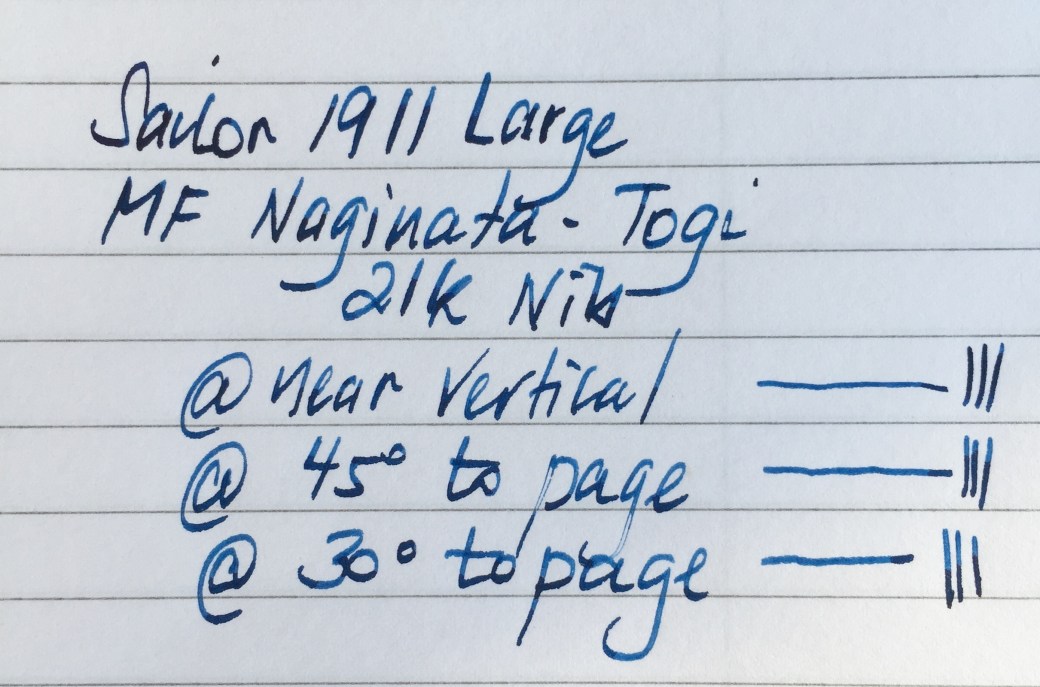
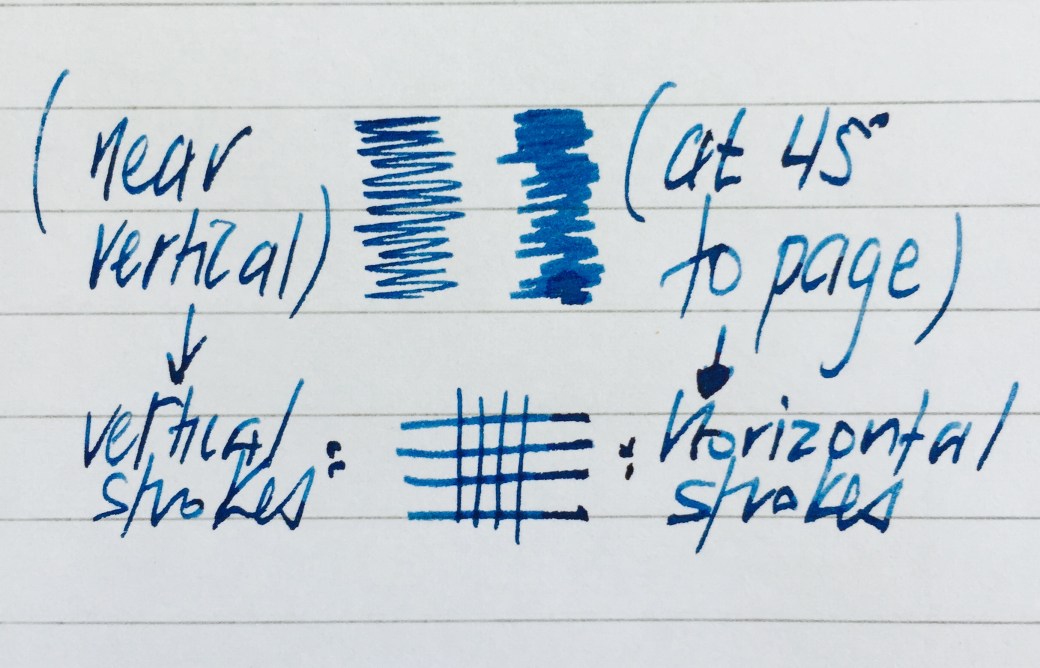
In terms of what you end up seeing on paper — yes, there is some line variation evident through the positioning changes noted above, however it is not a nib designed to achieve graduated line width through pressure — nor is it really suited to changes in line variation mid stroke. Of course with some focused effort this can be achieved, however I think you can imagine the difficulty in changing from a near vertical pen position to 45 degrees or below mid stroke.

IMG_1282

Line variation most evident on horizontal strokes

It is a reasonably firm nib, which I would describe as having a small amount of “give” however there really is zero flex. For standard cursive writing (about 45 degrees in my hand), the nib is an absolute dream. This small amount of give provides for an extremely comfortable writing experience, particularly when writing longer letters or perhaps draft blog posts about itself.

FullSizeRender 8

So where does the line variation of the Naginata Togi nib fit in with the average user? There are a few thoughts which come to mind here. More defined, deliberate writing, for example block printing, perhaps certain lettering types, or languages which use specific stroke widths within letters or phrases. I guess I am thinking along the lines of how one might use an architect ground nib or even your standard stub nib (which, as I’ve noted above, would be better options if a larger amount of line variation is required). One case where I have found the variation handy, is in marking up printed (or even handwritten) pages, and needing to “squeeze in” a few comments in a tight space between lines — vertical we go and those words fit right in.

While the ability to vary the line width is a fantastic option to have with this nib, it is the ability to pick it up and churn out a thousand handwritten words and having the last one as comfortable and enjoyable as the first is where it really shines. The biggest compliment I can give the Naginata Togi nib is that having a unique style of nib does not detract from the purpose I use most of my fountain pens for — medium to long form hand writing (which for me occurs with a fairly standard grip with the pen at about 45 degrees to the page). Of course it depends on the user, however I don’t necessarily think the same could be said about something like a more specific architect ground nib for example.

I say this not to suggest the Naginata Togi is necessarily a better nib than other specific types (which again, for line variation it isn’t), but merely to point out if you are concerned about applications for it — first and foremost (at least in my experience) you end up with an out and out fantastic everyday writing nib.

What you won’t end up with is a “jack of all trades” compromise, and I tend to pick it up just as much if not more (depending on what’s inked) as my Pelikan M805 — an exquisite 18k nib in its own right. So if you don’t intend to use the line variation capabilities much at all, and are simply looking to expand your nib varieties, I’ll say it again — you’ll end up with a fantastic everyday writer out of the deal. Although it is one of the cheaper Sailor specialty nibs (currently adding US$50 to the pen’s US$248.00 list price at Nibs.com), whether or not it is worth the cost is a matter for your budget and conscience I guess.

Not unique to this nib type, though certainly evident on this pen, is the pronounced “sing” it has whilst writing. A feature often described as a squeak or screech, there is a significant noise associated with the nib moving across the paper. More information on this phenomenon can be found on Richard Binder’s site, and is described as follows:

Singing is a harmonic vibration that occurs when friction between the nib’s tip and the paper causes the nib to “stick” and release repeatedly at the resonant frequency of the nib.

Although I’ve not written about resonant frequencies since my university days, I’d have to say in the current context, and given the way the nib writes — it is more music to my ears than annoying to the soul, and perhaps even adds a little more character to the experience of using the pen. I’d suggest it is also part of why I like the nib, most likely contributing to the ever so slight feedback it provides when writing. Whether or not this occurs with other Naginata Togi nibs I cannot say, however I don’t include comment here in a negative sense – more an observation.

Signing Off

The Sailor 1911 Large with the Naginata Togi 21k medium-fine nib. A long enough title in itself. What more can I say? This is simply a fantastic pen all round, and now sits beside the Pilot Custom Heritage 92 as a favourite in my collection.

I’m not someone who writes dozens of letters each week, however if you’ve received one from me in the past year or so, there is a good chance it was written using this Sailor 1911. Once picked up, it exists effortlessly in the hand, following every direction without fail, compromise or question.

If I’m still writing here in 30 years time, I’ve got no doubt many a draft will be written with this pen, however I suspect I might be angling it just a little closer to the page – I’ll be needing those thicker lines by then.


  1. To further explain the 875 gold designation, a definition from Sell Gold HQ:For example 21 karat gold is 87.5% pure gold so a piece of jewellery marked by a European jeweller (or meant for sale in Europe) will be marked 875 instead of 21K.

A Pen Index Page

With the number of pens in my collection growing substantially over the last few years, I’ve put them all together in an Airtable database as an attempt to keep them in some sort of order. Although the database is far from complete, and will perhaps be the subject of a post in its own right — my thoughts came around to the blog and how things are organised in terms of the pens and reviews I’ve put up so far.

I’ve decided on at least creating a basic pen index list for the blog, which will hopefully provide readers with a general idea of where I’m coming from as far as my fountain pen thoughts and opinions are concerned, along with a simple index with links to the posts I’ve managed to get around to writing so far.

Looking at the list, I feel incredibly fortunate to have the pen collection I have, which was largely brought about by a very kind and generous friend downsizing his own collection at about the same time. Although I’ve thanked him many times, it is a generosity that I will never be able to fully repay.

There are certainly some pens in the list I find myself coming back to, filling, and using more often, though at the current time I’m not ready to either put them in rank order or into a best/top type list. Perhaps that might come at some point in the future.

At the current time I’ve also limited things to fountain pens, having not decided on the exact nature of how I might include other types of pens I own without the index becoming a little too all-encompassing and unwieldy. I also debated on whether to include budget pens such as the Pilot Petit1 and Platinum Preppy, however having written a post on the Petit1, the decision was made to include them as well. After all, there are some solid pens at this end of the market, particularly at the price point they sell for.

If you’d like to take a look at the index, it is sitting under the Analogue Tools category of the site’s menu, or click the following link:

Current Pen Index

As I’ve mentioned, the list contains links to posts I’ve written on some of the pens. If you are looking for other reviews around the web, the best place to start is the magnificent Pennaquod pen blog search site run and maintained by Ian Hedley, of Pens! Paper! Pencils!

And the Airtable database I mentioned in the introduction above? That’s not a database — check out the one David Brennan of Too Many Inks uses for his pen and ink rotation. Now that’s a database.

In closing, I do hope to slowly get around to transforming more of the index to links, however of course that means finding time to write the posts.

I’m sure I’ll get there — eventually.


Some Fountain Pen Friendly Budget Notebook Options

2016-07-10 all_three_blog_postIf there is one thing I am somewhat mindful of in this hobby (or obsession if we’re being honest) relating to pens, their associated inks, and paper — it is the cost of feeding the habit. I am not even speaking of bigger ticket items such as a quality fountain pen or leather-bound notebook — simply those everyday stationery purchases we often make.

Of course relative to that new pen purchase, a notebook or notepad remains fairly cheap by comparison, irrespective of brand or manufacturing quality. Although your standard A5 (No. 16) Rhodia pad may come in at AU$7.00 – $8.00, and even the A4 variant only AU$13.00 – $14.00, things can go skyward pretty quickly when stocking up on a few “essentials”. Like many, I have boxes and drawers filled with a collection of such products ready to be called into action when the inclination or need arises.

That being the case, why the need to seek out lower end options? A valid question, and I often ask myself whether I have become someone who buys something just because it is cheap — regardless of quality. However I can assure you I do have some standards, and only search for, test out, and put into ongoing use the products which although may not be perfect, will at least pass those minimum standards and be enjoyable and satisfying to use. I am certainly not going to put up with poor paper just because it was a bargain, spending my writing time cursing at the ink feathering or nib catching on cheap, rough paper.

At times I’ve actually found certain features in some of the cheaper options have suited me a little better than some of their higher priced cousins. Let’s face it though, there is a certain amount of satisfaction to be gained in finding some local, readily available alternatives which reduce the rate at which I burn through those more “premium” products.

I do acknowledge I am lucky enough to have access to many retail outlets given I work in the Brisbane CBD. All of the products here were simply bought off the shelf, and if available online, result in additional postage charges, rendering them less of a budget buy. I do feel for those of you unable to simply walk by in your lunch break, drop a few gold coins and walk out with a notebook or two.

As always, my intention is not to sell these products to you — merely to report in on how I found them to be valid options which are a little easier on the budget. All three I purchased myself, and I have no affiliation with any of the manufacturers or retailers.

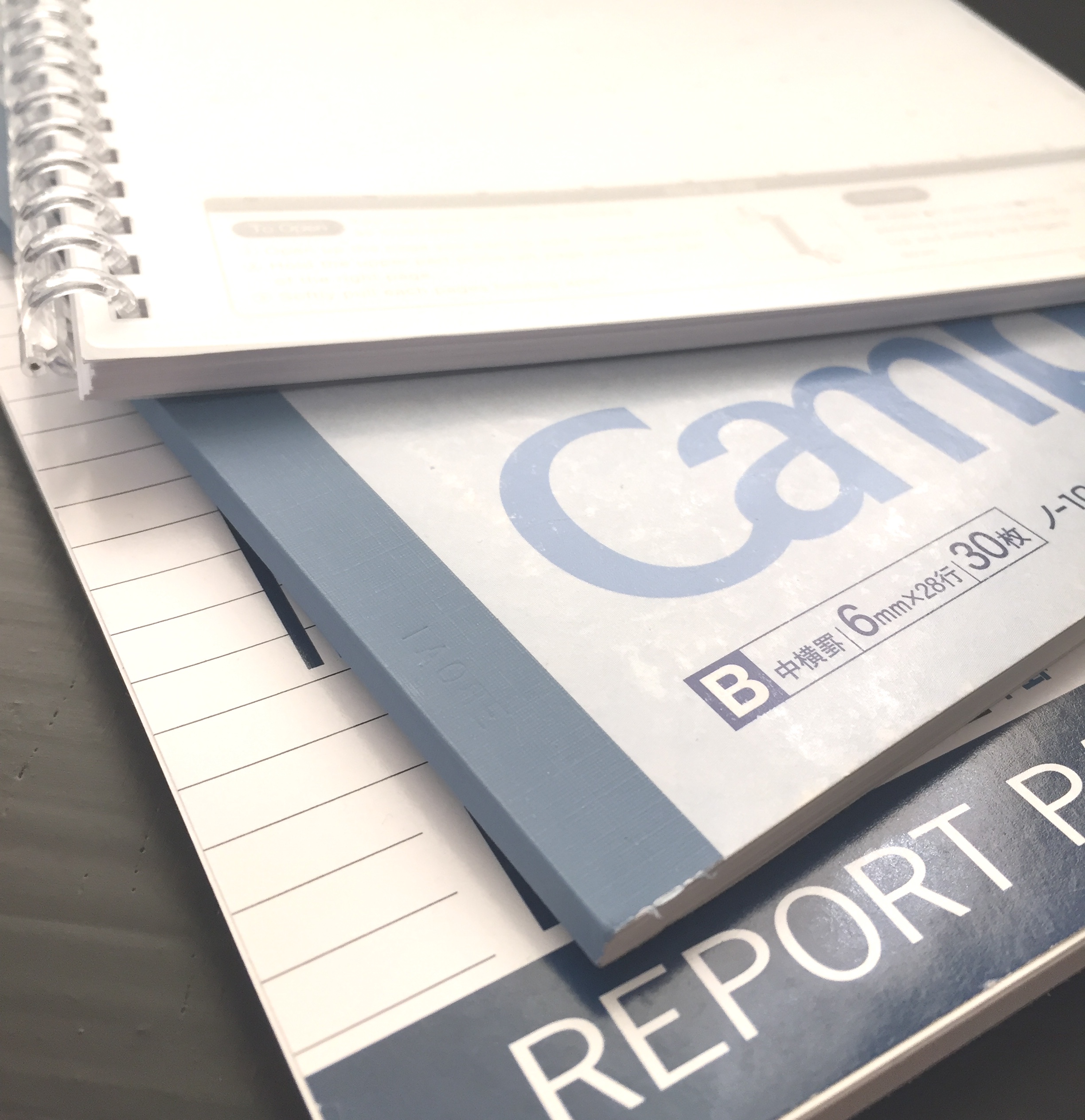
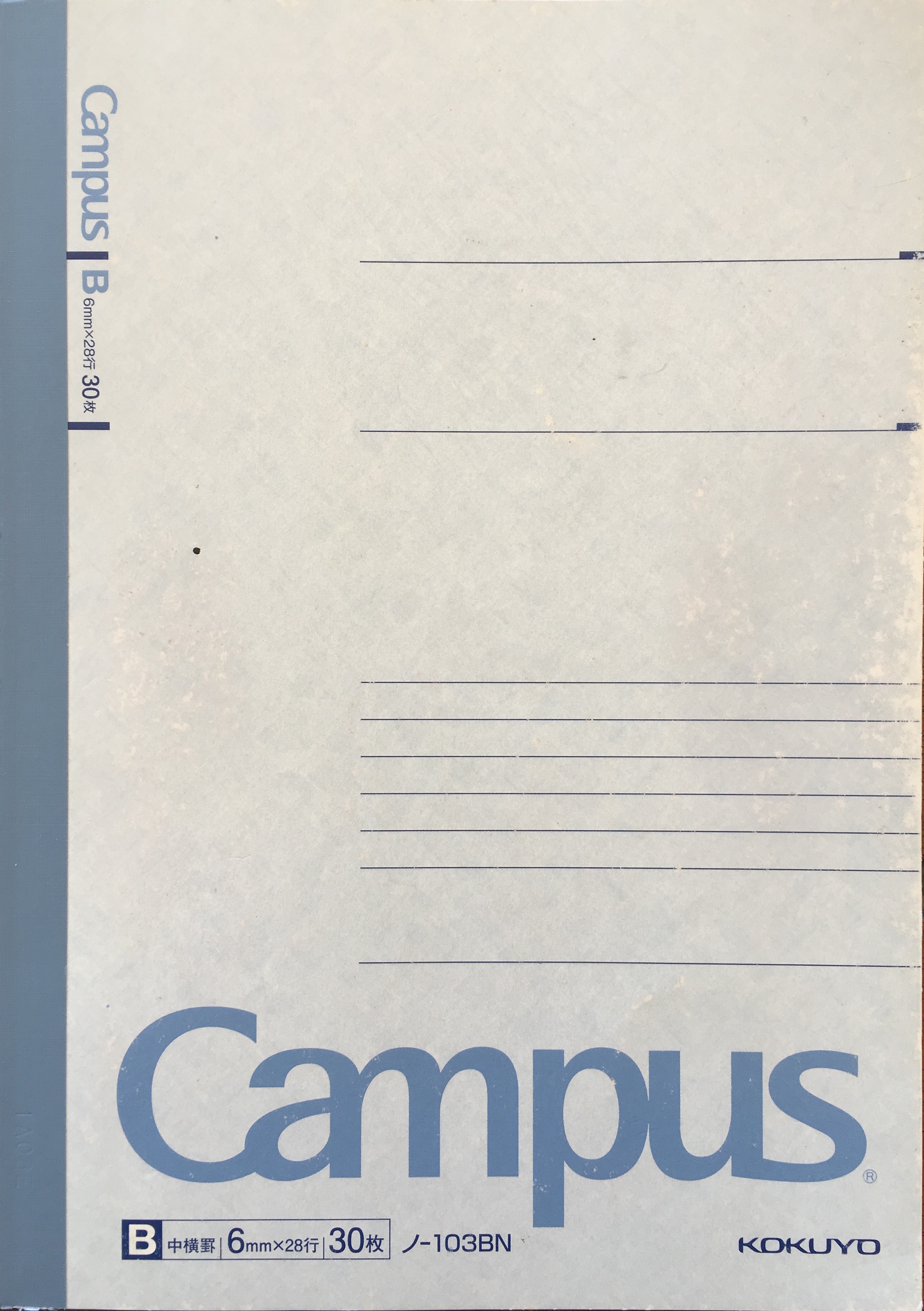
Kokuyo Campus B5 Notebook – AU$2.80 DanDa

2016-07-10 campus_cover_blog_postThis notebook has been in daily use for the past month or so, and performed extremely well at the task. As you can see the cover is a little worn. “Daily use” generally involves blog post drafts, coffee tasting notes, general notes or song lyrics rewritten to test out a pen or ink. Many and varied content, however a common theme being longhand writing — often several pages at a time.

Design wise, the Kokuyo Campus series comprises a selection of thin, glue bound (external tape reinforced) notebooks unadorned with any additional pockets, closure straps or the like. They actually remind me of a standard school exercise book in many ways (perhaps with the exception of the better paper quality). The cover is simple card stock, which is not overly thick however does the job as intended.

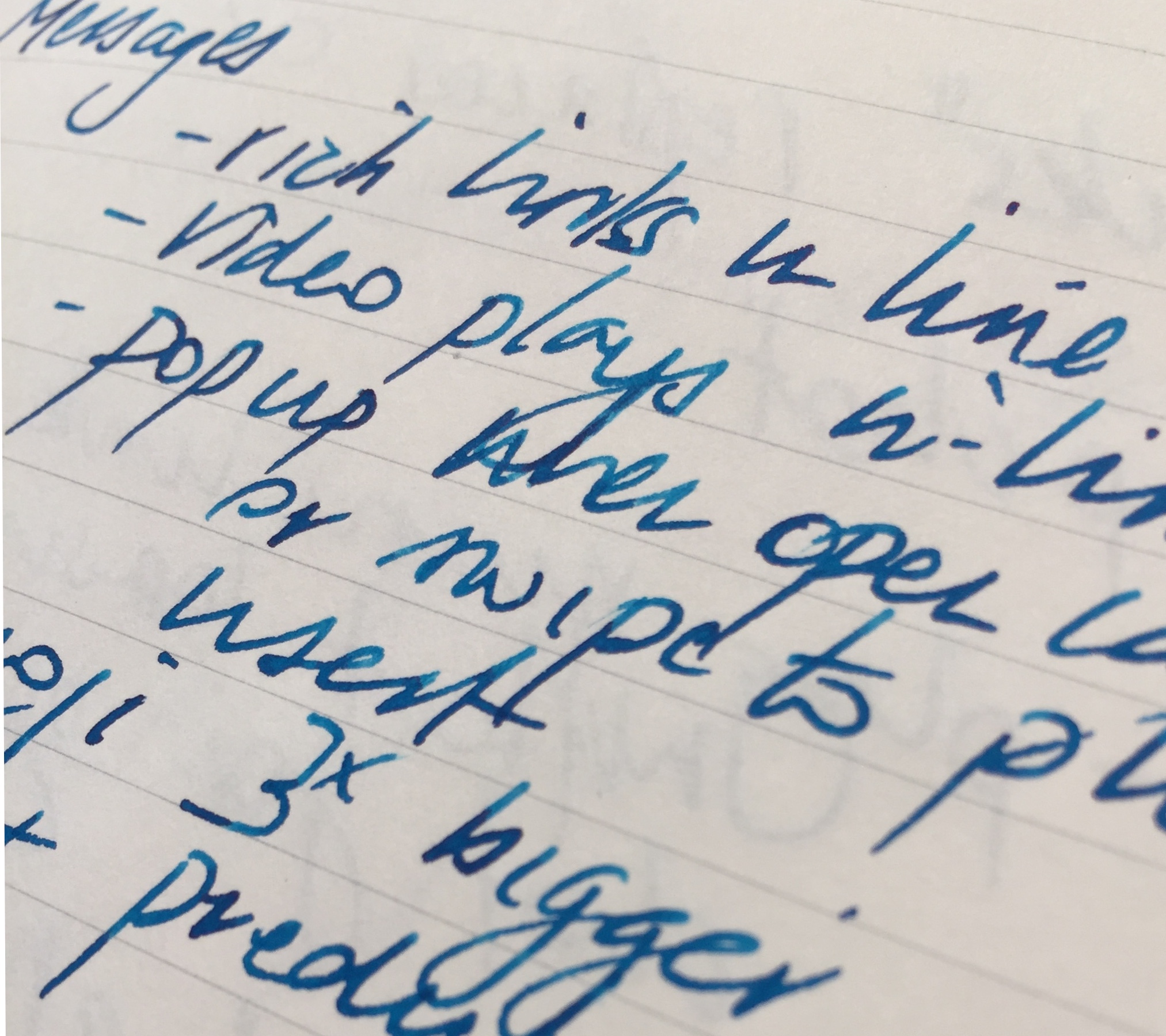
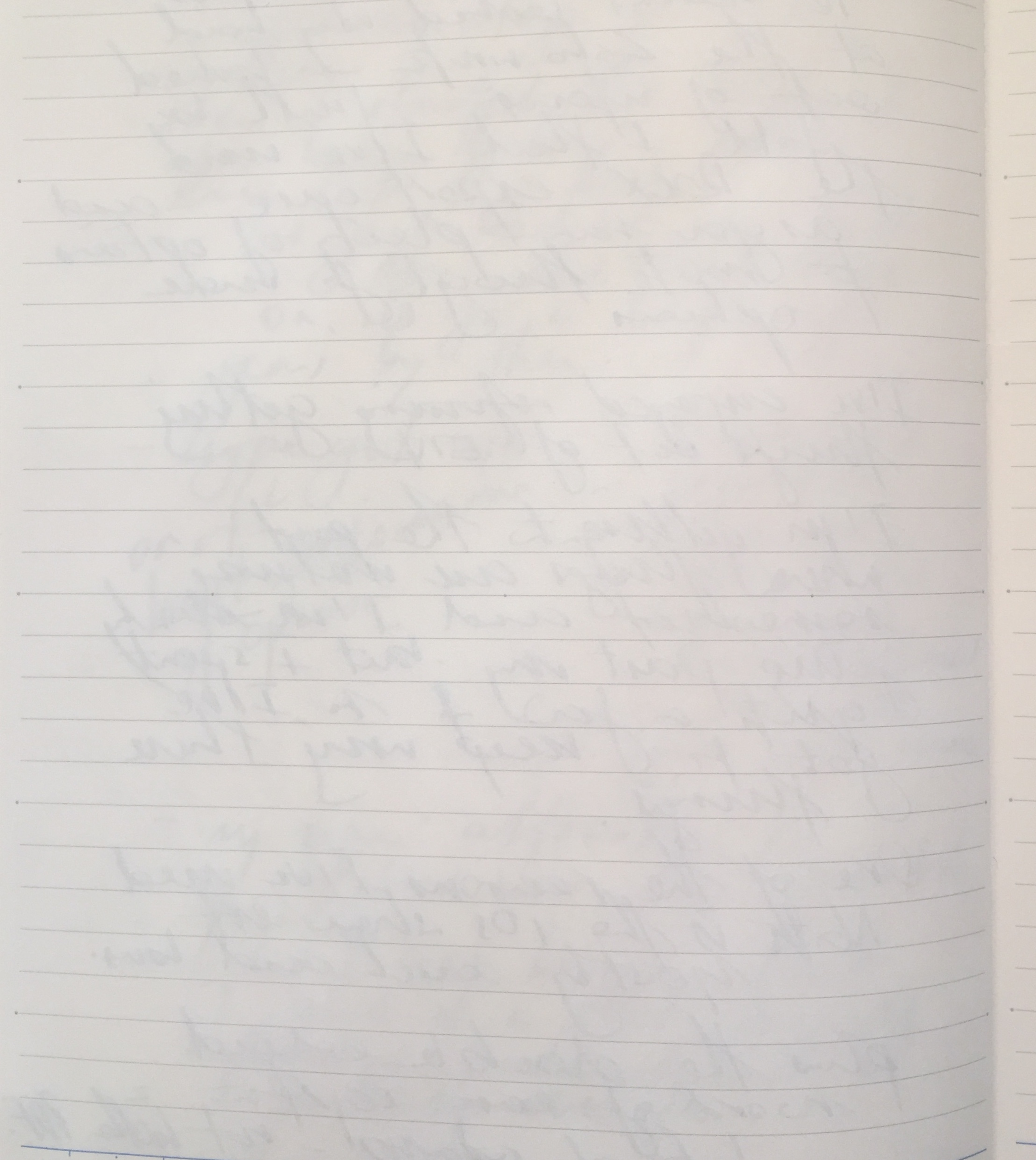
Not having used any of the Japanese made Campus line of notebooks before, the quality of the paper was certainly pleasing, though not a complete surprise given listings with online retailers noting the paper to be decidedly fountain pen friendly. The 70 gsm paper handled my daily writer (typically M or F) fountain pens with aplomb, showing no feathering, bleed through, nor ghosting of any significance. Writing is almost as smooth as you’ll find anywhere — great paper for most fountain pens.

2016-07-10 campus_close_blog_post2016-07-10 campus_reverse_blog_post

With a 0.7 mm Retro 51 refill, the show through was just a touch more evident, however as always I also put this down to my heavier hand when using rollerballs or ballpoints.

The slightly off white paper shade provides a perfect canvas for true ink colour representation, and dry time is comparable to, if not better than some of the heavier weight papers — dependent on ink type of course.

The Campus line of notebooks comes in various sizes in plain, ruled or grid options, and the pre-printed No., Date and bold title lines at the top of the page are a nice touch. Although my numbering always goes in the bottom right corner of each right hand page, other indexing or notations can always take advantage of the field provided at the top.

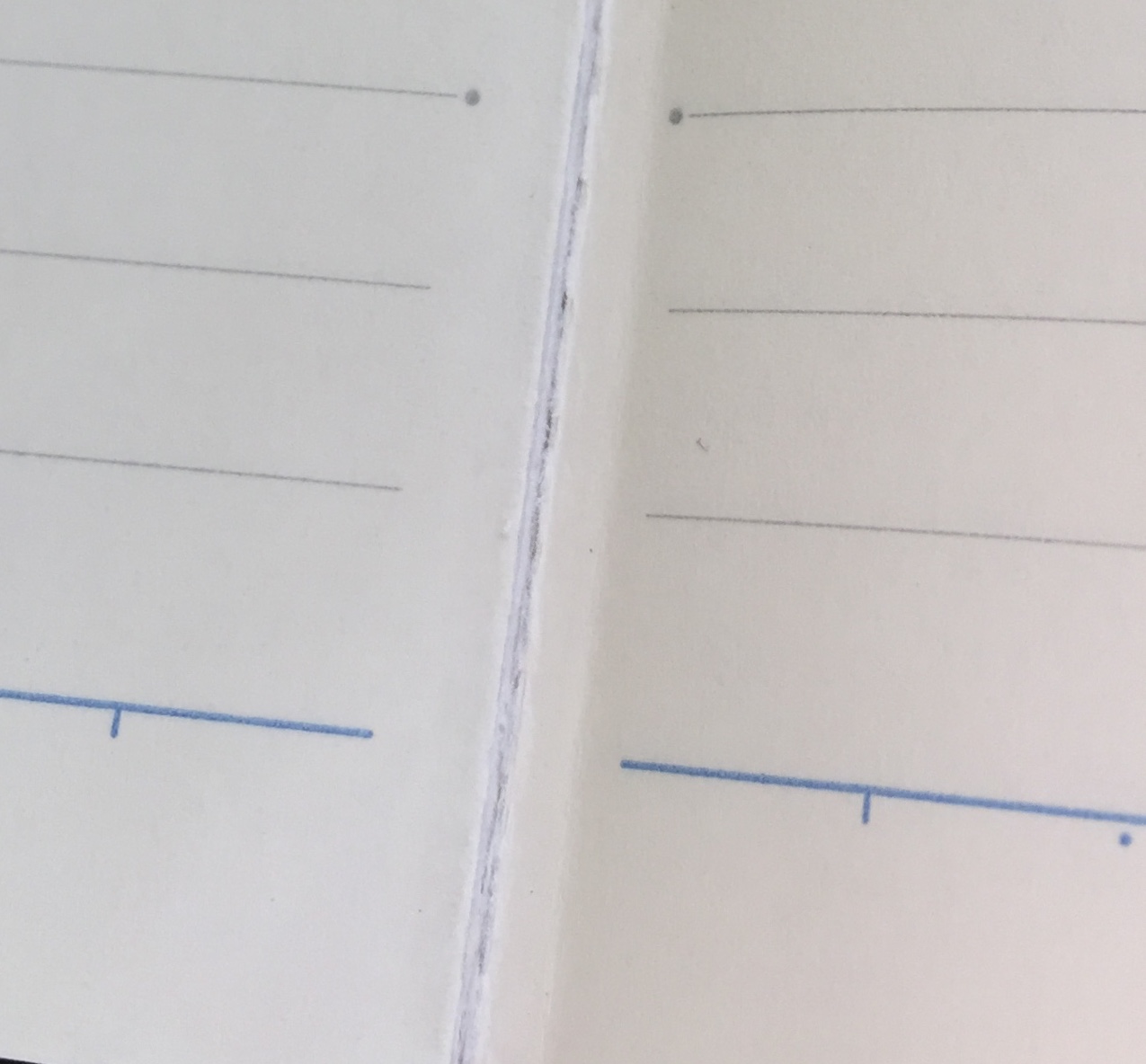
The model I’ve been using contains ruling at 6 mm spacings, with contains additional 7 mm markings along the top and bottom lines for reference in the vertical plane.

2016-07-10 campus_spine_blog_postOverall I am very impressed with this thin, light, high performing notebook, and if there were any negatives, it is probably only the binding, which is beginning to stretch a little in the initial pages. I suspect I have contributed to this by regularly (and unnecessarily) bending the book back on itself to then lay it flat for writing — probably not the best habit given running the heel of my hand up the open book would achieve the same result. Coming in at 60 pages, I imagine most will have this notebook filled and move on before any real issues are seen with the binding, however it is perhaps best to take at least a little care.

I’ll certainly be buying from the Campus line of notebooks in the future, and if you haven’t already — I’d highly recommend at least trying them out. For the princely sum of AU$2.80, there is not a lot to lose, and as far as I’m concerned is quite the bargain for what you get.

Side Note: The design and evolution of the Campus series of notebooks is also an interesting story.

The Complete Report Pad — AU$2.80 Daiso

2016-07-10 reporter_cover_blog_postThis particular purchase was driven by the need for a “correspondence” notebook or notepad which was fountain pen friendly, contained tear off sheets, and was a little larger than an A5 Rhodia No 16 notepad.

The specific reason for this being I write a good portion of the letters I send during my lunch break, and often do so sitting at the bar of my favourite cafe in the CBD. Said bar is fairly narrow from front to back, and not therefore suited to the Rhodia A4 sized pad I had been using. Having resorted to the A5-sized Rhodia No 16 instead, ideally I wanted something in between to fill the void, with a B5 sized notepad was of course the way to go.

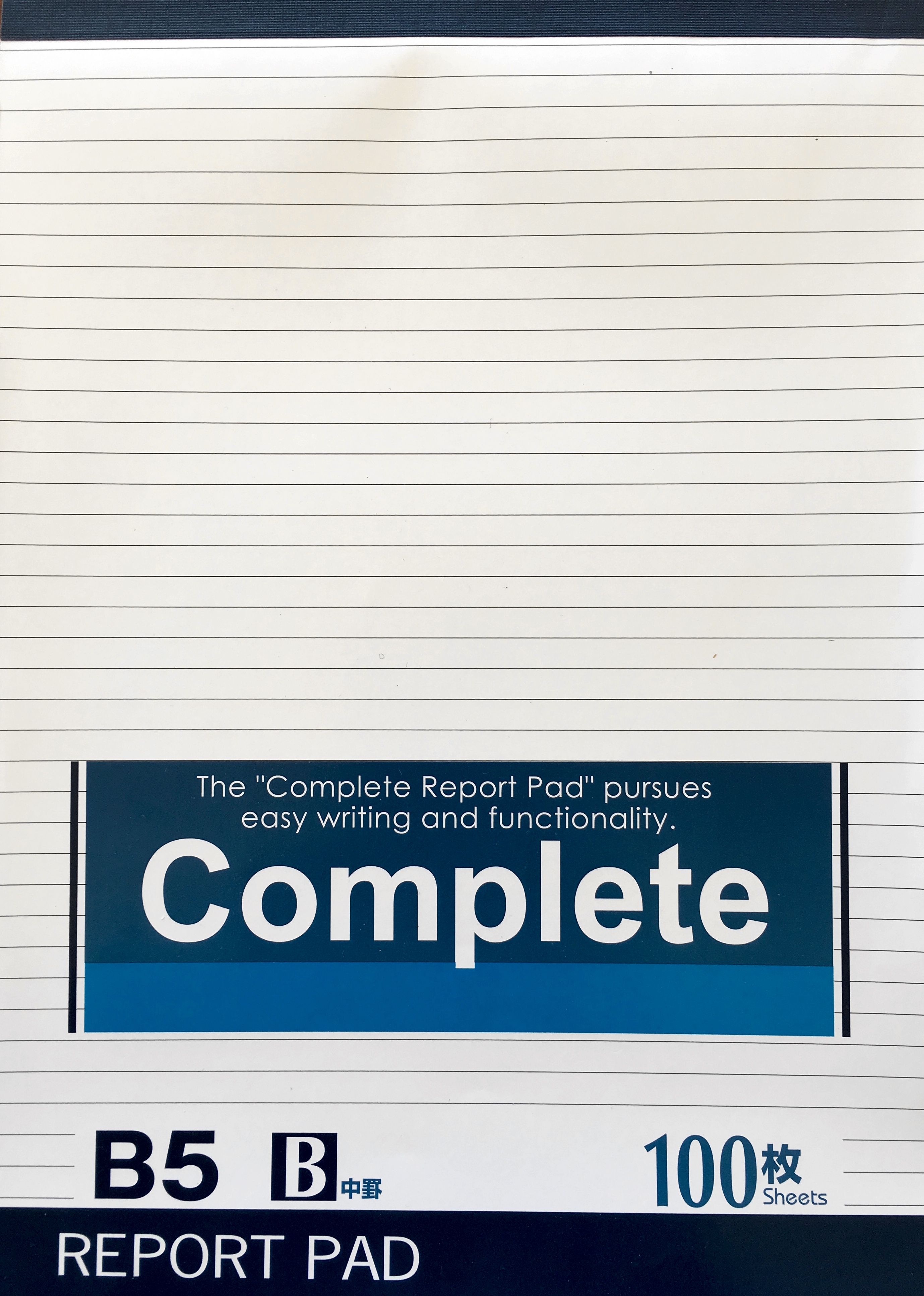
The Complete Report Pad is an Indonesian made B5 tablet style notepad sold through Daiso, and as noted above — for a bargain basement price.

The top binding is again glue with tape reinforcing, and allows straightforward tearing of sheets from the pad once completed. The front cover is your standard glossy, slightly thicker paper stock, with the rear thickened cardboard. Both do their respective roles as intended, however the front cover is not designed for very rough use.

Of course the most important aspect is the paper. Ruled at 6 mm spacings, the pages also sport a title bar along the top, containing pre-printed Date and No. fields. There are also 6 mm divisions marked at across the top and bottom-most line of each page. The ruling and printed divisions/fields appear on the front facing side of the page only, with the intention of single-sided use.

I’ve not been able to find specifications as far as the weight of the paper is concerned, however a reasonable estimate would be in the order of 70 gsm or so. Whether this is correct or not I am not sure, however the performance is certainly comparable to papers around that type of weight.

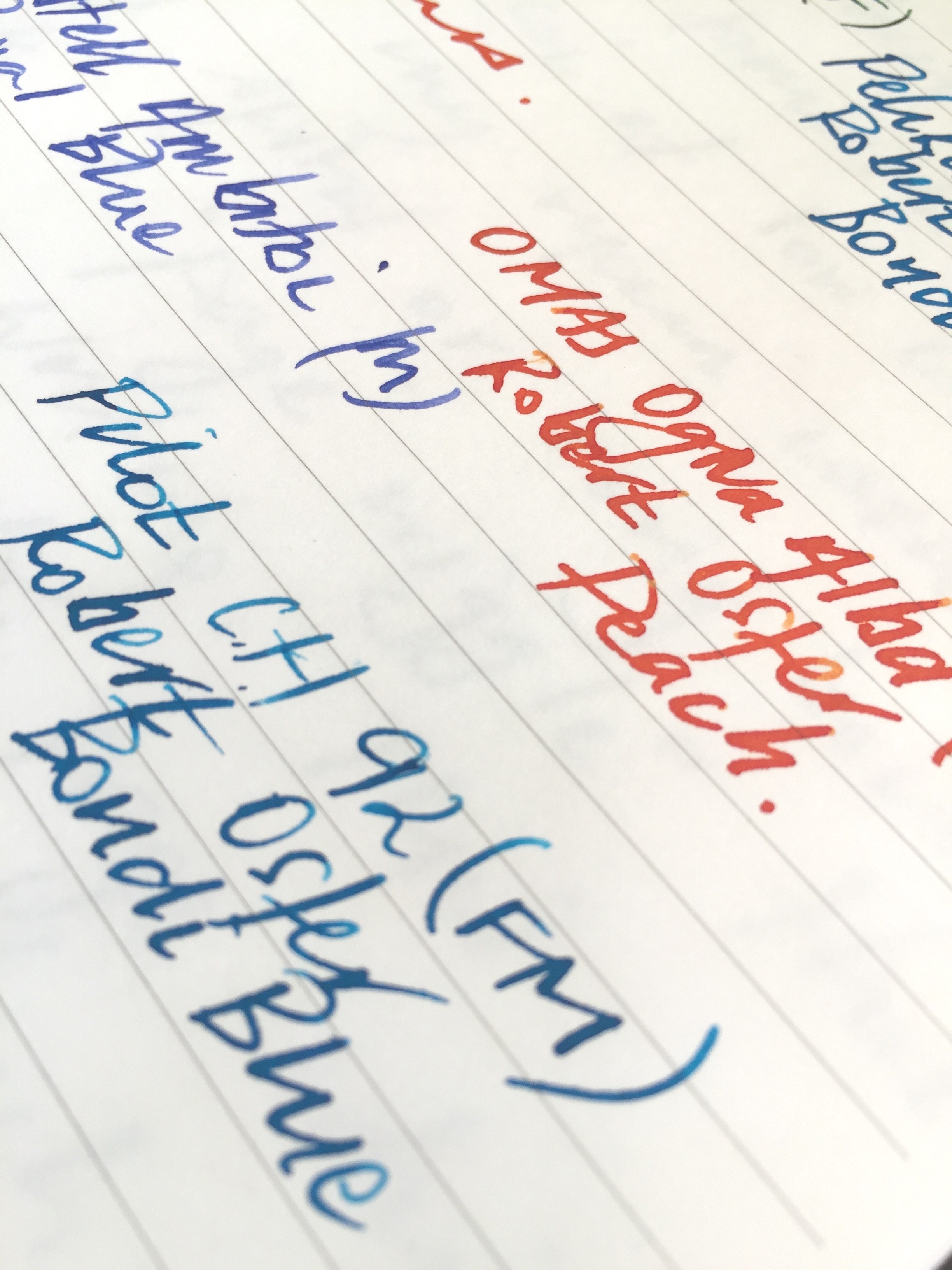
2016-07-10 reporter_close_blog_postWriting performance is very, very good for the price you pay for this notepad. It is not dissimilar to the Kokuyo paper I’ve described above, yet is marginally toothier to the feel. Again I’ve used numerous fountain pen nib types (M and finer) and inks with no problems. A small amount of ghosting with no bleed through; feathering is non-existent; and the overall feel of the paper provides a pleasant writing experience. I’d still describe this paper as being relatively “smooth”, yet of course it is not your Rhodia or Clairefontaine.

There really isn’t too much more to say about this one. For my intended purpose of finding an appropriately sized correspondence notepad, The Complete Report Pad is just about perfect. For the price you can pick these up for, they are exactly the sort of thing to grab a few and leave them in the various places you may jot down a few words or as I do — write a letter.

Wonder if they’ll let me leave a stack on the end of the bar?

Aqua Drops Twist Ring Notebook by Lihit Lab – AU$4.70 Officeworks

2016-07-10 aqua_drops_cover_blog_postHere is where I’ve really upped the ante, with the 30 page Aqua Drops Twist Ring notebook thundering through the register at a cost of AU$4.70 — almost double the price of the two mentioned above. To me it is still considered a budget option, though in the same store you can pick up a Rhodia No 16 Notepad for a list price of AU$7.16. There is also a B5 sized Aqua Drops notebook listed at AU$5.00 — agin for 30 pages.

The choice here though is not necessarily just price, but some of the utility gained in features of the Aqua Drops Twist Ring — namely the fact it is easily refillable, and those refills can be obtained in plain, ruled or grid loose leaf sheets. A packet of A5 refills will set you back AU$2.95, so in effect, once the notebook is purchased you have endless refills at a similar cost to the products above. I’ve mentioned the B5 size, and refills for this size are AU$3.50.

Although the utility of refilling and/or rearranging sheets in this notebook is probably the main drawcard, the writing performance is right up there as well. This is super smooth 70 gsm paper, and any nib or tip will glide happily across its surface. All of your ink colours will shine on the white paper, and while the lines are not overly dominating, aren’t quite as light as the Campus notebook.

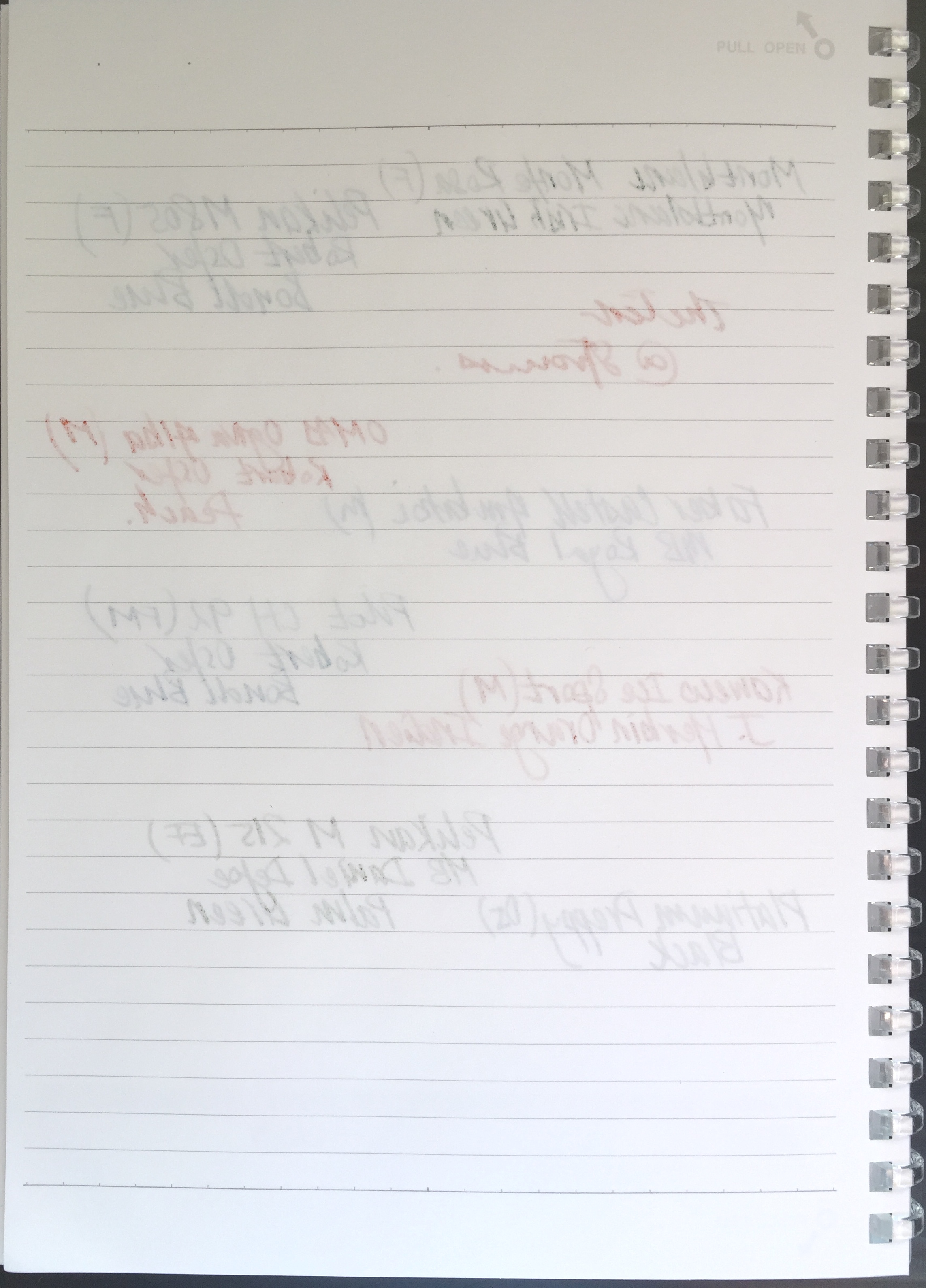
If you are a heavy fountain pen user, and use a lot of broader nibs combined with wetter inks, the paper is probably not going to be up to scratch for double-sided use. However for my medium nibs and finer, the only negative is a little ghosting on the reverse of the page. There is no bleed through or feathering to be seen at this end of the nib spectrum, however my European mediums were right on the cusp of feathering with certain inks.

2016-07-10 aqua_close_blog_post2016-07-10 aqua_reverse_blog_post

The refill system is quite straightforward, with a tug on the top and bottom of the page adjacent to the spine when the notebook is open, popping apart the rings. I’ve not had the product long enough to comment on the longevity of the plastic spirals, however they seem strong enough. Fatigue with repeated use may perhaps be a factor, though equally it may not. Being circular in shape, the rings feel quite strong, however I wonder about something like a heavy textbook being dropped on the spirals — which I guess you’d never know until it happened.

My other main quibble, which isn’t unique to this particular product — more so with spiral bound notebooks in general, is the inevitable “page wiggle” which occurs while I’m writing. Unless the pages are a fairly tight fit on the binding, which tolerances generally prevent — I find myself needing to hold the page steady rather than simply resting my free hand on or beside the notebook. Not a big deal however I do find this a little annoying to constantly do.

With a packet of grid refills, I’m planning on using this as a recording notebook for my coffee roasting. Perfect.

Three new notebooks — budget intact

Although this post is not intended to be a head to head comparison of the three products I have described above, I have certainly come out of the experience a little more knowledgeable on the merits of each. Also worth mentioning in addition to those above, is the “X” branded spiral notebook from Officeworks which I have previously written about.

To be honest, I would buy and use all three again. One thing is for certain though, the B5 Complete Report Pad is now my default for written correspondence. I love the size, the paper is great, and sheets tear off with ease. A definite ongoing purchase when the current one runs out.

Of the other two, the Campus Notebook slightly edges out the Aqua Drops, and appeals mainly based on the quality of paper and overall lightweight yet quality construction. The Aqua Drops notebook series I consider a solid option, and for me, would be an ideal “project” notebook, as the option to add, subtract, or rearrange pages (of ruled, plain or grid options to boot) is a real positive. A few sketches and notes as part of a project negates the ongoing “page wiggle” issue of prolonged writing sessions, and tends to be where a lot of spiral bound notebooks I try end up.

As I mentioned above, I do find satisfaction in seeking out lower cost stationery options, which, admittedly aren’t always on point, however the three above are great options to try out for yourself. If they don’t suit? Well, I guess you haven’t really lost much in finding out.