Wiser Web Wednesday

Wiser Web Wednesday – a semi-regular link to posts of interest from around the web, by those far wiser than myself:


Light & Ink
With one method of export in text editing app Ulysses now DOCX rather than Rich Text Format, some workflows may have suffered a little. Although I don’t often export with either, this workaround might be handy for some.

One that’s new to me is Zoho Writer. I installed it after checking the features page and seeing that it did indeed have RTF export. One nice feature is that it also shows up in Ulysses’ share sheet when exporting as DOCX.

Where there’s a will there’s (usually) a way:
Patching the RTF Hole in Ulysses


Katie Floyd
I’ve listened to the Mac Power Users podcast for long enough to know that if one Katie Floyd is reconsidering her Evernote situation then significant changes have occurred with the app. Of course that is exactly what has occurred with recent pricing increases causing many to rethink whether Evernote still has a place in their monthly subscription outgoings:

I understand the need for subscription pricing and sustainable revenue streams for App developers. But sometimes it feels like we’re being pecked to death by ducks.

I must admit for the first time, I’m seriously looking at other options including either dropping my plan down to the plus level or canceling the service all together.

I’ve mentioned on these pages before my slow migration from Evernote to Apple Notes. This remains incomplete, largely due to my extreme apathy towards sitting down and determining if I even need a lot of what remains inside Evernote.

Interesting times ahead with so many alternate apps which may not be exact Evernote replicas, yet might do the job well enough:
Sad Elephant


Fountain Pen Quest
Although my entire fountain pen collection almost fits into the array of Nock Co. cases I picked up in the original Kickstarter campaign a couple of years ago — that is not to say other options do not appeal.

This offering from Visconti, the subject of Ray’s keen eye, is a nice option if requirements call for a more rigid protective case:
Review: Visconti Dreamtouch Leather 3 Pen Holder


Ed Jelley
Upon seeing the Schon design pen pictured around the Internet, my main concern centred around the weight — simply from a personal preference point of view.

While the form factor is great for EDC, the weight of the stainless is just a bit too much for my taste. It’s fairly noticeable when you’re carrying the pen in pocket, and even more so when using it

I’m sure there are those who love the weight, however as always — each to their own in this hobby. There are plenty of great options for everyone.

A thorough review as always from Ed:
Schon DSGN 01S Stainless Steel Pen Review


Alt. Haven
Although I love my fountain pens, I do enjoy using great ballpoints and rollerballs almost as much.

Having a couple of Lamy 2000 fountain pens in my collection, the multi-pen variant of the 2000 line is certainly never far from the pens I consider as “possibles” in terms of future purchases.

Junee with another great review:
Review: Lamy 2000 Multipen


The Pen Addict
I’m a firm believer in highlighting posts such as these, for you never know when those new to the world of fountain pens enter the neighbourhood.

Although good reference posts exist, as far as I’m concerned the more the merrier, given it only increases the likelihood new users will come across information which is highly relevant and useful to the hobby:
Zen and the Art of Fountain Pen Maintenance


The Gentleman Stationer
As I work my way through the many pen reviews around on the internet each week, I have often wondered both (a) how do the prolific reviewers get through all of the pens they have queued up; and (b) how on earth do those reviewers ever get to use the pens they really enjoy and are favourites?

This might be the nerdiest thing I’ve ever written, but I needed to do something.  I didn’t like the feeling that the idea of testing and using different pens was overriding the joy I should be feeling in using them in the first place

The answer is to create a system such as the one Joe mentions here. A great idea, yet one that also reminds me how thankful I am I don’t have to:
Choosing Pens for the Daily Carry


The Pelikan’s Perch
Generally I’m more likely to add different pens to my collection rather than different colours of the same or similar models.

However, this soon to be released offering from Pelikan certainly tempts me to add to the red and the black M205’s currently in my collection.

Brough to you of course where you find all your Pelikan news:
News: M205 Aquamarine Special Edition Demonstrator


Too Many Inks
If I’m remembering the system correctly, this looks like ink number 355 entering the Too Many Inks stable.

BMW Blue didn’t disappoint, thought the scan below doesn’t do it justice, this ink shades very well with the dark areas having a red highlight just like the best of the shading blues from Sailor or iroshizuku. This is one very nice blue, I look forward to using it at the office this week.

Look, I’m very pleased the BMW Blue is an impressive ink and has gone to a good home, however someone has to do the responsible thing and say it: David – please don’t ink and drive1:
Montblanc for BMW Blue


Crónicas Estilográficas
Now that — is an interesting nib:
East Pen Made in Tokyo


ScotchWhisky.com
Having been earlier this year diagnosed with Coeliac Disease, I have a new found respect for the importance of accurate and clear labelling on the products we consume.

Ivan Menezes, CEO of Diageo, said: ‘We believe people should have the best possible information to make informed choices about what they drink: this includes alcohol content and nutritional information per typical serve. Johnnie Walker is one of our largest global brands, which means these new labels will arm millions of people around the world with clear information about what’s in their glass and in a way they can understand at a glance.’

Upon looking at the labelling, the benefits of listing kJ/calories and six further zero’s for the remaining nutritional categories may be questionable, though for the reason I’ve mentioned above, I am not complaining about steps taken in labelling standards.

Besides, I don’t really think you’ll find any negatives resulting from such a move inside your usual bottle:
Johnnie Walker to count calories on labels


jimseven
The struggle to further grow specialty coffee is real.

So here’s the problem: what we perceive as our biggest asset to win and retain customers doesn’t work the way we want it to. Not enough people are interested in upgrading the coffee they drink.

Of course it wouldn’t be a jimseven post without some valid solutions:
A customer conundrum


Sprudge
Although it might be summer in the Northern Hemisphere — it’s always BBQ weather in Brisbane:
Coffee BBQ Rub Is Magically Delicious


  1. Yep. Wow. Not only did I think of that – I actually wrote it. My apologies. ↩︎

What’s Brewing: Colombia San Marcos

I’ve been roasting and sampling quite a few coffees of late — certainly too many to write about all of them. There are however probably a couple worth mentioning — one of which is this beauty produced by a group of small farm-holders under the San Marcos name in the Huila region of Colombia.

The Region

Wikipedia tells us:

Huila (Spanish pronunciation: ˈwila) is one of the departments of Colombia, and is located in the southwest of the country, with Neiva its capital. Colombia’s second highest peak, the Nevado del Huila volcano, is located in the Huila department. The Magdalena River is Colombia’s largest river, and rises in the Huila department, with the river valley containing some of Huila’s most important towns.

Of course much of the country has a strong heritage with its coffee growing regions, and nearby department Quindío houses the National Coffee Park.

Again from Wikipedia:

The National Coffee Park (Parque Nacional del Café) is a theme park located in the department of Quindío, Colombia, 4 km south-west of the town of Montenegro and 11 km west of the departmental capital city Armenia. The park can be reached from a cable car, offers attractions orchid animatronics colorful, global coffee garden, a roller coaster, food stalls based on coffee, Colombian folk architecture, and other attractions.

1024px-Colombian_National_Coffee_Park_195

The Colombian National Coffee Park – Image courtesy Uria Ashkenazy

The Coffee

All information in this section courtesy Ministry Grounds Coffee:

  • Coffee: Colombia San Marcos
  • Region: Huila
  • City: San Marcos, Timaná
  • Variety: Caturra (70%), Colombia
  • Altitude: 1,500 – 2,000 metres above sea level
  • Processing: Fully washed and dried on raised beds
  • Owner: 30 small holder farms
  • Tasting notes: Balanced and clean, with bright orange acidity, intense sugarcane sweetness, and notes of milk chocolate, caramel, honey and marzipan and lingering sweet finish.

The 30 small-holder farms under the San Marcos name, farm in the town of Timaná — located in the south of Huila, 180 km from the state’s capital Neiva, a prime location for growing high quality Colombian coffee.

The San Marcos small-holders are members of the Association of Agricultural Producers of Timaná (Asprotimaná), who have helped this group find access to specialty markets for their exceptional coffee. Created by a small group of coffee growers in 2002 as a way to increase their bargaining power and achieve a better price for their coffee, currently the association has around 150 coffee producing members, who produce on average a total of 10,000 bags of green coffee annually.

The Brew

I often order in South American coffees with the expectation of fairly bold, full-bodied results in the brew. This offering from San Marcos in many ways achieved that, yet with exceptional balance and subtlety as well.

Brewed in a V60 drip filter, the end result was an exceptionally creamy, medium bodied drink, with a smooth, lingering finish. The overall flavour profile I’d describe as choc-orange, however there were definitely notes of blackberry, honey and toffee in there as well.

Whilst not as clean when brewed with the AeroPress, it was very well-balanced in the cup, displaying perhaps a little more of that toffee sweetness. It was enjoyed equally as well by my buds in our little office coffee collective as a start of the day pick me up.

When brewed as Espresso, again, the combination of orange acidity, sweet toffee, and chocolate, made for a choc-orange bomb in a cup. A real winner on all counts. When combined with milk in a cappuccino or flat white, although a little more subtle, the sweetness of the milk and those choc-orange flavours presented a Jaffa milkshake of sorts.

The Finish

This offering from the small-holders of San Marcos is well worth trying, whether you’re a filter or espresso type, and will serve you equally well through either method. If – like me — you are both, then there is a treat in store with this superb Colombian.

It looks as though there is still some available on the Ministry Grounds website (links above), and it would be advisable to get on over and order some, otherwise I might just snap up the rest.


Wiser Web Wednesday

Wiser Web Wednesday – a semi-regular link to posts of interest from around the web, by those far wiser than myself:


The Clicky Post
If you’re around the pen community long enough, you will see the inevitable (or so it seems) progression from wherever people start — to fountain pens. Perhaps even more inevitably, you feel you should be doing the same. Mike knows the feeling, and has written a fantastic post here — and judging by the comments, it struck a chord with many.

Lets say you are one of those people that really doesn’t like fountain pens. Sort of feels like you’re the odd one out or that you have to pretend to like them around the cool kids in order to fit in…

What also concerns me from time to time is how easy it could be to form the impression that to fit in, you need to spend a decent amount of money, and keep spending it.

Of course that isn’t true, yet can be an unintended and entirely innocent consequence of collective enthusiasm (like the point raised in Mike’s post above) — particularly in this age of social media:
Fad or Function? Using what you enjoy…and makes sense


Jake Weidmann Artist and Master Penman
You know things are pretty special when even the shipping process is in itself what I’d call a work of art.

Each certificate of edition bears the authentic JW gold seal; each one individually pressed with our customized embosser. This turn-of-the-century iron cast lion head embosser belonged to an old library on the east coast before it came into our possession. We customized the die to match our vision for the brand and we love the way it’s unified everything we do within the business.

Amazing work — and Works, for that matter if you care to browse a little through the site:
From the Studio


The Gentleman Stationer
One of my favourite notebooks of the past couple of years has been Baron Fig’s Confidant (mine was the Three-Legged Juggler edition). Exactly as Joe mentions here, I too was a regular Moleskine Cahier user until an increased use of fountain pens put an end to that.

Baron Fig uses some of my favorite all-purpose notebook paper. This isn’t Tomoe River paper, however, so if you’re looking for a notebook that will let you run wild with your widest and wettest fountain pen nibs, look elsewhere.

I include that quote simply to emphasise there is a limit to the paper in Baron Fig’s products as far as fountain pens go, however the threshold is a lot higher than you might think for an “all-purpose” notebook. Essentially all of my everyday writers performed perfectly, and I’m looking forward to placing an order once I power through a few more pages of what I am currently using:
Baron Fig Vanguard: A New Direction, and A Good One


The Frugal Fountain Pen
A problem Pilot Prera can be a frustrating thing — and understandably so.

I’ve had a Prera for over a year now and have not had any issues — perhaps just the luck of the draw:
My Problem Pilot Prera


The Sweet Setup
There is nothing wrong with an intermittent reminder to any or all who might listen, regarding either passwords and/or back ups.

This is the former:
The best password manager (and why you need one)


Finer Things in Tech
David Chartier takes a swipe (not just to reply) at iMessage, highlighting where it is lacking compared with other third-party messaging platforms.

Despite those impressive numbers, I strongly believe that, as the iPhone was five years ahead of the industry, iMessage and Messages have been roughly five years behind their competition

All I can really do is mostly nod along, as I see my kids Messenger and Snapchat their way through life with their friends.

Some valid points here:
What’s wrong with iMessage?


Ulysses Blog
Author Kevin Tumlinson discusses some advice for writers on all things writing, and the business of being an author.

I have no active memory of the first time I encountered this advice, but I know what I felt at the time: Pure dread. I hated that advice. It made me sick to my stomach. It made me angry, too, because what I wanted to hear was something along the lines of ‘send the right query letter to a publisher and you’ll get a contract and a big fat check, and you can take the next two years to write the book.’

His advice to aspiring authors on writing isn’t new, however is heard often enough to assume it probably works:
Being an Author Means Being in Business


The Handwritten Draft

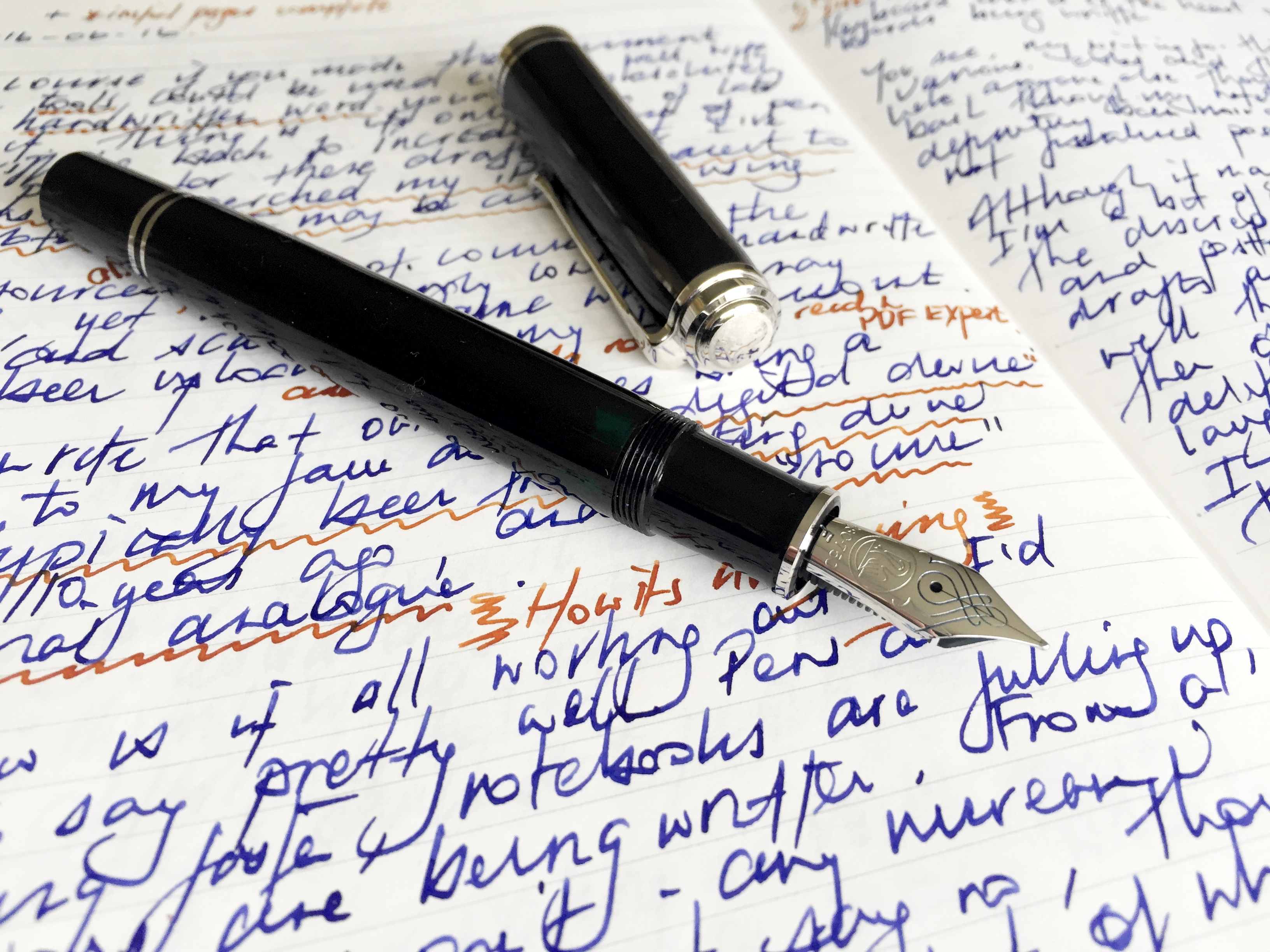
2016-06-26 handwritten_post

With so many digital tools at our disposal these days, handwriting often seems so far behind us. Of course many of the individuals whose work I read online are more likely to keep the faith than others, however when the words generally end up as pixels, perhaps it can be hard to justify transferring them from one to the other.

Some time ago I posted a picture on Twitter containing a page of handwritten words with a caption noting the (blog) post was now complete. In response, one commenter stated there was no way they had the time to perform such an undertaking. Another was surprised the proportion of posts I wrote this way was not higher (which I believe I estimated at around 30% at the time).

At the time I considered this for a little while and then didn’t really pay much attention to the thought — until more recently, when I realised the number is now reversed, with around 70-80% of posts you read here written longhand in their draft form1. A complete reversal of that proportion is a significant change, and for such a change to occur without a conscious plan to do so, suggests there are factors at play which perhaps warrant a little more thought.

My typical digital writing workflow

Looking back to the first couple of years of writing here, it is not hard to remember how things went. Ideas were kept in Evernote (often appended to the one note via a Drafts app extension); stimulus and/or reference material gathered online was largely stored in Pocket; and occasional post outlines created as mind maps using MindNode.

Sure, some handwritten notes were made in various pocket notebooks or slightly larger variants, however things were largely digital, and as I think back on it, the proportion was perhaps even higher than the estimated 70% of my original estimation. Even those handwritten ideas soon became text in Drafts or Evernote.

So the digital basis for a post was created, and all that remained was perhaps for some from of outlining and a first draft to follow. As I mentioned above, planning (on the rare times it occurred) was generally undertaken as a mind map, followed by writing — initially in Byword, and since 2014’s NaNoWriMo: Ulysses.

This process seemed to work for a good while, and I was happy enough for it to continue.

Why the change?

Well, in many respects, the following from Steven Pressfield which I linked to in last week’s Wiser Web Wednesday rings true:

For years I dove in on Page One, put my head down and started hammering keys. That’s not always a bad idea. Sometimes it works. But what usually happened for me was I’d get halfway through before it hit me that I was totally lost. Or I’d finish completely only to realize that I basically had to tear the whole house down and start over.

I’ve alluded above to the “rare times” post outlines occurred for good reason. If we take, say, 70% as a reasonable estimate again — that is about the proportion of posts which were written by sitting in front of the keyboard and writing. No real plan or outline other than a few random notes perhaps. That is not to say these posts were necessarily of high quality having been written this way, simply to say I may not have necessarily completed them all with a different approach.

As time has passed, I’ve found this an increasingly difficult way of getting words down on these pages at an acceptable quality and rate. On the surface I am not entirely sure why that is, however suspect (and hope) my writing has at least improved to some degree since commencing this blogging endeavour in the first half of 2013. Like many (I assume) — I don’t tend to go back and read many of my previous posts, however there is probably immeasurable value in doing so. If we then assume I would like my writing here to continue improving, a little more structure was needed.

Part of that structure began with increasing my use of those mind maps, and more recently, outlining in Workflowy. Perhaps there is something in the outlining versus mind mapping debate as far as which suits my style of planning best, however that is a post for another day.

Additionally, a gradual increase in the use of pen and paper to jot down some thoughts, turn them into an outline, and expand into the first draft seemed to improve the process immensely — and certainly did not go unnoticed. In considering how this change had come to be, and whether I should throw more effort into handwriting these posts, I received an article from a friend on this very topic — by author William Boyd, writing in The Guardian:

One great advantage of a longhand draft is that, in transferring it to the computer, every single word is written at least twice. Then the computer draft can be endlessly revised.

When you write in longhand you’re unconsciously aware of aspects of your prose – such as sentence length, cadence, rhythm, repetition, prolixity – that I find keyboard writing doesn’t alert you to in the same way. Also you can see all the litter of the progress you’ve made that day – the scorings-out; the arrows; the insertions; the bubbles; the second, third, fourth choices. The page reflects the mental effort that the screen doesn’t. It’s a toiling, messy business writing a novel.

Now of course I am not talking of novels here, and am always loathe to make comparisons with those who are actually writers (even though I’ve now done it twice in this post already), however the above quotes state quite succinctly what I believe to be occurring here — particularly the thought on every word being written twice, and the possible advantage to that type of approach.

So, in changing how I approach my writing here, where have I now ended up?

My writing process now: analogue first, digital later

For all of the words you’ll read in this post, here is where things are decidedly uncomplicated — probably a very telling point in itself I believe.

There is a pen. There is paper. They have a simple job in getting words on a page, and typically perform it admirably without interruption, syncing, charging or crashing. Save for a few ink refills, once I’m up and away, I’m well…up and away.

That said, I always think it is a little disingenuous to compare pen and paper directly to the digital tools at our disposal these days. After all, there is a heck of a lot those digital tools can do — and do extremely well, that our humble analogue favourites cannot. Once those words are transferred into the digital realm, they are available to me everywhere; are searchable; editable; and eventually exported and published.

As I mentioned earlier, a post starts as an idea, is expanded into an outline (which may equally occur in digital form), then written as a longhand first draft – all very simple.

Sure, those original source containers remain, in places such as Pocket, Safari, Notes, or even web-captured PDF’s, however you’ll find a good many more on scraps of paper or in pocket notebooks as well. Put an outline in Workflowy into the mix, displayed on my iPad beside me, and the handwritten words simply flow.

For those who perhaps may be interested in the specific tools, let’s just say it is a team effort — with many of the fountain pens, inks and notebooks I own all playing their part. You may have previously read about some of them — or may indeed do so in the future.

Of course, some of you reading this will have no doubt been writing this way for a long, long time — particularly pen bloggers and the handwritten review, to which none of this is particularly ground breaking — a fact I readily acknowledge.

Advantages of writing in longhand

Now, I’m sure we’ve all seen various articles around the web reporting on the benefits of taking notes by hand as far as retention and learning, however that is not what I’m talking about here.

In slowly transitioning to writing a larger proportion of posts this way, you would be correct in thinking there must be some underlying benefit. For me, the benefits are two-fold: more enjoyable writing, and more effective writing.

As far as more enjoyable writing is concerned, there would hardly be a pen lover amongst us that would not enjoy using their favourite pens and inks on a more consistent and frequent basis. Fountain pens are drained, more inks are sampled and notebooks filled. Contrasting inks are used for editing and revision. It is not so hard to see the benefits here.

I’m a little suspicious that somewhere in the recesses of my mind I seek to continue this cycle of more pens, more inks and more notebooks — though I am hoping for perhaps a more noble conclusion about this improved writing process.

How about more effective work?

Explaining the benefits I see in this aspect of my writing is perhaps a slightly more difficult proposition to those heavily invested in digital workflows for such a thing. The fact I have written many more drafts this way which remain unpublished is a victory in itself — for the more I write, the more I’ll eventually publish. As I’ve written about before, unpublished posts remain so often due to topic rather than process or quality, though of course not publishing garbage is also an ongoing aim.

So just how is writing in longhand more effective for me? Quite simply in the flow words onto the page. I’m a bit of a tweaker really, and when writing digitally at a keyboard, tend to stop, think and edit a little as I go, which on a first draft, ends up taking an eternity, given the amount of editing and rewriting which occurs. When drafting in longhand, I stop, think, and then continue writing — saving the editing and revisions for a few inserted notes, highlights or strikethroughs later, followed by an automatic editing stage as the handwritten words are transcribed digitally the first time.

I find I am far more effective at actually getting from start to finish, and by the time the first digital draft appears in Ulysses, it has been reviewed and has been rewritten as it is transcribed.

A final read through and revision is (usually) all that is then required before publishing. Conversely, with all the stop start editing, a post beginning its life in digital form may see a two-fold increase in the number of edits and revisions made prior to posting, for I believe no great improvement in content or quality. Even the “just jump in start writing” approach was in the past more effective than the constant “write and tweak” which tends to occur the longer I have a post in my Ulysses drafts folder.

Put simply — drafting in longhand sees more writing and less endless tweaking. A win for me by any measure.

Pitfalls of this approach

With any approach to something like writing, things will never be perfect, and yes — of course there are some disadvantages to writing this way.

One such disadvantage I’ve found is in covering some of the same ground twice. At times I don’t always have the same notebook with me, and in picking up where I left off (or at least thinking I am), I’ll occasionally rewrite a section.

Why I do that is anyone’s guess, and you could validly argue why on earth wouldn’t I remember where I was up to — and to be honest I cannot really answer that. Of course this is simply a process fault which could be easily rectified by ensuring I do have a specific notebook dedicated to this process which is always available when I need it. The reason that perhaps won’t happen is that I’m often trying out different notebooks and enjoy a little variety what I am using. In any event, yes it may be wasted time in some respects, however on the plus side I do get to then choose from the better draft, and I’d also refer you to the more enjoyable writing paragraph above.

To a lesser extent, even when I do use the same notebook, given these drafts often occur in fits and starts over a number of days, most sections of the posts have other material interspersed on pages between them, so there is a little flipping backwards and forwards at times through the actual notebook. Not a big deal, and assisted by reasonably consistent indexing and notations of page numbers.

Finally, and probably most obvious to many who write digitally — time. Yes, this approach would of course take far longer than an exclusively digital form of writing, with syncing across multiple devices and ease of editing, rearranging and rewriting those words. If that is how you write, you’ll hear no argument from me, and I’m certainly not advocating throwing away your keyboard.

Things have simply changed a little in how I approach my writing, and I am finding it far more enjoyable these days, so thought I’d share a little about the changes, and my thoughts around these processes.

Signing off

There is nothing like sitting down and outlining, drafting and revising a post such as this one, to point yourself in the direction of possible improvements in some of these processes — and this one is no different.

It looks as though I may need another notebook or two, some more ink, and maybe even another pen. Such a shame. If my new-found longhand writing process requires a few more tools and a broader experience in using them — I’m all for it.

While you may not end up reading them all, I can guarantee there will be plenty of writing going on, and for that I couldn’t be happier.


  1. Of course here I exclude the Wiser Web Wednesday link posts, which are generally put together via the iOS share sheet extension and sent straight to Ulysses ↩︎

Wiser Web Wednesday

Wiser Web Wednesday – a semi-regular link to posts of interest from around the web, by those far wiser than myself:


Macstories
With another Apple WWDC now behind us, and it will be interesting to see what developers make of new capabilities — particularly on iOS. Federico Viticci writing on perhaps why less than expected time was afforded the iPad during the keynote.

I wouldn’t be surprised to see Apple move from a monolithic iOS release cycle to two major iOS releases in the span of six months – one focused on foundational changes, interface refinements, performance, and iPhone; the other primarily aimed at iPad users in the Spring.

Although many were perhaps disappointed — with the iPad Pro line now in full swing, surely it’s only a matter of time:
On iPad Features (Or Lack Thereof) at WWDC 2016


Apple
It was also nice to see one of my favourite and most used apps, Ulysses win an Apple Design Award at WWDC.

Still the app in which these posts begin and spend their lives prior to publishing, and I’m looking forward to the next version when beta testing is complete.

Congratulations The Soulmen:
2016 Apple Design Awards


MacSparky
Every time I begin to think about possibly purchasing an Apple Watch, I remember it is probably not something I’d really use enough to justify the outlay. The redesigned UI and improved performance do seem impressive from all accounts:
watchOS 3: Reality is Matching Hype


Les Posen’s Presentation Magic
I’ve enjoyed reading Les Posen’s Presentation Magic over the past few years. Though I typically don’t present with Keynote, there are plenty of tips on offer for presenting in general.

In my sessions with anxious patients, the task as I see it is to assist them to wind back or recalibrate the threat or alarm system so they may bring focus and attention to the task at hand.

As you can see from the snippet of content and title below — this goes far beyond the usual presentation advice. As a Clinical Psychologist, Posen is well qualified to take a deeper look at the Breathe App featured in the WWDC Keynote, plus a few others – and a heck of a lot more around the physiological responses associated with anxiety:
WWDC and the Breathe app for the Apple watch: Apple is only half way there to be really helpful for anxious presenters (and others)


Eclectidbits
Nicholas Gold with an impressive review of Montblanc’s new Heritage Rouge et Noir Special Edition fountain pen.

The Rouge et Noir takes Montblanc away from its standard designs (the 149, 146, etc) into the territory of its special, writers, limited editions without asking the buyer for the same level of budget commitment.

It’s not for me, however there are a good many for whom it is:
THE BLANC ET NOIR on the ROUGE ET NOIR


Harvard Gazette
An intriguing look at a selection of some of the 2500 samples in the Forbes Pigment Collection.

By the 1920s, Forbes had amassed containers of deep blues, rich purples, vibrant yellows, and myriad other colors from his travels to Europe and the Far East.

One such sample is kermis — the source of the word crimson:

…an Old World pigment created by grinding tiny blisters produced by the insects Coccus ilicis, which lived on the kermes oak tree.

Fascinating stuff — a hat-tip to Smith Journal for this one:
A wall of color, a window to the past


The Gentleman Stationer
Joe with an update of the “Tier One” pen list on The Gentleman Stationer. I’m currently just putting together a basic pen index for this site, let alone adding any further categories into the mix. Perhaps in time.

Although we all have our personal preferences and favourites, I cannot see there being too many arguments here:
My “Tier One Pens” List (as of June 18, 2016)


Gourmet Pens
The Pelikan Stola is certainly on my list of possible purchases in the future, and part of that allure is a Pelikan without the usual price tag (not that I’m suggesting the quality isn’t worth the money on some of the pricier models). As an every day writer, it looks to fit the bill1 nicely:
Review: Pelikan Stola P16 III Fountain Pen


The Pen Addict
In picking up refills for both my own, and my son’s Pilot Hi-Tec-C Coleto multi pens, I often see the Uni Style Fit gel refills alongside them. I’ve never really been that enamoured with the basic Uni Style Fit pens though, however must admit the Meister is a decent looking instrument:
Uni Style Fit Meister Multi Pen Review


Ed Jelley
I’ve been looking at various iPad cases and keyboards lately, and appear to have narrowed things down considerably towards a final purchase.

A great review of worthy case contender here:
Galen Leather A5 Notebook/iPad Mini Case Review


The Whiskey Wash
A brief tour of some of the whisky producing islands in Scotland.

There is no distinctive Scotch whisky style in the Islands. Peat has a long association with the whisky industry here, but the use of peat varies widely depending on the distiller.

Who doesn’t love a little variety:
Getting to Know Scotch Whisky: The Islands


Starward
A couple of Starward Whisky based winter warmers for these slightly cooler temperatures:
Easy whisky cocktails to make at home this winter


  1. Entirely unintended, however I’ll take that pun. Surely …surely it’s never been done before. ↩︎