Recently I began writing a post about the merits of weighing espresso dose and yield, and then realised I haven’t really ever outlined just what my espresso brewing equipment consists of. I’ll warn you now this most certainly is not a post about fancy high-end equipment, however what I do have does a pretty good job at producing tasty espresso.

Of course you can spend as much as you like on this type of stuff, however I’m also a firm believer in maximising the potential of what you have, regardless of your particular level of investment. Further, I believe some great results can be achieved from what is available in the home appliance segment of the market.
So, as a preface to some more posts I am thinking of writing down the line (most of which admittedly exist only in my mind at the current time), what follows is the machinery and other bits and pieces I use to produce stunning, high quality espresso at home. Haha! If I knew what I was doing with this blogging game, that’s a better post title right there.
Before we move onto what is sitting on my kitchen bench, I think it is worth pointing out that while I may have high praise for the machine I use, your mileage may vary of course, and remember my perspective comes from a firmly narrow field of usage. I mean after all, you buy a machine and if it works well, you use it — for many years. I’ve really had no reason to look around or try others out.
In saying that, there are machines and home enthusiasts who can no doubt churn out better results, however I’m pretty happy with what ultimately ends up in my cup.
Let’s get underway then.
Machinery
As I mentioned in the opening, with the exception of my filter grinder (more on this below), my equipment remains firmly in the realm of what I’d describe as consumer-level home appliances.

The espresso machine is a Sunbeam Cafe Series EM7000. This particular one was bought from our local Harvey Norman after seeing an advertised price posted on OzBargain of $399.00. As you can see from the link in the section heading above, the model’s RRP is $849.00, and is routinely listed between around $699.00 and $899.00 in stores (for example at the time of writing, The Good Guys also have an online listing of $679.00).
We purchased the EM7000 fairly hastily, not wanting to miss such a good price, despite being a little wary of the reason for such a large reduction. The decision was made a little easier by the fact we had been using the previous model (EM6910) for about 4 years, and prior to that, the original EM6900 for nearly 7 years (after winning it through a magazine subscription competition). We at least had a certain expectation of reliability and performance through experience.
Although my intention here is not a full product review, suffice to say, in the two and a half years we’ve had the current model, with care and regular cleaning, it performs just about perfectly. Reviews online are mostly positive, and generally when there are issues, they centre around the performance and/or reliability of the steam wand and knob. Admittedly, in recent months I’ve had the steam control knob off and readjusted things slightly, however beyond that I’ve not had any concerns whatsoever. Beyond replacing the O-ring in the group head, that is also about my limit as far as taking things apart and tweaking them.
Why this particular model? As I mentioned, most likely familiarity in the first instance, after owning the two previous models, and the expectation of a few issues being ironed out now that a third generation had been released.
I should mention at this point that from a use perspective, the machine produces two espresso shots, with two (because one is low-fat, and one is not) associated milk steamings each weekday morning, three of each on weekends with an additional two or three more occasionally when visitors call in over the weekend. So although not high volume by any stretch, the machine does see use pretty much 365 days a year.
Other key features include a twin-thermoblock, allowing texturing of milk and extraction of espresso at the same time; relatively rapid heating when switched on; programmable water/steam temperatures and pre-infusion modes; and cleaning cycles for both back-flushing and descaling. A separate hot water arm though not essential, is certainly nice to have, and I do use it to pre-heat the cups.
An aside on the PID controlled twin thermoblock. I’m sure there are purists who prefer a twin boiler to a thermoblock set up, however at the price point we are talking about, the temperature stability is great, and having one thermoblock for espresso and one for steam is a godsend. Although it is of course not essential to simultaneously heat/texture milk and extract the espresso, not having to wait for the machine to alter its temperature before doing so has been a must-have feature for me since that initial EM6900. I don’t think it is something I could now be without.
 The 15 bar pump for producing espresso performs exceptionally well, with a pre-infusion mode to improve evenness of the extraction. Of course every few years the seal needs replacing around the group head, however I have never had any issues with the pump itself.
All in all I’m pretty content with the quality of output from the current machine, and I reiterate here my belief in maximising the little things to create better quality espresso, rather than necessarily spending thousands on a home machine. That being said, like anyone I do dream, and budget permitting I would of course do both — in a heartbeat. Honestly though, my main point is that a machine like this one or others in this category do a great job if you apply a little effort towards the details.
My main gripes? Not many really. The design of the drip tray seems a little short in relation to the group head above it, and sees water splash out onto the bench top when flushing the group head, though flushing into a cup avoids this fairly easily. There is a slight delay in the steam pump shutting off when the switch is closed, however this is easily accounted for after your first couple of uses. I don’t tend to use the milk temperature or espresso pressure gauges in day-to-day use, preferring to use other methods for assessing this information.
 The steam function for heating/texturing milk may be a little slow compared with some other machines (I’m not 100% sure it is), taking on average around 50 seconds for milk to come to temperature for a single beverage, and about half that again for two drinks. Again, in a home setting I believe this is more than acceptable, and I’ve no real complaints about that.
All in all, I’ve been very happy with the Sunbeam line of Cafe Series espresso machines for well over a decade now, and my current model certainly does not disappoint. This is a machine made with commercial touches (Twin thermoblock, brass 58mm group head, sloping portafilter handle etc) rather than commercial components per se (no E61 group head, twin boiler or pressure profiling), however this is what makes it such value for money in this segment of the market.
It’s a great machine I enjoy using each and every day.
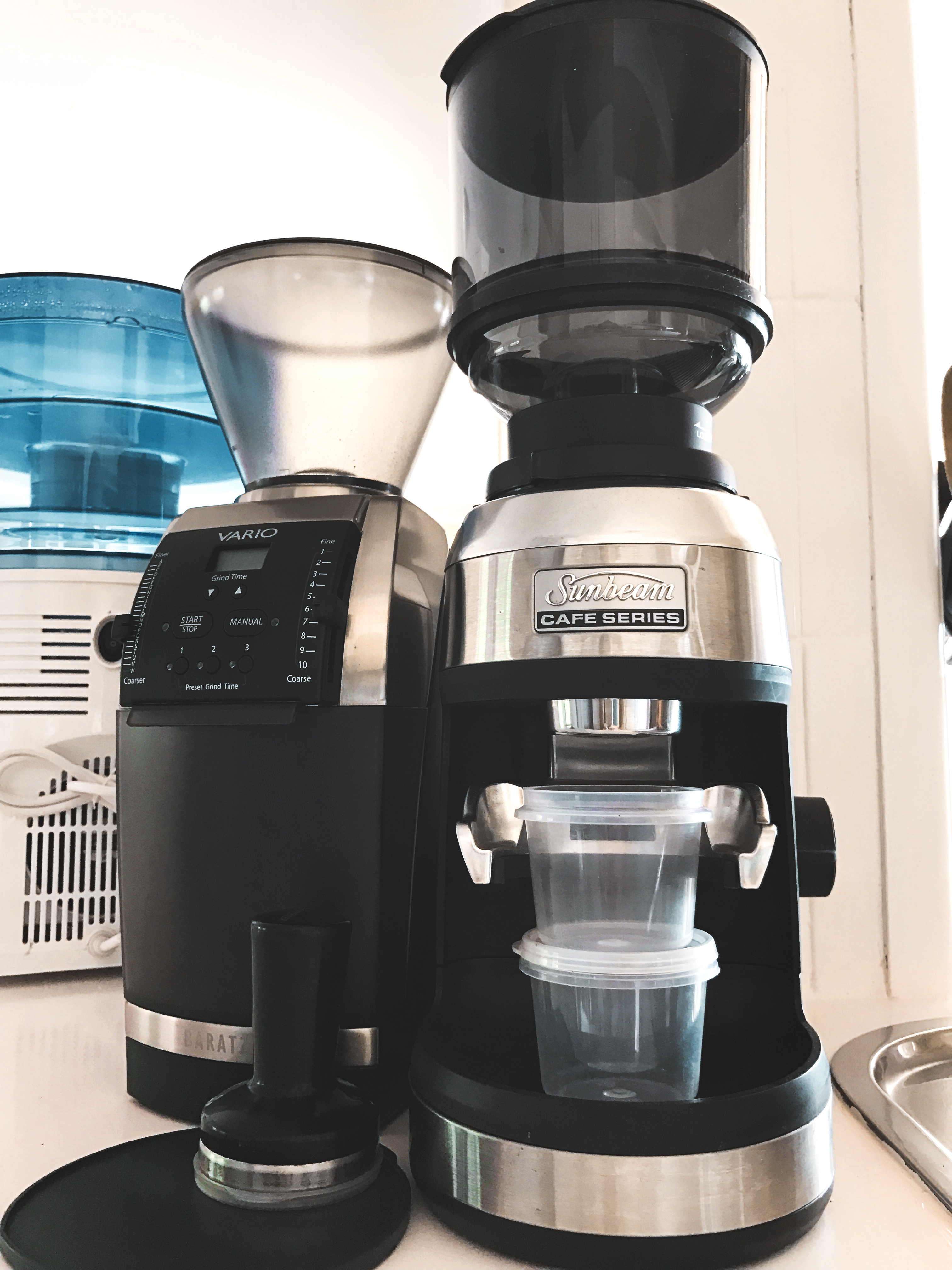
As you can probably tell from the above, I’m pretty happy with the espresso machine currently sitting on my kitchen bench, and have no real plans to look around for another. Not so the Sunbeam EM0700 grinder designed and marketed as the partner to the machine I’ve discussed above. I would say it does an admirable job, and a replacement will probably come for reasons other than dissatisfaction entirely.
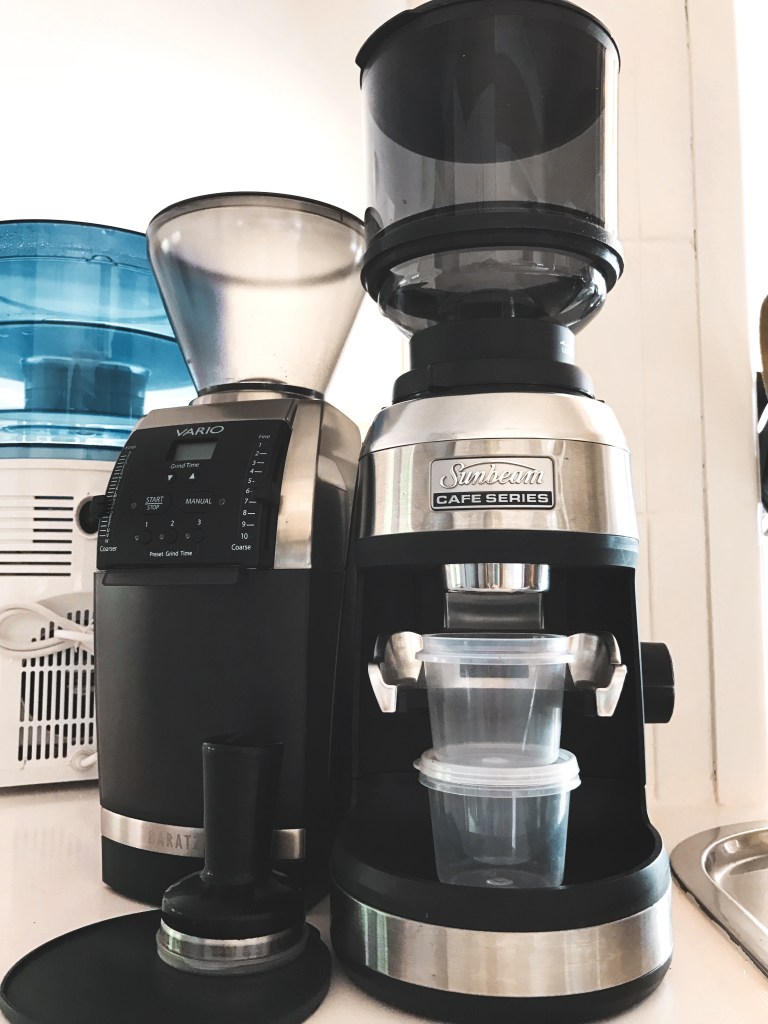
Along similar lines to the espresso machines I’ve owned, this is the third in a line of Sunbeam grinders, which have served me well over the years also. The purchase of the current model was made in mid 2014 after an ill-fated, short stint with a Breville Smart Grinder, with which I was unable to adjust the grind fine enough for espresso. I believe the Smart Grinder Pro is the one you want (should Breville be your choice), however at the time I had picked up the particular Breville model at a very discounted sale price.
In any event, it was back to what had been the faithful tried and true Sunbeams again. I say what had been tried and true simply because the EM0700 was a major redesign on its predecessors and I wasn’t entirely sure how the new model stacked up. On the whole I needn’t have worried, as it is more than adequate in coping with the required grind size (read “fineness”) of standard single floor filter baskets along with the aftermarket VST basket I know use.
 The grinder itself contains conical stainless steel burrs, has 30 steps of adjustment (more on this below), 450g bean hopper capacity, and the ability to grind directly into the group handle, with a built-in switch in the portafilter cradle to do so. It is belt driven in an attempt to reduce vibration and noise apparently, however what can I say — a coffee grinder is a coffee grinder — they are noisy beasts.
The main issues I’ve had over the past couple of years relate more to grind retention (grinds left in the chute or adjacent to the burrs), cleaning, and a little inconsistency at times. Add to that the grinds clumping a little has me thinking that if the EM0700 were to give up the ghost tomorrow, I’d probably be looking at an upgrade purchase rather than a direct replacement.
On a side note, in the images I’ve included in this post you’ll notice another grinder — the Baratza Vario, worth far more than the Sunbeam, and a much higher quality grinder in its own right. Why then would I be using the Sunbeam in preference? Simply the fact that every day I grind for espresso as I’ve mentioned above, and also for either AeroPress or my V60 drip filter. I’ve always been apprehensive about constantly adjusting back and forth between coarse and fine settings, preferring to keep one grinder for filter and another for espresso.
Firstly, a rather privileged situation I know, and my intention is to care for the grinders a little more in doing so. Whether this really makes any difference or not I’m not entirely sure, however that is how I roll, and on that basis I will continue. By the way, the Vario was an Instagram competition win through the good folk at Espresso Parts – yes I’ve been very competition-lucky in my coffee journey over the years.
So, the positives I’ve found with the Sunbeam – firstly the price. With RRP at AU$299.00, the grinder can often be found at various sales for around $50.00 less. Next, adjustment. The grinder comes with a stepped, 30 increment adjustment collar, which more importantly can be recalibrated at either end to go a little further than the standard 0 or 30.
Depending upon how you may use it, this ability could be a deal breaker. For my espresso grinders, I need to be able to achieve a fine enough grind to ensure my espresso machine is usable. That is, allows me enough flexibility to control the flow at a given dose. When using the standard single floor filter baskets which come with the EM7000 Espresso Machine, or VST baskets, the grind essentially needs to be similar to what you will find in a commercial setting. This is a lot finer than lower end machines which utilise dual floor baskets to accommodate the pre-ground supermarket coffee sold in vacuum sealed bricks.
I’ve recalibrated the grinder finer than the zero setting to the tune of 5-7 additional steps, which is a little over done, however I still like to be able to drop down a couple of steps if I need to, without hitting the zero marker. The user manual will advise if you recalibrate too finely, it will result in “a metallic grinding noise” as the burrs collide. We don’t want that of course, so if you head down this path, go in small increments. Once done, I was (and still am) more than happy with the level of control I have with the flow of espresso, using minor grind adjustments on a day-to-day basis (between settings 3 and 7 approximately).
I tend to think the EM0700 is better as an espresso grinder (once calibrated), as the particle distribution seems a little spread when grinding more coarsely for filter brewing. That is of course simply my opinion based on very unscientific tests (read a little haphazard use of a sieve to check a few times how consistent the particle size was).
 Those few negatives I’ve mentioned above in relation to grind retention and cleaning aren’t massive, however to elaborate a little. For cleaning, the adjustment collar removes and takes with it the outer burr — handy for getting a vacuum hose around the top and sucking out retained grounds. Firstly, removing the adjustment collar is not an easy task, and takes a significant amount of force to rotate it to the unlocked position, and a little less to remove it off the top (I use the handle of a wooden spoon to push on the lug and rotate it, and the flat end of a wooden kitchen spachelor to lift it off).
Once it is finally off, only then will you see how much retention actually occurs in and around the burrs — and it is significant. I do understand this occurs in many grinders, however takes a little dislodging it the dogleg into the chute. Of course the grinder still functions quite well, however this is not an ideal situation, and I suspect is a major contributor to the clumping together of grinds as they pass through the chute.
In summary, the EM0700 grinder from Sunbeam will serve you well, with regular cleaning and perhaps a little calibration adjustment. I don’t grind directly into the portafilter for reasons related to my own dose-weighing workflow, which is a story for another day. For the price, I’d say the output is of a good quality.
Ultimately though, if I had to choose between replacing the espresso machine or the grinder, it is the grinder which would be shown the door.
Other bits and pieces
What else do I use besides the machine and grinder? A set of Hario scales to weigh my dry coffee dose which goes in the portafilter, and the resulting beverage weight or yield produced in the cup. I’m certainly not going to recommend everyone start weighing their espressos, however it is surprisingly quick and simple to do with the right set of scales, and provides a great deal of feedback if you are looking to become more consistent with espresso brewing.
I use the standard Sunbeam supplied tamper, however one day will up the ante on this a little as well. Does it work as expected? Of course. Another point of note is the commercially sized 58mm portafilter of the Sunbeam EM7000 machine, which accommodates commercial tampers and filter baskets. A handy thing to remember when comparing machines if you are considering some aftermarket accessories or tweaks down the track.
 In addition (which relates to my weighing workflow), I grind into a decor small plastic container, which is easy enough to tare on the scales, and then transfer the grind into the portafilter, as the circumference of the container opening is a precise match for the inside of the 58mm filter basket. So, placing an upturned portafilter on the container, flipping the whole lot over and shaking a little provides a mess free transfer, unclumping of grinds, and decent initial distribution in the filter basket all in the same motion. I’ll go into a little more detail in a future post, however to explain the presence of those little plastic containers, there you have it.
As I’ve mentioned, I a VST filter basket, which is the 18g size. After trying a 20g basket, found that I am best dosing 20 – 20.8g (brew ratio approximately 1:1.8-2.0)in the 18g size. There are significant differences when using a VST basket compared with the standard Sunbeam one, and I’ve found the combination of grind, dose and flow achieved with this combination seems to better suit overdosing the 18g basket a little. Perhaps I am wrong on this, however the results seem pretty good to me.
Finally, I dry wipe the basket with a paper towel, tamp on an old rubber mat from the base of a previous (Sunbeam) grinder, and away we go. Once done, the used grinds are then disposed of in a Sunbeam knock box which sits in a corner on the kitchen bench.
To Finish
Boy, this has been a little long-winded compared with what I had in mind at the beginning, and when that happens I’ve probably made things more confusing, rather than simply providing better detail.
Frighteningly, there are a few points I’ve deleted and some I’ve left out, which I think will be best served in future posts I’ll hopefully get around to writing.

I think the best way to sum my feelings on the current set up is to report that this morning I got up, fired up the machine (which is ready in about a minute), made my wife a 6oz decaf flat white, and myself an espresso and 4.5oz flat white (21.6g dose; 44g beverage weight), and was more than happy I had the equipment to produce exactly what I wanted.
Further, I would be happy using everything I currently have for a number of years yet, and I think that speaks volumes for both the espresso machine and (mostly) the grinder.
Cheers. Like another?





 Pete Denison