Wiser Web Wednesday

Wiser Web Wednesdaya weekly link to posts of interest from around the web:

FiveThirtyEight
The humble Oxford comma – who would have thought a style of punctuation would deserve so much attention. Incidentally though, one I had not realised was ‘a thing’ until hearing it mentioned during an episode of the compelling series Boss, starring Kelsey Grammer, who, as mayor of Chicago didn’t rate the humble mark. A poll of Americans and their thoughts on the Oxford comma, thus:
Elitist, Superfluous, or Popular? We Polled Americans on the Oxford Comma
(Yes FiveThirtyEight, I see what you did there)

Unclutterer
For those very analogue, and perhaps a little GTD minded, comes a filing system which utilises a good deal of both (via The Cramped). Although it may be attractive to some, I can see things perhaps becoming a little unwieldy if unleashed without due care:
The Pile of Index Cards system

Unclutterer again, this time a method I have been using for some time now – simply without the name, however I am now happy to say “what? – the Noguchi system – you’ve never heard of it? Oh I’ve been using it for years”

I would say 95% of my workplace filing these days is of the digital kind, however what remains fits nicely into one office filing drawer. My utilisation of this system occurred simply through returning files to the front of my drawer, always with the intention of “eventually organising this better”. Of course this organisation never came, and the system has a name – thanks to Mr Noguchi Yukio (who is incidentally a Japanese economist):
The Noguchi filing system

Pens! Paper! Pencils!
Is anyone out there really still searching for a great mass-produced cheap office pen that performs well? Of course we are, and the Pilot Juice is another contender. It sounds as though Ian has tested quite a few colours along the way so far. Three tip sizes and considerably more colour options – certainly worth a look:
Pilot Juice gel ink pen review

The Newsprint
One link to a cheap mass-produced pen deserves another. I give you a review of the Pilot G–2 0.5mm by Josh at The Newsprint. I’ve written before about my thoughts on the 0.7mm G–2, and had hoped the finer version might be an improvement, though judging by this post, perhaps not:
Pilot G2 Extra-Fine Retractable Pen

Finer Things in Tech
I have been using Due as a reminder app for longer than I can remember, and having tried many others I keep coming back. It came as a surprise (to me at least) to learn if contacts are added to a task, swiping the task will show the usual action options for the particular contact. What did not come as a surprise was learning this tip from the Finer Things in Tech – a site we all should follow:
Due lets you message, email, call contacts involved with your tasks

~ PD.

Wiser Web Wednesday

Wiser Web Wednesday – a weekly link to posts of interest from around the web:

The Unroyal Warrant
A new Field Notes colours release always brings a good degree of interest around the web. This, a unique one in that we have a larger sized notebook in a two pack rather than the traditional 3 pack of pocket-sized notebooks. I’m really looking forward to getting some of these myself, however in the meantime, some thoughts from The Unroyal Warrant:
Field Notes Arts and Sciences Edition Review

Office Supply Geek
Whilst we are on notebooks, a look at the new limited edition 80 Year Anniversary Rhodia Ice notebook range from Brian at Office Supply Geek:
Rhodia Ice 80th Anniversary Notepad

The Writing Arsenal
OK – last notebook link. Writing Arsenal Tim with his Field Notes Shelterwood Review, concluding this particular edition is not a pocket notebook:
Field Notes: Shelterwood

From The Pen Cup
Of course we also need something with which to write in these notebooks. This is a great post from Mary describing how impressions of a pen can change markedly depending on paper and proposed/actual use. When I purchase my Metropolitan will it be M or F?:
Too fine?! The Pilot Metropolitan/Lizard/Fine nib

Gourmet Pens
I’ve been using my trusty Retro 51 Tornado (all black Stealth model) for a good while now, and hadn’t really been in the market for another, however the colour of this Kiwi model is enough to make me reconsider. Azizah at Gourmet Pens appears to be a fan as well:
Review: Retro 1951 Classic Lacquer Tornado

Chambers Daily
With the ever increasing number and size of apps, along with the amount of photo and video we all take these days putting a significant strain on a 16GB device, a nice guide from Bradley Chambers on managing this precious space:
How to Free Up Space On iOS

World Aeropress Championships
The World Aeropress Championships took place in Rimini, Italy last weekend, alongside the World Barista Championships (congratulations to Hidenori Izaki for becoming the new WBC). Give Japanese and WAC Winner Shuichi Sasaki’s recipe a run for yourself. Perhaps a return to the traditional, non-inverted style of brewing may be the order of the day?:
Shuichi Sasaki’s WAC winning recipe

Macstories
I’ve been a long time user of Launch Center Pro on my iPhone, and am currently setting up some actions on my iPad. A recent update of the app to version 2.3 saw IFTTT integration added, greatly expanding LCP’s ability to trigger automated web recipes in addition to the URL scheme actions that have long been at its core. Macstories also has a fantastic guide to getting started with LCP, a link to which appears early in the article:
Launch Center Pro 2.3 Extends iOS Automation

~PD.

Pilot Kakuno Fountain Pen – Impressions

Kakuno SmileyI like to think I set an example and guide my children’s behaviour rather than imposing my will upon them. So, when presenting my son with a Pilot Kaküno fountain pen on his 11th birthday recently, I’d hoped he would be pleasantly surprised rather than think “here we go with more of dad’s pen obsession again”. Thus, with a desire to check out a Pilot (F) nib, what better excuse… um…I mean – with my son’s best interests at heart, I decided to buy the Kaküno.

The pen was purchased on eBay, as finding a stockist in my home town of Brisbane proved fruitless, as did searching the Australian on-line stationery stores (if anyone has had more success I would appreciate hearing about it). In considering the cost ($16.50 rrp) along with P&H, the price was more than reasonable for a pen of this quality. Included in the box were the pen, and a standard Pilot blue ink cartridge. There is also the option of using a Con–50 converter in future for bottled inks.

According to Jet Pens:

…Pilot designed the Kaküno pen, a simple fountain pen that is great for beginners. Thanks to its many features that help ease beginners into the world of fountain pens, kids and adults can experience the joy of writing with these delightful instruments. “Kaküno” means “to write” in Japanese and that’s just what this pen helps you do!

Look and Feel

The design of this pen is spot on in my opinion. A concern was whether my son would like the overall look, colour and shape, however I need not have worried, as he loves it. The pen is constructed of plastic, with a steel nib, and has a hexagonal barrel, clipless contoured cap (with a small ridge at one edge), and a grip area guiding the user toward a preferred hand position. Although the grip section is also hexagonal, alternate sides are longer, creating a more triangular and smoother edged shape overall. I found this approach to grip shaping more subtle and therefore more comfortable than the Lamy ABC grip.

The entire range has a grey barrel, with colour introduced through variations in the cap, with lime green, pink, red, blue, orange and grey available. As you can see from the accompanying images, we chose the blue cap. The nib? Well it has a smily face etched on doesn’t it – a fantastic feature for the target market which also provides a hint as to the correct nib alignment for writing. A great feature which in no way dominates the pen itself – more a sneaky nod and wink to the user.

The size and weight are perfect for both smaller or average sized hands, and can be used equally well by an adult or child, which I see as an advantage over the Lamy, which clearly looks like a “kids pen”. For something I hope my son will use for a few years yet, I think he would have outgrown the “look” of the Lamy sooner rather than later. My other consideration was the Lamy Safari, however when capped, would have been a little tall for his usual writing position. At the current time my son writes with the Kaküno uncapped, however I think this will most likely change as he grows and his hand becomes larger.

Dimensions:
– Diameter – Grip 11.6 mm
– Diameter – Max 13.3 mm
– Length – Capped 13.1 cm
– Length – Posted 15.7 cm
– Length – Uncapped 12.2 cm

Performance

According to other reviews, the feed and nib are the same as those found in a Pilot Prera which I have not had the experience of writing with myself (are there any pens out there not on my shopping list!). I ordered a fine nib to ensure a quick drying, cleaner writing experience and the Kaküno writes flawlessly. I think this is vitally important in a pen such as this, for an introduction to writing with a fountain pen should be enjoyable, not alienate the user due to a scratchy nib, poor ink flow, smudging or just a “messy experience” in general.

As far as a hand written sample is concerned, I will invite the owner of the pen to contribute here. The following are my 11-year-old son’s true responses to the questions I posed (with a Kaweco Ice Sport (M); J. Herbin Orange Indien):

Kakuno Qu1_2Kakuno Qu3_4


Kakuno Qu5Kakuno Qu6

Conclusion

Overall, I could not be happier with the choice of the Kaküno as my son’s first fountain pen. My son loves the pen as well, which does make me happy. Whether or not he carries forward the same interest in pens and paper as I do (not sure whether that is a good or bad thing in any event!), at least using the Kaküno has been a faultless, enjoyable experience that opens up many possibilities or perhaps none, depending on his own interests.

Would I recommend the Kaküno to others? Absolutely, it is an ideal beginners (or anyone’s for that matter) pen, rather than simply a kids pen – a key difference in ensuring the pen suits a wide range of users, and has the ability to grow with a younger one. Indeed I (ahem), we (cough), – he will certainly be using this pen often, and for some time to come.

Reviews of the Pilot Kaküno:
– The Pen Addict: Pilot Kakuno Fountain Pen Review
– The Well Appointed Desk: Review: Pilot Kakuno Fine Nib
– My Pen Needs Ink: Review – Pilot Kakuno
– On Fountain Pens: Pilot Kakuno fountain pen – great for kids and beginners


Pen Innovation – All Done?

IMG_4386A recent episode of The Pen Addict podcast touched on innovation, with host Brad Dowdy questioning whether certain categories of the pen market had been “solved”. That is, whether innovation on particular market segments had ceased (namely your ballpoint/gel ink end of the market). As far as my thoughts are concerned on this particular topic, I think it is probably a fair question. The answer? Probably yes. Is this a bad thing? Probably no.

A knowledge base

At it’s core, the pen industry is probably no different to any other. At some level, there are “standards”, which provide an overall frame of reference (to both experts and those less so). For example, when recommending a pen better than the average 99c bulk buy office stick, many might suggest a Uni-ball Jetstream, Pilot G2 or Uni-ball Signo 207. (We could debate all day about precisely which is better, and I have previously given my thoughts on this). Another example might be the popularity of the Lamy Safari as an entry level fountain pen.

Without a certain amount of stability (some may read – lack of innovation) in these “go-to” recommendations, the pen landscape in this particular segment would be constantly shifting, and recommendations moderated: “well, you could try a Jetstream however they have recently changed the …….. so I’m not quite sure if they write the way they used to”. The “standard” or well-known frame of reference would no longer exist.

Innovation or simply variation?

How you define innovation will go a long way towards answering this question for you anyway. According to the Oxford Dictionary, to innovate, is to:

Make changes in something established, especially by introducing new methods, ideas, or products

If we are talking about better versions of the same product, new and exciting products, or simply variety in a typical segment of the market, then your answer on the innovation question will likely be different. The many variations in design, materials, nib sizes and inks available to fountain pen enthusiasts (along with after market possibilities such as converters and nib grinding) typically provide an endless array of choice for the consumer. To me, this is not necessarily innovation, simply variation, customisation, and choice, with many pen lovers going down the road of fountain pen experimentation (and often obsession), even if the starting point was gel inks and rollerballs.

Also, innovation generally occurs at the “pointy end” of an industry, and much of what is considered innovation at a manufacturing level is often concerned with better production techniques, efficiencies and overall productivity. Do these changes necessarily mean anything different for the consumer? Sometimes in the form of price point, possibly a better product, however often there may be no real discernible difference.

Conclusion

Essentially, in many ways, I don’t necessarily believe there is a great deal of innovation occurring in pens, regardless of the market segment we are talking about. However, I equally believe this is not detrimental to either the market itself nor the consumer. What we do have is endless variety in the marketplace, from a few dollars for a consistent, good quality gel ink pen, up to a few hundred dollars (plus) for a fountain pen – with many variations in between.

The good old gel ink standby or the customised fountain pen? Entirely up to you, however I guess if you prefer gel inks and rollerballs, that will be where your searches take you. Or perhaps an early foray into fountain pens. Regardless of which, many discoveries will be made on the back of reviews or blog posts on pens, with many of those pens compared to those that have remained unchanged for some time, and are therefore familiar to you (which is exactly why we need them).

At the end of the day we are after a consistent and familiar writing experience with a little bit of choice as to how we achieve this. If products are created simply to “make something new” without this philosophy at the core, I’m not sure that is the way to go. After all, surely no-one here wants to write with a “multi” fountain pen.

Uni-ball Jetstream – Good, but not the best

More than a little discussion, both written and verbal ensued after the publication of this Wirecutter article concluding the “best pen” (read – “the best affordable pen around for taking notes at school or a meeting”) is the Uni-ball Jetstream. In addition, my wife had recently started using one and absolutely loves it. The article itself was published in September this year, and upon reading it and hearing my wife’s feedback, I began to wonder why the 4 pack I purchased at the beginning of the year remains unused. Does the Jetstream have a place in the list of pens I prefer to use? The short answer is no, though it would seem reasonable to explain why.

According to the reviewers in the article:

For an affordable pen that writes smoothly; dries quickly and indelibly; won’t bleed, skip or feather; and has the best ink flow of any non-fountain pen; grab yourself the uni-ball Jetstream. Available in a number of sizes and colors, it’s the best affordable pen around for taking notes at school or a meeting.

As you will see, the “pen pedigree” of those utilised by The Wirecutter to reach the final choice is without question, many of whom I follow on the internet for their opinions on these very matters:

It’s worth noting the segment of use we are talking about here. This is an everyday pen – one that you don’t mind lending and ultimately losing if it comes to that. An office supply type pen – not your bargain basement sub one dollar pen, but a cheap one nonetheless, at under five dollars. We are clearly not comparing this pen to those in medium to high price ranges.

The Pens

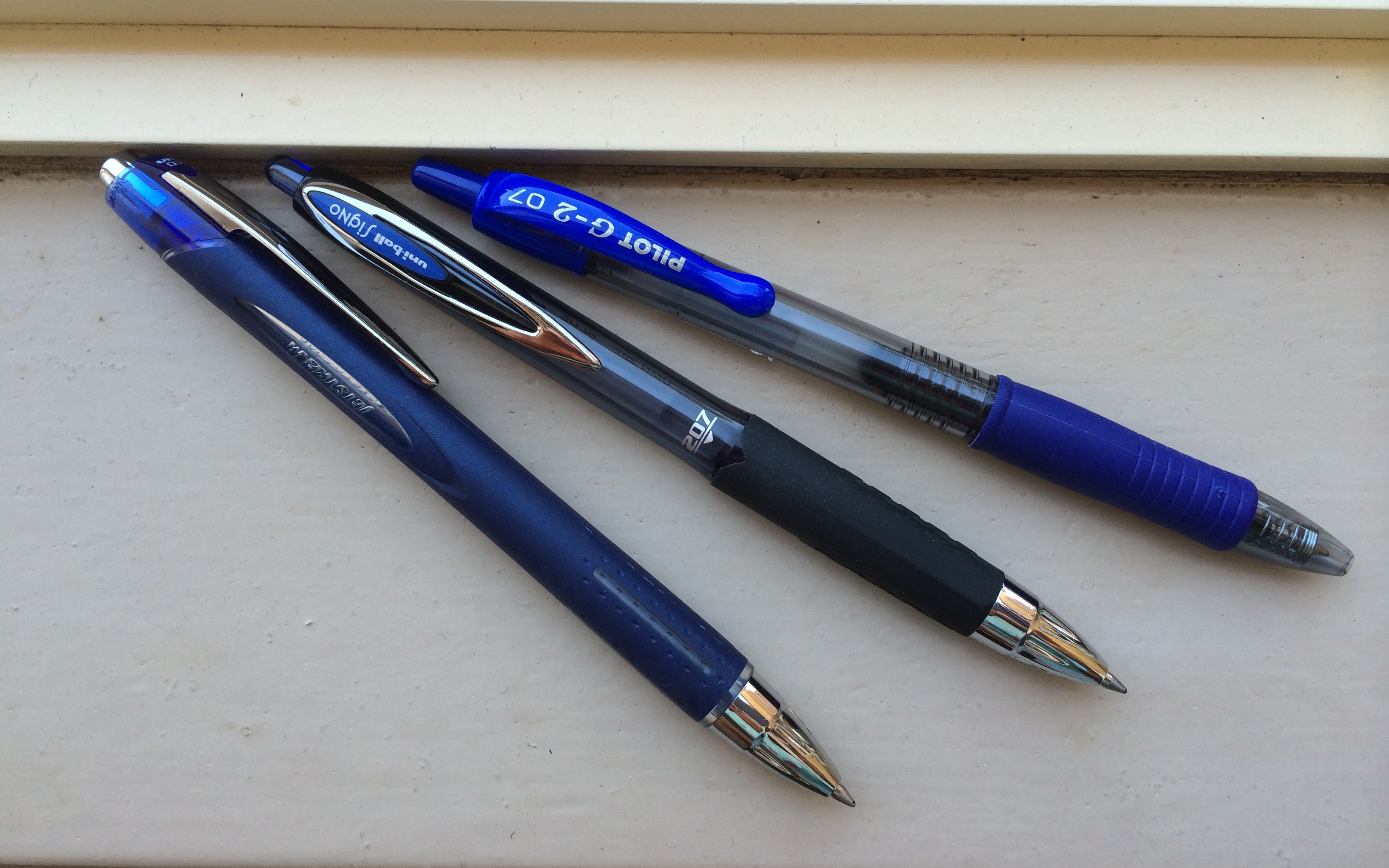
From left: Uni-ball Jetstream, Uni-ball Signo 207, Pilot G-2

From left: Uni-ball Jetstream, Uni-ball Signo 207, Pilot G-2

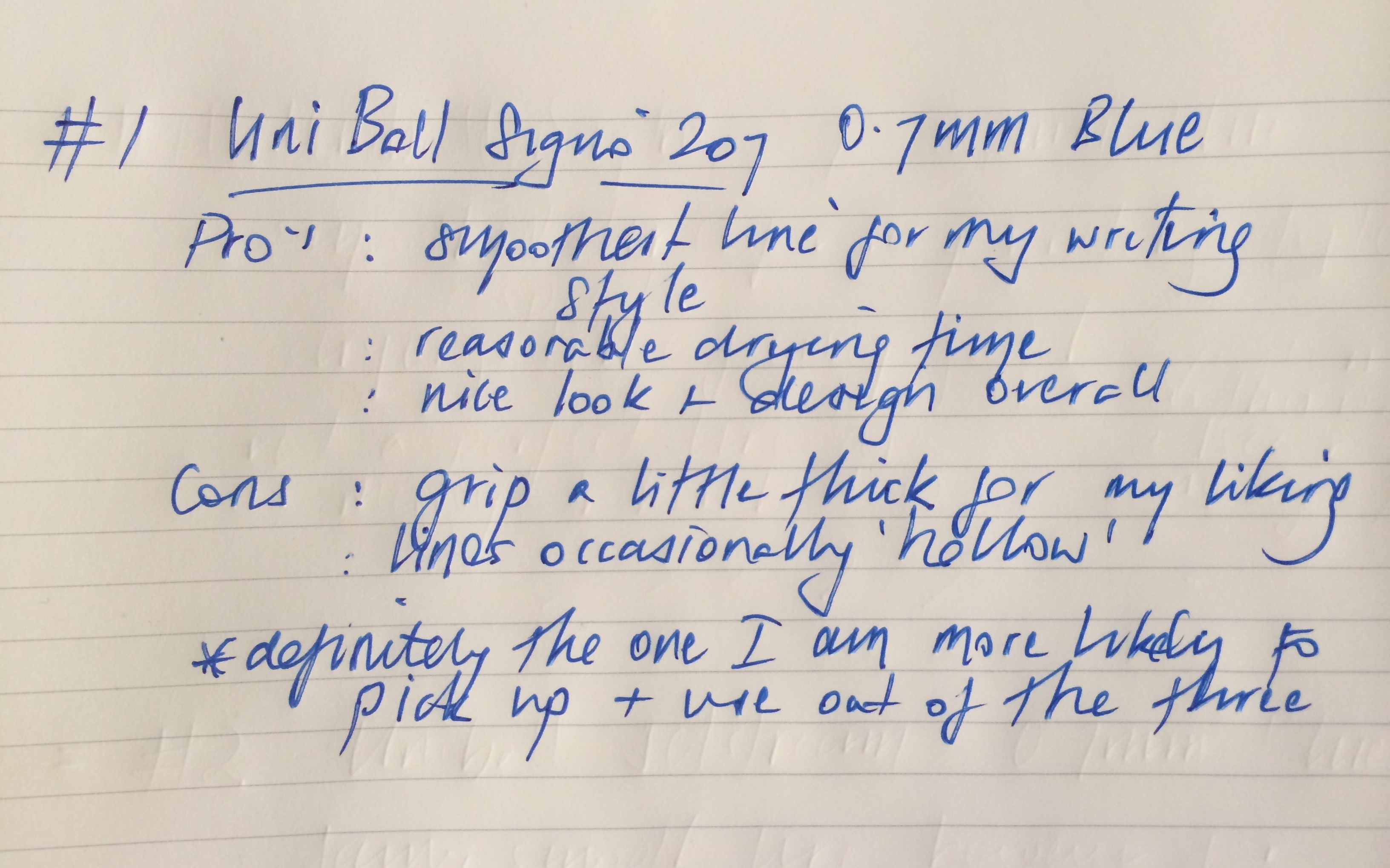
For a reasonable comparison, I picked up a blue rollerball ink 0.7mm Jetstream and a couple of other retractable gel-ink pens, the Pilot G–2, and Uni-ball Signo 207, spending a few weeks rotating between each. The conclusion? I prefer the Signo 207 over both the G–2 and the Jetstream – for very different reasons. So is the Jetstream really the best pen? The answer is probably yes as a recommendation for others – just not for myself.

My Use Case

A little background on my use first. This varies greatly depending upon what any particular day brings. The office I work in utilises a “paperless” approach, in that much of what I hand write is an initial or signature on the few pieces of paper which are produced and come across my desk to sign. Longer form writing occurs with meetings and telephone calls, for I am not capable of typing quickly enough to capture the necessary information electronically for either.

The paper? This varies between your standard copy paper for any printed documents (initialed or signed); a cheap office supply spiral bound A4 ruled notebook (telephone calls and general scratchpad); an extra-large ruled Moleskine Cahier (idea or ‘spark’ journal); a Moleskine Large Squared Softcover notebook (meetings); and finally, a Field Notes notebook – currently the Night Sky Edition (for random thoughts or anything else).

Pen Choices

As with most of us, my choice of pen is based on numerous factors. The look (overall aesthetics, design, colour) of the pen; the functional fit and feel in my hand (overall weight, distribution, thickness and length); the performance (ink flow, smoothness, skipping, boldness of line, feathering, bleeding etc); suitability for the variety of paper types I typically use in a day; and whether or not I look forward to using the pen – does it make me want to pick it up when I have something to write.

Listing the criteria above is a curious endeavour. Do I have a list of check boxes for each of the above in determining whether or not I like a particular pen? Not at all. For someone who is a little obsessed about what they write with, you would think this would be the case, however it is probably only when writing about what I write with that the delineation of these characteristics becomes more relevant.

Overall it is a fairly simple process:
– That’s a good-looking pen;
– It does or doesn’t feel right;
– It does or doesn’t write well, and has or hasn’t bled, feathered or smudged;
– Has it sufficiently dried by the time I need to turn the page

The Outcome

After already letting the cat out of the bag above, you know the Jetstream doesn’t come up trumps for me.

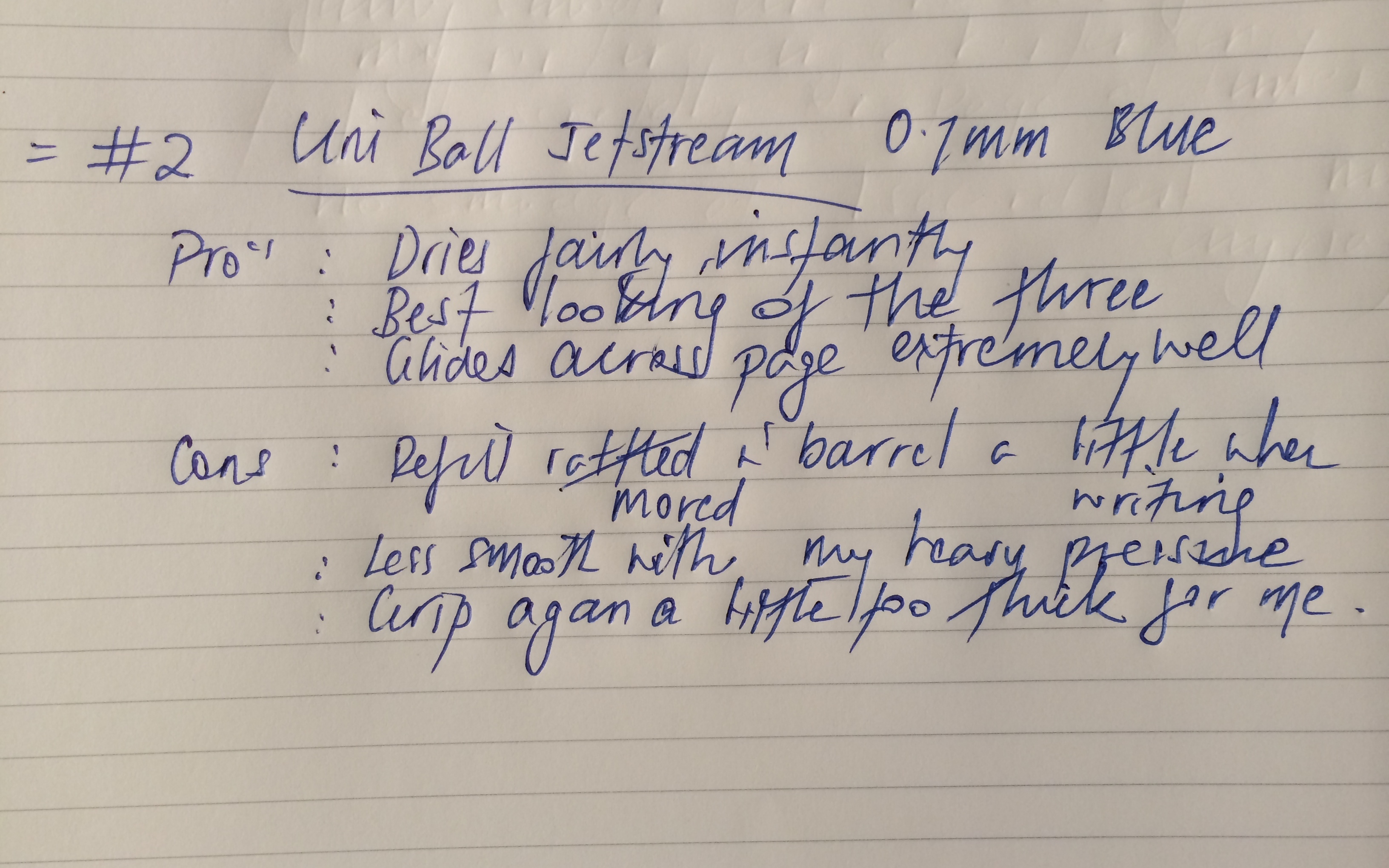
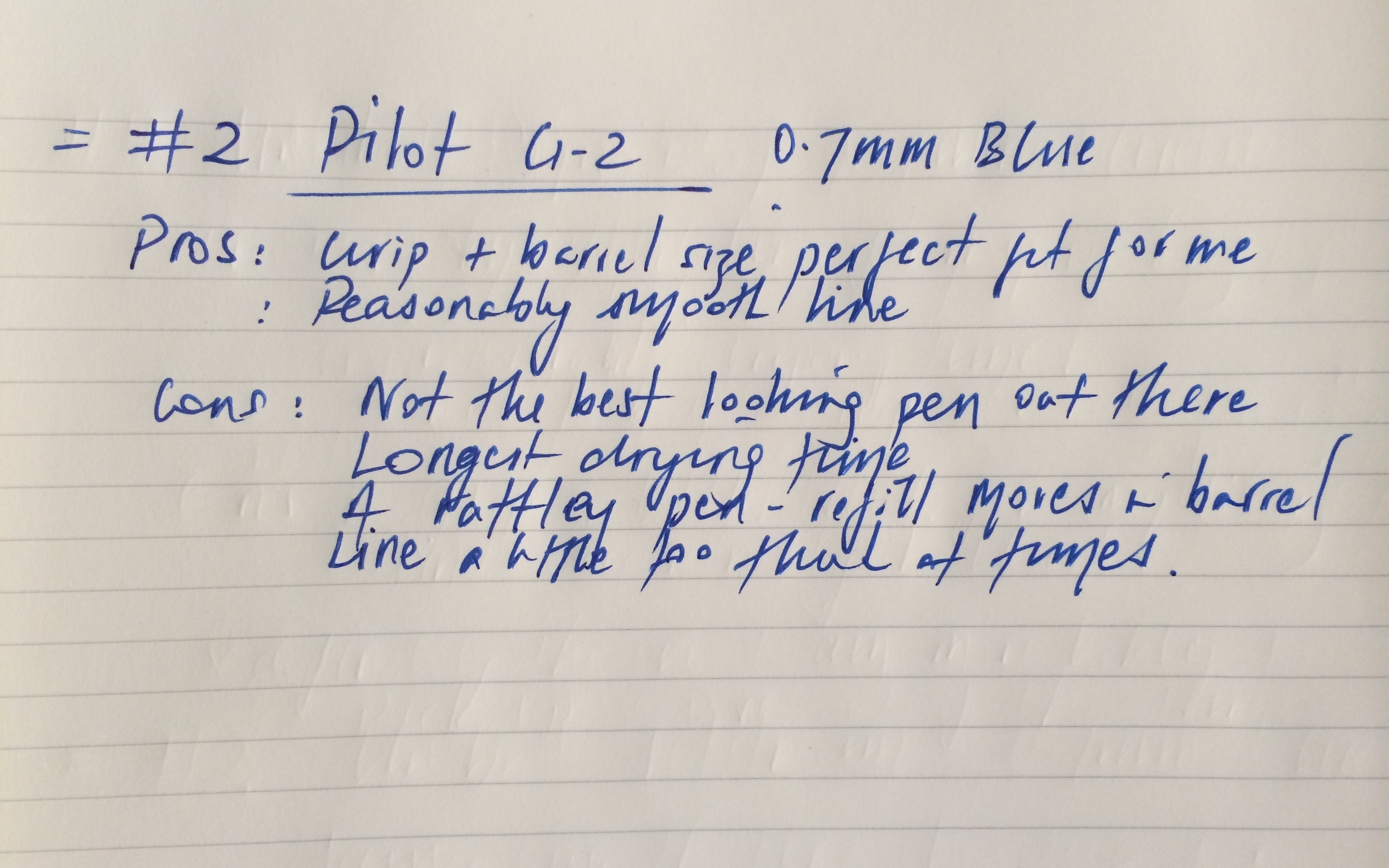
As far as looks go, firstly, I find the G–2 to be a pretty ugly pen, whereas both the Jetstream and Signo 207 are quite well designed, with the Jetstream probably looking a little more “premium” overall. In considering the feeling in my hand, here the G–2 does win out. I have always preferred a slight taper where my index finger sits on the grip section of the barrel. Both the Jetstream and the Signo 207 have no taper and the Jetstream appears to have a slight increase in thickness nearing the lower end of the grip (as an aside – is that an un-taper, de-taper or even an a-taper? – anyway, it gets ever so slightly thicker). So the winner here is the G–2.

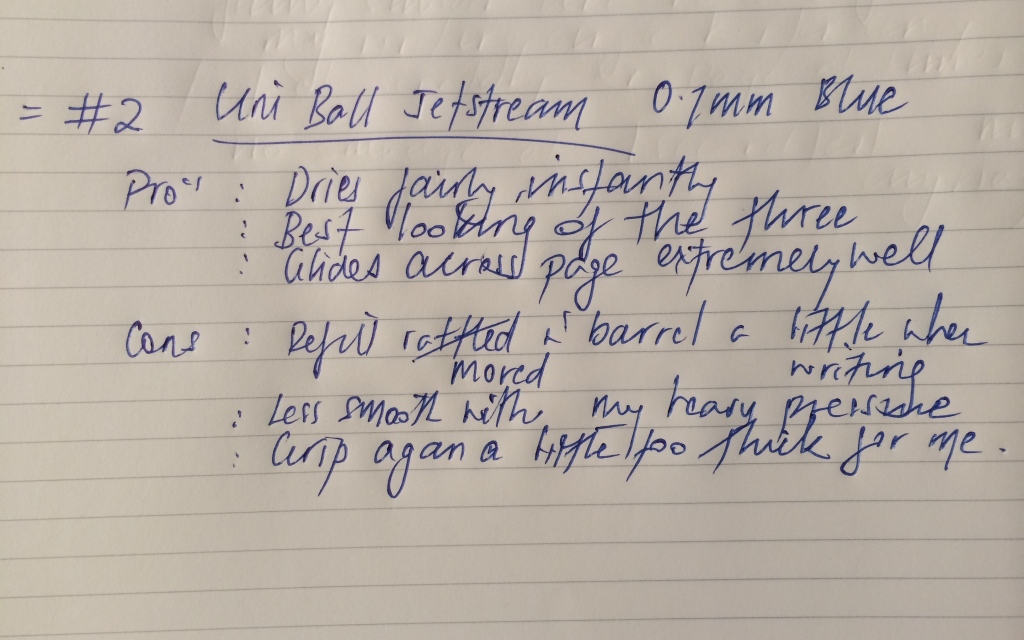
One other issue I found with both the G–2 and Jetstream was the refill moved around in the barrel a little at the tip – something which constantly annoys me about a pen when it occurs. As for the writing, I will let the images from my Moleksine Cahier do the talking here:

IMG_4383

IMG_4384

IMG_4385 copy

Conclusion

Although I have compared three different pens over the course of the past two weeks and collected my thoughts as indicated above, personally, I don’t really think there is a clear winner. I can certainly see (and mostly agree with) where the conclusions drawn in The Wirecutter article are derived, and for most I think the Jetstream would be a fine pen. I would also have no problem recommending the Signo 207 if asked (though I rarely am). The only one of the group I would not recommend is the G–2 – not for long form writing anyway.

To summarise why, firstly, apart from the shape of the pen which suits my hand and writing style, there are not too many redeeming features I see in the G–2. The Signo 207 and Jetstream are fairly close, however I cannot write for any length of time with the Jetstream, which I believe relates more to my style of writing then the pen itself. I tend to press heavily when writing and use quite an angled pen position, so without a fairly heavy ink flow, things feel pretty scratchy pretty quickly. In thinking back, this is no doubt why I have always used rollerball and gel ink type pens, along with the fountain pen I wrote about in a previous post.

This combination of writing style and the Jetstream do not quite mesh, and it often felt as though it was too much effort to push the pen across the page. Notably, this improved markedly with better quality paper and lighter pressure, though the paper I use is not always of this quality, and that is not the way I write. The Jetstream also produced a much finer line than the other two, so it could be suggested the 1.0mm may be a better fit, however I recall using one a little while ago and finding the same issue.

On most occasions when the three pens were available in front of me, the default selection was the Signo 207 – it was the one I wanted to pick up, and hence was the winner in this comparison. There is always one caveat to reviews or comparisons such as these, and that is to remember this is my perspective, based on my writing style and use case – yours may be very different.

My advice? Pick up a couple for yourself and give them a run (I’d go with the Signo 207 and the Jetstream in varying sizes). It certainly won’t break the bank, and you may find yourself with the best pen – for you anyway.

Me? I am still on the journey to find mine, although in the mean time I will revert back to my trusty Retro 51 Stealth Tornado and Kaweco Sport.