Cafes, Bloggers and Reviews

Whether or not you agree with ratings and crowd sourced or blogger reviews, there is no denying their influence. Enough to make or break a business? Maybe, maybe not, though in an increasingly connected world, where we are all constantly encouraged to “rate” our purchases or experiences, a large amount of data is available for those who wish to look.

Reviews, Ratings and Blogs

Often being on the lookout for quality coffee, one site and app I often consult is Beanhunter, which was created to fulfill this exact need.

James Crawford, Co-founder of Beanhunter in Beanscene magazine:

Beanhunter is about engaging coffee enthusiasts with great coffee shops. It’s a platform for people to know where great coffee is located and expose coffee shops, that’s why it started.

Which then brings us to blogs. Yes, point taken – look at the blogger judging the bloggers! From the same article:

If Catherine has a “mediocre experience”, she says she won’t hesitate to share it with her followers. “Why should I not write about it just because it’s negative? I think of it as a warning to others to keep in mind what they can expect to happen, whether it be bad food or bad service,” she says. “I guess [reviews] do have the potential to hurt a business, but if there are so many negative reviews about a particular venue, then they must be doing something wrong.

Fair enough, however why should I “expect” a negative experience to happen? Or will I simply not go at all, relying on someone else’s opinion (who I know nothing about) that a particular place of business is not worthy of even a second look or the benefit of the doubt. That perhaps they were visited on a day when the senior barista was away at a competition, the boss was off with the flu, and the remaining staff were doing everything in their power just to keep the doors open.

So, much-needed guidance or more confusion? That is for readers to decide, however many a blog with a strong following and sound reader engagement will wield a good deal of influence on consumer behaviour. The downside? In all of the writer and reader interaction, the one left out in the cold is often the proprietor of the establishment being critiqued. The scenario mentioned above? Perhaps enough to warrant a low star review and scathing few words, when a simple word to staff or management may have resolved any particular issue with product or service on the day.

Sometimes it’s a little too easy to judge, and judge in front of a large audience at that.

On a blog or well patronised crowd sourced review site, the particular review in question may sit at the top of the posts for a little or a long time, allowing a great many potential customers to view it. Will they necessarily realise this is an aberration in the generally stellar performance of a particular establishment. Maybe, maybe not. Such a scenario may be where the numbers and the average review rating saves the day.

Of course let’s not forget there are those cases with consistently poor service of an inferior product, which is another matter entirely, and neither numbers nor words will save you here.

Penny Wolff, of Brisbane’s Dandelion and Driftwood on reviews:

“This form of communication can be detrimental because business owners can’t control people’s opinions. In most cases, they don’t have the opportunity to rectify the issue or respond to the review and that’s just frustrating for the business owner.”

Even if the business owner reaches out to the person who was supposedly wronged with an explanation and attempted clarification of a situation (as was the case on Twitter recently by a very well-respected establishment on the Brisbane coffee scene), it can be met with a meaningless response “ok thanks, I’ll be sure to mention that to your competition down the road”.

One expert or a hundred reviewers

At the end of the day, isn’t it all about personal opinion anyway? And if so, should we trust one expert reviewer (however that may be defined) or listen to the collective voice of hundreds of our peers? In many ways this is indeed a double-edged sword, and perhaps the answer lies in whether consumers really understand what they are going to get for their hard-earned cash.

Beyond the fact that the collective voice of our peers can be tainted by personal prejudice which sometimes descends into unruly nonsense, we also must acknowledge we have different levels of experience, tastes and preferences.

Perhaps this is where a specialised review site such as Beanhunter has an advantage over more generalised sites, in being a little more limited to those specifically seeking out a positive coffee experience rather than stretching across the entire restaurant, cafe and bar scene. On the other side of the coin, does this then skew ratings towards the specialist end of the cafe scene? I don’t necessarily think so, as even within a defined review ecosystem such as Beanhunter, tastes and experience do cross a reasonably sized spectrum.

The point here? There will always be differences in knowledge, experience, and preferences of groups at either end of the expert-novice spectrum, as this article on beer tasting from Business Insider demonstrates.

It’s your opinion not mine

The final word? Make up your own mind, because at the end of the day, surely the benefit of the doubt should go to those who have just done their best to serve you, with the resources they have, on the particular day you visit.

Wiser Web Wednesday

Welcome to the first Wiser Web Wednesday (www), a weekly post with links to articles or blog posts from around the web I have found either interesting, beneficial or both. Why run a link post each week?

Firstly, I find these types of posts on other sites I follow extremely useful to broaden my knowledge and awareness of information on the web. Secondly, many links I collect either don’t make it into posts, or due to time constraints, planned posts may never be written, with the links archived in Pinboard rather than shared in a longer form post.

In summary, I’d simply like to share a little more of what interests me with you. Away we go.

Overthought.org
Great advice to follow that appears to have helped many a battery drained iPhone user:
The Ultimate Guide to Solving iOS Battery Drain

Out of interest, author Scotty Loveless’ follow up article on just how popular the battery drain article became:
Overwhelmed

Asian Efficiency
As I do 90% of my writing on an iPad mini, another view on going iPad only from Thanh at Asian Efficiency:
Going iPad Only: How to do it with the right apps and accessories

A Fool With a Pen
A review of a pen currently on my shopping list:
A Clear Winner: A review of the TWSBI Diamond 580

The Pen Addict
Jeff Abbott’s review of a notebook I have been meaning to get my hands on and try for some time now:
Leuchtturm 1917 Soft Cover Notebook Review

Field Notes Brand
With two packs of the Shelterwood Edition of these pocket notebooks ordered and on their way, I will write about my impressions once they arrive. In the meantime, watch this fantastic video on how the covers made of real American cherry wood are manufactured:
The Shelterwood Edition for Spring 2014

The Erasable Podcast
Just on 4 episodes old, now is your chance to get in at the beginning and see where this promising show goes. What do you mean a podcast about pencils seems strange? Go on, start:
Episode 1 – The Erasable Podcast.

Also worth a look are the individual sites of the three co-hosts:
– Tim Wasem: The Writing Arsenal
– Johnny Gamber: Pencil Revolution
– Andy Welfle: Woodclinched

Brew on Flipboard
For a varied collection of coffee related articles, I am always happy to share my own Flipboard magazine:
Brew by petedenison

I hope you get something out of the above www links – until next week!

My Aeropress Recipe – 2014 Update

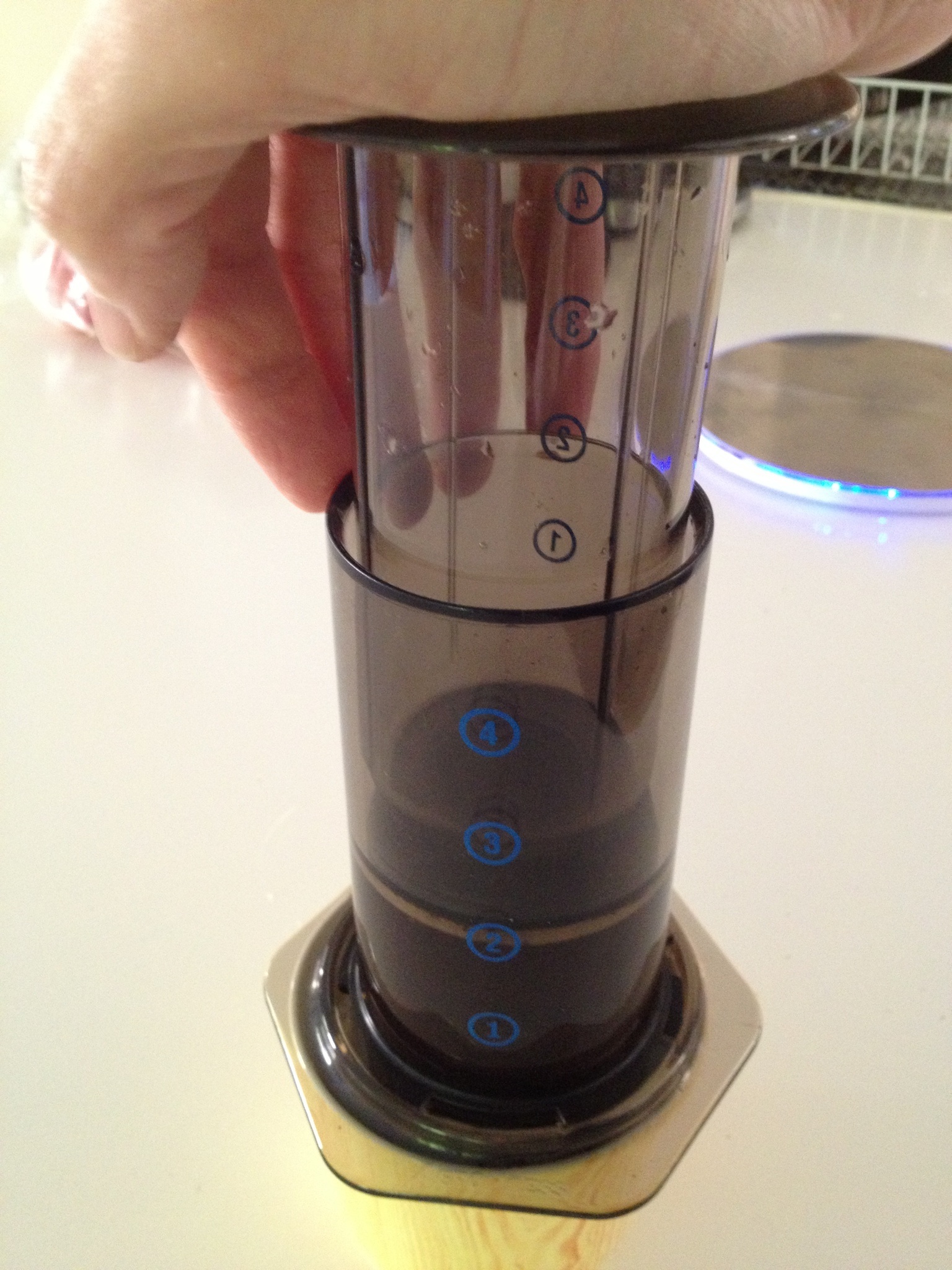
Aeropress plungeWhile writing a recent post on coffee pod machines, I looked back on my original Aeropress recipe and brewing method in use at the time. Now almost a year ago, I think it’s time to write an update of the recipe and method I am now using, given it is quite different to the original.

Although many readers will be well aware of the Aeropress as a brewing method, for those that aren’t, the Aeropress is a total immersion brewing system, which forces water through ground coffee by a large syringe like plunge mechanism, which pushes a pocket of air, forcing water through the coffee grounds at pressure.

According to the manufacturer Aerobie (yes the same company which invented the flying disc), the benefits of the Aeropress include:

Total immersion of the grounds in the water
results in rapid yet robust extraction of flavor.

Total immersion permits extraction at
a moderate temperature, resulting in a smoother brew.

Air pressure shortens filtering time to 20
seconds. This avoids the bitterness of long
processes such as drip brewing.

Why the Aeropress?

Although the Hario V60 pourover is probably my favourite form of filter brewing, the Aeropress has been a great method to use in the office due to its ease of use, minimal clean up, and being a little sturdier than the glass french press chambers I have chipped or completely broken on occasion. In terms of clean up, the Aeropress beats the french press hands down, with the spent coffee “puck” ejected straight into the bin, and a quick rinse of the filter cap, chamber and plunger completing the process.

As for the resulting brew made by the Aeropress, I have always found this to be smooth and well-balanced. Probably not quite as crisp and bright as the V60, but very enjoyable none the less. Although the recipe below uses the standard paper filter (of which 350 are included with the purchase of an Aeropress), using a metal filter disc allows more oils and some fines from the ground into the brew, providing a fuller bodied cup if that is your preference. Whilst negating the need for paper filters and more convenient for travel, the disc then becomes another item in the post brew cleaning process.

Overall, I see the Aeropress continuing to be a mainstay in my brewing repertoire for some time to come.

My Aeropress Brew Method

As I have already mentioned, the recipe below is certainly different (and more enjoyable) than the one I was using 12 months ago. The reason for the change? In part due to always working towards a better brew, however mainly due to attending an outstanding brew class at the Cup Specialty Coffee roastery here in Brisbane. The following recipe works well for me both in terms of the resulting brew, as well as overall convenience, and has a total time of about 1 minute and 15 seconds:

  • 12–14g coffee (med-fine grind; on the finer side)
  • 200g water (full chamber)
  • pre-heat chamber and cup; place filter paper in cap and rinse
  • assemble plunger slightly into chamber; invert
  • add ground coffee into chamber
  • add shot of chilled water^, then a little hot and rest 10–20 secs to bloom
  • fill remaining chamber with boiling water (swirling as fill)
  • screw on cap with filter paper
  • apply gently downward pressure to chamber to squeeze out air through cap
  • flip Aeropress onto cup
  • at 45 seconds, commence a 30 second press time (1 min 15 sec total brew time)
  • enjoy your coffee after minimal clean-up

^ As I am limited to the “always boiling” hot water urn in the office rather than a kettle, the shot of chilled, filtered water cools the overall brew a little and avoids dumping boiling water directly onto the ground coffee.

Aeropress fullAeropress cap

Conclusion

Aeropress cupSo, there you have it. My updated Aeropress brewing recipe. I’ll be sure to post an update again in another year or so should this change significantly. I’d encourage you to seriously consider this form of brewing both for variety and convenience, if it sounds like something that may suit your needs (and taste).

As always, there are many resources floating around on the web as far as recipes and techniques are concerned. Here are a couple to get you started, although a quick Google search will lead to many more:

Speaking of Aeropress championships, I am looking forward to getting along and watching the QLD rounds at Strauss in Brisbane in a few weeks time. Wait…no…am I going to have to change my recipe again?

Coffee Pods, the environment, and fiddling

Black HarioFlipping away through my cover stories in Flipboard recently, I came across an article which appeared on Quartz, titled Empire of the Pods: The world’s growing love affair with the most wasteful form of coffee there is.

It comes as no surprise the article lays a pile of landfill squarely at the feet of the “coffee pod” industry, for it’s wasteful cast off miniature plastic cups (commonly known as K-cups, after the Keurig company which popularised this form of brewing in the US) expelled from such machines all for the sake of one cup of coffee. Although not a new sentiment, the article goes on to note the staggering rise in popularity of the single use pod machines around the world, concluding with the following from Murray Carpenter’s book Caffeinated:

… the K-cups discarded in 2011 would have encircled the globe more than six times, and in 2013, more than 10 times

Then, not long after, an article with a similar sentiment and an interesting twist from the Coffee Contrarian, Kevin Knox, including this:

More than one green coffee importer (don’t worry, you shall remain nameless) privately refers to Green Mountain Coffee (now renamed Keurig Green Mountain) as “Greenwash Mountain,” and that’s certainly a succinct and accurate description of the company’s long-standing marketing strategy, using its sizable Fair Trade and organic volume to deflect attention from its actual main business: selling commercial coffee, much of it artificially flavored, in ecologically disastrous K Cups, to convenience stores and the like.

Knox also makes reference to this article on the topic from Mother Jones.

Grounds for outrage? Perhaps, however climbing up and looking over the large pile of cast off pods, why the increase around the world?

Image courtesy Mother Jones

Image: Mother Jones

Consumer demand, convenience and willingness (or lack thereof) to hone their coffee making skills beyond pod in-brew-pod out. A judgement on those using such machines? Absolutely not. For every article lamenting the environmental negatives of pod machines, there are 20 extolling the virtues of the specialty coffee scene, the third wave explosion, the palate development and demands of the consumer. The discerning consumers mantra: “We know good coffee, we know where to get it, and we’ll let you know if you’re not up to scratch”. What else will we as consumers do? Seek out a “cafe level” coffee experience at home with everything from – “wait…what? That is a lot of clean up, I’ll just get a pod machine and be done with it”.

AeropressIncidentally, there are four people within arms reach of me at the office who use Nespresso pod machines, and a family member uses a slightly cheaper clone – without question the popularity of these machines has definitely risen, and will continue to do so given the (large) segment of the home coffee market they cater for.

Seen by family, friends and co-workers as a bit of a coffee nerd, I am often asked about my thoughts on whether pod machines are a worthwhile purchase, with the expectation I will frown on such machines. My answer is usually along the lines of: they are great due to their simplicity – if you want a machine that will make the coffee for you and involve minimal preparation and clean up. Not everyone wants to grind and then brew (whether through a machine or manually) their own coffee, and frankly most don’t. One of the simplest forms of brewing I use at the office is my Aeropress, which often attracts comments in the order of “gee that looks complicated”. In reality, a plastic tube, a piece of paper, coffee and water – to me so simple. To others, a whole lot of messing around.

Such practices are summed up by Marco Arment in a great post which provides some perspective on the obsession with pod machines:

We’re the ones who obsess over every little detail of brewing technique as if they matter much more than they really do, making good coffee ever more alienating and confusing to casual coffee drinkers who don’t have time to study and fuss over it as much as we do.

The post goes on to list many ways these obsessive brewing techniques may also impact the environment in certain ways, not to mention the added time taken to brew with such methods.

In addition, the comments in the article linked to above on the Coffee Contrarian are worth reading, which include a dig at independent roasters, possibly those who have the most to gain from an environmentally based rebellion against the Nestlé and Green Mountain behemoths:

Passionate small roasters would like to believe that being smaller scale makes for higher quality, but all it really guarantees is higher overhead, higher green coffee costs and other structural inefficiencies that the consumer ultimately pays for.

Interesting times ahead no doubt.

My thoughts personally? The environmental impact should always be a consideration in whatever we do, however I can’t help but think those who judge these pod machines from a supposed position of “superiority” regarding quality may be missing the point. Do I personally think the coffee I make is superior to that emanating from the spout of a machine after water has run through grounds in a plastic pod? Yes I do.

The reason I think this? Well, for one, the amount of time I spend selecting green beans, personally roasting, resting and correctly storing them. Brewing through many different methods (many of which are a little fiddly) at just the right time to maximise freshness and ensure the flavours are at their peak. When visiting coffee shops and cafés, I seek out those with good reputations amongst the coffee industry, perhaps embracing the so-called “third wave” brewing techniques and approaches. Does all of this make me biased? Absolutely, which is where perhaps knowing the effort I put into these factors makes me believe this must be better – right.

And whilst I do not believe the following to be true – What if it isn’t better? What if it is all in my head and I simply want it to be better, so my already biased beliefs make it taste better? After all, what do both the pod user and myself end up with? A cup of coffee – and I bet the pod user was enjoying theirs long before I had finished making mine.


Dept4 – Yesterday and Tomorrow

Over the past few weeks I have been looking back on posts I’ve written on since commencing dept4 in May 2013, and more specifically, thinking about what I plan to spend my time writing about moving forward.

Reflection

For the most part, I have written about coffee, my favourite technology, and miscellaneous pieces about various things on my mind at any given time. A couple of posts hint at a slight obsession with pens, and this is an area certainly in need of more attention. I had initially planned to write more on productivity, workflows and self-improvement – however the productivity and workflow topics remind me a little too much of my office job. Perhaps that makes me well qualified to write on such matters, however to be honest, they are topics I feel least like writing about in my spare time. Self improvement? Perhaps that lies somewhere in between.

Granted, many of my posts touching on technology do indeed have some crossover into the productivity and workflows realm, however most of these have a personal productivity bent, rather than a specific office based one.

Future Plans

IMG_1922As I mentioned above, an area that has only seen a couple of posts to date, though is an area of intense interest for me relates to pens and paper (well actually, think anything in a stationery cupboard). This has been further compounded by embarking recently onInCoWriMo, or International Correspondence Writing Month, to the tune of sending a letter a day for the entire month of February. I have written more about my InCoWriMo experience here.

In this age of Twitter and Instagram, what would possess me to hand-write a letter a day until number 28 is posted? Pen and paper, plain and simple. My decision to participate in InCoWriMo is a point reached along a journey that has come a little way, though has many more miles left to run. A journey to be punctuated (quite literally) by many combinations of fountain pens, inks, rollerballs and even ballpoints, on a varied terrain of notebooks, pads and whatever paper I can reasonably lay my hands on – this I am sure of.

I have always been interested in pens. I distinctly remember the few basic Parker Jotter and Sheaffer pens from high school. My foray into Artline 200 fineliners, and the decision as to whether the 0.4 or 0.2mm version better suited my writing style (neither by the way, we are talking teenage boy penmanship here!). Then, onto the decision of whether I preferred blue or black ink. Throughout my university days the experimentation continued, though at a slower pace, until I received my first fountain pen in 1997 as a wedding gift from my wife. Seemingly that was pretty much it, the be all and end all of pens for me – until about 18 months ago. Don’t get me wrong, there was still much experimentation going on in the sub $10 office supply store pen category, simply not much beyond that.

I’m not exactly sure what piqued my interest again, however I began doing a few internet searches one day and stumbled across some sites recommending Rhodia and Moleskine notebooks (I think through researching the GTD method of productivity, and discovering a few Moleskine pocket notebook “hacks” for analogue versions of this system). One thing led to another and I soon found Brad Dowdy’s The Pen Addict, both blog and podcast, and from there it was all over. A similar fate has befallen many who stumble across Brad and his now infamous “penabler” influence to many followers around the world.

Through listening to the podcast and a little self experimentation, I have since purchased a few pens and notebooks, and am currently researching my next mid priced fountain pen to add to my collection. My Montblanc Meisterstuck will always remain my most valuable pen, both sentimentally, and likely monetary, however I am planning on starting again from the bottom and building a more varied collection. My own “beyond the office supply store” stationery cupboard if you will.

So, what does this mean for this blog moving forward? I would say a continuation of what you have already seen on the coffee and technology fronts, and an increasing amount of pen and paper related articles as my journey continues down this road. Where will these all fit in my current post categories of Thoughts, Improvement, Coffee and Tools? That I am not sure, though some of the categories could become a little more specific, and I will be giving this some more thought as things progress.

Let’s get to it then

Although I have broken and continue to break the cardinal rule of blogging, by writing about a variety of topics rather than focusing on one, I plan to continue, simply because I do not see dept4 as solely a Coffee, Pen or Tech blog, nor do I have any immediate plans to make it such. I have a keen interest in, however am not an expert in any of these topics.

Although there will be common themes running through those areas of interest, I do enjoy the freedom of writing on pretty much anything if the mood strikes me. Who knows, perhaps these topics may become more defined and specialised, spinning off into their own blogs in the future. Whilst I am loathe to rule out anything completely, I have no plans to undertake this in the near future.

As I write this, post number 84, I am pretty happy with most of what I have published over the past 10 months or so, and believe things have come a long way from my initial plans for the site. If being a “jack of all trades and master of none” limits my readership, (which has grown beyond what I could have ever imagined anyway, for which I am eternally grateful), then you may as well start calling me Jack.