No Need to Ask – I’ll Tell You

As so often happens, the internet tends to feed you a lot of what you do not necessarily need at the time (that’s what your favourite read-it-later or bookmarking/archiving service is for). Then, some days it slaps you in the face with those “you’ve got to be kidding me — that’s what I was just thinking” moments.

This post has been written after the latter occurred last week. Two posts — each written with a different focus — yet I believe, concepts which are inextricably linked. Introversion, and that old chestnut — the corporate “brainstorming session” — yes, you may shudder at the thought. I know I do.

The writing in question:

Introvert by Iain Simpson on his personal site (shared on Twitter by Matt Gemmell)

Isaac Asimov’s Advice for Being Creative (Hint: Don’t Brainstorm) by Cal Newport, on his Study Hacks site.

Some background

I work in a corporate office. There is brainstorming. Thankfully not often, with my role as a manager providing at least some authority to dictate the frequency of such sessions.

Occasionally this is not the case, and the result would be familiar to many of you. The “brainstorming day” which is beyond my authority to avoid. The large room of 20-30 people; the introduction of why we are here and how it will work; the groupings; the breakout sessions; the ideas we will generate which will create immediate solutions to problems years in the making; the solutions no-one has thought of in the past five years. Yet we will come up with them on this very day — oh yes we will.

I think you get the picture.

As far as introversion is concerned, I would certainly say I fall somewhere towards that end of the spectrum. Iain Simpson’s opening paragraph:

I hate attention. I can’t think of anything worse than being the centre of focus in a room. Everyone looking at you, thinking about you, listening to what you say. I feel unwell just thinking about it.

I describe myself as a very private person1, so in one sense I can relate to the above — yet mainly the first three words. I am the first to admit I am not great at small talk or self promotion, and am often fairly intolerant of the office loud talker — though here I am talking on the inside — as of course, I understand we are all different.

As my working life progresses, I have become more adept at leading my team and conducting group training sessions and seminars both in-house and across the industry in which I work. I would not therefore, say I have any great problems with everyone looking at me and listening to me, and certainly don’t feel unwell thinking about it.

Would I choose a career solely as a presenter and group trainer? Absolutely not, however my role dictates that I have important, relevant and valid things to say, and I am happy to share them to a group.

If I am guilty of anything in relation to these presentations it is over-preparing, however my experience indicates I have very different views on what constitutes “over preparation” to those around me.

The eye of the storm

So, away we go. Into the room, butcher’s paper strategically placed in every corner, ready for those ideas to be scribbled illegibly for all to see (and vainly attempt to read); spoken aloud by the group representative standing in front of the easel — back half turned to their audience — often articulating their idea with:

.. err.. I’m not sure why we wrote that. That was Jim’s idea.. uh.. umm.. ah.. Jim? Do you remember what we meant by that? Actually I can’t even read the rest um.. so uh.. I’ll just keep going..

Ground. Breaking. Idea. Lost.

Of course it wasn’t — and you know how these sessions go. You hear from the same people you always hear from — repeatedly. Good for them, I have no problem with that, otherwise there would be silence and all we would see on those easels would be large blank sheets of white paper. In fact I applaud these people for continually showing up and shouting out.

My main issue lies with the fact you don’t hear from the same people you always don’t hear from. Some are disinterested perhaps, however many simply are not suited to be thrust into the limelight at a moments notice, expected to give their thoughts — on what is often a complex and broad problem — to a larger group who wait expectantly in deafening silence for a response.

What comes with the “we’re having a brainstorming session today” is of course the “I expect everyone to contribute”. Because supposedly, in that deafening moment of silence I referred to above, the past six years of a person’s employment — grinding and grafting away day in and day out, making small suggestions quietly to their manager about how things perhaps could be done a little better is not — at that moment — a contribution. Well, today it’s not my friend, unless we hear something right here, right now.

Somehow the suggestion that these ideas are not real, meaningful, or actionable unless the form part of the “Action Plan” emanating from today’s “session” is laughable, and shame on you manager if you do not at least acknowledge and listen to these “grafters” from time to time in your day-to-day operations.

Why on earth we expect the best ideas to come out of a brainstorming meeting between 3:00 and 4:00pm on Tuesday when it is scheduled — wait..what? Oh, its been rescheduled — so the best ideas to complex long-term problems will now be generated between 9:00 and 10:00am on Thursday. Of course. If you must strike gold with a great idea on Tuesday – please hold until Thursday – but as God is your witness you certainly better have one when standing at that butcher’s paper come Thursday.

This is where I like the explanation from Asimov as outlined in Newport’s article:

The goal for creative meetings is not to come up with new ideas, he argues, but instead to transfer the raw material for these ideas between participants. As Asimov explains: “No two people exactly duplicate each others’ mental stores of items.”

Once done — we just need to get back to work (Newport again):

The goal of collaboration, in other words, is to quickly increase the store of material that the creative can then work with once returned to his or her isolated cogitation.

Further, as Newport opines, chatting around tables with butchers paper or in open plan offices is not likely to generate “deep insight”.

Don’t even get me started on open plan offices.

The intersection

If you are still with me at this point, then an explanation of where these two aspects of introversion and office practices intersect is probably unnecessary. That said, a couple of things bear highlighting.

Remember, deep thinkers are not by default slow thinkers — they simply consider things in more depth; require more information to formulate an opinion; and do not necessarily like to express it prematurely. Deep thinkers who may also be introverts to varying degrees by nature — do their best work alone, quietly, and without undue attention or fuss.

As Iain Simpson puts it:

If I haven’t told you how I feel about something, it’s probably because I haven’t decided how I feel about it. I can’t make decisions without all the information, and I don’t offer solutions without understanding the problem.

When they have something meaningful to say, they will say it, and expect you to listen. Conversely – at the very least — respect their silence. They are not disinterested, but are most likely thinking.

And when they’re done thinking and have a well formulated, meaningful answer?

No need to ask. I’ll tell you.


  1. Yet I write here, for the world to see – touché reader. Small fish – very big pond.


A reviewer — or not?

I have posed the title of this post purely with reference to my own writing about pens — a genuine question as to whether I should be considered a “reviewer”. My immediate answer is no, however I realise that is perhaps incorrect.

The Oxford Dictionary definition (insert “pens” if you will):

a person who writes critical appraisals of books, plays, films, etc. for publication

For publication – I guess writing on a blog satisfies that. Where I originally thought I differed slightly is that I do not set out to “critically appraise” pens — rather, I write about the pens I own and what I like or perhaps dislike about them. The reality is though, that is probably a reasonable definition of what it is to “critically appraise”.

First though — a little background. The stimulus for posing this question (mainly to myself — albeit now aloud through this site), was a post on Fountain Pen Economics (FPE) calling on reviewers to review bad pens. Although I have had some thoughts on this numerous times before — mainly when deciding how I want to write or what my “style” should be when writing about pens — now seems a good time to put them down.

A couple of prominent pen bloggers or reviewers were mentioned in the FPE post, which coincidentally came at a time when there has been a little — shall we say — “unrest” in the pen community regarding negative YouTube/blog commenting or online “trolling” – which is absolutely appalling and should be (and thankfully often is) widely condemned.

That said, I wonder if there is ever really a time where behaviour of such a nature is not occurring to some degree. I do applaud those who push on in the face of it, and add my encouragement for them to continue doing so.

Objectively based opinion and discussion — even of the “robust” variety — I believe, is valuable for the growth and maturity of any industry, community or even small working team. Of course not everyone has to agree, but if we are all working from roughly the same set of rules and respect each other, then theoretically there will be no problems — right. Right?

I simply want to say here that I do not think there is anyone in the pen community who would disagree with the sentiment that reviewers should be honest and transparent, and as a whole, I am comfortable with the current landscape relating to this. To be fair in relation to the FPE post, it is also made clear the author believes this to be the case. Speaking in broad terms, regarding the possibility of false positive reviews for “product”, FPE notes:

Now, I’m not saying that any reviewer in the community does this at the moment, simply that the potential exists.

A reviewer?

Here is where I believe things are a little less clear. Not simply in reviewers neutrality, but in what constitutes a “reviewer” in the first place. Back to what I mentioned above — all working from the same set of rules.

Here I am very much referring to myself, however perhaps there are others who see themselves in the same light. The very site you are reading was not set up to “review” pens — nor anything else for that matter. My About page indicates I started this blog for two reasons:

to share some experiences and ideas, and to continue further down the road of personal development and knowledge acquisition

Although the page probably requires some updating, I believe the above remains accurate today. I must admit though, at times I still don’t know exactly what this blog is for to be honest, but I do enjoy writing here. Therein lies the point. I enjoy writing here, and I enjoy the things I write about — one of which is the subject of pens.

So in relation to pens, does that make me a reviewer?

I say no — but is that simply because I say I’m not? Conversely, what if I do describe myself as a pen reviewer? Back to the Oxford Definition above — do I not critically appraise my own pens in some way?

Further, is there really any meaningful distinction?

To officially be classed as a reviewer, would I need to receive products for free — specifically for the purposes of a review. Would I get to keep them, return them, hold giveaways or on-sell them? Must they be from a manufacturer or a retailer — does it matter? Is my site reliant on page views and ads, and/or affiliate links or sponsors to generate some form of income? Do these relate to the suppliers or products I am also reviewing?

If it is reliant on one or all of these factors, when do I become a fully accredited reviewer — when my monetary return from the blog reaches a certain level? If so, what is that level?

Further, at what point do I then seek out pens to review which I know I am not likely to enjoy writing with, to ensure a balance of good and bad pen reviews appear on my site? That is, at what point do my responsibilities to readers outweigh the responsibility to myself to buy the things I enjoy — and perhaps write about them along the way. Do I have an obligation to review every pen I buy?

Or – more simply, as is often the case — am I one of the large number of people on the internet who buy pens with money from their own pocket, and write about their experiences, joys and excitement associated with their hobby? Simply someone who bought their first fountain pen 18 years ago — then not another for 15 years — only to again become hooked in the past three? Who, due to this renewed interest, stumbled onto a massive online community who write and share information about these things, and felt the urge to do the same.

I’d say this is exactly what I am — however does it really stop there?

What are my responsibilities?

Do I even have a responsibility that is defined by a certain set of parameters when I write about pens? I believe I probably do.

What exactly are those responsibilities?
I probably need to understand that anyone reading what I write might be influenced in some way by my opinion. In re-reading that statement it is hard not to laugh — from the point of view of: who do I think I am that my opinion counts enough to sway someone’s purchasing choices. Therein lies the very point doesn’t it. How is any first time reader of this site to know if I have absolutely any idea what I am talking about?1 Even if I do, how are they to know whether I know enough to warrant them taking heed of any of it.

Should my about page have a pen bio:

  • Year of first fountain pen;
  • Number of pens owned;
  • Number of forums active in;
  • Pen blogs regularly read;
  • Syringe experience;
  • Nib preference;
  • Number of custom nib grinds;
  • Pen shows attended etc

Of course not (well — at least I don’t think so), but you get what I mean. So, at first glance, or perhaps coming in at a random post on my site, none of the above will necessarily be obvious to a first time reader. Nor will it — in actual fact — to long time readers necessarily.

Therefore, I need to make sure each post or opinion is well written enough (hopefully) to get my point across clearly and concisely, with good, objective reasoning — again a difficult proposition in what I find to be such a subjective topic area2. I’m a firm believer in the theory that if you give someone enough information, they can at least make their own mind up from what you have provided.

Facts and opinion — with one the basis for the other, regardless of the pen or where it came from. Beholden to no-one other than myself to write honestly about what sits in front of me.

So what on earth am I trying to say here?

When I sat down to write this post I had several key points in my mind that have somehow blurred, bleeding out like De Atramentis Permanent Blue on the cheapest recycled office notepad.

A few things to finish if I might ask for a fraction more of your time.

I wholeheartedly agree that transparency and honest reviews are a vital part of the pen community. Where I find things a little more difficult, is in suggesting fellow bloggers (particularly those who buy the products they write about) get their hands on some bad pens to review. I say this, mainly because with so many items on my wish list, I’m not about to waste a cent on something I am probably going to dislike. Again, in fairness the FPE post, I think the perspective there was perhaps related more so (I think) to items specifically received “to review” from sellers.

After all, in doing so, I would then be left with something I rated poorly, didn’t like, and would either have to accept the monetary loss or try to sell it. But to whom? “Here, this is a really bad pen — please buy it from me, and then when you hate it — see if you can then flog it to someone else”.

Let’s not even start on how you might review a pen you may not like that was given by a family member as a gift for example. To avoid offending the giver, there is every likelihood the review would either overlook some of the negatives, or perhaps not be done at all. In this particular case we are back where we started aren’t we.

In conclusion

That’s it – I’m done.

I fear that in highlighting some of the difficulties in actually coming to a definitive conclusion about all of this, I may have simply come across as being argumentative or a bit of a contrarian. This is not my intention.

To those who love writing about their pens — be they bloggers or reviewers or both — please continue. We love reading about this great hobby of ours. While you’re at it, make sure you remain transparent and objective — but you already do that, so here I’d also simply say — please continue.


  1. Of course there are the usual criteria of blog longevity, update frequency, number of ads and overall style to go by – but again – how does that make me any more knowledgable about pens?
  2. I highlight the subjectivity of pens thinking of one of my favourites, which I never would have bought if I had read a couple of reviews prior to clicking “checkout”.


Memberships: money in – value out?

Last week I signed up as a paying member to a site I regularly read.

Startling news? Hardly. It is simply something I have not done before, and all in all, the decision to do so was not as straightforward as I’d imagined.

In the end, I’m very pleased I signed up, and will now receive the member’s only newsletter (amongst other things) from Matt Gemmell, my favourite online writer/author going around.

In the context of what this post is about, the actual site in question is not important, however credit where credit is due – if you have not read any of Matt’s work, I suggest you do so, as there is wealth of frequently updated, quality content at the link above.

The following are simply my thoughts on membership in general and a few other things that were a consideration along the way.

You can read Matt’s introduction to his particular membership here.

The Cost

My online purchases, whether memberships, eBay, backing Kickstarter, or buying coffee or pens, all come from the same bucket – our household income. Irrespective of whether money is put aside for such indulgences, it is still money that could be put to very good use elsewhere.

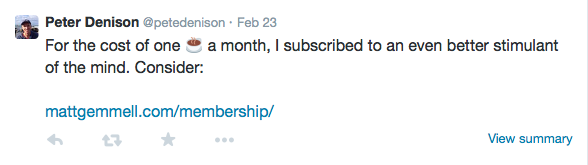
At first glance, a membership such as this seems a fairly insignificant monthly cost (as my Tweet below demonstrates), and certainly a competitive one as far as other memberships I’ve seen. However it is a cost nonetheless – and a recurring one at that.

Oh very clever Peter!

Oh very clever Peter!

A couple of points here. Living in Australia, or wherever currency exchange is involved, the actual purchase price is never the actual purchase price. For example, standard membership is $US4.00. The cost at checkout to me was $AU5.32. Not a deal breaker, however one consideration1, and again, a factor in all site memberships – not solely the one in question.

Clearly not relevant on this particular occasion, however shipping costs are a significant consideration in just about every other purchase I make online. Shipping costs at times can be a little unkind, however I am not about to shout too loudly, for after all, there are UK customs charges, and from what I hear are the embodiment of the devil incarnate.

With Kickstarter in particular, I have backed more than one project just under the first reward tier to provide my support for what I consider are worthy projects. This of course means I miss out on the actual product, however also avoid the postage – which sometimes adds almost 50% to the total cost.

Please note that none of the above is written in the context or tone of poor me – every purchase, which I’m sure is also the case with you – involves decisions. Some of these decisions simply relate to logistical factors, some of which I have described here.

The benefit

The clincher really isn’t it.

How do we determine what value we receive from laying down our hard-earned cash? I’d say this determination is relatively easy when considering a physical product which arrives on your doorstep.

Perhaps not so easy when considering “content” we consume on a daily basis – much of which is on the internet for free. Although I doubt it, perhaps there is free content out there I could access, similar in quality and topic to what I have just signed up for.

Even if that were true, I would say it is entirely missing the point.

In part, I have signed up for high quality, member’s only content through a regular newsletter.

I’d also like to think I’ve signed up and although not necessarily paid for, at least acknowledged, the high quality content I have already read – and which is freely available – on Matt’s site.

Finally, and probably most importantly, I have signed up on a promise. As a show of faith in what is to come. As a way to express (over and above any links, mentions or the like – which from myself are such a small, small drop in a very big ocean) the sentiment: “I love what you do, I believe you are great at it, keep doing it, and I’m looking forward to more”.

On balance, after reading the first newsletter and accessing the additional content which came with it – I’d say the real winner in all of this is definitely yours truly. I get to feel part of something, yet do none of the hard work. I see another side of quality workmanship, and at the same time, see a little more than what everyone else does.

But most importantly, I have more access to many things I am confident will assist my own writing to improve, and what price would I really place on that.

To finish

In summary, paid membership is of course so much more than: “What will I get for my few bucks”. To be honest, there are so many more thoughts I could throw in here, however I did not set out to write a 900 word post on why I subscribed to a particular site, and I think this is probably enough. In any event, not all would be relevant to your particular case.

Suffice to say, if you do find something which aligns with your interests, has proven longevity and quality2, paid membership is something well worth considering – provided of course it fits your particular criteria for committing your dollars.

I hope my contribution – which I feel very satisfied in making – goes a small way in assisting a great writer produce more great writing, though of course that will occur anyway.

So in that case, I’m happy to contribute to the next bottle of The Balvenie DoubleWood.

Cheers Matt – and thanks in advance.


  1. In fairness to Matt, there are options above and the below the standard $4.00 membership – down to as low as $1.00. I considered a $3.00 option, bringing my $AU price to $3.99. Somehow it just didn’t feel right – so the standard $4.00 / $5.32 it was.
  2. Again imposing my own standards here. I have been reading Matt’s work for a couple of years now, however I believe he is up to 12 continuous years updating his blog!


NaNoWriMo – two months on

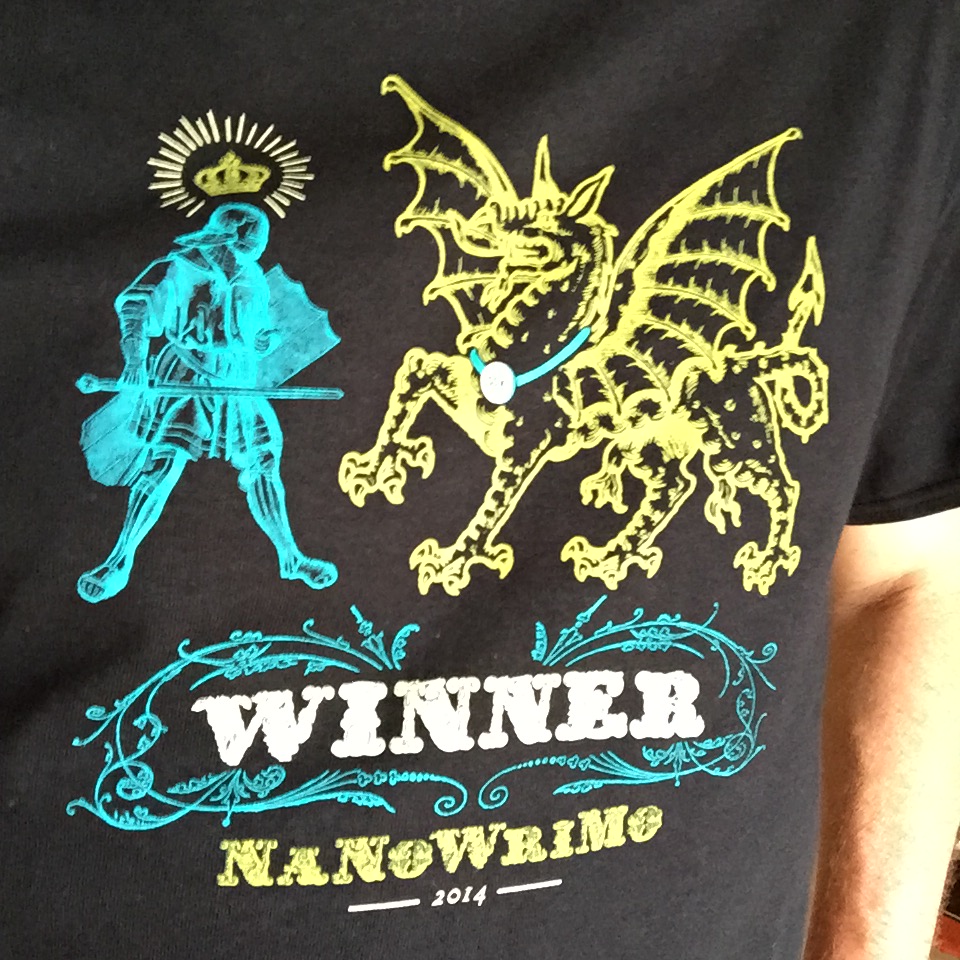
Regular readers may recall (and are perhaps a little tired of reading about), my participation in NaNoWriMo (National Novel Writing Month) last November, in which I managed to complete the goal of writing a 50,000 novel by month’s end. My continued posts on this topic are indicative of two things — one, it’s not entirely over; and two, as a prompt, my winner’s T shirt recently arrived.

The Winner's T-Shirt

The Winner’s T-Shirt

My original plan to write a follow-up post in December failed to eventuate. Simply put, I needed a break from the whole thing. So now, in the official NaNoWriMo “Now What?” months of revision, editing and publishing, it is time for me to revisit the story.

Upon taking a break, I am now looking forward to hopefully improving on the original draft. Achieving the goal of 50,00 words did not come without a few learnings and realisations along the way, some of which I thought worth sharing.

The Tools

I won’t go into any great detail here, as both the Digital and Analogue tools I used were covered in two previous posts. That said, a few other points I would add:

  • there is nothing like attempting a 50,000 word novel to become acquainted with an app you’ve not used before, and Ulysses III was a standout here;
  • a hat tip to author David Hewson (Twitter, Web), whose tips (particularly the story bible and keyword filters) from his ebook Writing a Novel With Ulysses III were invaluable in assisting my efforts;
  • although unrelated, using the Ulysses iPad app (currently in beta) for a month or so would suggest developer The Soulmen will also be on a winner for those wishing to write on iOS
  • conversely, when struggling with a scene or plot idea, more often than not, pen and paper sparked an idea to pull me through1

The Ideas – or lack thereof

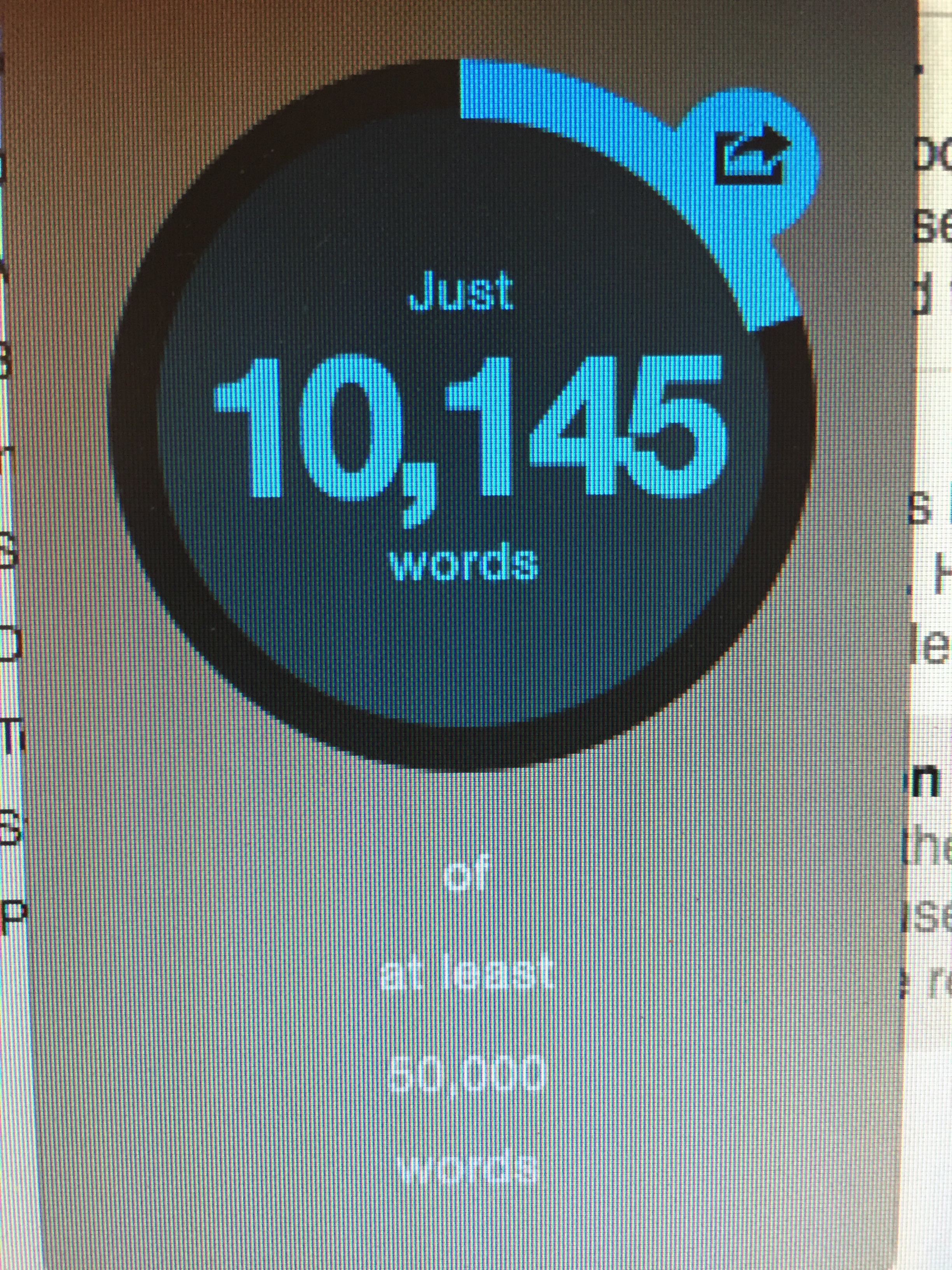
IMG_3076

A milestone

Upon starting on November 1, I had ideas. In my mind (and transferred to a mind map) was a basic plot outline and the semblance of characters. Exactly where they would take me as the story progressed was another matter entirely. There were many times I ran into an idea block, however found the following to be of assistance:

  • a written summary or debrief at the end of a writing session often generated a flurry of ideas about the next few scenes or the overall progression of the story (a what just happened generating a what will or should happen of sorts);
  • when stuck for ideas, progression was often made through either a break from writing, or brainstorming with pen and paper — the frustrating part being I never pinned down which would necessarily work on a particular day;
  • my best ideas (as always) tended to strike at random times, so a quick entry in my Field Notes or the Drafts app on my phone was essential to avoid losing them, for even a minute or two later I often had a hard time remembering that “killer” idea.

Participating in a Creative Writing Challenge

I still do not have the answer to what made me think I had enough creative ability to undertake such a project. The argument here being anybody could — the difference? Quality of the output I imagine. In my case for the past 25 years, my writing has centred around the following:

  • University papers and reports (science/medical/allied health based);
  • treatment reports and correspondence (as above);
  • file notations and forensic analysis of medical reports;
  • management, financial, and general business reporting
IMG_3140

Getting there

As you can probably guess, my career progression has followed down the list, with my current role involving the last two points on a daily basis. Nothing in the list above strikes me as being overly creative in nature, however in some respects it is all writing, and involves planning, organisation, structure, and clarity of both thought and delivery.

The chance to write more creatively was likely one of the reasons I committed to the attempt. I am certainly not of the belief I have a “killer novel” somewhere inside me. I simply enjoy writing, and hopefully have a little talent, that with some practice, research and patience, I may be able to develop further.

Some additional points on this:

  • who knew that working for my entire adult life in “non creative” writing would leave me so deficient in knowledge around punctuation, sentence structure, and many other things real writers simply know (I was actually quite appalled at the number of things incorrect or required clarification before proceeding);
  • I am currently at a loss as to where to even begin to re-learn many of these aspects from my schooling;
  • it was around the 42,000 word mark I felt I really found my creative voice, making it difficult to wrap up the story, and resulting in the finished draft coming in at 55,000 words;
  • for someone who has not attempted such a challenge before, 50,000 words (or the magical 1,667 per day) is a great length — achievable though certainly not easy;
  • deadlines are good, otherwise I would never have finished;
  • deadlines are bad, as I definitely got less sleep, less physical activity, and spent less time with my (thankfully very understanding) family members during November

People Care

Although I posted a few word count updates to Twitter, and wrote the blog posts I mentioned above, in my physical world, only my family and a very small number of friends were aware of my participation as it was underway.

Screen Shot 2015-01-24 at 6.39.54 am

That would be – relief

The support received from my family was expected — to a degree, however went above and beyond, through extensive and unwavering words of encouragement; understanding at my constant desk-bound position; the expert editorial services provided by my ex-schoolteacher mother (a constant source of advice around some of those appalling gaps in my knowledge I mentioned earlier); and general excitement at the prospect of reading the finished product.

A little unexpected was the level of enthusiasm shown by the few friends also following along as the month progressed. Requests for word count updates; the “have you written today?” queries; genuine excitement at my synopsis and various plot “leaks”; and sincere requests for a copy to read once I was done.

It would be disrespectful to those involved to say the above was a complete surprise, however the enthusiasm shown by those supporting me (both family and friends) was touching to say the least.

What Next?

Now that I have that first draft in my hand, it is time to revise and edit, taking into account feedback from those who have read the draft (and in my teenage daughter’s case, kindly made extensive margin notes — and I mean a lot!).

I am also in the process of taking advantage of the deals on offer through the winners page on the NaNoWriMo site, including a printed copy of the novel through Blurb, which is a nice bonus. Also, catching a glimpse of the online writing community was also an eye-opener, and from what I saw, it is a pretty impressive one.

Conclusion

I certainly have a reinvigorated respect for those I consider real writers. As far as I am concerned, I wrote the draft of a novel here, however most certainly do not consider myself any sort of creative writer — however one may be defined. This is perhaps something I need to think a little more about, and work a little more on, however on current form, my mind keeps returning to the following from a book review in The Guardian recently shared by Matt Gemmell (one of the real writers) on Twitter:

He is probably a nice man. He obviously cares deeply about these great historical movements and has done a great deal of research — my God, he has researched and researched and researched. But on the evidence of The Book of Kings, he could not write ‘Bum’ on a wall.

Finally, NaNoWriMo provided me with a fantastic opportunity to learn a lot about my creative talents, workflows, and how my tools work (or don’t) for me, in a deadline driven, fairly intense challenge. Learning just as much about myself in the process, I highly recommend NaNoWriMo if you even have half an inkling to undertake such a project — and perhaps you do have that killer novel inside you.

After all, it is for a great cause, and remember, although many are — you don’t even need to be a real writer.

  1. Although the benefits of using pen and paper for brainstorming ideas are well documented, I cannot help but think this very common occurrence in my writing was also due to my inexperience in producing such a large body of work (for me) in a digital format


The little black cup

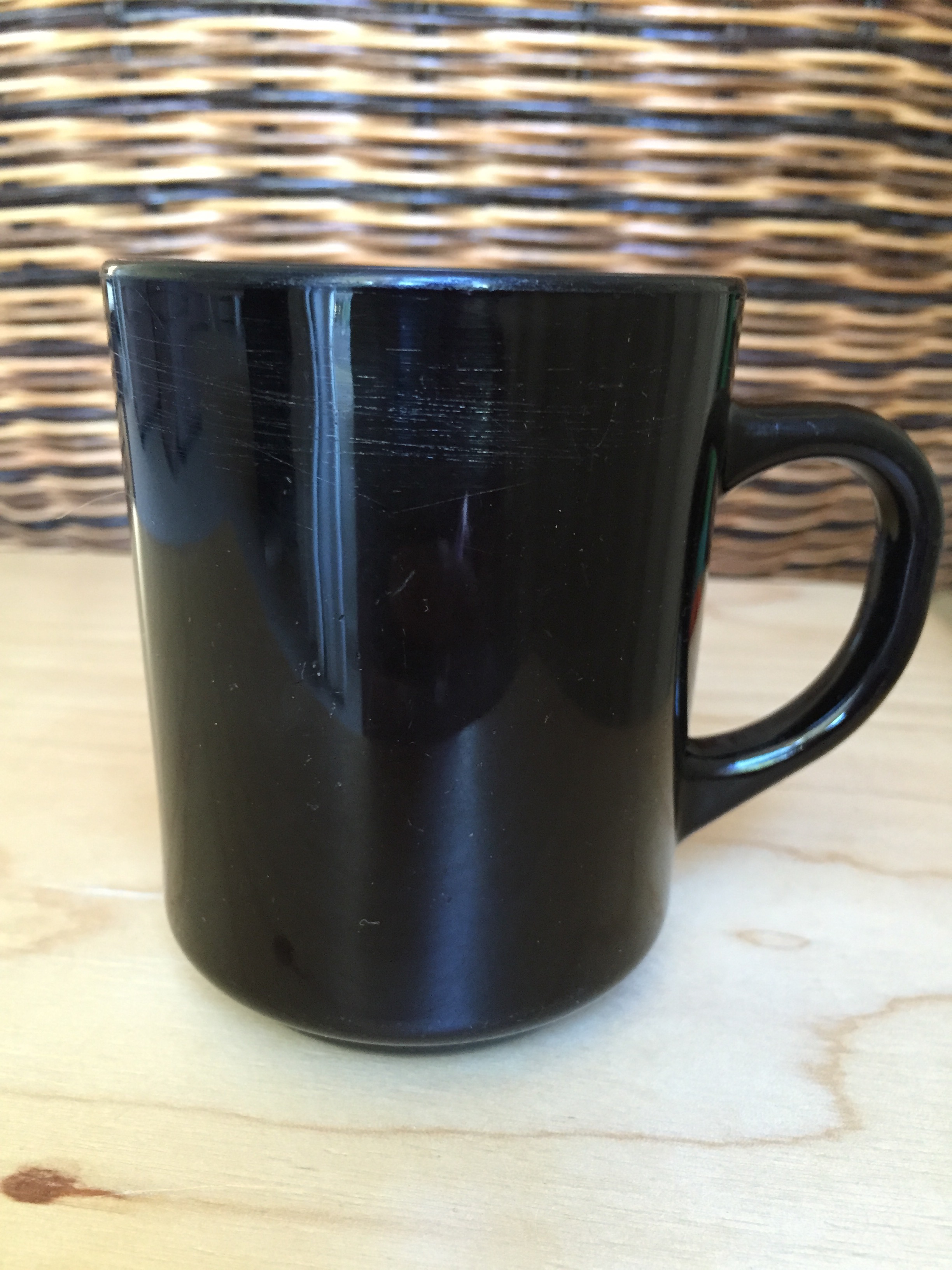
IMG_2970My niece is currently smack bang in the middle of her final exams for the NSW Higher School Certificate (HSC). Given her academic prowess to date, I expect she will do quite well.

It is now 25 years since I completed mine, and graduating in the class of 1989 from my high school. Whilst a little nostalgia is not lost on me, I am always amused by the kinds of triggers which remind of past events or stages in my life. In this case, surprisingly, it was not my niece and her exams, rather, noticing a black coffee cup residing in the back of the cupboard.

The cup you see, was given to me by my sister, with the aim of helping fuel the study sessions for my own HSC. The cup itself, meaning no disrespect to the item, nor the gift giver, is simply a plain, black, nondescript cup manufactured by Arcoroc . It is fairly small, light, and well…just black. At 8oz or 250ml in capacity, it is – 1 cup.

Although the cupboard is full of varying cups, glasses and mugs of all shapes, sizes, designs and colours – none mean as much as the black cup in question. Why so?

As you have no doubt worked out yourself, this cup is now 25 years old, and save for a few scratches is pretty much as good as the day I received it. It has been with me through my own HSC, eight years of University yielding two Degrees, and a further 17 years of employment. The cup a constant companion throughout, having only been relegated to the cupboard about 18 months ago with the purchase of my AeroPress for coffee brewing at work. Unfortunately the filter cap of the AeroPress is a little too big to fit on top of the cup, necessitating the need for a replacement.

The funny thing is, only now having realised the vintage of this cup, does it now make me a little nervous about possibly breaking it. Prior to this, it had been thrown in and out of work bags, office re-location boxes and office drawers. I do recall it also being dropped quite a few times, however it remains in one piece.

The significance of this cup now?

In many ways a reminder that where I am now is the sum of everything up to this point. Most of which I owe to those who set me on this path. Those who supported, guided, and gave me either everything I needed or the means to acquire it myself. It is not a priceless family heirloom, holding far more value to me than that.

We proceed through life not merely for ourselves, but for, and because of the “us”. The family we began with, and the families we ourselves create. The gift of this cup came at a time when I was about to leave a small town home and move to a city. A time where my day-to-day life would change substantially. To say this was an “adjustment” is probably somewhat of an understatement.

During times like those, the constants and familiarities are reassuring, and provide a little reminder of the “why”, along with that little push of support to help with the “how”, and you keep moving forward.

In these times, that little black cup is a reminder of those times, and because of those times I can now sit back and smile. “We” did it.

Upon moving out of this house, neither of my children may wish to inherit the little black cup, but what it contains will travel with them far and wide wherever they go.

To my niece, best of luck in the rest of your exams.