In Use – Nock Co. Pen Cases

The guys at Nock Co. have certainly had their work cut out fulfilling the orders of over 2000 backers since the Kickstarter funding goal was reached at the end of October last year. As a backer of the “All the Cases” level (one of each case manufactured), my order was shipped towards the end of the process, however was well worth the wait.

For a little background, Nock Co. are Brad Dowdy from The Pen Addict blog and podcast, and Jeffrey Bruckwicki. From my original post last October about the project:

Brad has teamed up with Jeffrey Bruckwicki of Old Fourth Tailoring to design and manufacture pen cases (all hand-made in the USA), and in a nice touch, we see notebook case integration into some of the designs as well. The two appear to be a great fit (pardon the tailoring pun), and have created some fantastic designs which you really should check out for yourself, as any attempt at describing the products to you in words will not do the cases justice.

After posting one final update in late October on the progress of the Kickstarter funding drive, it was a case of waiting patiently for the goods to arrive.

NockCo_LabelUpon receiving the cases (seven in total) last week, I immediately filled The Brasstown, a zippered case with a six pen internal “tongue” rollout which emerges from the centre of the case; The Maryapple, a bifold notebook case, and both Chimneytop cases (more of a traditional type pen/pencil case shape).

As far as the construction and materials are concerned, these are high quality cases, made with 1000D nylon, lined with pack cloth (unless otherwise stated) to provide a nice protective housing for those precious pens, the closures finished with YKK zippers. The design of the cases and materials used ensure each keep their shape, yet are pliable enough to be tucked into the corner of a bag or backpack with no problems.

There is no question they are built to last and to be used – not sit on a shelf or in a drawer. These are your favourite denim jeans, not a tuxedo to be kept for special occasions. This is freedom for the pens you might otherwise have to leave at home – get out and use them.

How have the cases themselves performed? Pretty well so far.

The Brasstown

Probably my favourite case of the lot. Design genius, catering for up to six pens, each within their own pocket, in an internal pen roll. There is also room for pens, pencils, spare inks, erasers etc in “general population” within the main barrel of the case. It is nice and compact when closed, however unfurls to provide a nice open display of the six pens in the rollout section. For me? This case provides both protection for any pens I would prefer not to have banging around together, however is equally useful to house whichever pens are in high rotation at the time, providing easy organisation and convenient access, ensuring I never have to dig around looking for a specific pen.

The Brasstown

The Brasstown (above and right)

NockCo_Brasstown_2

The centre roll accommodates all pen sizes, with the shorter and clipless Kaweco Sport disappearing down inside its pocket, however is easily extracted by simply sliding my thumb up the front material of the pocket and popping it out the top. All other clipped pens will simply sit securely in the pockets suspended by their clips in the usual manner. I can see this being my most used case, as it is the simplest way to carry my pens to and from work, knowing I have the six in the roll, along with any others (currently a further six disposable gel ink/rollerballs and a USB stick) in the main barrel of the case. As you can see from the image, my colour of choice was the Steel Exterior/Blue Jay interior combination.

The Maryapple

The Maryapple - interior

The Maryapple – interior

The bifold notebook case that is the Maryapple was also put to immediate use, given my usual practice of carrying two Field Notes notebooks along with the pens in my messenger style bag to and from the office. Why protect a Field Notes notebook? Are they not meant to be bruised and battered, showing the scars of heavy use, and then retired once full? Absolutely, and for myself, this will continue to be the case when carrying one in my pocket, however more often than not they are in my bag whilst commuting, and this is a great way of keeping them together.

Why two? One is used as a general catch-all for notes, ideas and numbers etc. The other is my coffee notebook, containing my roasting and tasting notes, along with any other coffee related information (blog post ideas, beans to try etc). Although my roasting is obviously all done at home, a good deal of tasting is done when out and about, or through my Aeropress brewing which occurs at the office.

The Maryapple - exterior

The Maryapple – exterior

Although two notebooks is generally my limit, this case would comfortably hold four Field Notes sized (approximately 9x13cm) books (two each side), or a couple of notebooks on one side, and a few pens in the other.

I made a similarly conservative colour choice here, going with the Midnight Exterior/Foliage Interior.

The Chimneytop(s)

The Chimneytop mini (L) and standard (R)

The Chimneytop mini (L) and standard (R)

These pop-up cases are my everything else cases, with the orange mini containing my Palomino pencil sharpener, a J. Herbin ink cartridge tin containing a selection of cartridges, and a screen cleaning cloth should my phone or iPad mini require it. I love the size of the mini, as it sits in my bag taking up essentially no room, however I can be sure of where those bits and pieces are should they be required.

The standard size Chimneytop currently houses my master store of ink cartridges, which, although sitting in my desk drawer, is a nice way of keeping them together.

Both Chimneytop cases are unlined, which to me is not a problem, for if they were to be used for pens, they would be those pens you would be happy to have all in together, and if this were acceptable, I don’t believe the lack of lining would be a concern.

Conclusion

Whichever way you look at them, Nock Co. cases are high quality, highly functional products that fit a specific niche in the market perfectly. I have often looked at other pen cases, however never really found anything to suit. More rigid leather pen holders seemed a little over the top, whereas the Nock Co. products provide a level of protection and functionality that I believe are unsurpassed, and they look pretty good too (though I acknowledge opinion on the aesthetics of such products is a highly subjective matter).

I am certainly spoiled for choice, having received one of each case manufactured, and believe me, they will all be put to good use. The remaining cases? Most likely to be filled as my pen collection grows, and of course backing the All Cases level was simply an investment in the future scale of both my pens and their cases – very wise!

I’d highly recommend considering these cases if you or your pen collection desire (or need) them. With the Nock Co. online store yet to open (sign up to be notified when that occurs here), there will be a short wait, however as I can attest – it will be worth it, and your pens will thank you.


Pilot Kakuno Fountain Pen – Impressions

Kakuno SmileyI like to think I set an example and guide my children’s behaviour rather than imposing my will upon them. So, when presenting my son with a Pilot Kaküno fountain pen on his 11th birthday recently, I’d hoped he would be pleasantly surprised rather than think “here we go with more of dad’s pen obsession again”. Thus, with a desire to check out a Pilot (F) nib, what better excuse… um…I mean – with my son’s best interests at heart, I decided to buy the Kaküno.

The pen was purchased on eBay, as finding a stockist in my home town of Brisbane proved fruitless, as did searching the Australian on-line stationery stores (if anyone has had more success I would appreciate hearing about it). In considering the cost ($16.50 rrp) along with P&H, the price was more than reasonable for a pen of this quality. Included in the box were the pen, and a standard Pilot blue ink cartridge. There is also the option of using a Con–50 converter in future for bottled inks.

According to Jet Pens:

…Pilot designed the Kaküno pen, a simple fountain pen that is great for beginners. Thanks to its many features that help ease beginners into the world of fountain pens, kids and adults can experience the joy of writing with these delightful instruments. “Kaküno” means “to write” in Japanese and that’s just what this pen helps you do!

Look and Feel

The design of this pen is spot on in my opinion. A concern was whether my son would like the overall look, colour and shape, however I need not have worried, as he loves it. The pen is constructed of plastic, with a steel nib, and has a hexagonal barrel, clipless contoured cap (with a small ridge at one edge), and a grip area guiding the user toward a preferred hand position. Although the grip section is also hexagonal, alternate sides are longer, creating a more triangular and smoother edged shape overall. I found this approach to grip shaping more subtle and therefore more comfortable than the Lamy ABC grip.

The entire range has a grey barrel, with colour introduced through variations in the cap, with lime green, pink, red, blue, orange and grey available. As you can see from the accompanying images, we chose the blue cap. The nib? Well it has a smily face etched on doesn’t it – a fantastic feature for the target market which also provides a hint as to the correct nib alignment for writing. A great feature which in no way dominates the pen itself – more a sneaky nod and wink to the user.

The size and weight are perfect for both smaller or average sized hands, and can be used equally well by an adult or child, which I see as an advantage over the Lamy, which clearly looks like a “kids pen”. For something I hope my son will use for a few years yet, I think he would have outgrown the “look” of the Lamy sooner rather than later. My other consideration was the Lamy Safari, however when capped, would have been a little tall for his usual writing position. At the current time my son writes with the Kaküno uncapped, however I think this will most likely change as he grows and his hand becomes larger.

Dimensions:
– Diameter – Grip 11.6 mm
– Diameter – Max 13.3 mm
– Length – Capped 13.1 cm
– Length – Posted 15.7 cm
– Length – Uncapped 12.2 cm

Performance

According to other reviews, the feed and nib are the same as those found in a Pilot Prera which I have not had the experience of writing with myself (are there any pens out there not on my shopping list!). I ordered a fine nib to ensure a quick drying, cleaner writing experience and the Kaküno writes flawlessly. I think this is vitally important in a pen such as this, for an introduction to writing with a fountain pen should be enjoyable, not alienate the user due to a scratchy nib, poor ink flow, smudging or just a “messy experience” in general.

As far as a hand written sample is concerned, I will invite the owner of the pen to contribute here. The following are my 11-year-old son’s true responses to the questions I posed (with a Kaweco Ice Sport (M); J. Herbin Orange Indien):

Kakuno Qu1_2Kakuno Qu3_4


Kakuno Qu5Kakuno Qu6

Conclusion

Overall, I could not be happier with the choice of the Kaküno as my son’s first fountain pen. My son loves the pen as well, which does make me happy. Whether or not he carries forward the same interest in pens and paper as I do (not sure whether that is a good or bad thing in any event!), at least using the Kaküno has been a faultless, enjoyable experience that opens up many possibilities or perhaps none, depending on his own interests.

Would I recommend the Kaküno to others? Absolutely, it is an ideal beginners (or anyone’s for that matter) pen, rather than simply a kids pen – a key difference in ensuring the pen suits a wide range of users, and has the ability to grow with a younger one. Indeed I (ahem), we (cough), – he will certainly be using this pen often, and for some time to come.

Reviews of the Pilot Kaküno:
– The Pen Addict: Pilot Kakuno Fountain Pen Review
– The Well Appointed Desk: Review: Pilot Kakuno Fine Nib
– My Pen Needs Ink: Review – Pilot Kakuno
– On Fountain Pens: Pilot Kakuno fountain pen – great for kids and beginners


The Pen Addict 100

Every day without fail – podcast on my morning commute, TV shows or movies in the afternoon. Not today. No way …not today. Today my podcast feeds were regularly refreshed, and with the episode downloaded, the afternoon commute was podcasting gold all the way.

Why the change? Well, today was a special day – The Pen Addict podcast hit episode 100, and for a podcast about pens, that is something.

Easily my all time favourite podcast – the path to which was simple: What? People write all these blogs about pens? Wait…what? There is a podcast about pens as well? Game over. Thus, my entry point – May 2012, episode 12.

As some of the international replies trickle in from my InCoWriMo efforts in February, it is a great reminder that although those within this global (yet somehow close) community love pens, we love the people holding them more. Brad Dowdy and Myke Hurley are truly two of the best, and deserve our heartfelt congratulations on reaching this milestone, having lost none of their passion or enthusiasm over the past 2 years doing the show. As much as Myke’s intro’s have been truly memorable, today’s closing remarks are worth more than all of them put together, and surely echo the sentiments of all listeners.

Did we tune in for the cool giveaways (and they are cool) from the episode? No, and most fans of the show would probably quite happily have paid to listen. It was to be part of something special, something to be celebrated. Cheers boys, and I look forward to entering the giveaway for the Karas Kustoms Spartan shield, commemorating #penaddict300.

In the mean time, I recommend heading over to Teespring and ordering a #penaddict100 limited edition, orange (of course) T-shirt. They come in F, M, B or Stub – for those with a shorter torso (or maybe just your regular sizes).

A truly great show from two truly great blokes. Thanks Brad and Myke, well done.

Ogami Stone Paper Notebook Review

Although I routinely purchase and try out many different notebooks for my own use, this post marks the first time I have put pen to paper and committed my thoughts to a more formal review. What makes me qualified to provide an opinion? Nothing other than a keen interest in all things pen and paper, a willingness to document the writing experience and features of this particular product, and a good few years of being a little obsessive about which pens I use and the paper products they are used on.

Ogami Stone Paper Notebook – Professional Edition

Why the Ogami first up? The search for something a little different is probably the most accurate answer here. The Ogami Stone Paper Notebook fits the brief well, given the unusual composition of the paper itself (more on this below).

Ogami Professional Edition Stone Paper Notebook

Ogami Professional Edition Stone Paper Notebook

This particular notebook is a softcover version from the Ogami Professional Collection range manufactured in Italy. From the manufacturer:

Specifications
– Cover: 300g uncoated paper
– Paper: Repap stone paper, 120 micron (approx 90gsm I believe)
– Binding: Handmade Point Singer (sewn)
– Pockets: Single, inside back cover

First Page

First Page

Options
– Cover: Softcover, Hardcover, Spiral Bound
– Colours: Blue, Black, Grey, White
– Sizes: Mini (90x140mm, 48 pages), Small (130x210mm, 64 pages), Regular (195x240mm, 80 pages)
– Pages: Plain, Ruled, Squared

Inside Back Cover

Inside Back Cover

Repap paper

The maker of Repap outlining its components:

Repap is made up of 80% calcium carbonate (CaCO) and a small percentage, 20%, from non-toxic resins (high intensity polyethylene).

The manufacturer also lists a number of advantages in using Repap over traditional paper, primarily the environmental benefit (it is “tree free”, uses less overall energy in production and is recyclable). Other benefits are said to include water resistance, greater durability than traditional paper, and its softness, having none of the hard edges or corners of traditional paper – that is “paper-cut free”.

Although the environment should be a concern, or at least a consideration for all of us, I am not about to debate the environmental merits of the Repap production technology over more traditional means, such as sustainable forest planting for paper production. There do appear to be environmental advantages in the Repap process, however in providing a balanced view, there are those that question the claims of such a product.

Anyway, on with the review.

Review

Test notebook – Grey, small, softcover, plain pages

Look and Feel
Ogami have produced an attractive product, which does not look out of place on a shelf next to a Moleskine cahier of identical size. In fact they look quite similar, as you can see from the cover image. This is probably where the similarity ends.

It is probably worth mentioning here that the similarity certainly ends when it comes to price. The Regular Ogami professional model of this review was purchased at a local bookstore for AUD$14.99. A three pack of Moleskine Cahiers the same size from the next shelf along are AUD$18.95. It goes without saying there needs to be a fairly compelling reason to pay what is almost 3 times the price of a more readily available competitor. Does the Ogami achieve this? For me, not quite.

Although not specifically a Moleskine vs Ogami review, compared to the Moleskine, the cover is much stiffer, whilst the paper is much softer, both around the edges and across the face of each sheet. The feel of the paper is akin to an extremely smooth hard surface when running your finger across the surface (like polished wood or tile). However, with any sort of point pressure, you tend to “sink in” to the surface (think vinyl table protector). This may not suit every type of writer, particularly those who may be a little heavy-handed at times (it is I you see looking in the mirror as I write that sentence). The Repap paper is indeed very different to what you feel in a traditionally made paper.

Probably my only issue with the overall aesthetics (and a minor one) is that although the notebook will sit flat when opened, once the spine is “broken in”, the cover sits at approximately 30–45 degrees open when the book is closed and sitting flat on a desk. This is most likely due to the stiffness of the cover I expect, however is something that annoys me a little, requiring an object to be placed on top for the cover to sit fully closed, though I acknowledge this may change as the spine ages.

Sewn Binding

Sewn Binding

Does this notebook feel any more “premium” than similar sized and designed products due to the silky smooth pages and stiffer cover material? Perhaps a little, although the manufacturers emphasis appears to be on the features and environmental benefits, however given the price, I think any advantage would be welcome. I very much like the look of the grey stitching on the white paper through the centre fold, which although is merely maintaining a uniform colour from the outside, looks great nonetheless (contrasting stitching on the outside would look great too – say in black perhaps?). I am also a fan of the bright white paper, which is much nicer than the yellow of the Moleskine.

Stitching contrast inside

Stitching contrast at centre fold line

Writing Performance
So – what really counts. How does it feel to write on this stone paper – like a stick on a stone tablet? Far from it, and whether or not this notebook is for you will be a very individual decision (as they all are), and will largely depend on your particular writing style.

Inks
The most obvious point to make here is fountain pen drying time, which, depending on nib size and ink, will run to at least 45 seconds, as was the case with my Montblanc Meisterstuck (M; Montblanc Midnight Blue) and my son’s Pilot Kakuno (F). Not a disaster, however a significant consideration for how you may use the notebook, to the extent I would consider it essentially ballpoint only.

Sample ink drying time

Sample ink drying time

No discernible feathering or bleed was evident, as the ink laid down seems to dry “on” rather than being absorbed “in” to the paper. I suspect the relatively non-porous nature of the paper is where the durability and water resistance are derived, however as you can expect, has significant ramifications for ink drying time.


Inks Page

Inks Page

Gel and ball point inks fared well, however those on the wetter side (Pilot G–2 0.7mm) required approximately 20-30 seconds to avoid significant smudging, and up to 45 seconds to fully dry. Felt tip fine-liners of 0.4mm, and a 0.7mm Jetstream dried immediately and smudge free, unless I waged a very strong fingered smear campaign.

Smoothness

Another possible deal-breaker for many. If you are at all heavy-handed, regardless of pen type, you will sink a little into this paper, and feel as though you are pushing a wave of paper in front of you. Probably the best way I can think to describe it is when writing on the fresh, clean, right side of the notebook, it feels similar to writing on the left (reverse) side of other notebooks about 10 or so pages in. You can see how this effect would be magnified when you actually are writing on the reverse side of this paper half-way through the notebook. The effect of pressure can be seen fairly markedly in the image of the reverse side of the paper.

Although this will vary for each individual writing style, for me personally it is a limitation.

Reverse side of inks page

Reverse side of inks page

Durability

As noted above, the manufacturer of Repap paper claims an advantage over other forms of paper in terms of resistance to tearing, water and overall durability. Testing these claims demonstrated a reasonably strong tear resistance at the edge of the sheet, however once the outer edge gave way, the sheet “split” down or across the page fairly easily (see right edge of page at the horizontal line in the image below). It is certainly not the type of notebook you will be tearing sheets out of with any sort of regularity.

Running a finger dipped in water down the page significantly smudged all words written 7 days prior (see bottom half of page in image below), with the exception of a ball point, so (though perhaps obvious) unless you intend to write with a ball point, I do not believe the resistance to water, and suitability to high humidity conditions (as quoted by the manufacturer) should really be a relevant factor in your purchasing decision. After a week in my bag, some early signs of wear are showing at the ends of the spine, with a little of the grey colouring of the cover beginning to come away.

Combat page - water and tear testing.

Combat page – water and tear testing.

Use Case
In retrospect, it’s probably a little unusual for me to purchase a notebook of this size, as I tend to use a smaller pocket variety (Field Notes), or the Extra Large sized cahier type notebooks which I carry in my bag, and on my desk, a Rhodia No. 16 Dot Pad. However, at the time it was the most reasonably priced version of the Ogami range in the store to buy purely for testing.

Notwithstanding the above, I can see this notebook put to good use in meetings, as an idea journal/planning tool, or even a daily record keeping journal. The cover has a good stiffness and solid feel to it which should protect the contents well. However, the paper may limit some users intending to write for any length of time in longhand, as the softness of the paper (in an ironic twist despite its smoothness) may be hard going over a longer period of writing. As I have mentioned, this would be the case mainly for those a little heavy-handed or perhaps using finer nib or tip sizes.

Conclusion
Would I buy and continue to use an Ogami notebook? Probably unlikely. Don’t get me wrong, this is a product on par as far as quality is concerned with those similar in the marketplace (though a little more expensive), however for my particular writing style, is not the best fit.

In particular, as I can tend to be a little heavy-handed with pressure, the soft nature of the paper requires me to push a little harder on forward strokes. I acknowledge this to be a limitation of my writing style, however I write the way I write, and will obviously find products to suit. Secondly, the Repap paper is really not designed for fountain pens, nor wetter gel or liquid inks, and I personally would consider this a ballpoint (or pencil) only notebook.

So, who should buy one? I would say users of fine tipped gel or preferably ballpoint pens. Those with a light (and perhaps right) hand who intend to use the notebook for short periods of writing, such as mind maps, lists or short journal entries.

Or of course if you are in any way like me and are curious as to how this form of paper may suit you. Grab one and try it out.


Pen Innovation – All Done?

IMG_4386A recent episode of The Pen Addict podcast touched on innovation, with host Brad Dowdy questioning whether certain categories of the pen market had been “solved”. That is, whether innovation on particular market segments had ceased (namely your ballpoint/gel ink end of the market). As far as my thoughts are concerned on this particular topic, I think it is probably a fair question. The answer? Probably yes. Is this a bad thing? Probably no.

A knowledge base

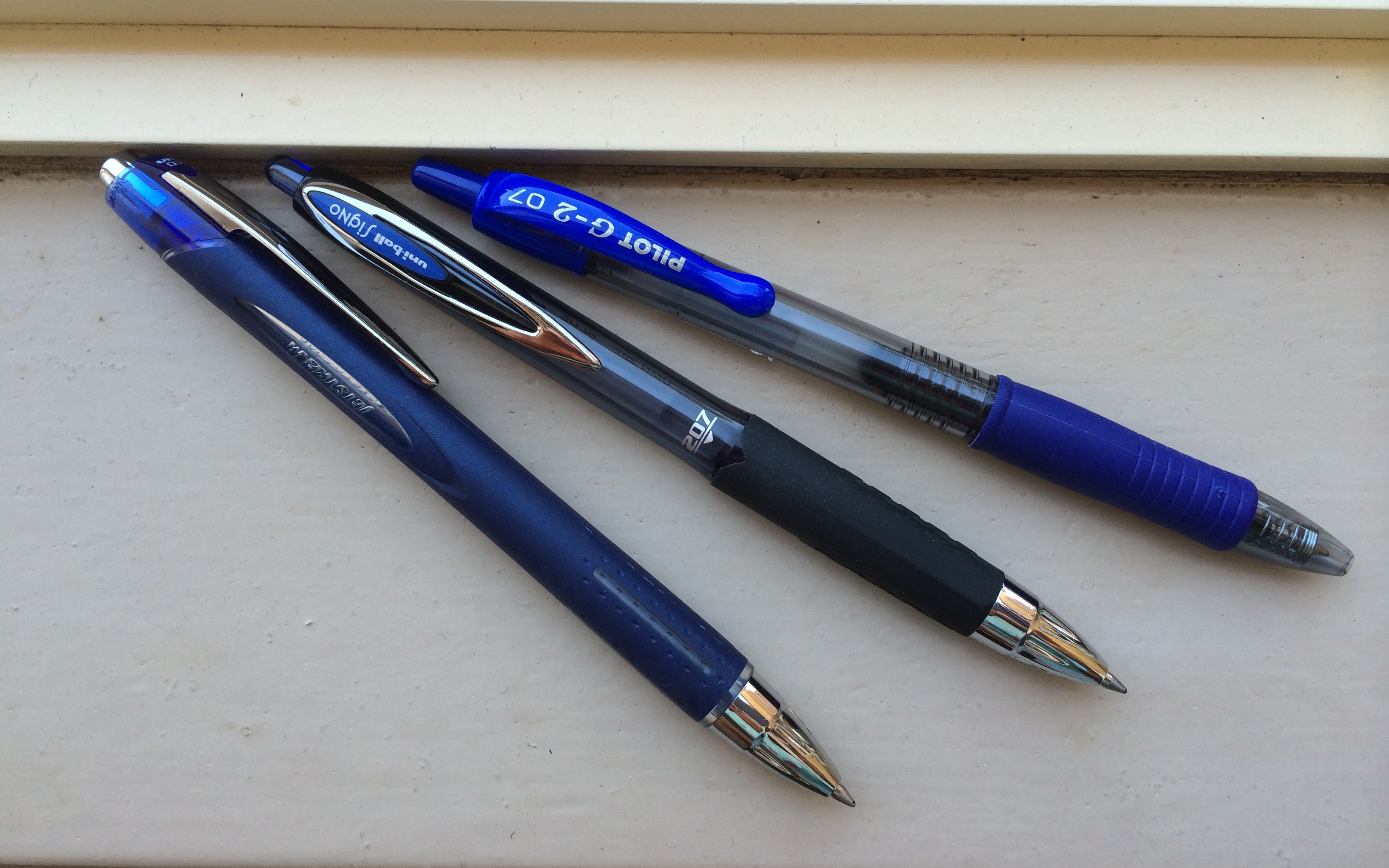
At it’s core, the pen industry is probably no different to any other. At some level, there are “standards”, which provide an overall frame of reference (to both experts and those less so). For example, when recommending a pen better than the average 99c bulk buy office stick, many might suggest a Uni-ball Jetstream, Pilot G2 or Uni-ball Signo 207. (We could debate all day about precisely which is better, and I have previously given my thoughts on this). Another example might be the popularity of the Lamy Safari as an entry level fountain pen.

Without a certain amount of stability (some may read – lack of innovation) in these “go-to” recommendations, the pen landscape in this particular segment would be constantly shifting, and recommendations moderated: “well, you could try a Jetstream however they have recently changed the …….. so I’m not quite sure if they write the way they used to”. The “standard” or well-known frame of reference would no longer exist.

Innovation or simply variation?

How you define innovation will go a long way towards answering this question for you anyway. According to the Oxford Dictionary, to innovate, is to:

Make changes in something established, especially by introducing new methods, ideas, or products

If we are talking about better versions of the same product, new and exciting products, or simply variety in a typical segment of the market, then your answer on the innovation question will likely be different. The many variations in design, materials, nib sizes and inks available to fountain pen enthusiasts (along with after market possibilities such as converters and nib grinding) typically provide an endless array of choice for the consumer. To me, this is not necessarily innovation, simply variation, customisation, and choice, with many pen lovers going down the road of fountain pen experimentation (and often obsession), even if the starting point was gel inks and rollerballs.

Also, innovation generally occurs at the “pointy end” of an industry, and much of what is considered innovation at a manufacturing level is often concerned with better production techniques, efficiencies and overall productivity. Do these changes necessarily mean anything different for the consumer? Sometimes in the form of price point, possibly a better product, however often there may be no real discernible difference.

Conclusion

Essentially, in many ways, I don’t necessarily believe there is a great deal of innovation occurring in pens, regardless of the market segment we are talking about. However, I equally believe this is not detrimental to either the market itself nor the consumer. What we do have is endless variety in the marketplace, from a few dollars for a consistent, good quality gel ink pen, up to a few hundred dollars (plus) for a fountain pen – with many variations in between.

The good old gel ink standby or the customised fountain pen? Entirely up to you, however I guess if you prefer gel inks and rollerballs, that will be where your searches take you. Or perhaps an early foray into fountain pens. Regardless of which, many discoveries will be made on the back of reviews or blog posts on pens, with many of those pens compared to those that have remained unchanged for some time, and are therefore familiar to you (which is exactly why we need them).

At the end of the day we are after a consistent and familiar writing experience with a little bit of choice as to how we achieve this. If products are created simply to “make something new” without this philosophy at the core, I’m not sure that is the way to go. After all, surely no-one here wants to write with a “multi” fountain pen.