Delfonics Rollbahn Spiral Bound Notebook

IMG_3485

In my ongoing quest for a quality spiral bound notebook, I decided to pick up a Delfonics Rollbahn recently, during a free postage promotion on Notemaker, one of Australia’s best online stationery stores.

Since then, I have also seen new stock arrive at the Dymocks Brisbane CBD bookstore, and the Rollbahn metallic covers (silver, gold) look absolutely fantastic. How do they perform? The most apt description here is also fantastic, and I have put together a few thoughts on this below.

The Notebook

The particular model purchased was the large (14 x 18 cm or 5.5 x 7 inches), which is a little more square in form than say, an equivalently sized Moleskine, which measures 13 x 21 cm (5 x 8 inches). I must admit, I do like the square format of the pages, as my writing is often not on the small side when jotting down a few quick notes, a list, or even something a little longer.

Specifications (from Notemaker):

  • PAGES: 180 (90 sheets)
  • RULING: 5mm x 5mm Graph / Brown-Grey coloured ruling
  • PAPER WEIGHT: 70gsm
  • PAPER COLOUR: Off White/Ivory
  • DIMENSIONS: 14cm x 18cm
  • SOURCE: Made in Japan

Look and feel

Looking more closely at the design, the binding is double spiral for added strength, with the cover made of extremely stiff, robust semi-gloss card stock (also described in the product specifications as splash-proof, however I did not specifically test this).

IMG_3466IMG_3468


At the rear of the notebook are five, top-opening, clear plastic sleeves between two thick yellow dividers matching the front cover. As with the front, thick card stock forms the back cover — this time in kraft, complete with a small letter-pressed Delfonics branding. An elastic closure strap in navy blue (matching the contrasting logo on the front cover) completes the picture.

IMG_3470IMG_3465


The overall look of these notebooks is quite striking, and I am quite drawn to the styling, quality and attention to detail applied to both the design and manufacture — not surprising given two factors: it is stationery, and it is made in Japan.

As I mentioned earlier, the silver and gold metallic covers are even more impressive, and nothing can beat seeing them first hand in a store. In fact, I have no doubt my accompanying photos would have been of the silver model had I seen them in-store prior to my online order.

As far as I am aware, the Rollbahn series come in 5 x 5 mm graph paper only, however the rulings are so faint I did not find it dramatically different to a dot grid type of paper, nor should those who find graph ruling a little “busy” for their tastes. At the very least it is worth a look, even if graph ruling is not your thing.

All sizes in the Rollbahn series contain 180 pages (90 sheets), with every page perforated for easy removal, however a little care is required when initiating the tear. I would note here I am always loathe to criticise a notebook for this, as my technique can be a little, how shall we say — “cumbersome”, at times.

Writing

Of course the best design components of a notebook pale significantly if the paper is not up to expectations.

A note here about the paper first up. It is yellow. Pale yellow, however yellow nonetheless. The specifications on Notemaker describe the paper as “off white/ivory” with “brown/grey” coloured ruling for the 5 x 5 mm graph paper design. Is the paper colour a deal breaker? I’d say no, however if you are someone who uses a lot of subtle colours or shades of inks, it just might be.

Not a great photo, however top to bottom: Clairefontaine, Rhodia, Moleskine, Rollbahn

Not a great photo, however top to bottom: Clairefontaine, Rhodia, Moleskine, Rollbahn

Just to confirm — it’s definitely yellow. There is no way I can be convinced this is merely off white or ivory, and if the performance of this paper were not as good as what it is, I may not have enjoyed using it as much as I did. I simply prefer paper towards the whiter end of the spectrum — particularly for those types of inks.

IMG_3474IMG_3514

That said, upon putting down some samples on a page, (see accompanying image above) most of my comments above might appear unwarranted or a little harsh — comments which I almost removed (the sample page being written after drafting the post). More vibrant, colours such as Montblanc Irish Green and J.Herbin Orange Indien were fairly true to their white paper appearance (the orange perhaps losing a fraction of nuance), however I have also added a shot below of some Montblanc Daniel Defoe Palm Green, where most of the green tones can only be seen in a smudge. Conversely, I have found a nice, consistent shade of earthy green when the same ink is used on whiter paper.

IMG_3475

See for yourself in the accompanying images, and the only reason I highlight this aspect in particular, is that for me, were this paper white, I would be telling you it would be pretty much perfect. It is that good.

The usual characteristics such as bleed through, show through or feathering are handled perfectly by the 70gsm paper — that is, pretty well none of these are demonstrated in the writing I have put down so far. This is great paper for note taking — fountain pens included, with dry time certainly on the quicker end of the scale compared with other brands of paper.

I find it a little less “slippery” for want of a better word than say Rhodia paper, my go to for fountain pens typically. The little bit of extra feedback suits my writing style perfectly, as I sometimes find a really smooth nib more difficult to control on very smooth (e.g. Rhodia) paper.

One minor qualm I noted when writing was the small amount of “wiggle” or movement of the page if not held with your opposite hand, mainly due to the large squares cut in the paper for the double spiral binding. Most likely not a problem in the extra-large size, however in a notebook of this size, I often rest my hand on the left page or off the notebook completely. Not a major issue however the movement was noticeable and something I thought worth mentioning.

Use case

For me, this large size notebook — my first Rollbahn, is best suited to shorter note taking given the size of the pages, however would hold up well for longer form writing. In a larger size, I can see this working extremely well as an office meeting note taker or “day book” of sorts, which is where I find the spiral bound books to work best for me.

Many of the notes I take during the day relate to meetings, general thoughts/ideas on processes, procedures or projects, and rough working, mind mapping or outlining these very topics.

Why does the spiral binding suit here? Simply because I prefer a notebook at work which opens flat, closes flat, and can be turned back on itself to allow notes to be taken on a somewhat stable and rigid surface if I choose to rest the book on my lap. This I find to be a common scenario, either for comfort reasons in a long meeting, or to jot down a few confidential notes, where the notebook is angled towards, and closer to me.

IMG_3516It is also at my office job I am most likely to be using ink colours in the blue-black spectrum, or more gel ink pens or my trusty Retro 51. As good as the paper is, as I’ve state above, the yellow shade is probably not best for testing your new ink colours — at least those on the subtle shade side in any event.

My purchase receipt tells me I bought this notebook in late October, and in the intervening two months, I have: made a few plot related notes for NaNoWriMo; jotted down some coffee tasting notes; written a few pages worth of outline for a post on what I learned from NaNoWriMo (must actually finish and publish that one!); and taken a dozen or so pages of notes whilst watching David Sparks excellent OmniFocus Video Field Guide (in Daniel Defoe Palm Green – see accompanying image). A group of notes largely consisting of bullet points, lists and short text notes.

Conclusion

It is pretty clear I am very impressed with the Delfonics Rollbahn, and find it suits my style of writing and notebook requirements extremely well. The styling, design and build quality are second to none. I will definitely be giving the extra-large size a run as my office notebook in future.

What do I like most? Definitely the paper quality, (if not quite the colour), the overall build quality and design, and the attention to detail that is apparent in the double spiral binding, rear pockets, and perfectly rounded corners. Although nice, the closure strap is something I generally prefer not to have (particularly in a notebook which closes well on its own) — as I find they often get in the way. Certainly not a deal breaker by any stretch.

My dislikes? Here it is really only the shade of the paper, for otherwise it is essentially flawless. A minor qualm about the “wiggle” in the page when writing I mentioned earlier is not something which would stop me buying more in the future.

As far as value for money is concerned, here is where things get a little (not a lot — but certainly a little, depending on your budget) interesting. The 14 x 18 cm sized notebook retails for $AU14.95 (either brick and mortar store or online), and the extra-large 19 x 26 cm for $AU24.95. Not an insignificant amount, however when balancing this with what you get for your money, that is, exceptional quality, and 180 pages of it, I’d say the value for money certainly is definitely there. I should also mention the notebook also comes in a smaller (10 x 15 cm), 180 page top opening reporter style notebook for $AU9.95.

Although this is my first Delfonics Rollbahn notebook, I doubt it will be my last. My recommendation would be to try one for yourself, and if you write with fountain pens, my advice is the same — try one out.

Just remember, though perfectly fine for most colours, the shade of paper isn’t made to showcase the subtleties of your ink collection, but will serve you extremely well for taking meeting notes or writing the intro or outline to your next long form essay.

A Guest Post for On Fountain Pens

One of my favourite pen blogs, On Fountain Pens is currently running a 12 Days of Christmas series of guest posts. The topic? You guessed it, fountain pens.

Maybelline describes the endeavour here:

Before the first day of Christmas, my fountain pen came to me: 12 bloggers on OFP.

…one fountain pen blogger a day, guest posting here on topics related to fountain pens and writing.

Although my pen experience pales a little compared to the other contributors, I was lucky enough, and feel quite honoured to have been able to contribute. My post is now up on OFP as Day 5 in the series of twelve, and with a title perhaps a little unusual for a lover of fountain pens, the full post will make things a little clearer.

Head over to On Fountain Pens to read the post, and while you’re there, check out the rest of the series, and everything else on this fantastic fountain pen blog:

Day 5: I’m glad you didn’t buy me a fountain pen for Christmas

NaNoWriMo – My Analogue Tools

The tools.

The tools.

With so many words to be written this month as part of my first foray into NaNoWriMo, I feared this blog would be a little forgotten over the coming weeks – and no, I had not planned ahead well enough to have written and scheduled posts in advance.

In a rare moment of wisdom, I came to realise my best chance of putting something up on the blog would be to combine the two. That is, participate in NaNoWriMo, and occasionally blog about participating in NaNoWriMo.

I plan to write a few more NaNoWriMo flavoured posts throughout the month, which is of course assuming the weight of expectation that comes with a 50,000 word target doesn’t crush me first.

So, with a tip of the hat to yesterday’s Fountain Pen Day, today I thought I would share some of the analogue tools I have been using to help plan out, and hopefully get written, the 50,000 words that constitute the NaNoWriMo challenge.

Notebooks

Various notebooks, pads, scraps of paper and even the odd dreaded yellow Post-It Note have all played their part here.

Although I have the overall plot and story outlined, my fear of running out of specific ideas to keep filling scenes, has resulted in a litany of places with either paragraphs, a line, or even a single word jotted down to avoid forgetting that great idea. Though I must admit, the more common scenario seems to be noting down why events written two chapters ago no longer make sense given the turn the story has taken.

This whole novel-writing thing is certainly not easy!

The paper I’ve been using:

Clairefontaine Essentials Notebook and Pelikan Edelstein Tanzanite ink written with Pelican M205 EF Fountain Pen

Clairefontaine Essentials Notebook and Pelikan Edelstein Tanzanite ink written with Pelican M205 EF Fountain Pen

Clairefontaine Essentials Notebook with Pelikan Edelstein Tanzanite Ink

Delfonics Rollbahn Notebook; Montblanc Daniel Defoe Palm Geen ink (Pelikan M205 EF Fountain Pen)

Pens

(L to R) Pelikan M205; Palomino Blackwing 602; Retro 51 Stealth; Lamy Safari; Montblanc Meisterstuck Classique

(L to R) Pelikan M205; Palomino Blackwing 602; Retro 51 Stealth; Lamy Safari; Montblanc Meisterstuck Classique

Again, this is either dictated by what is closest at hand for immediate idea capture, or what will be most enjoyable to write with for more extensive outlining. The following pens (and pencil) have to date suited either of these scenarios:

Inks

I have found using inks of varying colours quite helpful when going back through my notes to either check off ideas or plot lines I have implemented into the story, or in highlighting areas that may require more thought or detail. The Montblanc Meisterstuck inked with Burgundy Red has been particularly useful given it’s contrast to the Safari’s blue ink, clearly showing notes made as additions to the originals.

Markup in Field Notes Arts Edition; Lamy Blue ink (Lamy Safari M Fountain Pen); Montblanc Burgundy Red (Montblanc Meisterstuck Classique M Fountain Pen)

Markup in Field Notes Arts Edition; Lamy Blue ink (Lamy Safari M Fountain Pen); Montblanc Burgundy Red (Montblanc Meisterstuck Classique M Fountain Pen)

Rhoda Ice No 16 Lined Notepad; Lamy Blue ink (Lamy Safari M Fountain Pen)

Rhoda Ice No 16 Lined Notepad; Lamy Blue ink (Lamy Safari M Fountain Pen)

Summary

The most used of the items outlined above is probably a combination of the Field Notes Arts Edition notebook, the Lamy Safari for note taking, and the Montblanc Meisterstuck for marking up the Safari’s notes.

The Field Notes became the notebook of choice early on as I my initial intention was to keep all of my ‘NaNo’ notes in the one book, and the majority have ended up in here. I found the larger ‘Arts’ edition the ideal size for more extensive notes, yet small and light enough to carry with me.

Delfonics Rollbahn Grid Notebook

Delfonics Rollbahn Grid Notebook

The Delfonics Rollbahn notebook contains great paper stock for fountain pen use, however the yellow colour is not the best shade to highlight any particularly vibrant inks you may be using. Certainly not a problem for the darker blues and blacks if that is your preference.

The Safari was not necessarily my first choice pen, however is only a fairly recent purchase, and the paper based planning of this project seemed a great chance to test it out. No real complaints here, except it has been a little ’skippy’ occasionally, however I put this down to not having given it a thorough clean before inking it up after purchase.

I am really enjoying the Daniel Defoe Palm Green ink, which is now residing in the Pelikan M205 (EF). Again only a recent purchase, however what a great colour! I am sure it will see quite a bit of use throughout the remainder of November and beyond.

My main (and only minor) grievance has been the extent to which the Safari Blue Ink has faded. Although most likely due to both the ink and Field Notes paper (the same amount of fade was not evident on the Rhodia stock), I would have preferred it to maintain the vibrance it had when first laid down.

NaNoWriMo itself?

With my word count currently just over the 10k mark, I am finding this an extremely interesting challenge. I was falling on the side of “maybe I’ll just do it next year”, right up until a few days before November 1, however would perhaps have continued to say the same thing every year had I not bitten the bullet and entered.

So very glad I did.

Gotta go. There’s an important word count that needs increasing!!


Retro 1951 Tornado Stealth – My Workhorse Pen

As is the case with more than a few owners of the Retro 1951 pen in it’s various forms, mine was picked up after hearing the brand mentioned (often) in the relatively early episodes of the Pen Addict podcast. The enthusiasm with which hosts Brad Dowdy and Myke Hurley talked about these pens was enough to send me searching for them online soon after. The pen in question is now almost two years old.

FullSizeRender 4My choice at the time, a Tornado Stealth model, was ordered from Cyber Space Pens, for at that time I did not have a bookmark folder full of pen shops by the names of Goulet, Jet, Chalet and the like. Although in saying that, I see Cyber Space currently stock the Retro 51 Stealth at a very competitive $US24.00.

I do not recall the exact price I paid at the time, however it was essentially half the cost of purchasing locally through one of the brick and mortar stores in town. I find this both incredibly convenient and somewhat saddening at the same time, given I enjoy nothing better than stopping by and supporting one of the local pen stores, however it becomes increasingly difficult when the cost is often one and a half to two times what can be found online.

Look and Feel

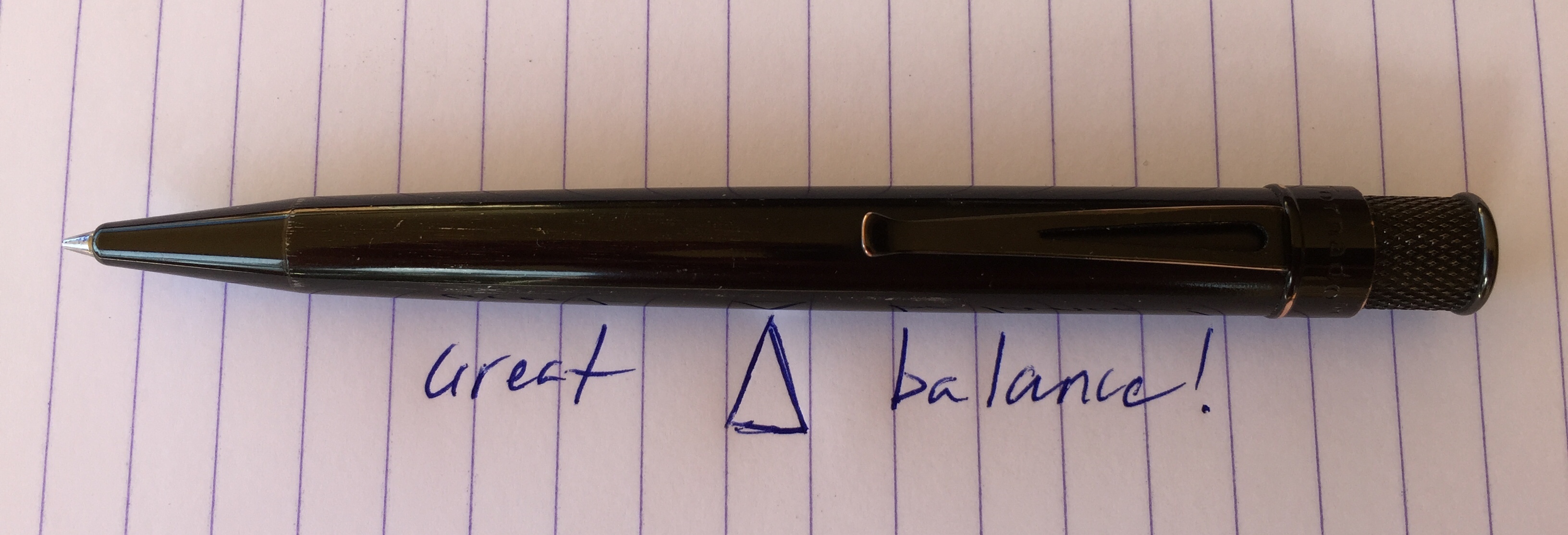
Overall I would say I am fairly conservative in my pen barrel colour choices, so of course I was drawn to the Tornado Stealth model, a sleek, all black, mysterious looking pen. The smooth glossy finish is a joy to both look at and hold.

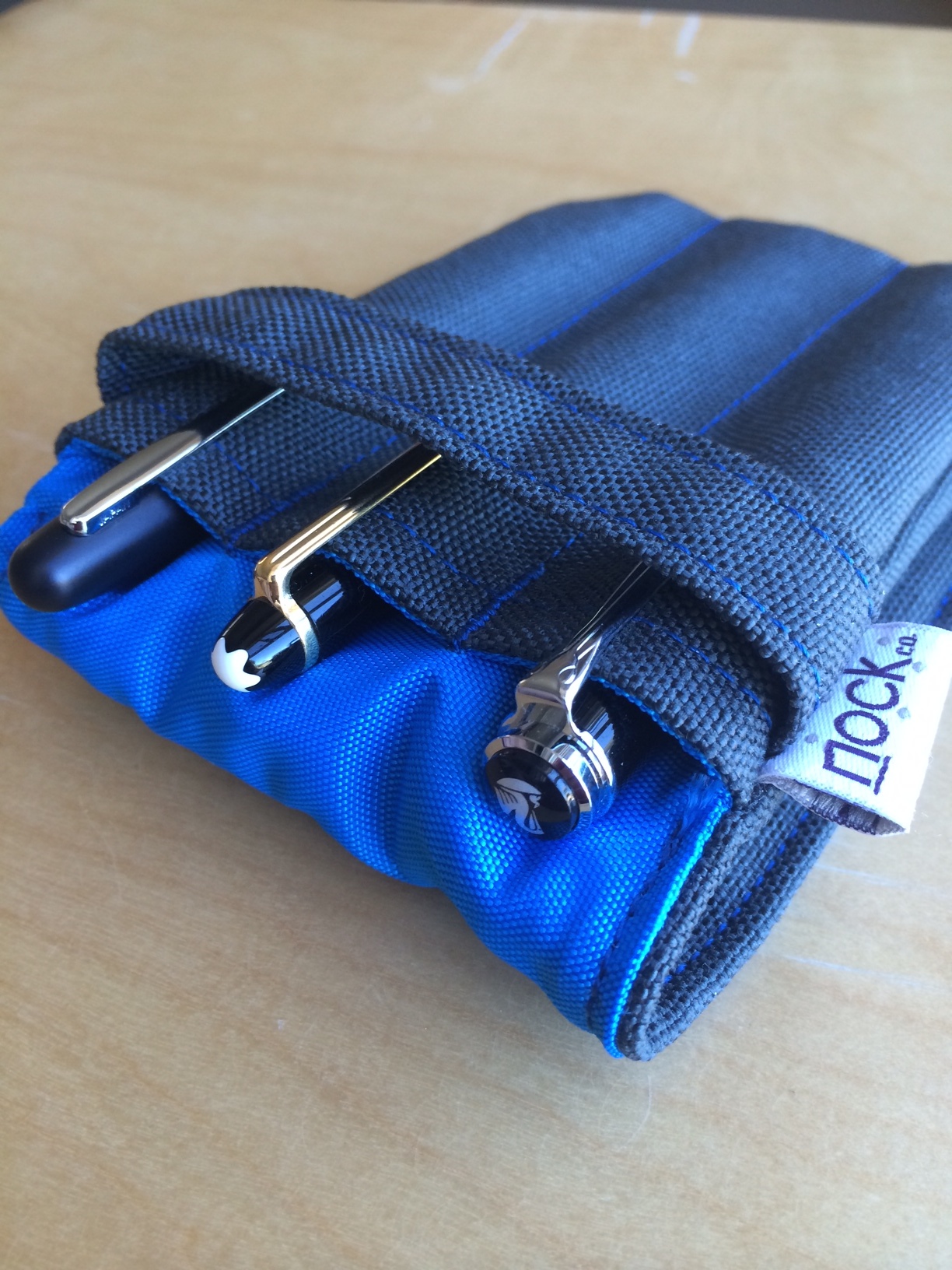
Now, as the title of this post and some of the images suggest, it has been somewhat of a workhorse pen over the past 18 plus months or so, and developed some nice brass looking highlights on some of the edges, given most of this use occurred prior to the relative luxury it now enjoys in a Nock. Co Sassafras pen case.

FullSizeRender 6

The band with the “Tornado by Retro 1951” branding adjacent to the clip, the clip itself, some of the knurling on the knock twist mechanism, and parts of the barrel have all worn, not quite to the Kaweco AL Sport washed look, however heading that way. That said, I couldn’t be happier. My pens are for using, with a little care, but heavily. They are some of the tools I enjoy using the most, and if that shows, all the better.

FullSizeRender 5FullSizeRender 3

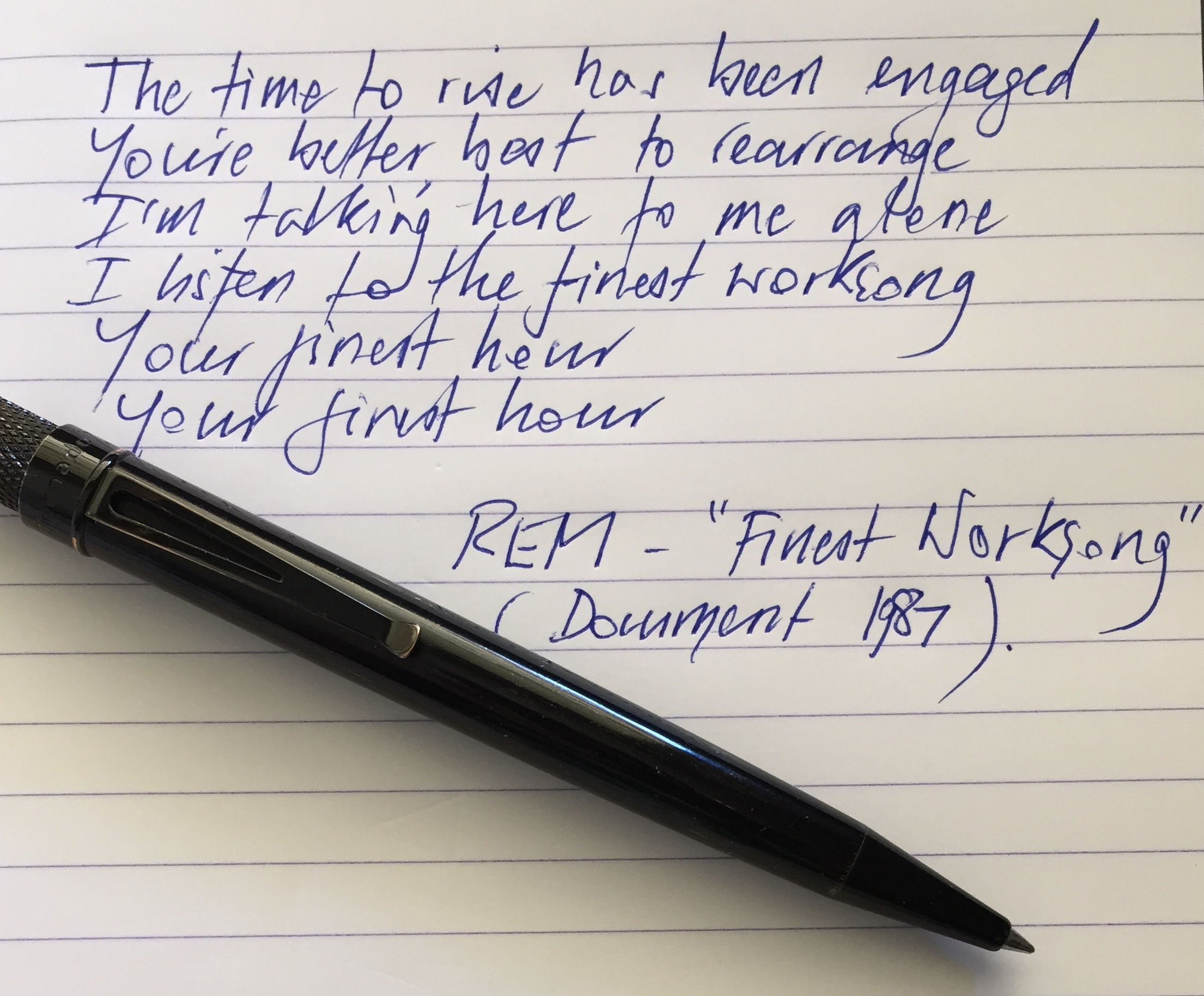
FullSizeRender 7Apart from the slowly evolving outer finish, probably what I like most about this pen is the overall size and weight distribution. For my writing style, it has perfect balance, with the length of 13cm a perfect size for my hand. While the weight is on the heavy side at 28g, the stature and weight distribution ensure this pen is a joy to hold and use, either for a few notes or longer writing sessions. Although my Lamy Safari Rollerball is a light 18.5g, I do prefer the Retro 51 out of the two.

Although the barrel is a smooth glossy finish, I have never had any grip problems, and my preference for a mild taper towards the tip is well catered for by the Retro 51 shape. At the other end of the pen, the knurling on the twist mechanism provides a nice texture, and the knock mechanism itself is one of the most solid you will encounter.

Performance

Once again, you probably need to go no further than the Pen Addict Podcast to hear mention of the Retro 51 and/or Schmidt P8126 refills as being one of, if not the best liquid ink or rollerball refill going around – and I’d have to agree. I am currently using the standard Retro 51 branded refill in the pen, and as you can see from the writing samples, the line could not be smoother, broader, or more vibrant.

FullSizeRender 8

The only time I have had the need to swap out the liquid ink refill was in recent weeks when I decided to try out the Field Notes Expedition edition, and needed an appropriate tip for the indestructible Yupo paper of that particular notebook. In this instance, a minor trim of a Uni Jetstream ballpoint allowed it to fit in nicely, which took me through to the and of the Expedition. Mind you, once the last page was written, out came the Jetstream and back in went the Retro 51 refill to an “ah…that’s better” moment.

The majority of use this pen sees involves day-to-day writing at my office job, which is often intermittent signatures, notes, marking up document revisions, or comments/feedback on team members work. I do not have cause (sadly) in a “paperless” office for extended periods of writing, and when I do, I tend to seek out a fountain pen from my desk drawer, though on occasion, will continue with the Retro 51 which does not disappoint.

Conclusion

Thinking back, when I first started searching for this pen based on a podcast recommendation (granted – not just any podcast), I had a nagging feeling in the back of my mind I would not necessarily like it. You know the scenario, something is spoken of so highly, upon finally obtaining the item in question, the expectation and excitement exceeds the experience and performance of the real thing. Definitely not the case here – the Retro 1951 Tornado Stealth is a great pen, has a great refill, and serves equally well as an everyday “workhorse” or as a writing instrument of great pleasure.

I really have no excuse not to add to my collection of these great pens – though I may have a hard time choosing colours. Perhaps a Retro 51 “Unexposed” release may absolve me of making that decision.

My Pelikan M205 Fountain Pen

The opportunity to pick up this Pelikan Tradition M205 was a little too hard to pass up back in May of this year, with Pen Chalet offering the model at half price during a period of The Pen Addict podcast sponsorship.

I was looking to add to my collection of quality fountain pens, and snapped up a black model with chrome trim and an EF nib. Ordering and shipping from Pen Chalet in the US over to Australia was quite fast, and in rapid time I was inking up the newest member of my pen family.

Look and Feel

There is no doubt the M205 is a great looking pen, with the black and chrome combination providing a classic, elegant look. It makes a great business pen – perhaps a little small in stature to be signing million dollar cheques, however I don’t sign many (who are we kidding – any) of those. It is also manufactured in Taupe, White and Red.

Image courtesy Pen Chalet

Image courtesy Pen Chalet

When capped, I find a certain appeal to the overall symmetry of the pen, and although not a large pen, the body diameter through the pen barrel is perfect relative to its length. The cap itself sits proud of the body when screwed on, further accentuating the central chrome band bearing the Pelikan and Germany insignia. An additional chrome band at the clip attachment, and another towards the end of the pen at the piston filler control, provide evenly spaced breaks to the shiny black finish of the barrel and cap.

M205_FinialM205_Nib_Cap_CrossM205_ink_bottle_pen_better

The finial sports the elegant Pelikan (pelican) bird and baby logo, with the clip shape recreating a long curved Pelikan (pelican) bill. The clip itself functions well, with suitable spring, yet is smooth enough to avoid snagging on either my shirt pocket, placket, or the Nock Co. Lookout in which it usually resides.

M205_LookoutWhen uncapped, with the exception of the fine chrome ring at the top end of the pen, and the dark tinted ink window adjacent to the grip section thread, the body of the pen is solid black, right through to the stainless steel nib. The nib itself is plain, polished stainless steel, with the logo, Pelikan name and EF inscription. Perhaps another chrome ring near the section may have been a nice addition, however would run the risk of creating a less seamless grip, and for the sake of appearance only is probably best left alone.

Constructed of a plastic resin, the pen is quite light (14.8g fully inked), particularly when used un-posted (9.9g), which I tend to prefer for extended writing sessions. Larger hands may find the barrel a little short for use without posting. A three-quarter turn will remove the threaded cap, which posts securely for writing and in no way affects the overall balance of the pen.

Performance

Great purchase deals aside, this is a $200.00 pen at standard retail pricing, and the expectation is that the writing experience will be commensurate with the price tag – that is, exceptional.

Others experiences

This is where things get a little interesting. Generally, when deciding on a pen purchase which will set me back a decent sum, I tend to consult the opinions of a number of pen bloggers who have tested and reviewed the pen in question. In this instance, that was not the case, as the podcast recommendation and great deal were encouragement enough to click the purchase button.

Subsequent to my purchase, I then read the opinions of those I hold in high regard who found the M205 not to their liking, and had I read these reviews prior to ordering, may never have picked up the M205 at all.

Boy am I glad that didn’t happen. I love this pen.

The reviews:

Pelikan M205 (the Illustrious) Fountain Pen – F Nib (The Clicky Post)
Pelikan M205 (the Illustrious) Fountain Pen – Update (The Clicky Post)
Review: Pelikan M205 Fountain Pen (The Well Appointed Desk)

I’d encourage you to read through the articles above for a full appreciation of the issues raised, however if I could summarise, others have found the nib “sweet spot” to be quite small, requiring a good deal of concentration to keep the pen within it, if the writer is even able to do that at all. This obviously places a question mark over whether the pen is suited to all writing styles.

Conversely, other reviewers have found the pen a delight to use, living up to every expectation, straight out of the box. Luckily I found myself in this camp.

Pelikan M205 Review (The Pen Addict)
I heart you: Pelikan M205 and Levenger Shiraz Ink (From the Pen Cup)
Pelikan Tradition M205 Fountain Review (Pen Paper Ink Letter)

On balance, it is therefore difficult for me not to recommend this pen, particularly at the discounted sale price, which is again available from Pen Chalet at the time of writing.

My experience

Sweet spot troubles? Myself, not so, and I would put forward a couple of theories on why that is. Firstly, although it is 17 years since I began using a fountain pen, my experience has not been widespread across different brands and nibs. Further, I have recently begun using pens with nibs a little finer than what I was previously used to, and in part appreciate the increased feedback of the finer nibs on the page. Here I am also acutely aware of the fine line between “feedback” and “scratchy”, believing I can appreciate the difference, however my experience on this may differ to a more experienced hand.

M205_BoxWhen testing further to get my thoughts together on this, I wrote with a more expensive pen (Montblanc Meisterstück Classique 14K gold M nib) and a couple of cheaper ones (Pilot Kakuno steel F nib and Pilot Metropolitan steel F nib) on a rotational basis line by line down a page for quite some time. There was a clear difference in feedback from the Pelikan and Pilot nibs when compared with the Montblanc, likely due in part to  the change in nib size, though of course material and manufacture no doubt play a part.

I could go on and about the ins and outs of these comparisons, however at the end of the day, my point is – for me, this is a great pen, and one I enjoy using very much. This is a fact I am certainly thankful for, as again, great “50% off” deals aside, $100 of my money still went on this pen. Whether or not $100 is too much for a stainless steel nib is for you to decide, however perhaps just shy of $200 is.

Writing

In my experience, the M205 writes extremely well, and I have not had any false starts, skips or unintended line variation in the three months I have used the pen, irrespective of the ink used.

As expected, the stainless steel European EF nib was still broader than the Japanese Pilot F nibs in a direct comparison. The writing sample below shows the Pelikan EF compared with a Pilot Kakuno F (Metropolitan F results equivalent) and Montblanc M, along with line variation achievable with varying levels of pressure, as the nib does demonstrate a small amount of flex.

Line width comparison

Line width comparison


I would also point out here that when inked with something like De Atramentis Permanent Blue, which I have found to be a fairly wet ink, the line is considerably wider than seen with the Pelikan Edelstein Tanzanite used in the image below.

Writing sample

Writing sample

Conclusion

The Pelikan M205 is a pen I am very glad to have in my collection, and is one I could happily write with all day. Its looks are commensurate with the writing performance, and it is a pen I use at times in the office, given it’s classic, elegant style.

As I have indicated above, I found no issues with the nib, however others have, so perhaps that is a caveat to consider before purchasing. Whether there is perhaps a question mark on the overall value of the pen if assessed at full price, given the plastic body and stainless steel nib is a personal choice (despite the gold nib, my Montblanc is also a plastic resin).

Personally, I would have no hesitation in recommending the Pelikan M205 to someone looking for a quality pen, and if you can pick one up on a fantastic deal like I did – go for it.