Season

In what will be a final post before the Christmas festivities begin in earnest, I would like to thank you dear reader, for your support over the past year, as this blog continues on its journey to wherever it may be heading.

If you have contacted me and provided feedback, constructive criticism, praise or advice — I thank you. If you have simply read along over the past twelve months, yet never been in touch — equally, I thank you as well. You may be here as a pen-friend, coffee-friend, other miscellaneous-post-friend, or a little bit of them all.

In whatever capacity your readership takes, I hope in the next twelve months, this at times erratically scheduled and topic-scattered place that is my online home, will provide at least something that may be of interest to you.

Please know I sincerely value your support in providing the very reason I keep writing here — that is, knowing at least a few great folk read these words. That means a great deal after starting out a couple of years ago thinking no-one would.

I am not sure of your particular plans for this season we are now headlong into.

If you are taking a well-earned (and perhaps extended) break, enjoy it. I have no doubt it was hard-earned.

If you are seeking a frenetically-paced blur of fun and excitement, then go and get into it.

Perhaps you are expecting a particular gift, or a bonanza of many, and if so, I do hope you receive them all.

Or if — like me, you’ll enjoy the festivities, then hope to find a quiet spot to catch up on a bit of reading with a drop of your favourite, then I hope you get there too.

Speaking of reading, to those behind the great blogs, newsletters, and podcasts out there, thank you for providing fantastic content for us all to enjoy. To those I’ve yet to discover, perhaps next year it will be.

On that note, I’ll leave it there. To the writer’s — thanks for writing. To my readers — thank you so much for reading.

Best wishes to you all, and do enjoy what you find under your tree — just enjoy those sitting around it with you a little more.


Wiser Web Wednesday

Wiser Web Wednesday – a semi-regular link to posts of interest from around the web, by those far wiser than myself:


From the Pen Cup
There are no Vespas in my household, and I do not typically buy pens to match anything in particular, however I must admit Mary puts forward a compelling argument for doing just that.

Did I look around for something brown or olive green after I read this? Might have.

The Karas Kustoms Bolts, the Nock Co Sinclair, great photography and handwriting — it’s all here for your reading and viewing pleasure:
Everywhere Carry: Nock Co. Sinclair and Karas Kustoms Bolts


Too Many Inks
A high price for an ink? Yes. Too high? Maybe, maybe not — it all depends on your perspective and reasons for buying of course. Collect them and want it? Enough said really.

Two things on this. One — I actually think it is a pretty great colour; two — I’d argue it is better value than perhaps a rare set of Field Notes.

Again — perspective and reasons:
First Use: Montblanc Mahatma Gandhi Orange


Alt. Haven
It is the time of year for lists, and there is no better place to start than with pens and inks of course. Kicking things off are Junee’s lists of favourites for the year:
Top 5 Favourite Pens 2015
Top 5 Favourite Inks 2015


The Fountain Pen Quest
Some initial thoughts on the Visconti Homo Sapien Bronze Age. As Ray indicates, there are a few points to note if you are thinking of buying one yourself, though overall, I’d say he is glad he did:

When taking notes for work I use big words since they take longer to write. When I’m not taking notes I’m doodling. At night I look for things to write.

A more detailed review is planned in a few months, which I for one am looking froward to:
This Just In: Visconti Homo Sapien Bronze Age


Goodwriterspens’s Blog
Not owning any of the restoring kind, I’ve not had any pens restored to this point in my pen journey. Something I hadn’t really thought of though, are the rights or wrongs when the practices of the restorer are questioned by a customer. Perhaps neither of course, and it is simply a matter of opinion.

That said, here, the restorer provides some sound rationale which makes sense to me about the methods used and reasons for using them:
Restoration Practices


The Gentleman Stationer
I recall looking in earnest (you know — staring really intently at a web browser pointed at an online stationery store) at these pens when I dabbled in a couple of multi-pen variants, thinking they represented a fairly stylish version of said multi’s.

As Joe mentions, it is a fairly slender pen, which I don’t mind – particularly in a pen that for me, won’t see any sustained writing sessions either. I would though agree with this:

Where the Sharbo X will kill you, however, is on the gel refills, if that’s your preference.

Yes, they aren’t that expensive, though at volume? It certainly adds up. So in the end I didn’t buy one, but boy, I still very much like them.
Zebra Sharbo X: The Premium Multi Pen


The Pelikan’s Perch
Nice to read what might be coming — both in online shops and therefore subsequently through my Instagram and RSS feeds next year. Where they won’t be heading is through the post to my mailbox – I’ve certainly more than enough pens to keep me going for a little while (still plenty to write about that’s for sure).

Good odds that many of these beauties will be store bound in the new year:
Rumor: What to Expect in 2016


Peninkcillin
Value can mean many things, but surely a $2.50 fountain pen which provides a writing experience like a… well… a decent fountain pen would fit anyones definition of the word.

A thorough and informative review, which will surely lead you to check for some change down the back of the couch and perhaps pick one up:
Baoer 507 fountain pen review


Pens! Paper! Pencils!
As Ian states, although better known for their pencils, Tombow do make some great fountain pens. The Tombow Object fountain pen I own is a great pen indeed, and this Zoom 101 looks fantastic.

This is one of the best pens no-one has heard of and has firmly, and unexpectedly, become of my favourites.

Well worth considering it would appear:
Tombow Zoom 101 Fountain Pen Review


CRS Coffeelands Blog
The final in a daily eight part series on modern slavery in Brazil’s coffee sector.

This is not about 15 coffee estates in Brazil that appeared on the government’s Dirty List.  It is not about the more than 400 workers who were rescued from those estates by Brazilian labor inspectors.  It isn’t about calling out Brazil because we found evidence there is slavery in its coffee sector—modern slavery is everywhere.  And it isn’t really even just about coffee.

Mentioned in an earlier post was also the fact that conditions are not necessarily worse in Brazil, just that the country has better governance and transparency on such matters, which can only be a positive thing.

A fascinating read from start to finish on a topic that absolutely is not just about the coffee industry:
Slaves in Brazil’s coffee sector. So, what?


The Sweethome
When you first start taking more of an interest in coffee, you begin to see the same recommendation from just about everyone “in the know” — its all about the grinder. If you are going to spend some money, “spend it on the best grinder you can get”.

Is that the most expensive grinder? Not necessarily, and again, one of the trends you begin to see is the outstanding reputation of Baratza’s range of grinders. I myself had my eye on this very model for my filter brewing needs, until I was fortunate enough to win its big brother, the Vario, in an Instagram competition.

Please note though, as the post states, the Virtuoso is best for anyone “not making espresso”. Any other forms of brewing? Do not spend any more money. In Australia, distributor Five Senses currently have the Baratza Encore for $AUD205.70 — noted to be a close runner-up to the Virtuoso, yet a bit easier on the wallet.

This is one of the best comparison reviews backed up with data and rationale I’ve seen (and not just because I agree with the conclusion):
The Best Coffee Grinder


The Whisky Topic Podcast
Yes, an interview with a micro-biologist involves a little science, however the conversation was far broader than that. As brand ambassador and micro-biologist for Highland Park and The Macallan, Nicolas Villalon does a pretty good job.

Really enjoyed this one:
40: Highland Park & The Macallan with Nicolas Villalon – “To add insult to injury, my boss was paying for them!”


MacStories
I’ve used Skitch for my iOS photo mark ups for quite some time. Again, whether we are talking apps for email, photo mark ups or anything else — simply further evidence of a very fickle market:
Evernote Ending Support for Skitch on iOS

While at Macstories, check out King of iOS Federico Viticci’s list of must have apps for the year. There are 50 apps in this list — yes 50 (43 of which are universal for iPhone and iPad). I’m not about to recommend you try every one of them, however even if you pick up one or two, perhaps it’s been worth it:
My Must-Have iOS Apps, 2015 Edition


MindNode Blog
I love the ease with which mind maps come together on MindNode, and I probably should use it more than I do.

Here, a couple of reminders why:
MindNode for iOS Hidden Gems #1


Wiser Web Wednesday

Wiser Web Wednesday – a semi-regular link to posts of interest from around the web, by those far wiser than myself:


Three Staples
Before a short trip away recently I had a look back through a travel journal I had written almost twenty years ago, having a chuckle at what it contained. A lot of memories came flooding back. As Jinnie describes, that is generally the aim with such a journal:

At the end of the trip, we end up with a nice, tangible reminder of our time together that we can look back on.

I did feel a little guilty at not continuing the tradition in the intervening years, thinking to myself I must return to that very habit. I must admit I wasn’t successful in recording that particular trip, however there are those who are, and they do it in style:
Travel Journaling


You Tube – Murphy Report
Courtesy of Pen Economics on Twitter.

At just under 6 minutes, a wonderful tale of a fountain pen collector, showing the passion behind accumulating and enjoying a 200+ fountain pen collection:
Fountain Pen Collector Jose “Butch” Dalisay Jnr.


The Washington Post
I was occasionally guilty of this one, often being admonished by my teenage daughter with “Daaaad – punctuation?!” in a tone of disbelief and pity. Never again.

Now a study has confirmed it. Researchers led by Binghamton University’s Celia Klin report that text messages ending with a period are perceived as being less sincere, probably because the people sending them are heartless.

All the while I thought I was simply being a little uncool:
Study confirms that ending your texts with a period is terrible


The Verge
Advice apparently received by co-founder Gentry Underwood when raising funds to develop the now discontinued email app Mailbox:

“This path,” they told him, “is paved with corpses.”

A tough market:

Ask Sparrow, or Molto, or Boxer. Everyone uses email, but most are content to stick with the default mail app on their phones. At worst, you’re dead within months. At best, you’re acquired, and then killed off a few years later

As mentioned in last weeks links, I was a Mailbox user for quite some time, however the ease with which I simply logged into an alternative is perhaps somewhat telling for this market segment also:
Why Mailbox died


MyProductiveMac
A handy tip for Drafts users. This magical place where text can begin and go just about anywhere, does not limit you to just one action.

Get cracking and stack those actions:
Drafts – Dual Actions


Perfect Daily Grind
The effects of climate change are of course far-reaching, not the least of which in the coffee industry.

Ethiopia is not only said to be the origin of Coffea arabica, but also a genetic bank of coffee. The natural diversity of coffee plants here is stunning. However, the Intergovernmental Panel on Climate Change (IPCC) predicts a 10-20% decrease in overall crop yields by 2050, due to climate change worldwide.

This piece also notes that by 2080, wild arabica plants could be virtually extinct, and this amazing genetic diversity may vanish. Yes, that would mean some amazing coffees many vanish before they are even tasted, yet probably of equal importance is the livelihood of those the farmers who rely on coffee — currently one in four Ethiopians:
The Price of Climate Change on Ethiopia: Extinction of Wild Arabica


Jimseven
The first in a three-part series of posts on the current state of specialty coffee, which has already generated a few counter points and discussion over Twitter from other coffee professionals.

I don’t believe coffee cannot, or should not be, improved; it can and should always get better. I think we just need to readjust our expectations of what an isolated sensory experience can do. Yes, sometimes it can change someone’s life. However, it can’t do it every time or even most of the time.

The piece goes on to discuss how the excitement and innovation in the industry has perhaps stagnated somewhat, with great coffee far more accessible, and as a result, no longer exciting.

As a consumer I would agree that high quality coffee is now being served in far more places than ever before, which is clearly a positive.

How to maintain the excitement in an industry is more of a challenge, and there are some interesting points here, and I am certainly looking forward to the two follow-up posts:
Part 1: The Lull


The New York Times
Author Bret Easton Ellis on the now well established culture of reviews and likes, where everyone has an opinion on just about everything, and is happy to provide it, cultivating their online reputation the process.

The reputation economy is yet another example of the blanding of culture, and yet the enforcing of groupthink has only increased anxiety and paranoia, because the people who embrace the reputation economy are, of course, the most scared. What happens if they lose what has become their most valuable asset?

Touching on the herd mentality of always positive reviews or taking the conservative option to fit in:

Empowerment doesn’t come from liking this or that thing, but from being true to our messy contradictory selves

Things have certainly changed, and we now live in this world of rating and being rated:
Bret Easton Ellis on Living in the Cult of Likability


Study Hacks – Cal Newport
A common theme on Cal Newport’s blog is the idea of “deep work”. I may have mentioned previously that I think along the same lines however have always described this in terms of “sustained focus”.

Alice never went more than twenty minutes or so without switching her attention away from her primary task to something else. It’s tempting to dismiss these breaks because they’re so fleeting — lost in the standard background noise of knowledge work — but their cost is substantial.

Again, nothing new in that quote above, however something seen all day every day. Think about that in the context of the supposed benefits of “fleeting” or “spontaneous” interactions in your open plan office. Think about it in the context of the constant stream of text messages you receive and respond to with your phone on the desk in front of you.

Sure, it only takes a few seconds. A few seconds every few, ten, or twenty minutes. It still amazes me why people cannot seem to comprehend this:
Deep Habits: The Danger of Pseudo-Depth


John Scullen
The tools! The processes! What is it about reading how others get their work done that so intrigues us — myself very much included. Rather than simply being nosy, it definitely gives the reader (and the writer for that matter) a chance to think about their own practices, perhaps tweaking and improving things a little.

Having a reliable process makes it easier to keep going when I get tangled in the jungle of words.

Absolutely — having a process (whether yours is perfect or not), at least gives you a systematic way to work through things when they become complex or a little convoluted perhaps.

Tools are secondary to the process though. Tools come and tools go, but the process is more enduring and evolves gradually. The more consistently you work that process, the better your writing gets.

I wholeheartedly agree. I believe that is the key point which is sometimes lost when we read about how people do their work. True, if certain apps or pieces of software are not known to us, it may be about the tools just a little. Most often though it isn’t, and the real value indeed lies in the process. The patterns of thought and procedures that fit a particular persons method of work.

This is a really great post by John, and I’d highly recommend poking around his site a little more while you’re there:
How ideas come to life: a revealing look behind my writing process


Monokaki A5 Notebook

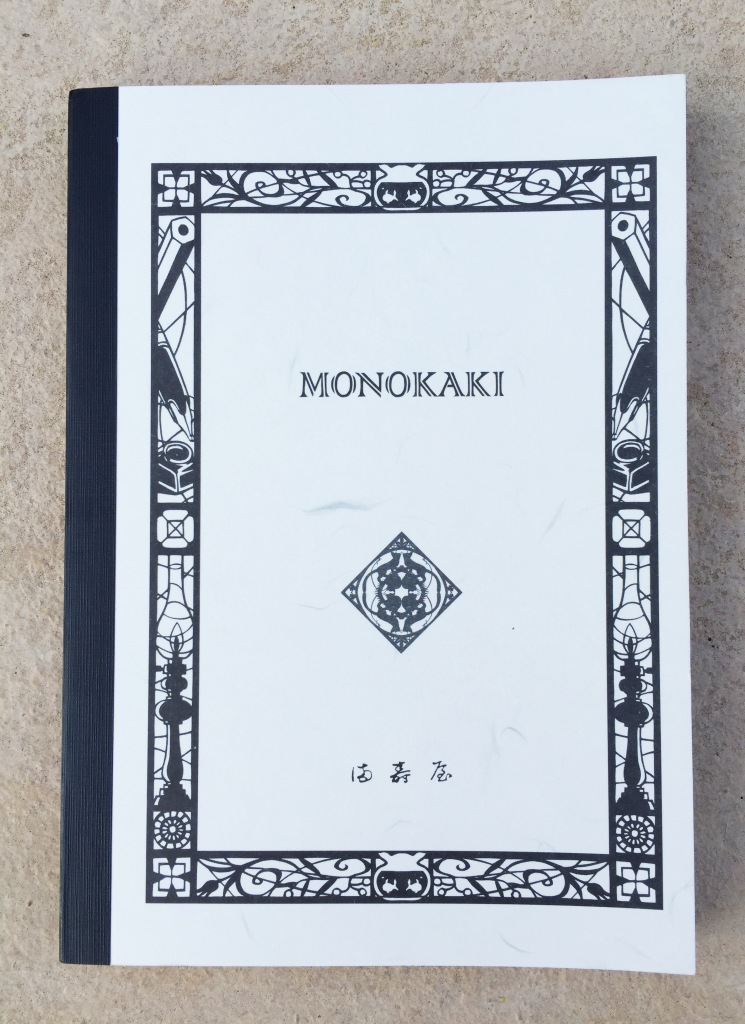
Having this Monokaki A5 notebook arrive in my letterbox a little while ago was indeed a pleasant surprise. Picked up in a Japanese stationery store by a friend during a recent trip overseas, I was the lucky recipient of a notebook I had not come across either in stationery stores or online.
image

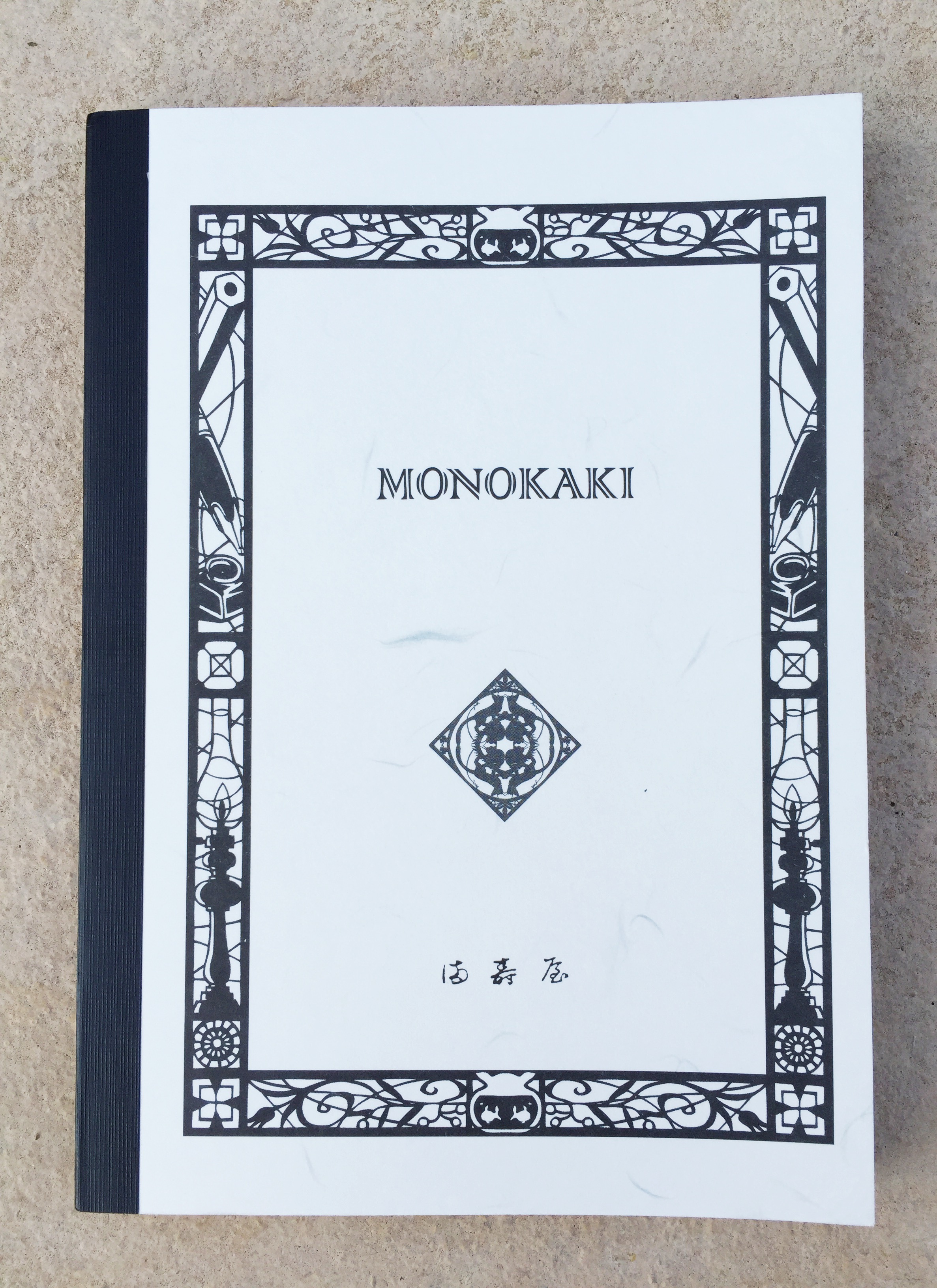
Although I knew nothing about the Monokaki range of notebooks (Monokaki meaning “writer” in Japanese), the quality of both paper and overall manufacturing was immediately apparent. Also, given the decorative border around the front cover included pencil, fountain pen and inkwell motifs, I was further encouraged as to the likely merits of the paper stock, and its ability to handle my favourite writing instruments.

Yes, I was a little excited about this one.

Background

Seeing the unfamiliar Monokaki brand name immediately sent me on an internet search for a little more information, an endeavour which also had me thankful for Chrome’s translation button when viewing the manufacturer’s website. There isn’t as much information readily available compared with some of the more common brands, however what I did find was indeed of interest.

UK store Choosing Keeping (online or 128 Columbia Rd, London) provided some background, which included a little dig at another major brand’s claim about being a notebook for novelists:

The one exception being that while other’s marketing campaigns are entirely fabricated, the Monokaki notebook’s paper – Kotobukiya paper – was really created as a bespoke product for Japanese author Fumio Niwa by the company’s present day owner’s grandmother in 1939 and used by countless authors and poets including no less than two Literature Nobel prize winners and one nominee.

I’d encourage you to click-through and read a little more, as the page also includes information on the company, which continues to operate and manufacture the notebooks from the Sakura district in Tokyo. The 1940’s woodblock cover design apparently comes from Japanese manga artist Ryo Takagi, commissioned to create a design of “traditional Japanese atmosphere – to include familiar stationery and writing instruments”. I think you’d agree the design goal was achieved.

On a more practical note, and certainly of great interest to many of us in the pen community:

The manuscript paper was indeed designed with novelists in mind for its excellent performance when used with fountain pens – no bleeding, no feathering

So all in all, things were looking good, with both first impressions and an initial foray into learning a little more about the brand yielding positive results.

For reference, some links (I’d recommend Chrome for opening those in italics and translating the result):

Update, 13 December 2015: I have now updated the information above which incorrectly stated Choosing Keeping were an online store. The store has been in touch to advise they also have a brick and mortar shop specialising in classic stationery and notebooks at 128 Columbia Rd, London as well. Thanks Julia!

Look and Feel

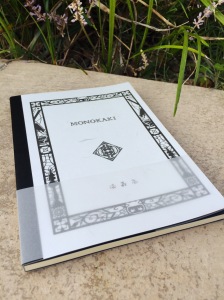
If I consider what actually is my preferred or favourite “look” for a notebook, I don’t believe I really have one to be honest. There are times when an understated black might be what I am after, yet other times it might be something a little more individual or unique. The Monokaki range is itself a little unique in that it probably fits both these descriptions.

I do enjoy a little variety from time to time in what I am carrying, however not at the expense of the writing experience. Considering this, I do have what I’d call a spectrum of tolerance here. By that I mean certain notebooks I’m happy to use even if it means finer nibs and certain inks only, as long as things are not too restrictive. Mind you, that particular subset of nibs, inks and pens must perform without further compromise, otherwise the notebook will be gently set aside and see no further use.

Although I’ve probably begun to drift a little off track, my intended point is to merely highlight the fact there are no real compromises with the Monokaki’s paper — to any of my pens, nibs or inks, as you’ll read about a little further below.
imageimage

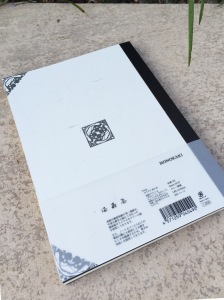
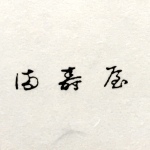
I do love the look of this notebook, with its relatively understated, yet very individual cover design. The contrast of the binding tape complements the unique monokaki_traditional_japanborder and designs contained within it. Even the font used on the cover branding, combined with the central symbol and what I believe to be traditional Japanese lettering (part of manufacturer Asakusa Masuya’s logo) add to the overall design aesthetic of the front cover. The back cover is also not forgotten, containing a central symbol, with both corners also demonstrating fairly intricate detailing.
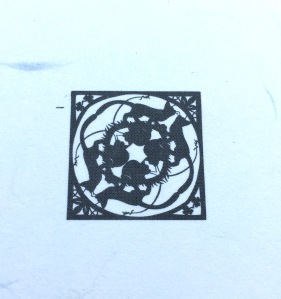
image


While I am not entirely certain if some of these symbols carry significant meaning over and above their decorative effect, the overall feeling I have about the character of the design is one of old world Japanese tradition or history. I have no specific basis for that, however that is the feeling I keep coming back to when I look at it, and is something I find quite compelling.

In the hand, there is a feeling of quality evident in the construction. With time, I’d expect some wear and tear around the corners of the front and back cover if it were going in and out of a bag on a daily basis, however it would more than likely be filled in short order as well if that were the case. That said, I have no real concerns about the overall durability of the cover, if a little care is taken along the way.
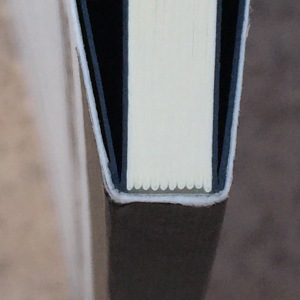
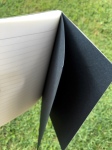
imageThe paper is thread-bound and glued in small sections (apparently to assist flatter opening), and externally reinforced with tape along the spine, which not only provides additional support, but I believe enhances the overall external look. Additional stiffening is also provided by a second sheet of card stock inside the front and back cover, providing a kind of double cover for want of a better term. monokaki_dbl_coverThis again adds to the overall sturdy feel of the notebook, providing additional rigidity to the cover.
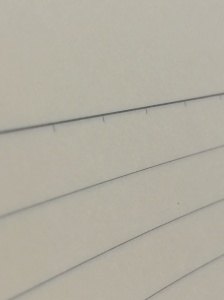
The pages themselves are lined, with a larger margin at the top of the page. The only additional markings are 10 mm graduations marked along the top and bottom line (which are themselves bold), allowing the accurate addition of a vertical margin if you so desire. monokaki_vert_margAt a guess I’d say this may be present to allow vertical rulings to be created for a grid of 24×18 boxes, similar to the Masuya manuscript paper from the same manufacturer.
I do not find the absence of other possible additions such as page numbering or date fields detracts in any way from either the look or the usefulness of the page. In fact, the simplicity of what is offered fits with its overall character.

Specifications

Courtesy Choosing Keeping:

  • Monokaki Notebook
  • A5 210 x 148 mm
  • Soft flexible washi paper card cover
  • Acid-free smooth light cream paper
  • Plain or ruled (lines 9 mm apart)
  • 160 pages
  • Fountain pen friendly cream paper
  • Thread-stitch bound in small sections for flat opening throughout
  • Sizes available
    • Large, B5 – 257 x 175 mm
    • Medium, A5 – 210 x 148 mm
    • Small, B6 – 182 x 128 mm
  • Price £12.00 ($AUD24.70)

Also available on Rakuten Global Market with a list price of $AUD12.56.
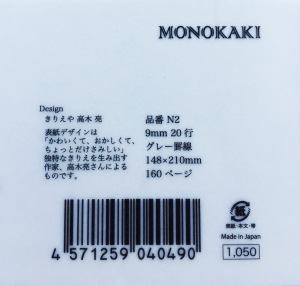
imageA word about the Masuya paper (English page link), which is used in the Monokaki range of notebooks (also referred to as Kotobukiya paper, with both terms used somewhat interchangeably from what I’ve read). Masuya manufacture 2 types of manuscript paper and have a range of 35 different products. Originally cream, the paper also comes in white, created to better reflect the light source — apparently coming about due to one of the previously mentioned “novelists” writing by a single spotlight.

From the site itself (unaltered):

Masuya in Asakusa is a traditional company successing Japanese hand-writing culture. We have various products made of high quality paper many famous writers have chosen. Japanese traditional design, unique touch…

Along with the rather unusual:

Feel Japaneseness through Masuya’s products.

It has been a little difficult to track down more detailed information about the Masuya paper used in the Monokaki line of notebooks, and you will note the absence of a gsm rating in the specifications above. The paper in this notebook is certainly far thinner than a 90 gsm Rhodia or Clairefontaine notebook, and also the 80 gsm softcover Leuchtturm1917 notebook I have been most recently using — by a considerable margin. Given Tomoe River paper weighs in at 52 gsm, then at a guess — and I repeat this is my own guess-timation only, this paper feels like it would be around 60 gsm. I may be way off the mark here, however it is very thin and very light compared to your standard “fountain pen friendly” notebooks — and is certainly closer in properties to Tomoe River than any other paper I have used to date.

Once written upon, the paper has a little of what I’d call that “crinkle”, reminiscent of Tomoe River paper, and does seem to have properties that lend me to think of it in similar ways. At times I feel I have turned one page when I have actually picked up two.

Needless to say, I like it — a lot.

Writing Performance

From my comments above, you probably can see what is coming here.

This paper is pretty amazing — particularly if you enjoy writing with fountain pens, meaning of course it handles pretty much anything else you care to throw at it as well. The exception of course being Sharpie markers and the like, where thin doesn’t always hold up to such an onslaught of saturated ink. For fountain pens though, this is some of the best paper I have written on since, well… since I’ve been concerned with such matters. As much as I loved my Rollbahn and Apica Notebooks of previous reviews, the paper in this one surpasses those.

monkaki_ink

For my paper requirements and preferences, this one is now certainly a favourite. Beyond the obvious shockers of horrendous feathering (my number one hate and deal-breaker), excessive bleed-though (a slightly lesser evil to me), and show through (perfectly acceptable to me for the most part), I’m sure we all have our favourites for various reasons.
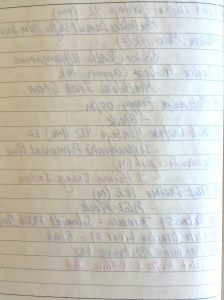
monokaki_reverse_pageThe paper in this notebook has what I’d call a moderate amount of show through for darker and more saturated colours you might use. So in all likelihood, many of your fountain pens. Again if we compare it to Tomoe River, it has possibly a little more — but only just, assuming my eyes aren’t deceiving me.

Because the paper is so lightweight, although it has a little tooth to a gliding nib, there is no sinking in feeling from toothier, heavier-weighted paper. I’ve also noted in the past how on some heavier paper such as a Clairefontaine notebook, I feel as though the nib skates away from me a little, and what I gain in less resistance, also results in less control. There is none of that here — even with more rapid writing. To me it really is the best of both worlds. As far as feathering goes – what feathering? None of that here.

IMG_5250As far as the shade of paper is concerned, I’m a little picky here. Every time I try a notebook in the off-white/cream/yellowish spectrum, I begin by thinking: gee, this would be fantastic in white. However this is typically followed by filling up the notebook with all manner of ink colours and not thinking another thing of it. As you can see from the writing sample page, all of your colours will vividly show in all their glory.

One point I should make here, is that this is not a flat opening notebook, even through the middle third of the book. I have doubled it back and left it open in attempts to coax it a little flatter through the spine to no avail. While not a deal breaker for me, it is noticeable, and something which does get in the way of the writing experience somewhat. Something to consider in any event.

In summary, the writing experience is as close to a Tomoe River experience as you can get. Why is that relevant? Well, Tomoe River paper is popular and well regarded for a reason. Light weight paper, smooth without the slip, handles pretty much every ink and nib, a little show through yet no bleed or feathering. Sound familiar? Indeed it does, however applies equally well to the Masuya paper in this Monokaki notebook.

Probably the one thing about these types of paper that can sometimes be an issue is ink drying time. By comparison, the Monokaki on average dried a few seconds faster for a given ink — often at around the 15 seconds mark, versus 18-20 seconds for the Tomoe River. So again I found the overall performance quite similar.

Without a doubt this is great paper, and if you are at all able to get your hands on some, I highly recommend trying it out — whether in notebook or manuscript page format.

Conclusion
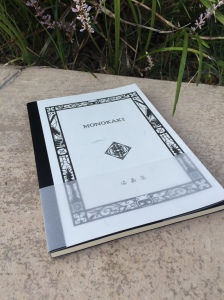
imageThe Monokaki A5 Notebook is indeed a joy to use, largely due to the writing experience of the Masuya paper itself — and isn’t that pretty much the key to our love of pens and paper? True, I have a little flexibility as far as my specific paper requirements for writing, and this Monokaki Notebook sits very close to the favourite end of that spectrum.

To make it pretty much perfect? There is probably nothing I’d change about the properties of the paper — for fountain pens it is pretty much spot on. I’d perhaps tweak the binding to allow truly flat opening; opt for a truer white in paper shade; and finally, have a local store or online seller stock the range so I can easily replenish my supplies when they dwindle!

This is certainly a great notebook, and with 160 pages to play with, will serve me well for a little while longer — and that can only be a good thing. I often get the impression there is a whole world of Japanese stationery that I am entirely oblivious to — which is also a good thing, for it simply means there will always be more to discover.

Wiser Web Wednesday

Wiser Web Wednesday – a semi-regular link to posts of interest from around the web, by those far wiser than myself:


Vox
Ahh yes, remember those? The real video store? No doubt many of us spent a good few hours wandering the aisles picking out the perfect film on that perfect delivery vehicle – the VHS tape.

The decision to leave a movie behind on the next technological leap is market-driven, which makes video stores the last safety net for things our corporate overlords discard. (That’s why the chain stores died first — like Netflix, they peddled convenience and “all new, all the time” — Netflix came along and just did what they did more efficiently.) A real video store buys a movie and saves it, regardless of such considerations.

A lot has been said about the merits of “curation” in music streaming over the past year or so. Although unfortunately a tale of demise, it could be said this is an example of curation at its finest:
I worked in a video store for 25 years. Here’s what I learned as my industry died


Femsplain
Although only a few of those listed align with my own, as a father, I have an equal number of triggers which may set me off on varying degrees of sternly worded explanation and rationale to my children.

I finally understand, that he only gets as upset as he does, because he really really cares. About his family, his country, his home, his responsibilities — the care runs DEEP.

Unsurprisingly, all for much the same reasons mentioned above:
Papa Loco


James Greig
Sound familiar?:

Option 1: Pull out your phone, and automatically tap Twitter open. Scroll through your feed for a few minutes, the usual stuff, nothing that interesting. Then Instagram. Ditto for that feed. Then Facebook. Baby photos. More baby photos. Then you look up, and ten minutes have evaporated, and your train is pulling up in front of you.

Option 2: Pull out a book, and read for ten minutes.

Not such a bad idea:
Can’t concentrate? Try swapping your ‘smart’ phone for a monotasking device


Pens! Paper! Pencils!

While it is nice to uncap and let loose with a pricey pen, in the mayhem leading up to Christmas, I’d agree that finding value at the other end of the dollar spectrum can be equally, if not more rewarding.

Top end pens are exclusive and, thereby, excluding, and whilst I do like some really rather pricy pens I do much prefer it when I find a bargain

As a bonus in this link you will also see one of Ian’s fine sketches:
Dorset Countryside


The Pen Haul
Sometimes the cheap ones just do the trick. Although not to be confused with the Red and Black notebooks available at Officeworks in Australia (or perhaps they may perform equally well, I’m not sure), these appear to have the key criteria covered:

The characteristics that we look for are all there. No feathering, no bleed through (besides the above exception), fairly smooth with a tiny bit of tooth, and best of all you can still see the full depth of the ink, such as shading and sheen.

You never know where the next hidden gem will come from:
Black n’ Red Notebooks


The Clicky Post
Ok I admit it – part of me wanted this review conclude the Dyson pen wasn’t so great. Then we could at least say it sucked couldn’t we?

My apologies, and I will now show myself to the door. Before I go, at least read this great review of a pen it would appear not many of us are likely to find in our hand:
Dyson Biro Ballpoint Pen Review


Pentulant
There is something fairly satisfying in knowing exactly what writing experience you will get when purchasing a familiar notebook. In this case, the quality Rhodia experience. After that, you are left to experiment with external appearance at will, and I do love this Silver edition.

A great review, with images to match, capturing the essence of that gorgeous silver finish.
NOTEBOOK REVIEW: Rhodia Webnotebook Silver Edition


Macdrifter
How will you ever find these gems unless they are shared?

As usual, the documentation is the weakest part of the product. Every week I find some new reason to love my big phone.

Sometimes I get the feeling every OS update (whether i for X) simply brings a few more features I remain unaware of:
The Hidden Convenience in iOS 9


MacStories
Federico Viticci on Dropbox announcing a shutdown of the email app Mailbox and photo management service Carousel. No sooner had I read this than the official Saying Goodbye email came through from the Mailbox team.

Knowing this was coming (lack of development; rumours), the goodbye email was ironically one of the first I read using Spark mail by Readdle, having installed it on my iPhone that morning. Now that is indeed a great app.

Another one (or two) bites the dust:
Dropbox Is Shutting Down Carousel and Mailbox


Perfect Daily Grind
Although discussion on traditional Vietnamese coffee often focuses on the unusual sweet brew:

It’s a super concentrated shot of coffee – around 25 g of coffee with a small amount of water – and served with sweetened condensed milk. It can be enjoyed hot or cold, and this preference can vary from region to region.

A nice reminder here of the ritual involved in preparing a cup.

The Vietnamese coffee ritual is almost a revolution against our fast-paced modern lives. It goes against takeaway coffee culture, rushing in and out of shops to sip your coffee in environmentally unfriendly cups.

It’s for everyone who understands that good things take time. It makes you take a step back and enjoy the little things.

Isn’t that what we should all be doing — enjoying the little things:
Time to Slow Down and Rediscover Vietnamese Coffee?


HUH
This one via Ben Brooks.

Yes one of those unsurprising conclusions. I have been on Facebook for less than year, joining for a specific and very worthwhile reason.

I’ll continue, however it’s not hard to understand why quitting what is on many days, an endless feed of either “look at me” or conversely, a chronology of whinging, moaning and complaining might make you a little happier:
Study Finds Quitting Facebook Makes You Happier and Less Stressed