Wiser Web Wednesday

Wiser Web Wednesday – a semi-regular link to posts of interest from around the web, by those far wiser than myself:


Pens! Paper! Pencils!
What appeals to me most about systems such as the Atoma or Arc is the ability to reorganise the page order at will — something I typically find quite useful for larger projects.

What makes it not quite perfect: while the system is good, the paper can come unstuck now and then if you’re careless turning the pages. There’s also something lovely about writing in a good quality hardcover notebook that you don’t get with this.

Ian has done a pretty good job in sourcing a great value alternative, which incidentally appeals to me even more:
Atoma and Arc Notebook Systems


Alt. Haven
Junee reviews a pretty good-looking and well performing entry-level pen, in the Platignum Studio.

An affordable and colourful offering from a brand I haven’t really seen a great deal written about before:
Review: Platignum Studio


Crónicas Estilográficas
After seven years of blogging on mainly vintage pens, some thoughts from Bruno Taut on some of the changes that have occurred over that time — particularly as the actual pens become more difficult to acquire.

The conclusion of all this is that writing about pens and, particularly, about vintage pens is a bit like shooting ourselves on the foot. But somehow I enjoy it—the writing, not the bullet.

Thanks to blogs like this one, the information is certainly a little easier to find, but the pens themselves? Perhaps not:
Side Effects


Ink and Ben
Ben Elijah with some thoughts on encryption, and an interesting take on perhaps improving your own.

It’s important to make a difficult, mature decision about the compromise you’re prepared to make between the convenience you want and the security that you need. Right now, I want more security and I’m prepared to tolerate less convenience.

So, I’ve decided to experiment with taking my task system partially offline. So I’ve retired my OmniFocus installation and work from paper.

Whether you are talking simple organisation, or something as important as encryption, we all make trade offs in what we use and how we use it. In case you were wondering, the possibility of loss or theft of a physical notebook is also acknowledged:
Upgrading to Paper


Laughing Squid
These great looking postcards have a complete picture only when stained with the ring from a cup of coffee — just don’t waste too much finishing off your masterpiece.

Better yet, send me one and I’ll finish it off myself:
Adorable Postcards That Are Only Completed When You Stain Them With a Coffee Ring


MacStories
Yes — another blurb from me on Ulysses.

I’ve been using Ulysses on my Mac (and subsequently my iPad) since 2014’s NaNoWriMo, and have not needed to look elsewhere. It has all the features I need, and beyond that, it simply suits me, the way I write, and what I then do with said writing.

One of the significant ways Ulysses stands out and earns its price tag is with a variety of feature, power, and polish in the vein of what I’ve already mentioned, spread throughout the app. In my experience with nearly every app you could name, you’ll be hard-pressed to find much of this elsewhere.

With Ulysses for iPhone now released, read a comprehensive review on Macstories.

Ulysses for iPhone — you complete me:
Review: Ulysses 2.5 for iPad and, now, iPhone


Macsparky
One of the reasons I love Ulysses so much is its suitability for all my writing, large or small. Don’t take my word for it though – David Sparks is infinitely more qualified to comment than I:

It lets you collect bits of text together and organize them, reorganize them, hide them, delete them, write them over again, and generally carry you through all the angst that comes with large writing projects. I currently have 2 books half-written in Ulysses and several long legal briefs and letters.

Collecting bits of text? Absolutely, these weekly links are now collected as seperate sheets via the Ulysses iOS extension; tweaked a little; then merged into this post.

Brilliant:
Ulysses Version 2.5 — MacSparky


Open Culture
My high school years through the 80’s were in no small part accompanied by a New Order soundtrack.

Not played quite like this though:
New Order’s “Blue Monday” Played with Obsolete 1930s Instruments


Colossal
While we’re on music — not really sure how to explain this one.

…the Wintergatan Marble Machine, a hand-cranked music box loaded with instruments including a circuit of 2,000 cascading steel marbles. As the devices cycles it activates a vibraphone, bass, kick drum, cymbal and other instruments that play a score programmed into a 32 bar loop comprised of LEGO technic parts. The marbles are moved internally through the machine using funnels, pulleys, and tubes.

That will do it. Certainly worth a look:
This Ludicrous New Instrument Makes Music with 2,000 Marbles


The New Industrialist
A post which although not its specific intention, goes a long way towards explaining why we are so passionate about our side interests.

We may even have an organisation chart that shows that someone is now an ‘Improvement Champion’, ‘Project Champion’, ‘Lean Facilitator’ or some other title. They have been touched by the Magic Wand!

I know them well. Someone, please save me… please?:
Why Lean Manufacturing, Six Sigma And Other Improvement Projects Fail


The Fix — MistoBox Blog
You could do worse than cherry picking a few of these items for a home coffee brewing setup:
Inside Peek: MistoBox Director of Coffee’s Favorite Coffee Gear


The Barista Hustle
A new page on The Barista Hustle looking to create the resource for links to articles on all things coffee, many of which would otherwise be scattered about the Barista Hustle Facebook page.

Matt Perger in the Barista Hustle newsletter describing the page:

Brew recipes, research papers, blogs, videos; you name it, I want The Guide to have it. Soon it’ll be a one stop shop for anyone looking for anything to do with coffee.

A great resource in the making:
The Barista’s Guide to the Galaxy


Coffee: A Natural Processing Experiment Part 2 – Methods and a little madness

Welcome to the second instalment in a series of posts describing my use of dry processing methods to take a small batch of coffee cherries from the tree and into the cup. If you missed the initial post, you can find it here, along with a series of posts from a couple of years ago on washed processing methods which I have recently combined and republished.

Since publishing Part One some weeks ago, I’ve been crunching a few numbers (I do mean just a few: no complex algorithms or statistical modelling here), and hopefully can present something coherent about how this whole thing proceeded.

My expectations

To recap, I am experimenting with two dry processing methods: Natural processing, where after picking, the whole coffee cherry is simply laid out and sun-dried. Once the whole cherry has dried, depulping and hulling then follow. The second is Honey processing, where the flesh or pulp is removed from the cherry first, leaving the sticky mucilage layer on, with the beans then laid out and sun-dried.

At the outset, I planned to have the beans drying for three to four weeks or so, remove the pulp and mucilage from the naturals, and allow them to dry for a further week before roasting. The honey processed batch? Well, that was anyone’s guess, as I really had no idea how long it would take for the sticky mucilage to dry on the outside of the bean — particularly in a climate known for its humidity. Time would tell me, or so I hoped.

For that matter, I wasn’t even entirely sure as to how I would tell when the drying process had reached a stage where roasting would then be possible. I have mentioned the often quoted 12.5% moisture content in previous posts, however I do not have the necessary equipment to readily determine the exact moisture level.

Time and estimation would have to do.

Tools

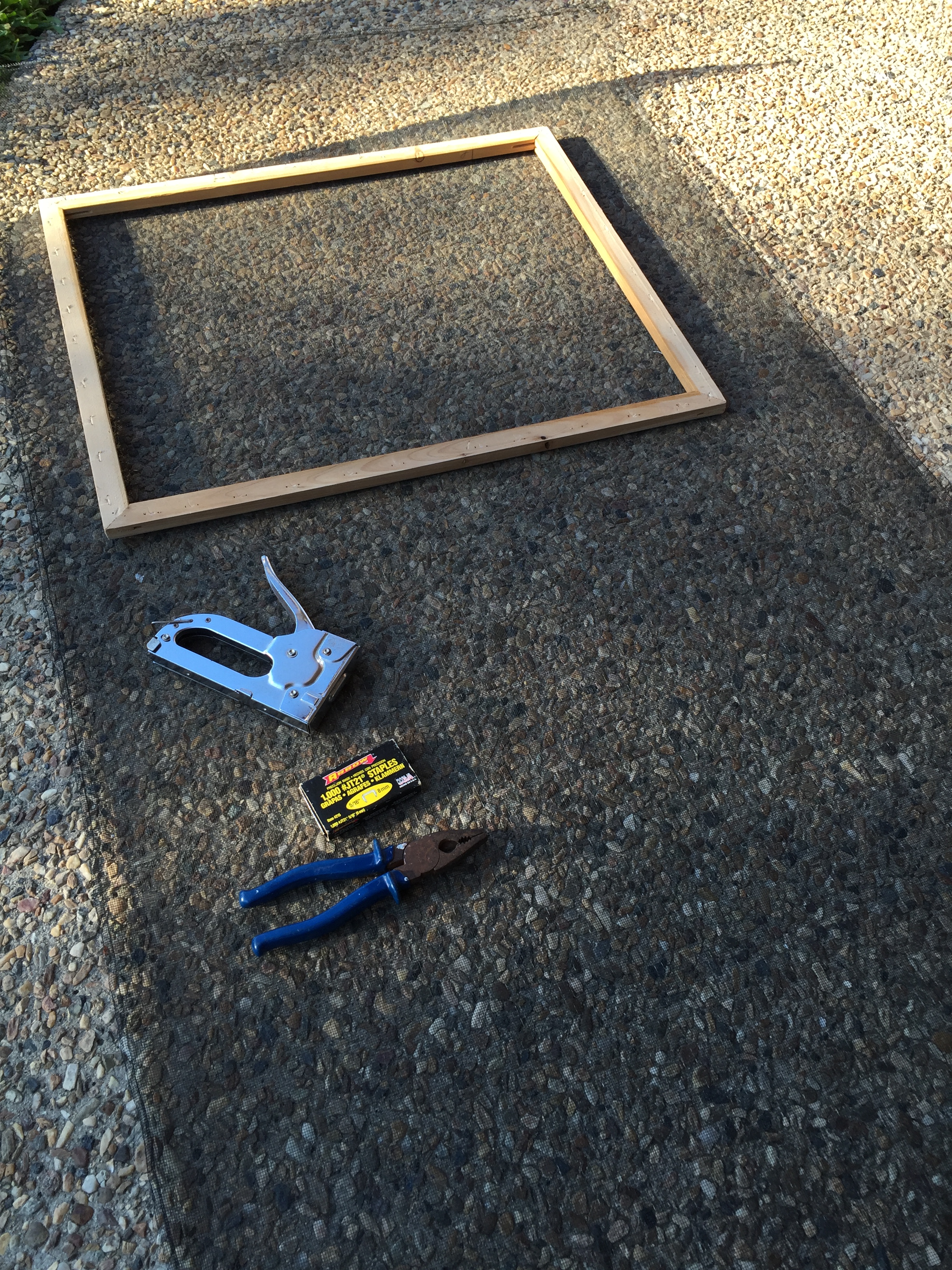
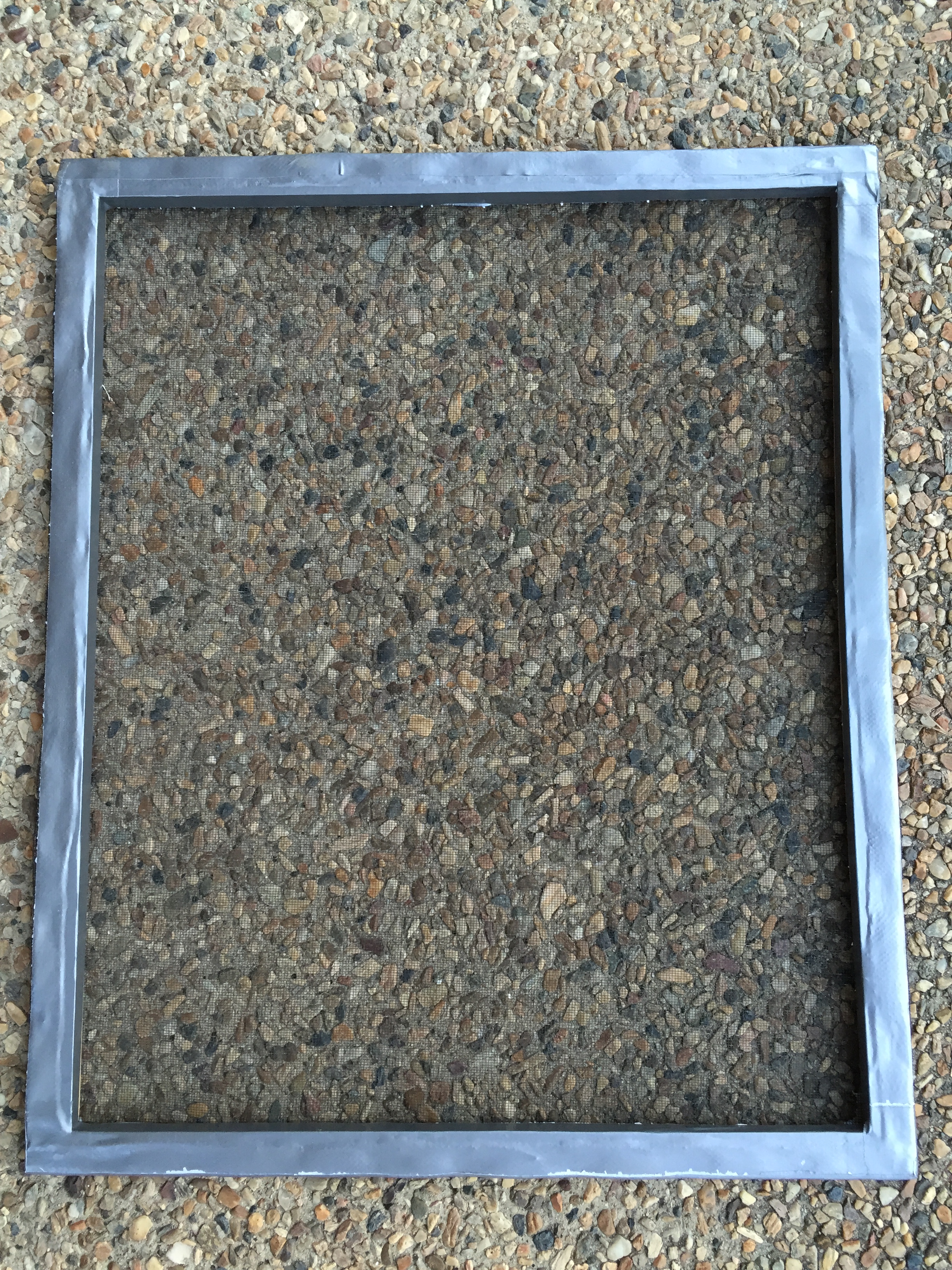
I say tools — however there was really only one: my custom-made raised drying bed. Sounds pretty fancy when described like that, however it consisted of a flyscreen-covered picture frame sitting across the arms of an outdoor chair. Fairly rudimentary, however not a great deal of complexity is needed to ensure adequate ventilation and airflow.

IMG_4915 IMG_4923

Other than that, it was simply my iPhone for recording photos and data, Day One app as I’ve mentioned in a previous post, and a couple of bowls for both beans and debris when depulping the honey processed lot and eventually the same for the naturals after drying.

Methods

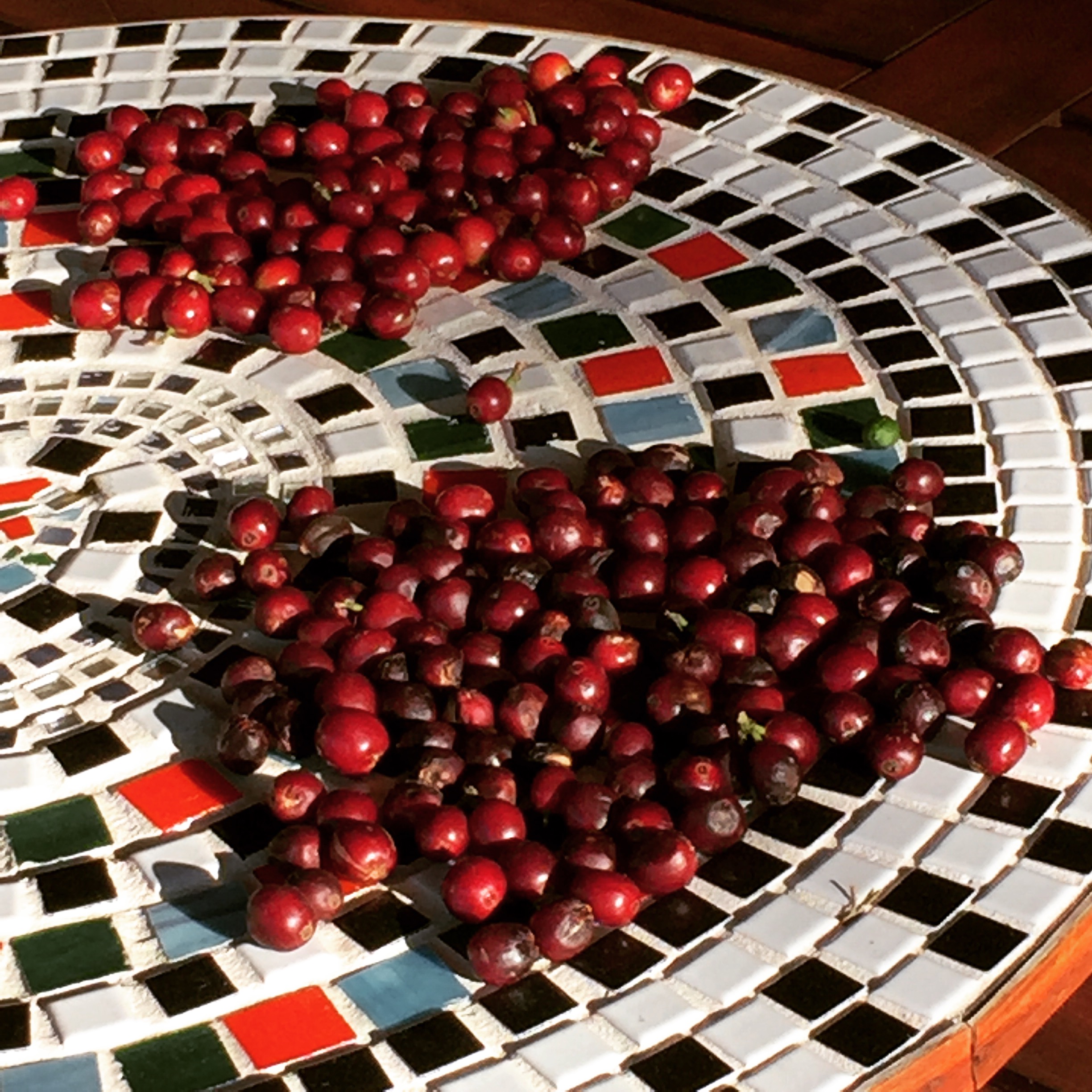
Before we get too much further not things, I probably should mention upon beginning this whole process, I had 420 grams of coffee cherries by weight at my disposal.

IMG_4919

These were split into the two groups evenly, with 210 g into each of the natural and honey processed groups respectively. Of course this reduced quite significantly in the honey group once the pulp was removed, however I did not check the actual weight again.

Initial processing

As you can imagine, the naturals required zero processing to prepare for drying, with the exception being to check for any bad fruit.

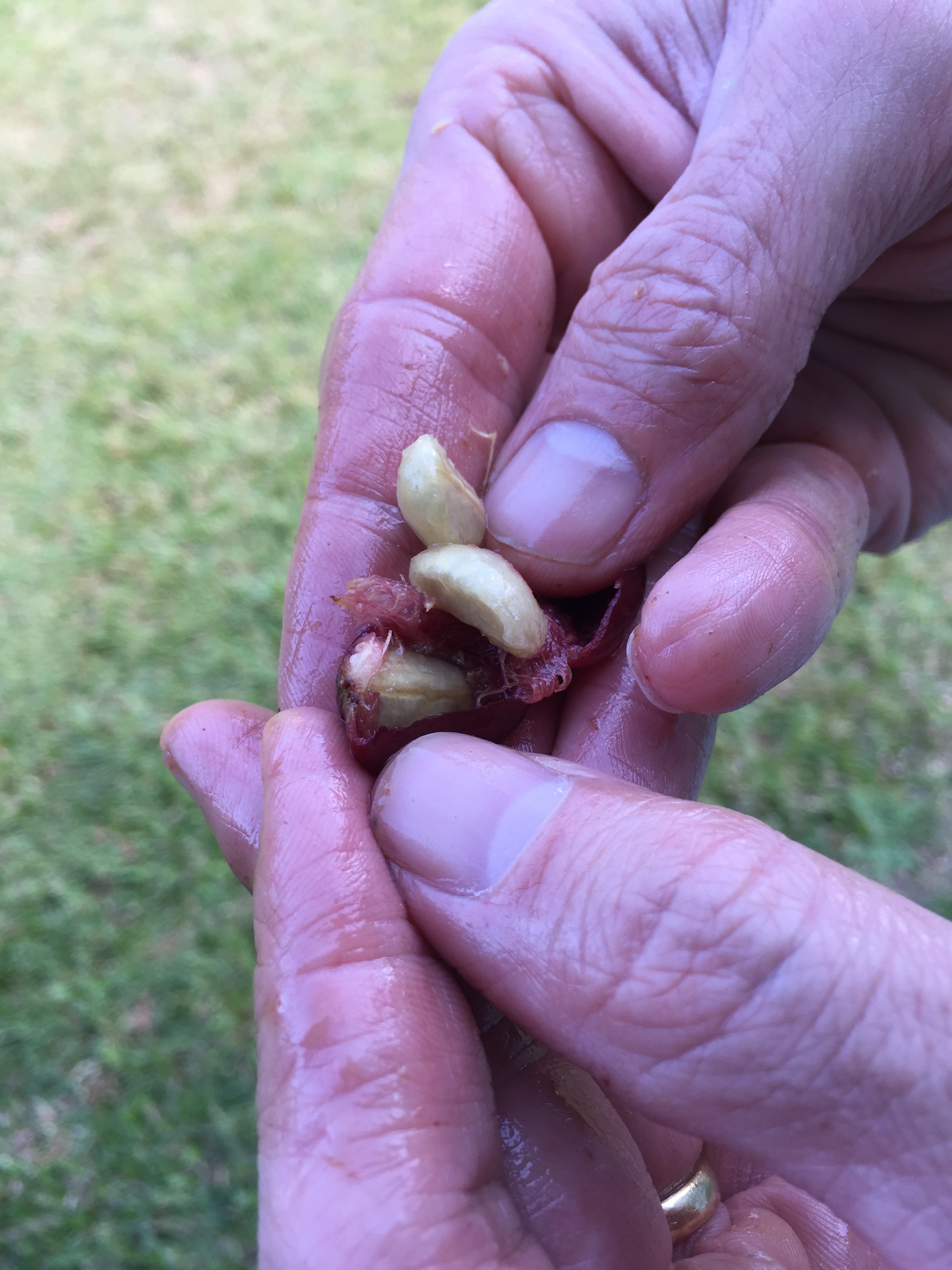
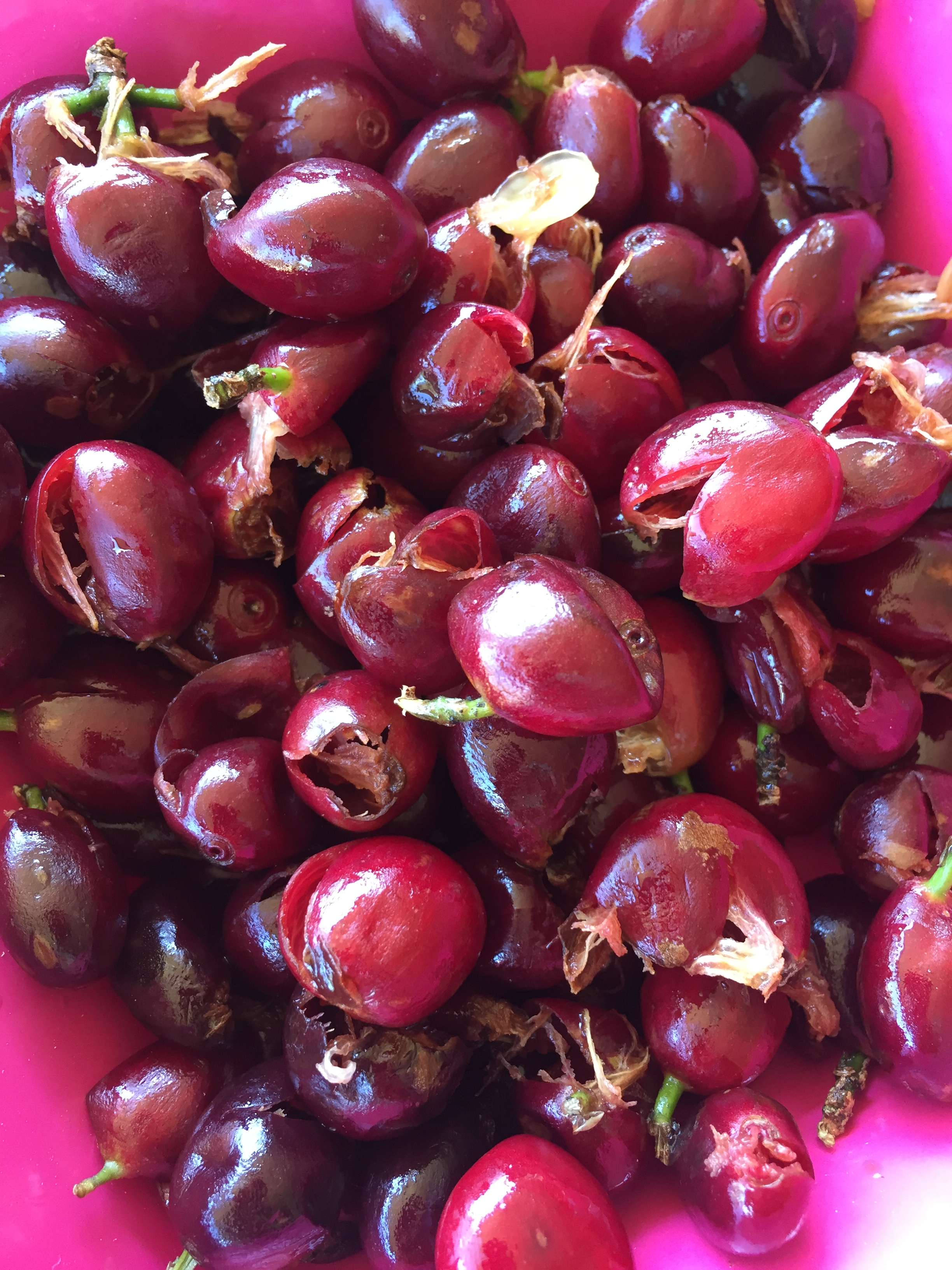
For the honey group, this amounted to depulping or removing the skin and outer flesh by hand, leaving the sticky mucilage covering the parchment layer on the outside of the seed or “bean”. Not an overly onerous task, however at any great scale would require significant time and effort — or machinery.

IMG_4929 IMG_4930

Once complete, out on the drying rack they went, with a Day Zero photo taken, and we were under way.

Drying

Over the course of the drying period I followed the same routine to ensure the beans were regularly turned, and also covered from any dew which formed in the evenings:

  • at around 6 am each morning the chair and drying rack were placed out in my back yard in a position of full sun;IMG_4934
  • a photo of each batch was taken and uploaded to Day One with additional humidity data from the Bureau of Meteorology (courtesy of the Pocket Weather Australia iOS app);
  • any additional comments were added to the entry;
  • upon returning home from work, both batches were manually turned, with the drying rack placed back under cover of the patio roof, ready to repeat the process each day until completion.

It was during this process a little bit of madness set in. As I have mentioned on numerous occasions, the mucilage remaining on the honey processed batch was quite sticky. If you’ve ever had to move and turn numerous small sticky objects you’ll invariably understand the ensuing challenge.

By hand, well… the beans simply stuck to my hand. By a plastic IMG_5086paint scraper… the beans simply clumped and stuck to that. Eventually, I resorted to simply turning them by one by one. Wait…what? Yes, that’s right, flipping over each little bean and placing it softly down again on its little bed for the night, only to have it face the searing sun again the next day.

One. At. A. Time. Like I said — madness.

Despite this insanity, the routine worked well over the weeks this IMG_4995whole process took, with the exception of a few days where I was either home late or in a rush, and didn’t stop to turn them or record data and photos. In any event, each night they were in and the following day back out. During some stormy weather for a few days during the middle of the drying period they were also left under cover during the day. Better safe than sorry.

Final processing

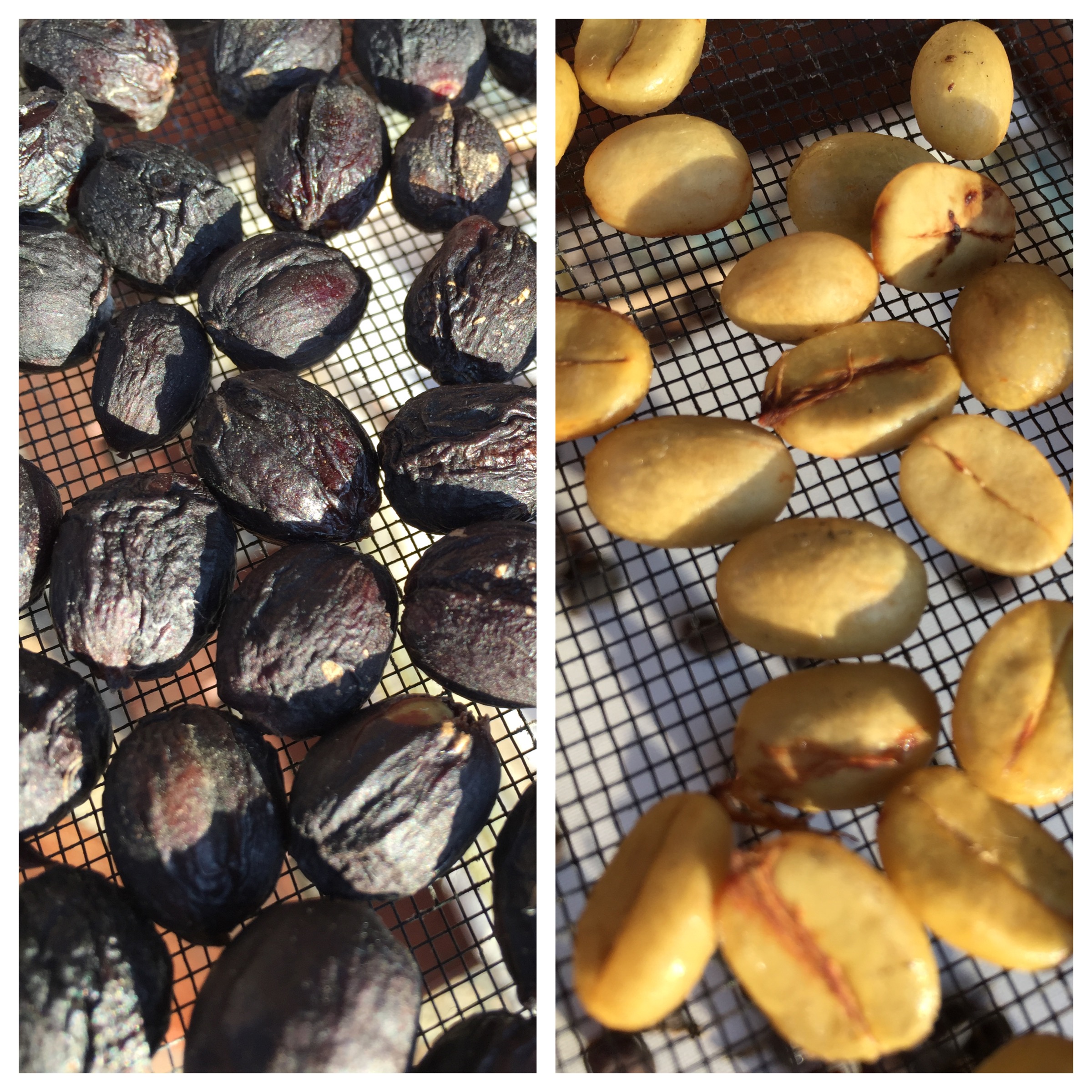
Once the drying process was complete, we end up with essentially the reverse to how we started. The naturals required depulping, and for the honey group, only removal of the final parchment layer to expose the bean inside.

Just to be sure I planned to then leave the beans a further week before roasting.

The data

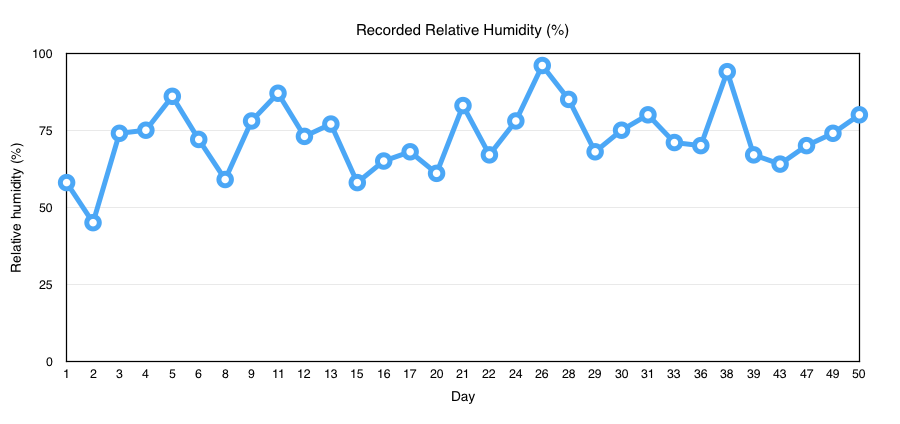
The result of the data recording in Day One was a 64 page PDF export containing basic data such as day, date and time; weather information (temperature and description); a photo record of the bean appearance, and any additional comments I made for the day’s entry, which importantly included a record of the relative humidity at the time — a known enemy of natural processing.

Although there were 64 entries, these were made on 32 individual days, with two entries per day the result of taking separate photo of each of the natural and honey groups each day. Although it might have been nice to upload two photos on the one entry, that was not a feature available to me at the time, however it is now, with a fantastic recent update to Day One.

Drying progress one week in.

Drying progress one week in.

Further to this point, although the entries were made on 32 individual days, with a few days missed here and there for various reasons, the entire process spanned 50 days in all — perhaps a little long, however we will get into that later. Typically around the time I begin entering data into a spreadsheet is when I also realise a few additional data points or variables collected may have assisted the overall analysis a little — this time was no different. Upon adding the temperature data, it soon became apparent the numbers probably didn’t quite reflect the actual temperature during the day, when those little beans took one for the team, and spent many hours in reasonably hot sun.

When entering the numbers I found myself thinking it had been a very mild October compared with how I remember it feeling day-to-day. It wasn’t long before I realised this was largely due to the fact that the times I had available to snap the photo and add the Day One entry, were either before or after work. Of course both these times occurred when the temperature had either yet to rise, or was already falling — really, must an occupation get in the way of everything — particularly hard-core science?

Thankfully, gathering additional data retrospectively is what we have the Internet for. The Bureau of Meteorology kindly helped out with mean, maximum and minimum temperatures, and a few other pieces of information such as rainfall and average sunshine over the course of the drying period. Would all of this additional data make any difference to how I conducted the drying? Absolutely not, however I think it does provide you with some idea of the conditions at the time, and perhaps whether or not it might be something you’d try yourself relative to how things turned out.

So, those numbers:

  • Drying period 50 days through October/November (Southern Hemisphere Spring);
  • October mean temperature range 16.3 – 27.1 degrees celsius (actual temperatures 12.9 – 33.8 degrees celsius);
  • November mean temperature range 19.8 – 29.2 degrees celsius (actual temperatures 16.1 – 33.4 degrees celsius);
  • mean hours per day of sunshine: October 9.1 hours; November 9.2 hours;
  • Total rainfall: October 55.8 mm; November 74.2 mm

What good is recorded data without a few charts, so I have included daily temperature and humidity recordings below, along with my own bean turning degree of difficulty score — which I understand is quite complex, however if you look hard enough I think it tells a story.

Screen Shot 2016-03-13 at 6.29.10 AM

Screen Shot 2016-03-13 at 6.29.29 AM

Screen Shot 2016-03-13 at 6.29.56 AM

Next: results and a few lessons

This post has started to become a little lengthy, so I have split off a closer look at the results and outcome for next time.

I’ve said it before and I’ll say it again here: the absolute best thing about writing this blog (beyond the knowledge that a few people actually read it), is what I learn along the way. Not simply from the research and dodgy backyard experiments that ensue, but how the act of writing makes me think a little more on the results, and what I might do differently or look into further next time. You know, that realisation you sometimes get: “well now that I say it out loud I’m not sure if it really is such a great idea”.

I hope you’ll join me for a few more realisations in the next post.


Wiser Web Wednesday

Wiser Web Wednesday – a semi-regular link to posts of interest from around the web, by those far wiser than myself:


The Pencilcase Blog
Making a pen display cabinet like this one is certainly an impressive feat. Filling it with hand-made inlays as well? Even more amazing.

Wow! Job well done I’d say:
Tinkerink: Making A Pen Display


The Gentleman Stationer
I put down a few thoughts about my blue Custom Heritage 92 a little while ago. It is a pen which remains one of my absolute favourites, and I cannot see that changing any time soon. Looking at the orange model in this review gives me an inkling I may want another someday.

Pilot makes a “FM” nib (or a Fine-Medium), which is the perfect width for me to use as a daily writer. On more absorbent paper, the FM nib leans more to the medium side; on Rhodia or Clairefontaine, the nib writes more like a Western fine.

Judging by the review, Joe quite likes it as well:
Pen Review: Pilot Custom Heritage 92

Without making this a Gentleman Stationer link-a-thon, Joe also wrote a great post outlining some resources to encourage and inspire the analogue side of your life, which of course should assist in balancing the digital we all have our heads buried in a lot of the time:
10 Resources to Help You Improve the Digital-Analog Balance in Your Life

Oh — and incidentally, this ties in well with Digital Divide, a special monthly edition of the TGS Newsletter Joe will be sending out, addressing that very analog and digital balance.

Ok I’m done now. Moving on.


The Ink Smudge
Although you’ll find many reviews of the TWSBI Eco through an online search (which should always begin at Pennaquod of course), I particularly thought this was an apt description for such a pen:

What I mean by beginner pen isn’t necessarily the first pen, but the pen you get when you aren’t afraid of buying a whole bottle of ink.

Or perhaps the one you get to try out a stub nub:
Review: TWSBI ECO 1.1 Stub Nib


The Pelikan’s Perch
A great early scoop on a possible limited edition Pelikan M1000 coming this year.

Thanks to an anonymous source out of Japan, we may just have our first look at the rumored but as yet unannounced Pelikan M1000 Raden Sunrise.

Looking at it (though I’d never be in the market to buy), this is one of those pens I’m not sure if I like it or not. Whenever this situation arises, with time it often hits me one way or the other.

For now, I’ll reserve my decision:
News: M1000 Raden Sunrise


John Scullen
A nice overview of Spark, an email app for iOS which seems to be quite popular at the moment — and for good reason. Like many others, I switched over during the twilight of Mailbox and have stayed on since — both on my iPhone and iPad.

Everyone has a different approach to email, so flexibility is important. There’s not much that you can’t configure in Spark

Agreed, there is certainly scope for customisation so, however for me, it is also just an attractive, functional app that suits how I deal with email:
Spark: The Innovative Way To Fly Through Your Email


9to5Mac
Speaking of Spark, here is a list for going a little deeper into the details:
How-To: 50 getting started tips for new Spark users


Macdrifter
Most of us need to redact and/or annotate screenshots on iOS from time to time.

While there’s a wealth of options on the Mac for image annotation, there are very few complete options on iOS.

A great idea — why not go with a fairly powerful app when you do need one?
Redaction and Annotation With Pixelmator for iOS


Daily Coffee News
A phenomenon not unique to used coffee capsules I’m sure. Still, an unsurprising yet no less unfortunate scenario:

When the pods are not visible in the trash or recycling bin, people care less.

Compounding things is the popularity of capsule machines and the subsequent volume of waste produced. A simple “solution” it appears is not about sustainability, but simply invisibility.

As consumers are we really that simplistic and it must be said — disappointing in our attitude?
The ‘Out of Sight, Out of Mind’ Solution to the Capsule Sustainability Problem


Perfect Daily Grind
An interesting discussion on improving the criteria for identifying the ripest coffee cherries for harvesting. Looking at factors such as colour change, pulp softening, sugar content and aromatic compounds, the study resulted in an interesting finding:

We compared the color of the 1,000-day lots to their cupping score and found a strong correlation. In fact, we found it to be the most significant out of the three variables

That’s right, the highest correlation with cupping scores was found in the colour of the coffee cherry — something readily identifiable by an experienced harvester, and in many ways the traditional means of assessing fruit:
Coffee Science: How Can We Identify & Improve Cherry Ripeness?


The Guardian
A plausible explanation from two of the world’s largest coffee companies: Nestlé and Jacobs Douwe Egberts?

…both companies – whose brands include Nescafé, Nespresso, Dolce Gusto, Coffee-mate and Senseo – admit that while they do not buy beans directly from “blacklisted” plantations where human rights abuses are known to take place, they cannot rule out that slavery-like conditions may exist in their supply chain

Or an overlooked issue perhaps not addressed until it had to be:
Nestlé admits slave labour risk on Brazil coffee plantations


The Fumbally
What happens when someone in a cafe thinks: “Surely there’s something we can do with the milk we tip out of these jugs all day”.

We get about 1kg of cheese from 8 litres of milk which we then season and mix with herbs and spices for our sandwiches and specials, or give it to our baker to use in some of the cakes as a cream cheese substitute.

Nicely done:
Fresh cheese from waste milk


Wiser Web Wednesday

Wiser Web Wednesday – a semi-regular link to posts of interest from around the web, by those far wiser than myself:


Cardiogram: What’s your ♡ telling you?
Perhaps I should be more interested, however I’ve never felt the need to track my incidental movement or exercise.

In cardiovascular terms, the drop in heart rate from 1000 steps/day to 2000 steps/day is significant: a full 3 bpm decrease. And as step count increases, resting heart rate steadily drops—until you reach about 5000 steps per day. After that—6000, 7000, even up to 10,000 steps—the curve flattens.

For those that do, perhaps the threshold for benefit is lower than first thought — or at least the minimum effective dose, in any event. Of course a reduced resting heart rate is only one benefit of increased movement — if you’re aiming for weight loss, the more movement the better:
Do you really need 10,000 steps a day?


WhiskyCast
Following on from last year’s request by the Scotch Whisky Association for Compass Box to remove age information from marketing materials:

Today, they took that fight to the whisky community with an online petition drive aimed at persuading the European Union to change the current regulations to allow whisky producers the option to provide full disclosure on the component whiskies used in a specific product.

It’s only transparency after all:
Compass Box Launches Scotch Whisky Transparency Campaign

An initiative then immediately endorsed by fellow distillery Bruichladdich:

We believe that our customers should be able to find out the age, provenance and proportions by volume of all the casks that make up the different vattings of The Classic Laddie, bottles of which do not carry an age statement.

Sounds fair:
Bruichladdich Stands Behind Compass Box in Scotch Whisky Transparency Campaign


Harry Marks on Medium
My favourite literary podcaster Harry Marks on filling those empty notebooks sitting on your shelf:

There’s only so much joy you can get out of looking at an unopened pack of notebooks before that joy is replaced with longing. Longing for stories untold and lists un-checked, for ideas and phone numbers and ephemera that whips across your face like a blizzard as you go about your day.

I’d agree, and argue far more joy can be had from looking at the worn spines and swollen pages of full cover-to-cover writings:
How Many Notebooks Do You Really Need?


MacStories
For anyone who follows Federico and Macstories, a piece such as this comes as no surprise.

The tide, however, is turning. Over the past year, it’s been fascinating to observe how, gradually, using an iPad as the primary or only computer has turned from a nerd chimera into an acceptable narrative.

One thing I have (I think?) noticed is a significant increase in iOS and iPad love across the internet since the release of the iPad Pro. A better iOS experience or just a bigger one? Of course those concepts probably aren’t mutually exclusive.

It doesn’t really matter, for the Viticci iPad train continues to charge along, regardless of screen size:
Working on the iPad: One Year Later, Still My Favorite Computer


Study Hacks – Cal Newport
Cal Newport on why you might need an “attention charter”:

And yet, in my own experience, I find that the occasions when I most despair about the tattered state of my schedule are almost always the result of the accumulation of a dozen yeses that each made perfect sense in isolation.

And an “attention charter” is?

An attention charter is a document that lists the general reasons that you’ll allow for someone or something to lay claim to your time and attention. For each reason, it then describes under what conditions and for what quantities you’ll permit this commitment.

I’m sure we all have some vague concepts or intentions in our minds, however perhaps a more formal approach to something like this might bring greater success in its application:
Write an Attention Charter


Diana Urban
Some straightforward advice on cutting a little cruft from your word count.

While this might not be the ultimate list of all words you should remove, these are the ones I look for when I’m doing revisions

Upon reading this, please don’t apply the concepts to any of my posts. I’ll improve – I promise:
43 Words You Should Cut From Your Writing Immediately


Sanspoint
I made the switch from OmniFocus to 2Do a couple of months ago, as I have mentioned more than a few times on these pages.

There have been times when I found OmniFocus too restrictive, and times I’ve found 2Do not restrictive enough in my short time with it. Still, for anyone else in the same boat, I offer you my brief guide to moving from OmniFocus to 2Do.

Far from being a recommendation for you to switch or even a negative reflection on OmniFocus itself, I merely find these types of posts useful. Perhaps you might as well:
2Do for OmniFocus Users


The Gentleman Stationer
Using fountain pens invariably leads to cleaning fountain pens — or at least it should anyway. I’d say I fall into camps (1) and (2) below, depending on how long a pen has been inked.

Pen cleaning is one of those things people do either (1) all the time, such as, after they finish every fill of ink; (2) semi-regularly, such as whenever they change colors or every 1-2 months; or (3) whenever the pen clogs up and stops writing.

Whatever the approach you may take, Joe has put together a great post on the different fountain pen filling types and the joys (or not) of cleaning them:
Cleaning Pens: Meditative, or Just Annoying?


Eclectidbits
I’m guessing most readers interested in this will be well aware of the sad demise recently of a 90-year-old fountain pen manufacturer OMAS. As good a tribute to OMAS as you’re likely to see — not to mention the images:
A tribute to O-MAStery


Pen Economics
Further analysis on the possible “why” of the OMAS decline:
Vale Omas


The Clicky Post
As someone who probably doesn’t really even have a “grail” pen in mind, I can only look on in wonder at these uniques sets of pens.

Maybe they only made a very small number and there are few surviving examples… Whatever your grail quest is about, it can be your own.

Exactly. Whatever it is — or isn’t, it is indeed your own:
When Grail Pens Become Grail Sets – Collecting The Impossible


Perfect Daily Grind
Since I’ve been experimenting with a little natural processing myself (a part 2 post is well underway I promise), all I seem to come across are articles on that very topic.

It’s always been a cheap, simple processing method: all you need is sunlight and a flat surface.

…yet it’s also one of the most difficult ways to produce good coffee.

Things generally turned out pretty well in my backyard experiment, which is of course, a far cry from specialty grade coffee processed naturally:
Processing Improvements: The Key to Specialty Grade Naturals

Also from Perfect Daily Grind, a handy guide to the coffee growing regions of Guatemala.

Guatemala: a tiny country of 108,890 square kilometers producing some of the world’s best coffee. Let me put that into perspective for you. That’s less than half the size of the UK. Less than a third of the size of Malaysia. And less than 1/70th the size of Australia.

Size isn’t everything:
Barista Guide: 8 Different Coffee Regions of Guatemala


Wiser Web Wednesday

Wiser Web Wednesday – a semi-regular link to posts of interest from around the web, by those far wiser than myself:


Bookbinders Online
As well as recently introducing some fine Tomoe River paper products, Bookbinders have now added some interesting looking inks to fill them up with.

Bookbinders Snake Ink was inspired in design by the wily snake oil salesmen of the early 1900’s, and in colour by the beautiful and dangerous snakes of the world.

The Snake Ink range comes in five colours, is produced and bottled in Australia, and has some great names, including my favourite — the Red-Belly Black. Though I never enjoyed seeing them in the wild, I certainly wouldn’t mind an up close encounter with a 30 ml bottle of this “venom”:
Snake Ink – Red-Belly Black


My Pen Needs Ink
A nice comparison of a good cross-section of D1 refills.

Most pen manufacturers just don’t make a lot of variety in mini refills. One ubiquitous refill is the somewhat universal D1 size used in many different pens.

And the winner is… over at My Pen Needs Ink:
D1 Pen Refill Shootout


Scrively
A nice addition to the Kaweco Sport fountain pen range:

“Finally”, I am sure many will say. After quite an amount of adventurous posts on the web on how to use bottled ink with any of the SPORT-series fountain pens (including eye-dropper conversion) and after quite some discontent with the current Squeeze Converter, Kaweco has now released a piston converter to fit the SPORT-series fountain pens.

I guess I won’t need to refill quite so many cartridges now:
News from Kaweco: STUDENT Demonstrator Fountain Pen and (long awaited!) SPORT Series Piston-Converter


That One Pen
This is it: the final list — and a varied one it is. To me, the content of a list like this is symbolic of one thing — how different we all are in our tastes. Wouldn’t it be boring if we all liked the same pens (or pencils as it were).

Great series of posts Todd:
I Know What I Like – Top 10 Pens and Pencils


JetPens Blog
A nice guide from Jet Pens which would make a good starting point for someone looking to get into fountain pens:
Choosing a fountain pen


The Pelikan’s Perch
Speaking of getting started in fountain pens, judging by some of the comments on this post, Pelikan is about to price itself squarely out of any entry-level recommendations — let alone talking about the higher end pens.

Nobody likes to read headlines of a cost increase but I think that this round of new fees in particular won’t sit well with the community at large.

When reading news such as this, I do often wonder just how big the “loyal fan base” is from a revenue perspective, and whether that even has an impact on the decisions of a company such as Pelikan (a genuine thought as I have absolutely no idea):
News: Pelikan Price Increases 2016


Pen Economics
While the above post isn’t great news, this won’t exactly brighten your day either.

I’m the first to admit I don’t spend much time at all on the Fountain Pen Network. The basis for this is I’ve simply found I have enough to keep up with through other sources. In any event, a lot has been going on in relation to some posts about upcoming Montblanc releases, some deleted threads and a censored flow of information.

As usual with posts highlighting issues such as these, the comments are well worth reading, as will an upcoming follow-up pice looking more closely at Montblanc’s role in all this:
The Craven Submission of the Fountain Pen Network


The Urban List
I typically find when reading lists such as these I’m thinking: “mmmm… yeah… I don’t know about that one” for about a third of the inclusions.

Although personal preference and individual opinion play a large part — in my humble one, this list is decidedly accurate and fairly complete:
Who Does The Best Coffee In Brisbane?


Sprudge
Things are hotting up in the AeroPress world, especially the usual promo poster wars that ensue in the lead up to each years competition.

WAC events will happen hot and heavy between now and June, leading up to the 2016 World AeroPress Championship event in Dublin, Ireland

Aussies out there will surely appreciate Ned “AeroPress” Kelly in the Victorian competition poster:
The 2016 World AeroPress Championship Is Popping Off


Steven Pressfield
In a follow-up to last weeks link to some compelling ideas around theme in your writing, this time a look at the difference between theme and subject.

Some practical examples to boot:
The Difference Between Subject and Theme


James Croft on Medium
I’m certain we’ll eventually be wearing these, it’s just a question of when, how, and how much. James Croft outlines a few simple requirements for successfully putting together a pair of truly wireless earbuds.

Requirements which I’m sure many would agree with:
Apple, Here’s How To Make A Pair Of Amazing Wireless Earbuds


Whisky Cast
Releasing its first single malt nine years after coming into existence, the Ailsa Bay master blender has apparently been doing a little experimenting with maturation methods.

“We knew we couldn’t out-Islay Islay,” Abrook said in a telephone interview. “What we wanted to do was celebrate that at a modern distillery using the latest methods but still obviously adhering to the traditions that are in single malt whisky.”

…the “cask-starting” process uses small casks previously used at New York’s Tuthilltown Spirits for Hudson Baby Bourbon to give the new make spirit an initial boost for several months before the whisky is transferred to a mix of traditional-size refill, first-fill, and Virgin Oak barrels for the rest of the maturation period.

Reading this in Australia, the main disappointment comes in seeing the availability will be UK retailers and several Nordic countries. Oh well, I guess there are plenty of others to try:
Cask Finishing: Ailsa Bay Turns the Process on its Head