Wiser Web Wednesday

Wiser Web Wednesday – a semi-regular link to posts of interest from around the web, by those far wiser than myself:


Stratechery
A great piece by Ben Thompson on the position Apple finds itself in regarding its services (i.e. App Store, iCloud, Apple Music).

Apple will not fix the services it already has, or deliver on the promise of the services its hardware might yet enable, unless a new kind of organization is built around these services that has a fundamentally different structure, different incentives, and different rhythms from Apple’s device teams. You don’t make great products because you want to make great products; you make great products by creating the conditions where great products can be produced

A sound rationale put forward here on the need for change:
Apple’s Organizational Crossroads


John Scullen
Even if you have a solid system in place for processing the multitude of sources we gather information from each and every day, it never hurts to review that system for possible tweaks to improve it.

Do I process everything in all my inboxes every day? No chance! Not all your inboxes are created equal. While I usually clear my task manager inbox at least once per day, I’m comfortable processing my email inbox and notebook entries less often. Once or twice per week is enough for my physical in-trays and camera roll.

John never fails to get you thinking with these types of posts, Well worth reading, and then genuinely asking yourself the question:
Are you absolutely sure you’ve processed all your inboxes?


The Pelikan’s Perch
An interesting post on the back story behind Pelikan’s 4001 Blue-Black ink, which I was unaware is not available in the US.

While today’s packaging omits such phrases, Pelikan’s own published literature does indeed confirm the presence of at least a small amount of iron gall in their Blue-Black ink.  The iron gall allows it to be more light resistant than any of the other inks in the 4001 line (though less than Scribtol or Fount India)

Although I don’t own any myself, it’s always interesting to learn a little more about the tools we may come across in the pen and ink realm:
The Story Behind Pelikan 4001 Blue-Black


The Pen Addict
Great tips and a look at some possible tools for fountain pen photography by Susan M. Pigott writing at The Pen Addict.

I’ve never really been a photographer by any definition, with the first half-decent camera I’ve really used being the Canon DSLR we purchased second-hand for my daughter’s senior school art projects. Even now, the photos for this blog are still taken on my trusty iPhone 6 with the stock standard lens.

One thing I would add, for just A$4.49 from the App Store, the iPhone app Camera+ has a macro mode, which captures pretty decent close up images (such as this one from a recent post), without having to resort to an expensive add on lens.

Clearly my photography and image processing are not up to the standard of many, though I think it’s worth pointing out you can achieve a lot (and perhaps enough for what you need) before outlaying a significant amount of money on additional equipment.

Mind you, there are some great and very well styled images here, and there is a lot to be said for natural light:
The Art of Fountain Pen Photography


From the Pen Cup
Certainly not the usual Pilot-Namiki post, given those are traditionally pen-containing pieces. Not this one, with Mary bringing a couple of mechanical pencils into the fold.

These look and feel like heirloom quality pencils, and came with price tags that seemed more than fair.

At first glance they look like pens, however provide a great option for a beautiful looking mechanical pencil:
Namiki What?


Pens! Paper! Pencils!
Ian takes a look at the recently released Pelikan M120 fountain pen, which probably has a certain appeal to many given the “old school” looks.

I think it looks great: very Mad Men, which is a good thing, although of course I don’t suppose that lot would have used a pen with a steel nib.

As noted in the review, Ian had a few issues with the nib skipping when writing, incidentally not found by two other reviewers using the same pen:
Pelikan M120 Fountain Pen Review


The Well Appointed Desk
Such a shame to see things like this, which I guess is always a risk when having work done on any pen – vintage or otherwise.

In other words, my pen was returned to me more damaged than when I left it with him and I only received a cursory apology and a “these things sometimes happen”.

Sound advice here which may not prevent such occurrences from ever happening, however might at least limit the damage or expense if they do:
When Bad Repairs Happen To Good Pens


Nib & Ink
Matthew Morse with a great review of the Visconti Rembrandt. A lovely blue, though perhaps not to everyone’s tastes as far as overall styling is concerned.

The Rembrandt collection is offered in a few colors, all of which are made from a variegated resin, giving them a visual texture reminiscent of the chiaroscuro technique so popular with the pen’s namesake

I must admit I don’t mind the overall style seen in the images, however you can only be certain when seeing the pen in the flesh (or variegated resin as it were). If you agree, click the link to check out the post, and enter the giveaway running through to the end of the week:
Review & Giveaway: Visconti Rembrandt


Fountain Pen Quest
Not a bad ink and pen combination by any stretch. Ray describes an interesting occurrence with the nib appearing to loosen of its own accord. I had a similar experience with a Pelikan M205, however put it down to somehow loosening the thing myself. That was some time ago and I’ve not had any problems since.

From the sounds of it, perhaps this nib’s days are numbered in its current form anyway:
Ink and Pen Notes: Pelikan M805 Stresemann with Pelikan Blue-Black


Pen Economics
Jonathon puts forward the valid suggestion that any list of beginner pens could well do with one of the vintage variety.

Most bloggers have a list of five beginner pens which they feel are good value, but I worry sometimes those lists are more about the five best pens which could be your very first one. My feeling is that the first five you buy should offer you a nice range of experiences so you can help to figure out what suits you: long/short pens, thick/thin sections or barrels, East/West nibs. And those lists should probably include a vintage pen as well.

Upon thinking a little on that, personally, my hesitation centres around two points: my own lack of experience with vintage pens, and additionally, the possibility that if the first pen was a dud (which of course is possible with any pen), the other four wouldn’t even matter.

Still – a good point, and one well worth putting some thought towards:
Why aren’t vintage pens more popular?


Scrively
I’m not the biggest fan of the standard Whitelines paper, however expected this collaboration with Leuchtturm would perform better on that front.

Apart from being a bound notebook and Leuchtturm paper, the major difference between ‘regular’ Whitelines paper and the Whitelines Link-thing is that the latter comes with a designated App to scan in the Whitelines Link paper.

Although upon reading the post it does sound like an improvement, I’ll most likely not be racing out to buy one, even though it does do a pretty good job of scanning the results:
Review: Leuchtturm 1917 “Whitelines Link” notebook


Five Senses Coffee
Exclusive Australian importer Five Senses with a brief rundown on the new Sette grinder from Baratza.

The Sette is a complete overhaul on its predecessor models with not only a new look but also an innovative approach to the internal mechanics.

Also without doubt on of the best looking consumer level grinders out there (check out this video).

Expected at Five Senses around June:
Introducing the Baratza Sette


Barista Hustle
Recently, some professional coffee folk banded together on a project to do with coffee grinding – it turned out pretty well.

So interesting, that we decided to turn it all into a paper; subjecting our methods to peer review and the rigorous process of publication. Last week, this paper was published in a Nature sub-journal -Scientific Reports- as open access.

There are some interesting findings on origin, processing, fines, and temperature, all in relation to grinding. Without resorting to reading the full, in-depth paper – a nice overview by Matt Perger – one of the authors:
The Grinder Paper: Explained


Sprudge
At SL28, a members only coffee bar in London.

Of course, due to the nature of the co-working space being accessible only by members, you have to belong to access the cafe. Luckily there is a membership tier available just for the intrepid coffee drinker: for £10 a month, you get access to the delicious coffees of SL28, with three free cups included in your monthly dues.

All that remains is to check the entry criteria.

“What! Are you serious? Sorry buddy – not in those shoes.”
Inside London’s First, And Most Exclusive, Members-Only Coffee Bar


Coffee: A Natural Processing Experiment Part 3 – Results and Conclusion

Welcome to the third and final post in a three-part series on a small-scale coffee processing experiment I undertook in my back yard. The first two posts can be found here:

Coffee: A Natural Processing Experiment Part 1- Processing Methods

Coffee: A Natural Processing Experiment Part 2 – Methods and a little madness

A quick recap:

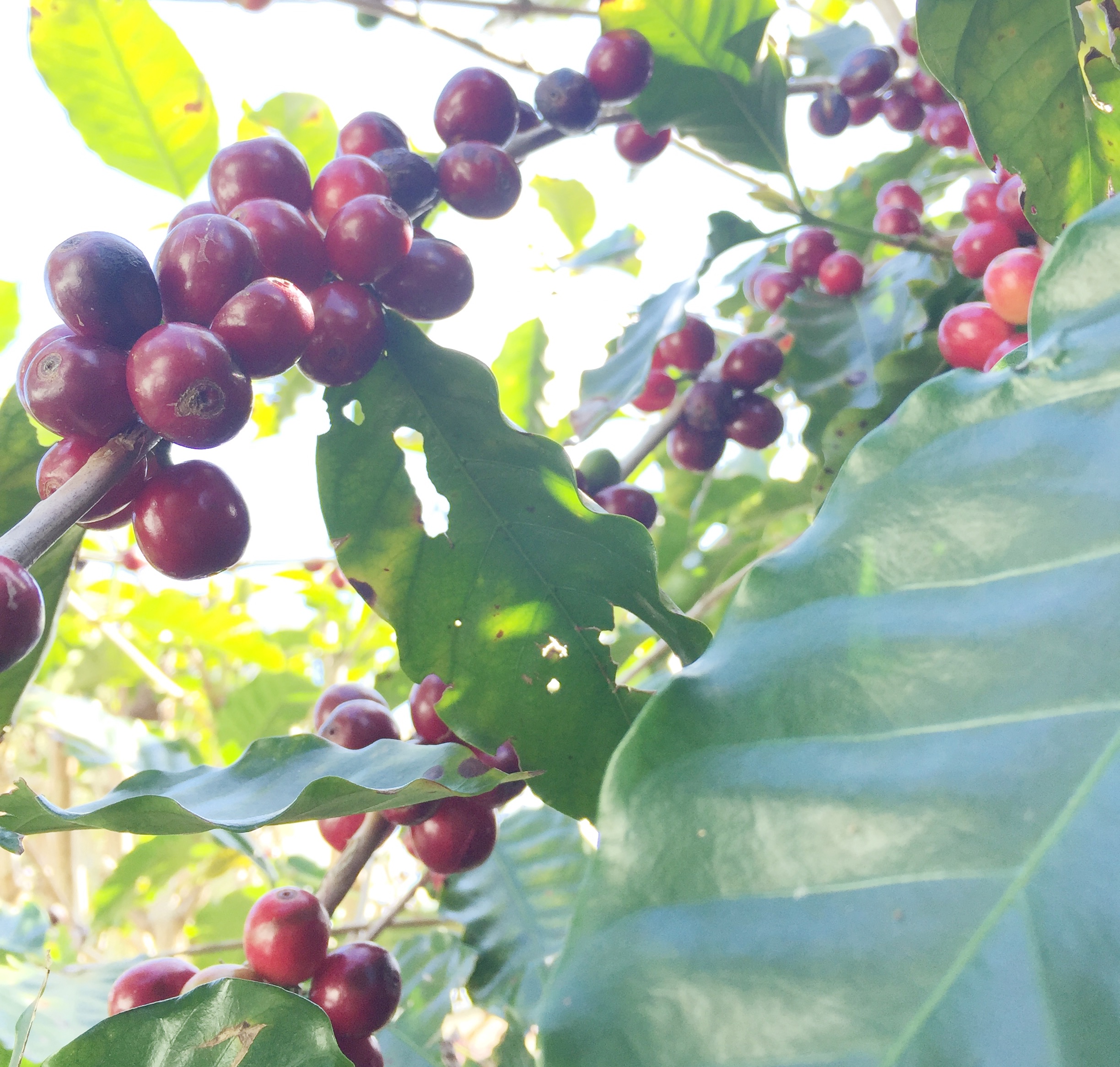
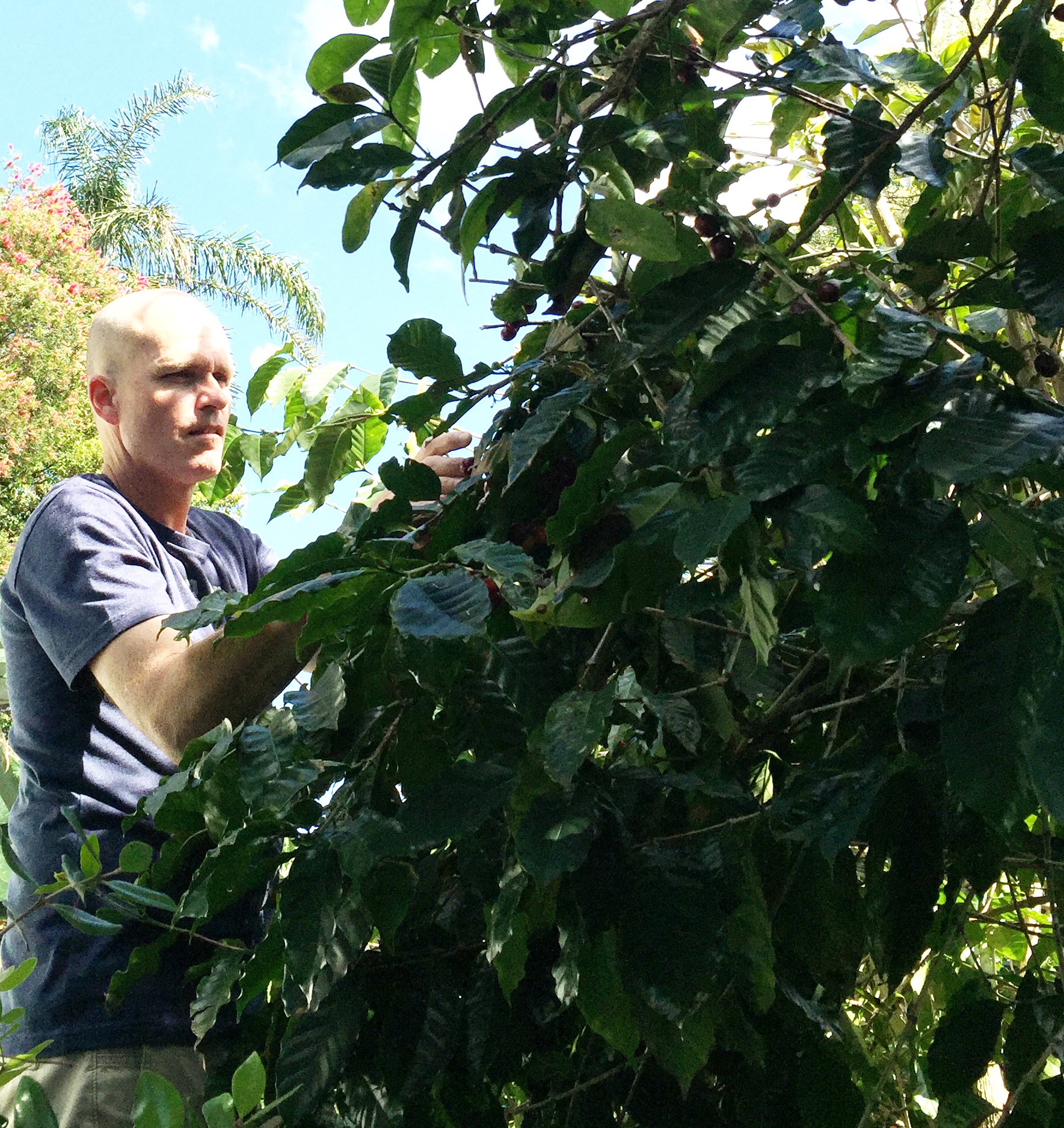
Late last year I picked a small crop from the coffee trees which are thriving at my parents house in northern New South Wales. Having processed a batch of the same coffee using a washed method a couple of years ago, I decided to try my hand at natural methods. The previous two posts and what follows below describe how things went for two separate batches: one “honey” processed, and the other a “natural” processed batch.

Part of the crop

Part of the crop

Results are in

In summary, the natural processed lot dried really well, however as I alluded to in Part Two of this series, the honey processing wasn’t quite as straightforward. I’ve broken things down a little further on each below.

Natural process

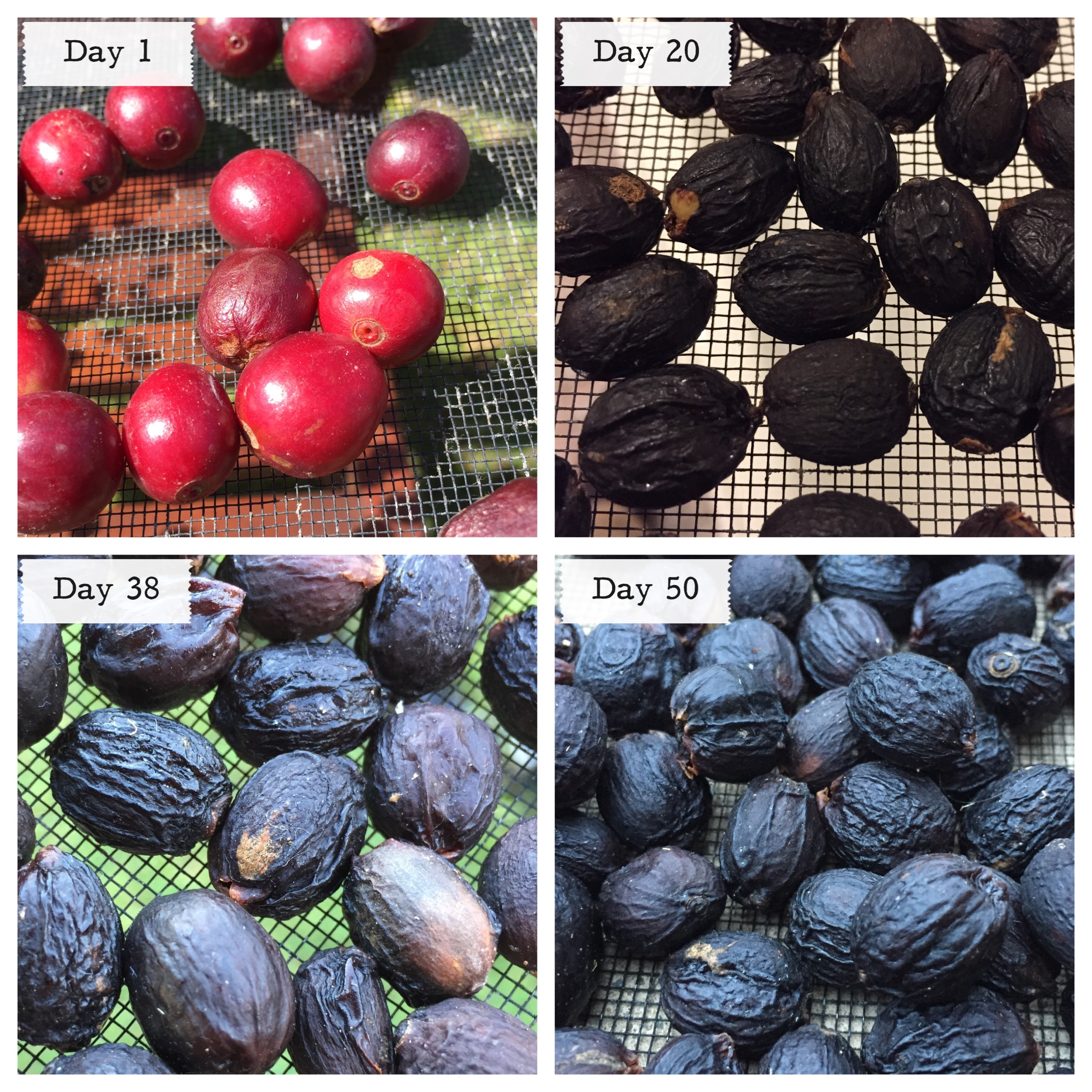
The naturals were a breeze to manage, and appeared to move fairly quickly in the early days of drying. It was fairly apparent early on some of the beans most likely commenced the process with less moisture content than others, as the darkening and progression from red to almost black which occurred within the first 7-10 days proceeded at different rates.

Once this first week or so had passed, the entire batch of naturals were mostly a uniform black colour, and the outer skins began to shrink and harden further. Looking back on some of the guidelines from the Part One post in this series — from Sweet Maria’s on climate suitability:

If a farm can dry coffee from ripe cherry to hard, dried pod in 20 days, it is probably well-suited to DP (dry processing) methods.

If I look at the naturals after 20 days, I think they would have been almost ready to go, and probably could have been removed from drying, hulled, and the bean then dried a little further at that point, resulting in a total drying time of around 30 days.

Natural processed batch across four time points.

Four time points: natural processing.

This is exactly what I should have done, however with a lot of my focus on the honey processed batch, it didn’t really occur to me to just pull the naturals from the drying bed and proceed with the next stage of processing. As I write this it sounds ridiculous not to have done this, however also in retrospect, I at least know what the longer end of the drying scale produces, and I’d rather have that knowledge in the bank and work on a shorter time period in future. Have I ever mentioned before I do these things to learn? I think I may have somewhere along the line.

In any event, the naturally processed batch had dried well, and it was onto hulling – or removing the outer skin, pulp and parchment layer. This was a fairly straightforward process, however with anything more than a very small batch becomes very time intensive. Piercing the skin with my finger nail, opening the dried pulp and pulling away all of the layers together left the just the green been, with a little silver skin which often clings, and is blown off during roasting.

Hulled and ready for roasting

Hulled and ready for roasting

In comparison with the washed processing method (of the DIY kind), if we are talking total effort and time, I found the removal of these outer layers all at once to be easier than the separate steps of pulping followed by removal of the dry parchment post-drying.

Honey process

It was with the honey processed batch that things were held up a little. I’ve mentioned in Part Two about the sticky outer coating of mucilage on the beans — and when I say sticky, I mean really, really sticky.

I had assumed after a week or so this would begin to dry out, which did occur as a warm dry day progressed, however as each day drew to a close and the air temperature fell, the stickiness returned. I even tried bringing them inside at night (stopping short of tucking them in after turning down the bed and laying a chocolate on their pillow) for a number of days however this really had no effect.

At the time I simply pushed on, assuming perhaps after a few weeks I’d have a dry batch, however this wasn’t so. Of course my error here was assuming an outer dry layer correlated with drying of the inner bean. I’ve yet to work out an exact relationship between the two, however I’d they are in some way related.

At around day 16 or 17 the first signs of dark spots began to appear on the outer surface of some beans. I proceeded on the basis I would either end up with a batch of beautiful “black honey” processed beans, or a heap of mould. I had my hopes on the former, however fully expected the latter. Remember at this stage things were still quite sticky, so I thought I had a way to go before they might be ready. In reality, it took another 10-12 days before the black spots began to increase. After around 38 days, it had well and truly taken hold of many of the beans.

Four time points: honey processing

Four time points: honey processing

So, by that stage I was indeed left with what appeared to be a pile of mould. The evenness in appearance of a true black honey processing method was replaced by what definitely appeared to be groups of black spores enveloping each bean. It was time to cut my losses and proceed only with the naturally processed batch.

A few lessons

First, I’d pull up stumps earlier on both batches of beans if I’d had my time again. Waiting for the honey processed batch to dry further was probably an exercise in futility. In doing so, I inadvertently left the naturals a good deal longer than planned (at least a coupe of weeks longer).

Also, plan on life getting in the way a little. By the time I had really decided the drying time was probably done, it was another week to remove the hulls from the naturals, and a further two until roasting. Not the end of the world, however when most things are limited to weekends, it’s not hard to blow out a scheduled timeline by weeks at a time. That said, I’d rather have that happen than not try this at all.

After all was said and done, I did actually venture back into the shed and remove the parchment layer from a couple of beans in the mouldy honey processed batch. Surprisingly, the bean appearance was reasonably good, however by that time I had already decided to abandon them — probably the wisest choice given the amount of mould on those outer layers.

If you are considering processing your own coffee at home, my advice would be to stick with a fully washed process, or if you are looking to dabble in some dry methods, perhaps go with a straight “natural” process.

Also, having now tried both wet and dry processing methods, I can offer the perspective that in a backyard DIY situation there is a little more work at the “front end” of the washed processing, however after that first week of pulping and washing, there only remains the hulling — or removal of the parchment layer once the beans have dried out.

By comparison, in a natural processed batch, there really is minimal effort required at the front end of the process, and come the time when the dried cherry is pulped and hulled, all layers come away pretty easily, and all you have left is the bean — ready to roast. On balance, looking at the total effort involved with each, I’d come down in favour of the natural processing method. Remember, the issues I had with turning the coffee during the drying process were all related to the honey processed batch. The naturals? As simple as running your hand over them or giving the drying frame a bit of a shake.

Concluding the processing

Reading through what I have written above, you may get the impression getting the coffee this far was all a little too hard, and perhaps not worth the time overall.

Nothing could be further from the truth, and I will definitely be processing more coffee naturally in future. Honey processing? Probably not — I’ll leave that to the experts in Costa Rica, and many other countries now processing this way.

For future batches though I’ll probably begin by limiting the drying time to around 20 days or so and see how the roast and taste compares with the current batch of 50 days duration. From there it’s only a matter of altering the time frames for further experimentation. I’m definitely looking forward to pursuing this further in future.

The remainder of this post will focus on the naturally processed batch, given the outcome of the honey processed lot detailed above.

Roasting

Once processing was complete, it was time to turn to roasting. Something which would be a fairly delicate task given the size of the batch remaining.

Remember, I began with 210 grams of coffee cherries in the each group. After the drying, the Natural crop had reduced in weight to 100 grams, and after de-pulping: 46 grams — a fairly small batch to roast. However, roast we must — otherwise everything to this point becomes fairly irrelevant.

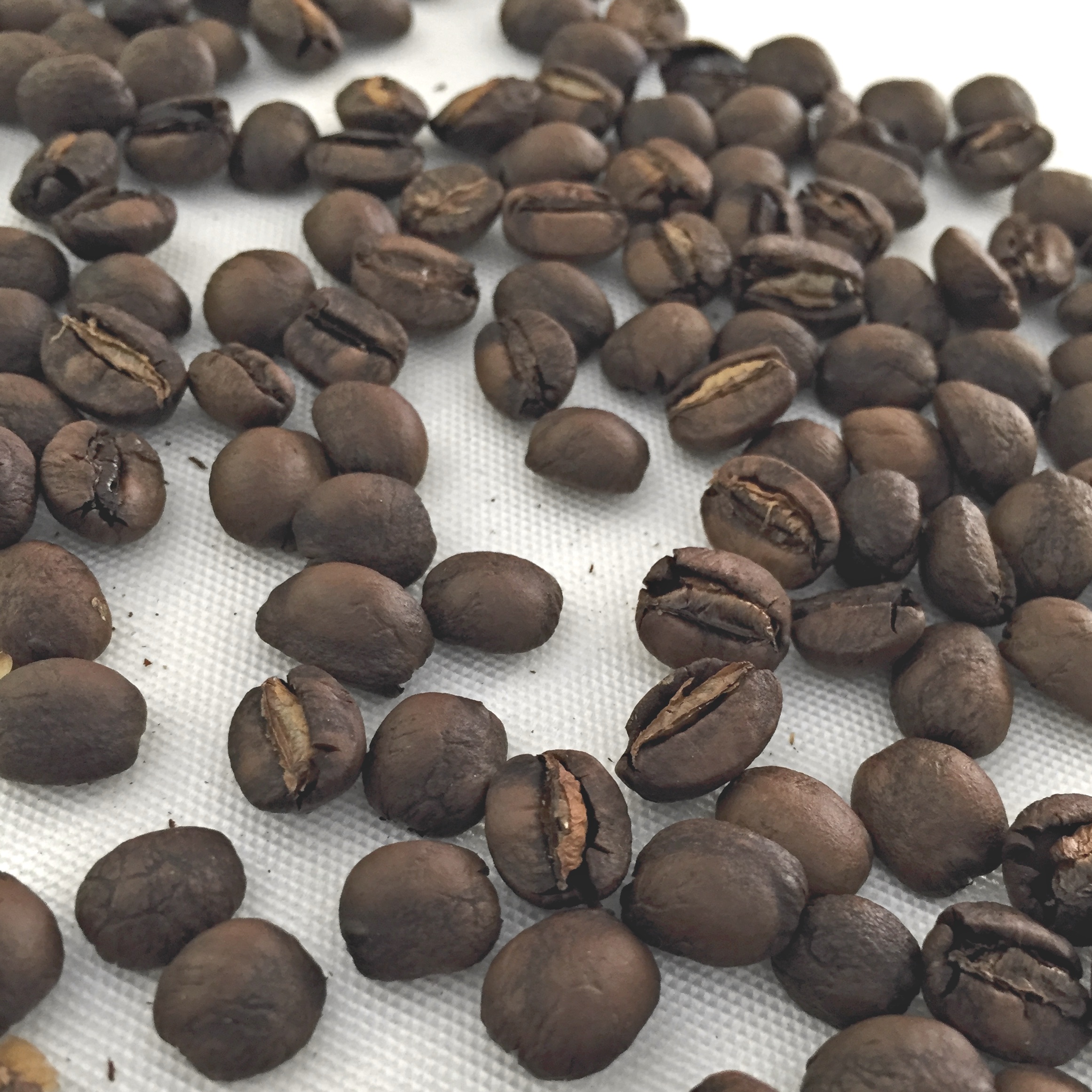
A successful roast

A successful roast of the naturally processed batch

The plan was to brew the resulting roast by filter, so a light to medium roast was in order. For those who may be interested, checking back on my roasting notes, the total roast time was 11 minutes, with a development of 19%.

Drinking

Having climbed the mountain, we were now at the summit, and the amount remaining to brew? A healthy 37.5 grams of roasted coffee, which had rested for seven days post roast and was now ready to go. Given I had a few tasters (family members) around the table, we had one shot at it, so with the hope my grind setting and brew recipe were somewhat close to the mark, away we went.

  • Coffee: Nine South Estate 2015 Natural
  • Region: Alstonville1 NSW, Australia
  • Grower: L & J Denison
  • Elevation: 140 m
  • Processing: Sun-dried Natural
  • Crop year: 2015

So how did it taste?

The result: shared with those who produced it

The result: shared with those who produced it

In all honesty, better than I expected. Sure, it wasn’t the pinnacle of fruity naturally processed greatness, however overall I would describe it as very well-balanced, with medium to light body, mild citrus acidity, with the predominant flavours woody spice and a hint of chocolate. Although not overpowering, there certainly some of those earthy flavours which can be apparent in naturally processed coffee, and these were also evident in the dry aroma after grinding.

A very enjoyable brew, for which I admit to being quite thankful for given the process leading up to actually tasting the stuff. My group of tasters around the table? In summary, I’d say there was general acknowledgement the whole process had been a success, given what was now being consumed. Mostly, the “actually that’s not too bad/pretty good” comments you expect when taste testing something you may be a little dubious about initially.

Of course it would have been sensible at this point to have on hand a sample of the same coffee processed by the fully washed method wouldn’t it? It’s probably a little late to think of that when pouring the brew into the cups. Another for the “in retrospect – this is what I will do next time” file.

In conclusion

I began this natural processing experiment in the knowledge at some point in the next few years I will need to be processing the fruit produced on the coffee tree now growing so well in my back yard.

Where it all began

Where it all began

Having previously managed to process a batch using the wet or washed method successfully, I was keen to see how a naturally processed lot turned out in comparison. In summary, I’d say I have a way to go with both methods, with some experimentation still required as to the length of the drying time with my naturals; and more efficient methods associated with the wet processing. Of course the joy in all of this is the amount of taste testing required to assess the results from tweaks in my processes.

After completing my first foray into natural processing, I think I’ll leave the “honey” methods to the experts, having found this more difficult every step of the way, however I certainly plan to be using the power of the local sunshine for some more natural process drying in future.

I hope you’ve enjoyed reading this series of posts, and perhaps learned something from them — I know I certainly have. Signing off with a special message from the honey processed batch: ”thanks for sticking with me”.


  1. The town I grew up in before moving to Brisbane in 1990. ↩︎

Wiser Web Wednesday

Wiser Web Wednesday – a semi-regular link to posts of interest from around the web, by those far wiser than myself:


512 Pixels
This time of year there is much ado about the Atlanta Pen Show, and of course The Pen Addict podcast community as an ever-increasing subset of attendees. Although I cannot see myself ever getting over there, I’ll chip in for the Live Podcast Video while each year it continues to run on Kickstarter.

I like the challenges presented by producing a live podcast. The tech requirements are different, as is the environment. The Pen Addict community is amazing, and it’s always fun to do something new and exciting with them.

Here Relay FM co-founder Stephen Hackett with a little of what goes on behind setting and recording the live show:
Behind the Scenes at The Pen Addict 200


The Pencilcase Blog
Pocket-sized pens do hold some allure for me, as I’m often walking from office to writing spot (read:cafe) with a pen in my pocket.

Of course having a demonstrator pen eyedroppered is awesome, but the folks over at FC went beyond that, and added a custom, rough finish to the inside of the barrel and cap. This texture adds a lot of visual interest to the pen, with ink sloshing around inside, that gets stuck on the texture.

There is even more allure with a pen that looks like this one. A great review, and also check out the associated giveaway:
Franklin-Christoph Pocket 40 Review


Peaceable Writer
I still find Patrick Ng’s Chronodex system to be one of the more attractive ways of managing time and tasks in an analogue system.

After trying it a few years ago, I couldn’t quite make it stick. That may have had something to do with me drawing freehand the graphical dial at the heart of the system on occasions when I ran out of printed templates.

There were some areas of Patrick’s Daily Scheduler that didn’t resonate for me, and so I, uh, took them out.

As described here, probably a little modification of the template is perhaps as far as one should go with any “mods”:
Tale of a Vandal Notebook User: More #Chronodex


The Clicky Post
I must admit some of my favourite posts are those celebrating some of the cheaper options in this hobby of ours.

Whilst it may seem that the only writing instruments I use are fancy fountain or machined barreled pens, I actually use my fair share of your normal, everyday, “over-the-counter” pens for much of my general writing and note taking

I’m with Mike. Despite the blog posts and Instagram feeds full of fountain pens, fancy nibs and inks – I’m sure a lot of gel, felt tip and “roller-balling” goes on in the day-to-day of many:
Inexpensive Pens That I Reach For Often


Dot Cross Dot
After seeing this Indian-manufactured pen reviewed by Ian Hedley on Pens! Paper! Pencils!, I remain no less intrigued upon seeing it again.

The level of craftsmanship involved in making this pen is amazing, the finish looking as good as an Edison even if the design is not as well refined

In keeping with that initial post, more words of praise from this thorough review:
Fosfor Bangalore


Crónicas Estilográficas
A summary of some recent “issues” that have played out, and continue to do so in many ways within the “enthusiast” segment of the pen community.

I have always argued that we, stylophiles, were a small group, economically weak, almost irrelevant in the economic balance of pen makers when compared to the group of occasional pen buyers.

Highlighting what I have often pondered: which is whether — as a community of enthusiasts — the collective weight of the “little guy” has much sway in the thinking of larger companies, given the market afforded them by the volume of casual purchasers.

I also wonder if we will ever really know the answer:
Signs of Change


Macstories
Being fairly entrenched with Spark for iPhone and iPad, and the Gmail web interface on the Mac for my email needs, I’m not inclined to shake things up again. One thing I will say though, for something I spend a bit of time in each day – design is a little more important to me than what the following suggests:

While Airmail’s iPad design won’t win any design awards, its support for iOS 9 technologies is some of the finest on the platform. Alongside integration with Split View for iOS 9 multitasking, Airmail for iPad comes with fantastic keyboard shortcuts which highlight how the app strives to provide desktop-class versatility to its users.

I guess for those looking for the full iOS and OS X suite – it’s now all there:
With Version 1.1 and an iPad App, I’m Switching to Airmail


Finer Things in Tech
David Chartier on the iOS file system:

After working in various forms of customer support, campus laptop rental support, classic computer sales, and ‘friends and family support’ throughout the years, and doing my fair share of people watching in cafes, businesses, and Apple Stores, I believe the file system never actually worked for regular folks who don’t live and breath technology. The Windows and even Mac file systems were something they barely tolerated or, most often, simply avoided by saving everything to the desktop.

I’d agree with the above, and when you read enough tech writing, it’s easy to think every user is at least a little interested, which of course could not be further from the truth:
Apple made the right decision in hiding iOS’s file system, and now we have the tools to make everyone happy


You Tube – USA Network
After initially being a little hesitant about whether I’d enjoy Season 1 of Mr Robot, that was soon resolved after a couple of episodes.

Looking forward to Season 2:
Mr Robot Season Two Trailer


That Inking Feeling
Now headlong into an Olympic year – come the August opening ceremony in Rio, stories such as this will probably be more common than we think.

Some time, some perspective and some travel have reminded me of a few things. If I’m going to define myself as a hockey player – and maybe even as a person – based on whether I’ve played in the Olympics, I’ve realised I’m devaluing myself

So close, yet a champion all the same:
The Story of a Not-Quite Olympian


CRS Coffeelands Blog
After a flurry of writing on the slave labour in Brazil’s coffee industry, it’s nice to see some follow-up.

It won’t be easy.  But thanks to more than 20 years of relentless innovation by leaders in Brazil’s public, private and non-profit sectors, the path to total eradication of slave labor may be shorter there than anywhere else in the world.

Interesting reading in relation to what this all might mean for policy makers, coffee companies and consumers:
Stamping out slavery in Brazil’s coffee sector


Brisbane Times
Firmly in the camp of just because you can doesn’t necessarily mean you should, we have a Sunshine Coast cafe serving coffee made on camel milk.

The milk is very accessible and because it is a tourism area near the Australia Zoo we have people interested in camel milk

Yes… of course they are. So – for your $14.50 — I guess only one question remains: One hump or two?
Sunshine Coast cafe serving up camel milk coffees


Perfect Daily Grind
Sometimes I think the great coffee which comes from many countries is in at least some ways because of the challenges faced in bringing it to the consumer.

Don’t get me wrong, great coffee is great coffee — and some grown virtually on our doorstep in Papua New Guinea fits that description.

If you could design the perfect country for growing coffee, it would look something like Papua New Guinea. With its vast mountain ranges, tropical climate, and fertile volcanic soils, it has the ideal mix of environmental factors.

It certainly looks like a tough slog in producing it though:
Poor Roads: Are They the Biggest Issue Facing Papua New Guinea’s Coffee?


Sprudge
With an increasing amount being said on the topic of gender diversity in the coffee industry, this piece I found particularly interesting, given the views on traditional roles and societal norms playing a large part in where things stand today.

Our own gender expectations—and what classifies as public/skilled work, typically classified as male, as opposed to private/service work, typically classified as female—can lead to this sexism problem, e.g. men being expected to have more technical proficiency than women, and women to be better at hospitality.

An interesting read:
Gender & Coffee: Challenging The Status Quo


The Whisky Sponge
Angus MacRaild on perhaps the passing of what made great whisky, well… great. Settle in (with your favourite dram of course) – this one is an interesting read though certainly not a short one.

How connected can you feel to a product when your role in its creation becomes solitary and related to the correctly timed pushing of buttons? There are undoubtedly many good malt whiskies still produced in Scotland but it has become an industry of factories. An industry long divorced from true notions of craft, authenticity or tradition; except in the abstract as instruments of marketing. The very worst aspects of capitalism emerge when it is allowed to unleash the natural hunger of human greed without checks or balance. A vast corporation is a machine in which each individual can contribute but in which so few can regulate. The greed of the whole is greater than the sum of its parts.

Posts on The Whisky Sponge typically bring about a smile or chuckle, however it’s all business this time. In the midst of corporate efficiencies, large-scale production and the dreaded distiller’s yeast, thankfully there appears some remaining hope for greatness again:
Whisky: The Past & The Possible


A Small Tale of Pen Grail

For quite a long time I have been a little uncertain about the “grail” pen thing. No doubt the concept is a valid one — what I am referring to is just how it might relate to my particular thinking on the subject, and perhaps what my grail pen might actually be. Further, given I have often struggled with that very question — whether I even have one at all.

Occasionally I think about the where I might start in search of such a pen, and it is usually when reading others thoughts on the topic. For example, the post published earlier this year by Dr Jonathon Deans at Pen Economics on this very topic, in which a fairly clear conclusion is reached about the author’s grail pen — a pen which subsequently has been added to said author’s collection. Another more recent post by Thomas R Hall on Penucopia, describes the amazing and lengthy process of coming up with the design of, and having manufactured, a custom designed grail pen from scratch.

If you have not done so, I would highly recommend reading both posts, which are quite different in nature, yet together in many ways encapsulate the concept of a grail pen, in that the technical and emotional aspects may carry equal weight — yet we all are no doubt influenced differently by each.

The notion of grail

In times gone by, when the question arose (podcasts, discussions, or blog posts) as to what my grail pen might be, truth be known I could never really come up with an answer.

The first possibility of course is that my journey of discovery in the pen world, though I’ve logged a few miles — has not gone far enough to uncover a suitable candidate. The more I think about the concept though, the more I lean towards a second possible scenario: in the truest sense of what a grail pen means to me — I already own it.

Although most have a good idea of what we are referring to in speaking of a “grail” pen, the online Oxford Dictionary offers two meanings for grail. The first, a reference to the cup or platter used by Christ at the last supper, and a second, more relevant one to the topic at hand:

A thing which is eagerly pursued or sought after

Simple — but accurate. It’s the pen we so very much want, the one that draws us towards it — the one calling our name. The pen we will go to great lengths in seeking out and acquiring — dare we call it a quest?

In considering the grail pen, I wonder what particular criteria need to be fulfilled for inclusion in this much sought after group. Clearly this will (and should) be different for everyone, and any list of check boxes relating simply to pen specific criteria, will likely not be enough — however for some it might.

There is something else. Some other significance, meaning, or purpose. Again you will find evidence of this in both the posts I’ve mentioned above.

For me?

Writing a post like this one can sometimes pose new questions of yourself, or perhaps expose some new realisations. In doing so, my thinking has been clarified somewhat on the notion of a grail pen, and what it represents most clearly to me.

Are there are any pens out there I’ve always wanted or dreamed of owning? One out there calling my name that I simply have to seek out, plan for, and buy? A pen I am constantly coming back to, over and over?

At the current time the answer to those questions is no, however there is one pen which repeatedly springs to mind in considering them.

I still vividly remember the feeling of how badly I needed to have this particular pen. Of repeatedly entering the pen shop and fawning over it in the display case, then going home to come up with a strategy to save and eventually make a purchase. Whether the pen was worth the price1 was never in question.

In some strange twist to all this, the only pen that has ever engendered these sorts of feelings in me is already in my collection. I’ve written a little about it before: my Montblanc Meisterstück Classique. It was a gift from my now wife of 18 years on our wedding day. It was also my very first fountain pen.

To those who would suggest there is a difference between “sentimental value” and “grail pen”, I certainly don’t disagree with you, however prior to having that pen in my hand, let me tell you, it was a quest, and a pretty obsessive one. For a number of years I had wanted a great fountain pen, and it always had to be a Montblanc.

In the many years since, my preferences and experience with fountain pens have certainly evolved, and granted, there are better performing and more attractive pens both “out there” — and for that matter, in my own collection as well. However I know how much it meant to obtain that pen, how much it means to me today, and what it will continue to mean in the future.

Not that I’m saying there will never be another, although at the current time I would still struggle to answer you if asked what pen I might buy were price and availability unlimited. Personally, my search for a grail pen is certainly more Monty Python than spiritual at the current time. That said, the search only needs to go as far as my pen storage drawer to find at least one that I know of.

To those who are yearning for, planning a strategy to acquire, and actively searching for their grail pen, I wish you every success in finding it. I consider myself pretty lucky to conclude in all likelihood I already own mine.


  1. A$435.00 circa 1997 ↩︎

Wiser Web Wednesday

Wiser Web Wednesday – a semi-regular link to posts of interest from around the web, by those far wiser than myself:


The Pen Addict
It was only recently I was thinking I must put my thoughts together on one of the pens which makes me smile every time I use it: the Faber-Castell Ambition – a really great pen.

The model I own is the green variation, here Susan Piggot reviews the Blue Ocean edition for The Pen Addict:
Faber-Castell Ambition Blue Ocean OpArt Fountain Pen: A Review


The Finer Point
I must admit to only occasionally browsing through both the genuine and non-Midori options for housing the Traveller’s Notebook system. No, I don’t use them – however like many, I have a strange fascination with what others are using.

I have two Field Notes memo books in my Raydori, my Midori passport sized clear pocket and my Midori passport sized monthly calendar.

For those who do, this looks like a decent option from a UK-based supplier:
My Life All in One Place Leather Notebook Cover (or the Raydori)


The Gentleman Stationer
Of course it’s all pen show action this week leading up to Atlanta — particularly for readers/writers in and around The Pen Addict podcast community.

Happy hunting to all those attending:
Pen Show Primer, Volume 1: Why Visit a Pen Show?
Pen Show Primer, Volume 2: Getting Ready for a Pen Show


The Well-Appointed Desk
Ana with a review of the Baron Fig Squire pen, and having just received my shipping notice, I’ll soon be in possession of the charcoal version I backed in the Kickstarter campaign.

But in the end, I am really quite pleased. I suspect I will use it regularly. Its aesthetically appealing, comfortable in the hand and allows me plenty of refill options since I’m a great big picky-pants about that. And isn’t that what you want from a good pen? Something that feels good in the hand and writes the way YOU want it to write?

Again, as with other first impressions I’ve read to date, things sound promising — reassuring to note given mine is on its way:
Review: Baron Fig Squire

More from Ana — this time some packing tips on the topic of the moment: pen shows. Probably not surprising a “Fashionable Friday” post relegates the fishing vest to the not-to-pack list:
Fashionable Friday: The Pen Show Edition – The Well-Appointed Desk


Pen Habit
An impressive looking pen with an interesting filling system.

You fill the pen by depressing the metal “arc” protruding from the top of the pen’s barrel. Pressing down on the arc compresses a metal bar inside the pen which in turn compresses the sac. When released, the sac re-expands, sucking ink up into the pen

As noted in the post — I am not entirely sold on the lock collar appearance either, however am not sure what a better alternative might necessarily be as far as material and colour:
Visconti Millennium Arc Moonlight


CBS News
It’s easy to forget the direct effects our coffee habits have on the growers and farmers who produce it.

That cup of coffee — and I’ve seen it — changes the life of those growers. That’s a massive, massive difference. It is one cup of coffee, but it’s changing a life

Out of context quotes like these are often simply seen as hyperbole, however celebrity or otherwise, the means to effect change for the greater good is something to celebrate and support.
​Hugh Jackman: Changing lives, one cup of coffee at a time


Smart Girls Make Coffee
Indeed they do, and there are lots of them. Unfortunately the experiences are not always positive:

I’ve been treated like garbage by male colleagues because they just can’t seem to fathom that I am delegating as a manager, rather than being an emotional woman.

Taylor Browne shares her story of hard-earned success, and it is well worth reading (link via the Barista Hustle Newsletter)
The person, the story and the hard work I knew…


The Singleton Argus
The Australian made Starward Malt Whisky was my favourite among those I received as gifts over Christmas. Although not the double-gold medal winning wine cask matured single malt, it was a mighty enjoyable drop, in no small way attributable to Melbourne’s variable weather according to founder David Vitale.

Our four-seasons-in-a-day is our secret weapon. It creates a richer, mellower whisky in a shorter time frame because those barrels are working so hard every day.”

Apparently, said barrels worked hard enough to get Starward over the line at the recent San Francisco Global Spirits Competition, along with fellow Aussie Four Pillars Gin.

A congratulatory dram is in order:
Victorian whisky Starward strikes gold at Global Spirits Competition


Herald Scotland
Speaking of Aussies, there are probably not many of us with the inclination to buy a Scottish distillery — though I expect the means to do so may have something to do with it as well. One man who did, and had, of course proceeded to buy the Bladnoch distillery in Newton Stewart.

While Pure Scot is hoped to be the distillery’s main volume driver – it currently retails for A$80 (£43) in Australia – Bladnoch single malt will launch in Australia later this year, with the US and UK to follow in 2017

I’ve yet to taste the drink itself, and perhaps the Pure Scot blended might be the way to go while waiting for the Bladnoch single malt to arrive:
Australian yoghurt mogul aims to return Bladnoch distillery to former glories


Macdrifter
A considerable amount of words have been spoken and written about the recent changes to TextExpander – the Mac and iOS app which has now moved to a subscription service model.

Smile has a new business model for TextExpander 6. They call it a subscription model but I’m going to call it app renting. I think of a subscription as a recurring fee for ownership. When I rent, I get an access and usage permission but I get nothing to keep. It’s pedantic and probably wrong but it’s how my mind keeps track of value. They can call it what they want and I can call it what I want. We’re good.

Although quite a long post in its entirety, I think the above quote pretty well sums I up. Various monetisation models within the app-sphere are defined differently and mean different things to different people. The result? Different views on the value of such changes and whether they are worthy of our money. However you may define it – the decision to pay up is yours to make:
TextExpander and App Rental

Further, a possible alternative:

I’ve discovered weaknesses in my systems for shortcut expansion as my collection grows. I just can’t remember all of them. Even worse, accidental triggers eliminate all of the efficiency gains for shortcuts. So, I started using organized lists of snippets and Copied.app is great for this.

Whether or not a full featured worthwhile alternative exists across both the Mac and iOS remains to be seen, however I don’t believe we’ll be short of suggestions:
Copied App for Snippet Management


Macsparky
Though I’ve not had the need to nest any folders in the Apple Notes app to date, as the number grows it will most likely come in handy.

Open Apple Notes on your Mac and simply drag an existing folder on top of another. That adds a disclosure triangle to the folder and placed the moved folder inside the destination folder. Then open up the Apple Notes application on your iPhone or iPad and give it a second to synchronize and you’re good to go.

Glad I have a Mac to do it though (or alternatively, it can be done by logging into iCloud on the web):
Nesting Folders in Apple Notes — MacSparky