The Montblanc 100 Day Writing Challenge — Epilogue

All done. With the Montblanc 100 Day Writing Challenge tools laid down on September 8, we stepped away from our worksheets and prompts to take a look back through 100 entries.

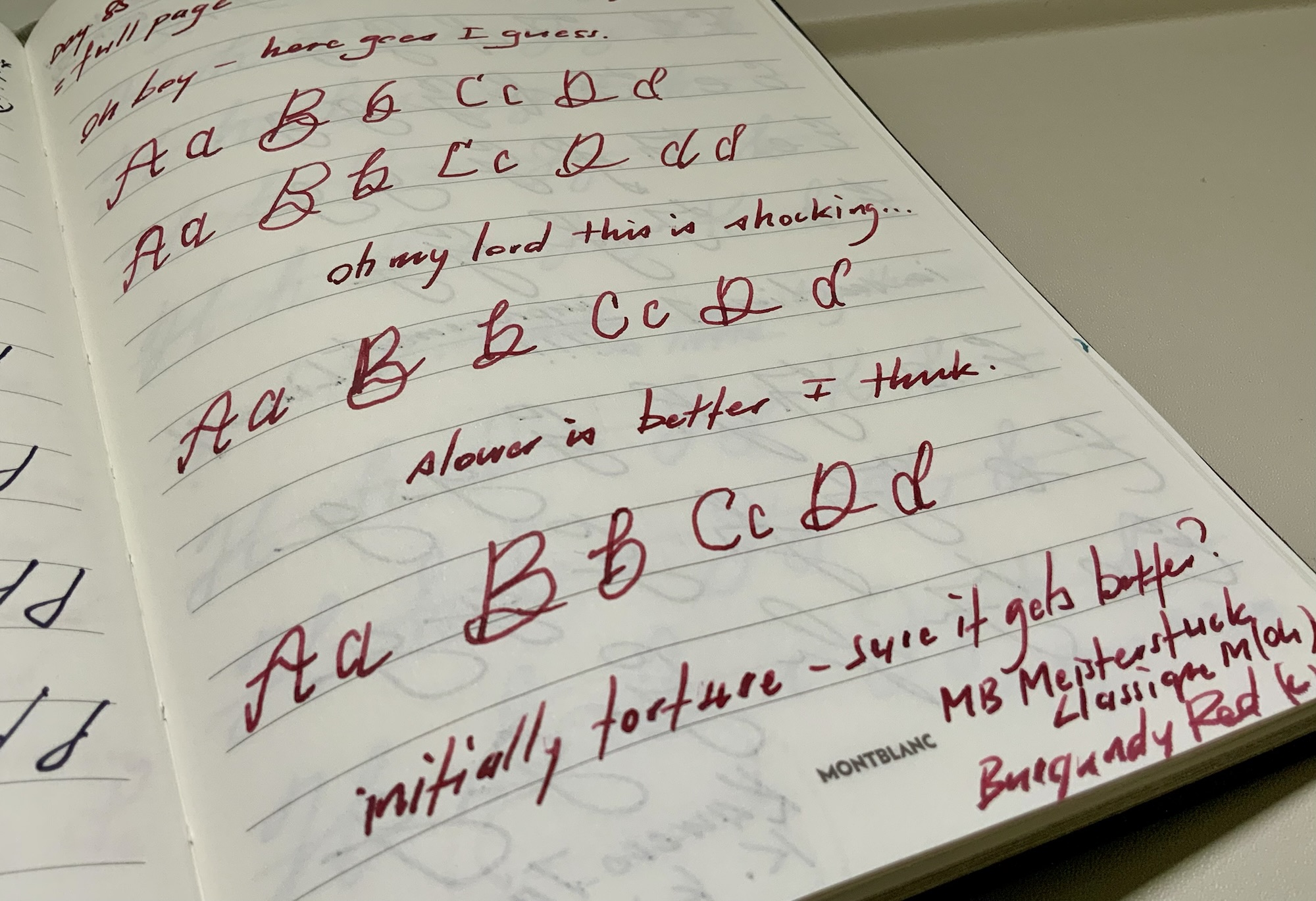
I must say I found this an enjoyable undertaking, having set out (and succeeded) with a plan to limit each day to one A5 page — that is, as manageable as it would ever be. The “challenge”, however, did come in days 80 and beyond, where my not-so-dab hand at calligraphy was brutally exposed. Of course, that was to no-one but myself, and perhaps you dear reader, should I decide to add a few images to this post.

The Tools

Notebook

The canvas hosting my challenge was a “25th Anniversary” edition of Montblanc’s A5 sized #146 Notebook. The anniversary moniker is of course entirely my own making, having bought a pair of these notebooks for myself and my wife on our 25th wedding anniversary a couple of years ago. Monogramming undertaken at the best pen shop in the world completed the picture. Given the challenge honoured Montblanc’s 100th anniversary, it seemed an appropriate occasion to break open and use the notebook.

Tools down and book closed…

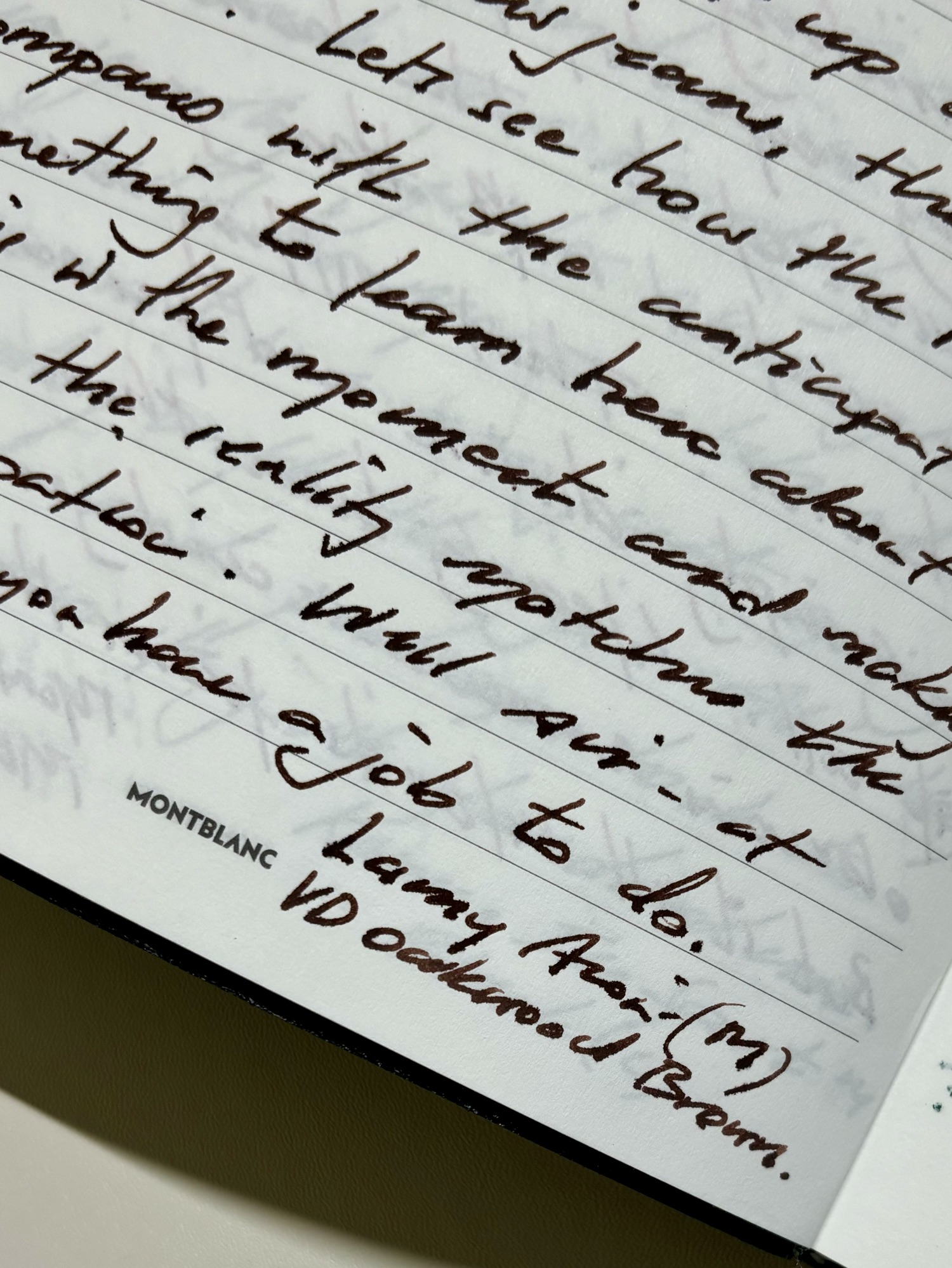
More on the pens below, however in terms of paper quality, I find the Montblanc notebooks handle almost anything, except for the wettest of inks and broader nibs. Now, a caveat here: ”wettest” and ”broadest” being extremely relative terms. If you’re reading along here, please understand these are based on the inks and nibs in my collection. One of my broadest and fastest running nibs? The OMAS Ogiva Alba — it’s a “medium” (albeit a European medium). One of my wettest inks? Van Dieman’s Oakwood Brown. Put those two in combination and there is distinct feathering on the page and show through on the reverse. This does not happen for example, with the same ink in my Pilot Custom 823 — a Japanese medium nib.

I would say it’s probably a case of creating a notebook suited to “our” pens and inks if you asked Montblanc, for I’ve typically found my Montblanc inks to be drier than some others. Of course, not being a BB nib type of pen owner, take this commentary how you will.

I do love the Montblanc notebooks, in so far as they really are the complete picture in themselves. The leather cover in a variety of styles (the subject notebook here carries a Saffiano leather cover), the gilded silver paper edging, and just the overall weight suggestive of a quality item. And yes, all of which you will indeed pay for. Probably not one for your daily driver — you most likely don’t want to be buying one every month or so.

Pens

With most typical days involving gel pens (a Traveler’s Notebook bullet journal system) and ballpoints (standard work notes in the office), I like to balance that out with some fountain pens. This mostly involves some other form of journaling, writing or planning in what I’d call a “desk book”. The 100-day challenge was of course a great fit.

As I look back through the challenge (where 80% of the time I captured what I used on the day in a footnote), it was a rotation of the following pens (and inks):

  • Montblanc 147 Traveller; Medium (Montblanc Royal Blue cartridge)
  • Pilot Custom Heritage 92; Fine-Medium (Edelstein Tanzanite)
  • Pelikan M805; Fine (Montblanc Irish Green)
  • Montblanc M; Medium (Montblanc Burgundy Red cartridge)
  • Lamy Aion; Medium (Van Dieman’s Oakwood Brown)
  • Kaweco Ice Sport; Medium (Kaweco Black cartridge)
  • Parker 75; Medium (Parker Quink cartridge)
  • Pilot Custom Heritage 92; Fine-Medium (Iroshizuku Shin Kai)
  • Platinum President; Medium (Iroshizuku Momiji)
  • Montblanc 146; Medium (Bookbinders Red Belly Black)
  • Montblanc 144; Medium (Montblanc Burgundy Red cartridge)
  • Pilot Custom Heritage 91; Fine-Medium (Van Dieman’s West Coast Sunset)
  • Pilot Custom 742; Sutab (Iroshizuku Shin Ryoku cartridge)
  • Lamy 2000; Fine (Robert Oster Peach)

A few other non-fountain variants made their way into the mix as well. Two colour variants of the uni-ball Signo 0.7 mm, a Pentel Kerry mechanical pencil, and a couple of Pentel Energels in 0.5 mm and 0.7 mm.

If I had a favourite combination during the challenge, I’d say it was the Pilot Custom 742. I love that Sutab nib, and I hadn’t tried the Iroshizuku Shin Roku before, so I’m thinking that had a fair bit to do with it. In general, I’d say they are all delightful to use, and worked pretty well on the Montblanc paper.

Accessories

This heading — though plural — really only offers one type used a few times through the challenge: stickers. It’s one of those cases where talented sketch-noting would go a long way, however in the absence of that, sticker (stick noting?) additions are it. Here it was a combination Traveler’s Company stickers, a few from a Melbourne creator I picked up at the Rose St Market on a trip to Melbourne last year, and a sticker sheet received with an issue of Standart (a coffee publication).

Much more appealing decoration than my efforts below…

I find the stickers a great way to break up the blocks of text, and are certainly more visually pleasing than my shaky calligraphy efforts.

Speaking of which…

Challenge challenges

I have long held ambitions of becoming better at the more creative side of my writing, and by that I mean the visual side of said writing. Calligraphy is the most obvious choice here; however, I’ve never really had the motivation to start. What better way than rolling through days’ 84 to 93 of the challenge and working on a page a day of modern calligraphy?

Well, shaky at best, simply weird at worst. I’m happy I gave it a shot, although I’m not even sure modern calligraphy is a style I particularly enjoy. To that end, I’m not even sure that some older styles like Copperplate or Spencerian appeal to me either. To say I just need to find something that appeals to me would perhaps be a little flippant. I feel in the back of my mind, the truth probably lies more closely to the fact that I’ll never really get around to putting in enough time to get more proficient — regardless of the style.

As far as writing each day is concerned, that wasn’t difficult at all, and I’m sure anyone reading this is most likely a daily writer as well. Having the prompts? Well, that does make things easier, and is perhaps a lesson learned from me, as someone who never uses them and occasionally resorts to re-writing song lyrics to get something down each day.

Wrapping Up

In summary, the Montblanc 100 Day Writing Challenge was both enjoyable and a success. It does make me wonder why I don’t use more prompts in my journaling, and also why I choose some “challenges” and let others pass by. Whether that changes in the future is another matter, and I’m glad I chose this one — shaky calligraphy and all.

The Montblanc 100 Day Writing Challenge

Thinking back, perhaps I should have written about the Montblanc 100 Day Writing Challenge a little earlier, however having started myself a few days late, this post was always going to be a mid-challenge update.

With day 37 just completed, it is of course a fine time to tell us now… Well dear reader, you are indeed correct; however, this blog certainly isn’t known for its cutting edge hot takes on the stationery and writing communities, releases, or events.

Carrying on that tradition, things are going pretty well at a little over a third of the way through, and it’s been an enjoyable diversion in addition to my usual pen on paper ramblings.

The Challenge

I could say “never one to miss a marketing opportunity” about Montblanc, and while that statement is true enough — why would they? There is nothing inherently wrong with a business promoting itself or its products, and the emphasis on ”any tools will do” in the webinar sessions is certainly welcome (though of course you’ll see an array of Montblancs’ used on screen).

The writing challenge ties in of course with the 100th anniversary celebration of the Meisterstuck pen, which also brought a few new pens, other associated products, a Wes Anderson short film, and quite a few other events if social media is anything to go by.

Image courtesy Montblanc

A quick aside: the 100th anniversary pens? Well, nice enough yes, however never has my excitement peaked more than when I thought a re-release of the original versions may have been coming upon seeing some promo photos earlier in the year (for me, it’s the original green version from halfway down this page). To say my disappointment peaked even higher upon realising the anniversary release was simply a modern take paying homage to the originals, would indeed be accurate. Don’t get me wrong, the pens are indeed impressive, though not a patch on the aesthetic of the originals. Time marches on, I suppose.

Finally, the Wes Anderson designed Schreiberling pen does look intriguing, however at an estimated price tag of $2,500, is certainly not for me either.

Anyway, back to matters at hand. You’ll find details of the Writing Challenge through Montblanc’s Inspire Writing series, under Creative Writing Courses on the Montblanc website via the Discover menu (or more easily from the link above).

Having dabbled in some of these webinars in the past, and looked at others (with calligraphy I have intent, yet to date, no action), the 100 Day Challenge seemed both achievable and worthwhile at the same time. Catching up on the kick-off webinar in the “past sessions”, under presenter Brittany DeSantis, I came in a few days late, however quickly caught up given the writing prompts lead to as much or as little time investment as you like.

The Idea

On the surface, exactly as it says on the tin: to write daily for 100 consecutive days. Now for those of us who are well into the thousands of consecutive days writing (journaling, blogging, note-taking or the like), I generally consider the occasional challenge like this one as simply: 100 days of different writing.

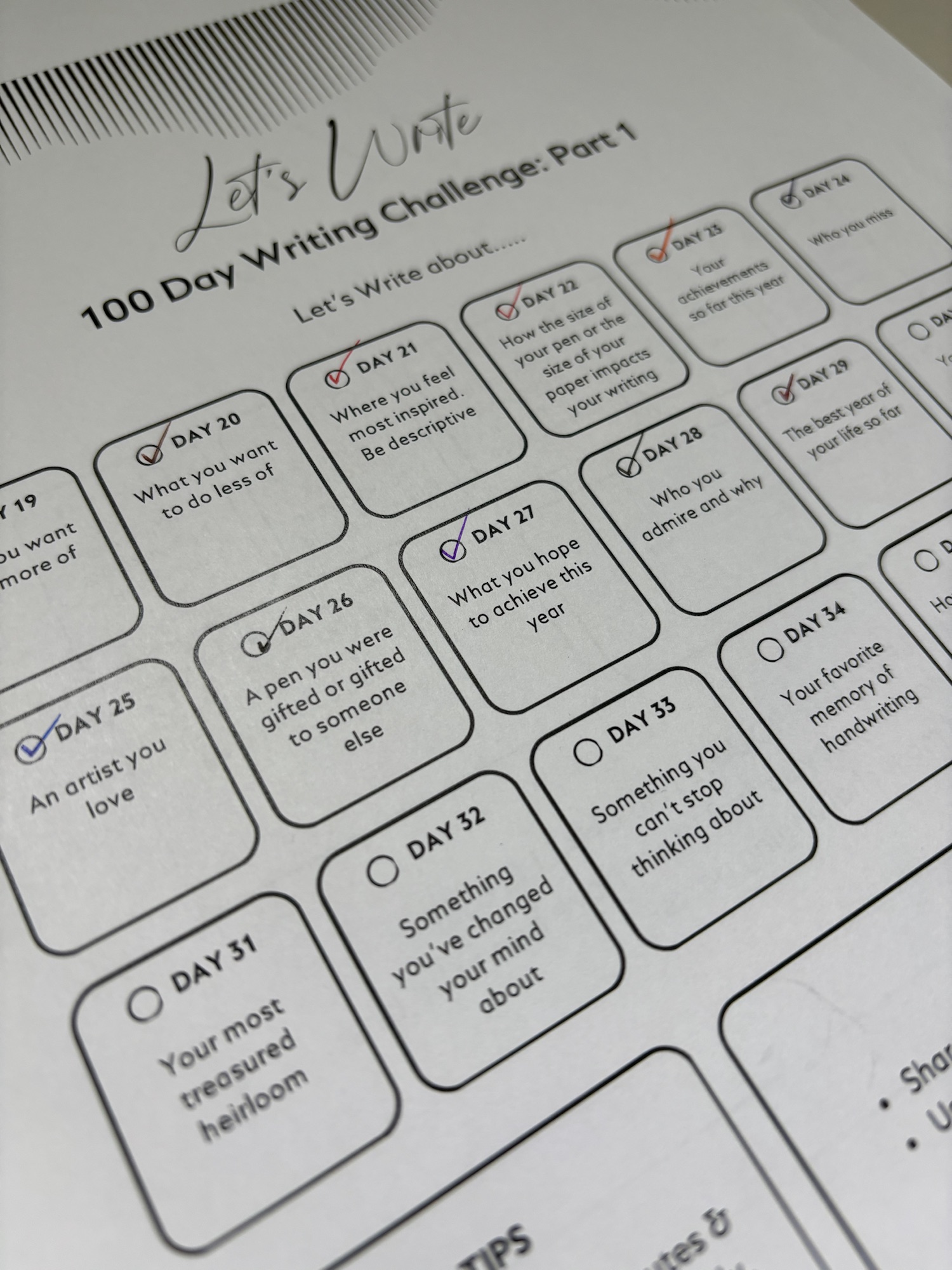
The challenge is divided into a couple of parts, the first being Your handwriting and history, comprising 43 days worth of daily prompts, mostly on writing and stationery habits, though also some general life themed questions as well. Part 2 will apparently be delving into lists to “discover more about ourselves and plan ahead” which I believe will begin at the next webinar taking place on July 10.

A daily commitment of about 5–10 minutes is the pitch, and I don’t find it overly burdensome, having limited myself to one page of an A5 Journal for each prompt. Accessible and achievable — always the best way to ensure those who start do a fair job of engaging, continuing, and finishing.

The Prompts

I’ve never been one to use journaling prompts, though at times when I sit in front of a blank page I think perhaps I should. Adding an extra A5 page a day as part of the challenge certainly provides no great impost, and given the fairly straightforward prompts, I’ve not found myself staring at a blank page.

Perhaps the secret is to take the prompts literally if that suits, or simply as a guide if there is a tangent you’d like to work through on a particular day. It really is a choose-your-own adventure. I’m sure if you are a prompt user, then you’ve likely seen them all, however a couple I enjoyed:

  • Your earliest memory of handwriting
  • How your handwriting changes based on what or where you’re writing
  • How your tastes in pen and ink have changed

There are also quite a few around “your favourite…”, along with more inspirational and life-themed questions, however the general Part 1 arc of Your Handwriting & history seems captured well enough through the prompts.

Signing off

Acknowledging I’m a bit late to the party in passing on the message out there about this challenge, there are still two remaining webinars and another two thirds of the writing days still to go. Perhaps it’s something to pick up now or even retrospectively complete at your leisure. I’ve certainly found it an enjoyable and worthwhile endeavour.

Back in Ulysses

Originally this post was to be about Setapp, which I’ve now been subscribing to over the past three months or so. Perhaps I’ll get to that at some point, however I probably haven’t poked around or utilised enough of the apps to really write anything of worth. One of the big draw cards though for hitting the signup button on Setapp was full access to Ulysses, and on that point I do have a little bit to say — not so much about the app itself, more so that it actually has me writing again.

Go figure.

Back in Ulysses… and actually writing

What is it about Ulysses then?

Before we get to that, just briefly, Ulysses being one of the plethora of text editors out there for Mac and iOS competing to be the heart of many a writing workflow. Running on a subscription model either direct from the developer or through Setapp as I’ve mentioned, it may just be the ”ultimate writing app” as the developer suggests:

Powerful features and a pleasant, focused writing experience combined in one tool, made for people who love to write and write a lot — this is Ulysses.

Sounds about right.

Image courtesy of Ulysses

While this post is about the app itself, it also isn’t at the same time. Of course no-one uses an app or system which is difficult to use or not to their liking. We all have our criteria here, and we could go down the path of the various UX and UI aspects of the app, and all manner of technical capabilities and limitations. Well, lets be honest — we could do that if I were in any way capable of such a thing, however in reality I’d be wading in waters I had no business being in. Add the debates around subscription pricing, data storage, true markdown and proprietary file databases and you have a lot more to discuss. That isn’t the purpose of this post.

No, the purpose of this post is explicit in the section heading above. Getting back into writing again despite a couple of very, very lean years here on the blog, during which time I was in and out of quite a few text editors. I hear you (and a smattering of YouTube thumbnails) telling me: It’s not about the tools it’s about doing the work…I certainly don’t entirely disagree with that sentiment, however I’m increasingly inclined to believe it’s even less true than I once thought.

Ulysses can’t do the writing for you though, surely?

No it cannot, and arguably there are just as many capable apps out there that will do the job (believe me, I’ve tried a few…). It’s just that for many years, Ulysses was where I wrote. Plain and simple. Back in the heyday of this blog, posting regularly, committing to a weekly link post, heck — even giving NanoWrimo a crack and getting 55k words done in that crazy month. All done in Ulysses.

So no, Ulysses didn’t put words on a page for me, but certainly helped me find my way and regularly do something I inherently enjoy — writing. Sure, most of what I write never sees the light of day, but cliche’s exist for a reason: it’s about the process (journey) not the result (destination). Somehow, somewhere along the way, that process for me became “writing in Ulysses” rather than simply “writing”.

Well if it’s so great why did you stop in the first place?

A very fair question given the high praise above. Part of me probably believes the blog would have gone from strength to strength had I stuck with Ulysses, although that would be a fairly unrealistic and flawed argument. There is no discounting the million and one other things going on in our lives, and truth be told, my writing consistency and rate of posting was on a downward — let’s call it a slope rather than the somewhat harsher spiral — long before I pulled up stumps with Ulysses the first time around (somewhere around 2017 I believe). In fact I do recall thinking that if I wasn’t writing all that much then there wasn’t much point in paying the ongoing subscription. In many ways a periodic “what am I paying for and what am I actually using” review of my subscriptions at the time. For the record, I have no issue with subscription pricing models, as a consumer, the power is entirely with me, and decisions simply need to be made from time to time.

So yes, that first time it was a casualty of competing priorities, commitments, general life challenges (nothing major mind you, just the day to day getting in the way a little), and perhaps a waning of will. The funny thing is, those very life challenges seem best countered by doing just this — writing, with my good pal Ulysses helping me along, and that’s exactly what I’m seeing and thriving on now. I for one certainly hope it continues.

Incidentally, I’d planned to link to a couple of previous posts relevant to what I’m discussing here, however going back through the earlier years of the blog really puts the recent me to shame as far as output is concerned, and indeed gave me pause. Here they are anyway:

NaNoWriMo – My Digital Tools

NaNoWriMo – Two Months On

Writing With Ulysses

Ulysses 2.6 – An update to my favourite text editor

In Conclusion

So there you have it. Me and Ulysses. Butch and Sundance. It’s not the tool it’s the mems!! It’s an ode to the golden years of my writing. The Once Upon a Time in Hollywood of markdown! Wow, I’m not sure how we ended up here, so it’s perhaps time to wrap this one up.

Whether or not this is some fleeting zen moment and things won’t actually change all that much will perhaps be seen in the fullness of time — or at least next January when thoughts again come to the year past and the one ahead. For now, the butterfly is in the sky and seems to be flying along pretty well.

I remain optimistic, with a trusted companion at my side(bar).

Selfish writing

A good few posts here on the site reference learning as one of the key reasons for commencing this blog and indeed carrying on to this point — some four years later. A noble goal — or at the very least — a reasonable basis for applying a little effort towards producing content.

Over that time period, I’ve been through various phases and feelings about writing here. Beginners nerves (which merely evolve into more experienced nerves upon hitting “publish”); gaining some, then wanting more readers; realising more posts gain more readers and writing them; burning out a little, and realising 20% less monthly readers affords 80% (if not more) better balance. Blogging as a hobby really should not be a chore.

Now? I’m quite content with how things are. Thanks for asking.

Accompanying the passage of time has been a realisation the knowledge I gain through researching, reading, and organising my thoughts on various topics and posts is indeed quite valuable to me. It is however, secondary to something far more important. Something I perhaps didn’t anticipate, understand, nor fully appreciate until now. Something inherently more selfish, which far outweighs the learning — and indeed sharing — of knowledge by a significant order of magnitude. It is probably also time to own up to that truth.

When all is said and done, I’m really just writing here for my own sanity. Plain and simple.

The longer I do this, the more I realise the predominant, though unintended (yet most welcome) benefit of all this is the process of writing, and the switch-off it affords from most other goings-on while I’m doing it. Even better? The option at any time to not do it for a while — whether by choice or circumstance — and return when I choose.

Should this really come as much of a surprise? Probably not, and is simply a classic case of forest for the trees if ever there was one, however I am glad to be a little more aware of such a welcome reality.

Undoubtedly this is probably not a surprise to anyone who writes in a similar way, unencumbered by deadlines, contracts or commitments. Then again, who am I to assume — perhaps those who write for a living feel the same way, although I suspect there is at least some additional burden on the minds of those who do.

Maybe arriving at this point was inevitable, and I was simply unaware of it when starting out. After all, those sayings don’t lie do they. You know them: the process not the outcome; the journey, not the destination; the writing, not the readers.

I’ve taken some liberty in including that last one, and to explain further, you — the reader — are extremely important to me of course. I simply realise doing my best to provide readable content which may (hopefully) be helpful or provide value in some small way is part of the process, may be an outcome, however is not stoking the fire as it once was. Or at least as I thought it was.

So, have I been lying to you all this time?

I’d say no, however perhaps no more so to you, the reader, than to myself. Let’s think of it merely an oversight rather than outright deception. What next then? Well, I guess there is nothing to do but continue, and do so in the knowledge at the heart of these pages lies an intrinsic motivation which will likely keep me writing far longer than any extrinsic reward.

For that, I am extremely grateful — as I am to you, for reading.

Ulysses 2.6 – An Update to My Favourite Text Editor

Ulysses-iOS-1024Regular readers of the site would be aware Ulysses has been my writing tool of choice for over two years now, and I must admit that is unlikely to change in the foreseeable future. The latest update to this Apple Design Award-winning app released a few days ago adds some great new features in version 2.6 which are likely to appeal both to current users or those on the fence about giving Ulysses a try.

Ulysses 2.6 adds direct publishing to WordPress (in addition to Medium which has been a feature for a while now); Dropbox support on iOS (in line with what already existed for the Mac); Quick Open via Global Search on iOS; typewriter mode on iOS; and full voiceover accessibility.

This is certainly a fantastic update, and is perhaps a game changer for some, though given how I currently work in Ulysses, for me it merely adds a little more icing on the cake.

Dropbox support

Having used iCloud syncing without issue during the past couple of years, improved Dropbox support across devices is indeed a nice addition however my writing will continue on in iCloud. At this juncture its also worth mentioning “my writing” amounts to what you see published on this site at somewhat irregular intervals. With the exception of one large project two years ago which incidentally brought me to Ulysses in the first place (syncing perfectly at the time I might add), everything else remains short to medium form blog posts.

That said, I do know there are those for whom Dropbox integration is a deal breaker, so it is perhaps a big addition in some quarters. I can say though, a quick duplicate, drag and drop will be nice to create a Dropbox version of each post in addition to my iCloud “published” archive. Said duplication on iOS to this point having been managed via the Workflow app.

Direct publishing to WordPress

Of those new features, for me, direct publishing to WordPress will probably be the main change to my day to day use of Ulysses. Admittedly, I never really found my select all-copy as HTML-paste into the WordPress editor overly difficult, however also remember the days of hitting the publish to WordPress button back when I was writing in Byword. Given that was about three years ago: (a) it has taken Ulysses some time to get there (as acknowledged in The Long Overdue Update moniker given to this release); and (b) clearly I haven’t missed it much either.

Screen Shot 2016-08-06 at 6.03.47 AM

Direct publishing to WordPress

Of course depending on the particular method of publishing to your blog, there may be larger benefits to the WordPress support. One of the more detailed explanations of such a change is seen in this piece by Ben Brooks — longtime champion Ulysses and now working exclusively in iOS for publishing to The Brooks Review:

This one feature has made Ulysses the only iOS app I truly need in order to blog. So cool.

Typewriter Mode

IMG_1242

Typewriter mode has never been a big thing for me, however I must admit to enjoying the increased serenity of a highlighted sentence (or line, or paragraph — choices within the typewriter mode settings) I’m working on, as the previous text fades into the background. Personally I prefer sentence highlighting, which also serves as a nice real-time reminder of just how each one is growing as you write.

Quick Open

Quick Open is also a handy addition, however I typically don’t have more than half a dozen sheets in each of four different folders going at any given time, so finding where I need to be isn’t generally too much trouble.

In closing

I’ve intermittently shouted from the rooftops about Ulysses before, which is perhaps why I haven’t warmed up my voice too loudly about this update — despite some fantastic additions this time around. Don’t get me wrong – I absolutely love the app, and haven’t really considered shifting since my first month or so of using Ulysses, so it’s all cream on top for me now. Of course I also do not wish to be overly flippant about the efforts developers put into these types of improvements and updates, on what is a rock solid, stable, and brilliantly efficient app.

Truth be known, at this point of Ulysses’ evolution, continued refinement and iteration on top of that rock solid base suits me perfectly. No doubt however in a couple of months if I stop and think – I’ll probably wonder what I ever did without the direct publish to WordPress feature, and as I finish the latter half of this post on my iPad — that typewriter mode really is killer.

Bravo The Soulmen — love your work.