The Montblanc 100 Day Writing Challenge — Epilogue

All done. With the Montblanc 100 Day Writing Challenge tools laid down on September 8, we stepped away from our worksheets and prompts to take a look back through 100 entries.

I must say I found this an enjoyable undertaking, having set out (and succeeded) with a plan to limit each day to one A5 page — that is, as manageable as it would ever be. The “challenge”, however, did come in days 80 and beyond, where my not-so-dab hand at calligraphy was brutally exposed. Of course, that was to no-one but myself, and perhaps you dear reader, should I decide to add a few images to this post.

The Tools

Notebook

The canvas hosting my challenge was a “25th Anniversary” edition of Montblanc’s A5 sized #146 Notebook. The anniversary moniker is of course entirely my own making, having bought a pair of these notebooks for myself and my wife on our 25th wedding anniversary a couple of years ago. Monogramming undertaken at the best pen shop in the world completed the picture. Given the challenge honoured Montblanc’s 100th anniversary, it seemed an appropriate occasion to break open and use the notebook.

Tools down and book closed…

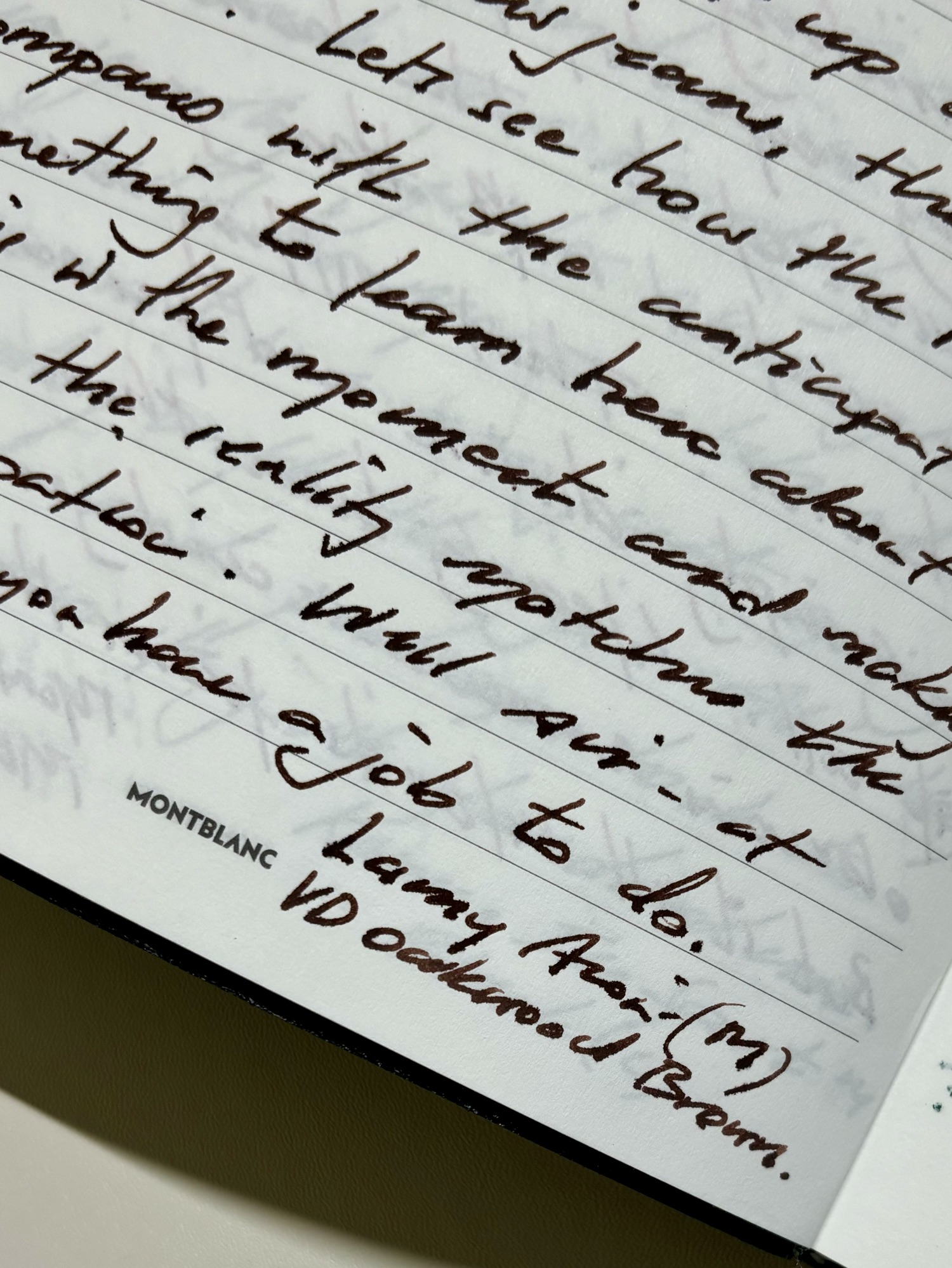
More on the pens below, however in terms of paper quality, I find the Montblanc notebooks handle almost anything, except for the wettest of inks and broader nibs. Now, a caveat here: ”wettest” and ”broadest” being extremely relative terms. If you’re reading along here, please understand these are based on the inks and nibs in my collection. One of my broadest and fastest running nibs? The OMAS Ogiva Alba — it’s a “medium” (albeit a European medium). One of my wettest inks? Van Dieman’s Oakwood Brown. Put those two in combination and there is distinct feathering on the page and show through on the reverse. This does not happen for example, with the same ink in my Pilot Custom 823 — a Japanese medium nib.

I would say it’s probably a case of creating a notebook suited to “our” pens and inks if you asked Montblanc, for I’ve typically found my Montblanc inks to be drier than some others. Of course, not being a BB nib type of pen owner, take this commentary how you will.

I do love the Montblanc notebooks, in so far as they really are the complete picture in themselves. The leather cover in a variety of styles (the subject notebook here carries a Saffiano leather cover), the gilded silver paper edging, and just the overall weight suggestive of a quality item. And yes, all of which you will indeed pay for. Probably not one for your daily driver — you most likely don’t want to be buying one every month or so.

Pens

With most typical days involving gel pens (a Traveler’s Notebook bullet journal system) and ballpoints (standard work notes in the office), I like to balance that out with some fountain pens. This mostly involves some other form of journaling, writing or planning in what I’d call a “desk book”. The 100-day challenge was of course a great fit.

As I look back through the challenge (where 80% of the time I captured what I used on the day in a footnote), it was a rotation of the following pens (and inks):

  • Montblanc 147 Traveller; Medium (Montblanc Royal Blue cartridge)
  • Pilot Custom Heritage 92; Fine-Medium (Edelstein Tanzanite)
  • Pelikan M805; Fine (Montblanc Irish Green)
  • Montblanc M; Medium (Montblanc Burgundy Red cartridge)
  • Lamy Aion; Medium (Van Dieman’s Oakwood Brown)
  • Kaweco Ice Sport; Medium (Kaweco Black cartridge)
  • Parker 75; Medium (Parker Quink cartridge)
  • Pilot Custom Heritage 92; Fine-Medium (Iroshizuku Shin Kai)
  • Platinum President; Medium (Iroshizuku Momiji)
  • Montblanc 146; Medium (Bookbinders Red Belly Black)
  • Montblanc 144; Medium (Montblanc Burgundy Red cartridge)
  • Pilot Custom Heritage 91; Fine-Medium (Van Dieman’s West Coast Sunset)
  • Pilot Custom 742; Sutab (Iroshizuku Shin Ryoku cartridge)
  • Lamy 2000; Fine (Robert Oster Peach)

A few other non-fountain variants made their way into the mix as well. Two colour variants of the uni-ball Signo 0.7 mm, a Pentel Kerry mechanical pencil, and a couple of Pentel Energels in 0.5 mm and 0.7 mm.

If I had a favourite combination during the challenge, I’d say it was the Pilot Custom 742. I love that Sutab nib, and I hadn’t tried the Iroshizuku Shin Roku before, so I’m thinking that had a fair bit to do with it. In general, I’d say they are all delightful to use, and worked pretty well on the Montblanc paper.

Accessories

This heading — though plural — really only offers one type used a few times through the challenge: stickers. It’s one of those cases where talented sketch-noting would go a long way, however in the absence of that, sticker (stick noting?) additions are it. Here it was a combination Traveler’s Company stickers, a few from a Melbourne creator I picked up at the Rose St Market on a trip to Melbourne last year, and a sticker sheet received with an issue of Standart (a coffee publication).

Much more appealing decoration than my efforts below…

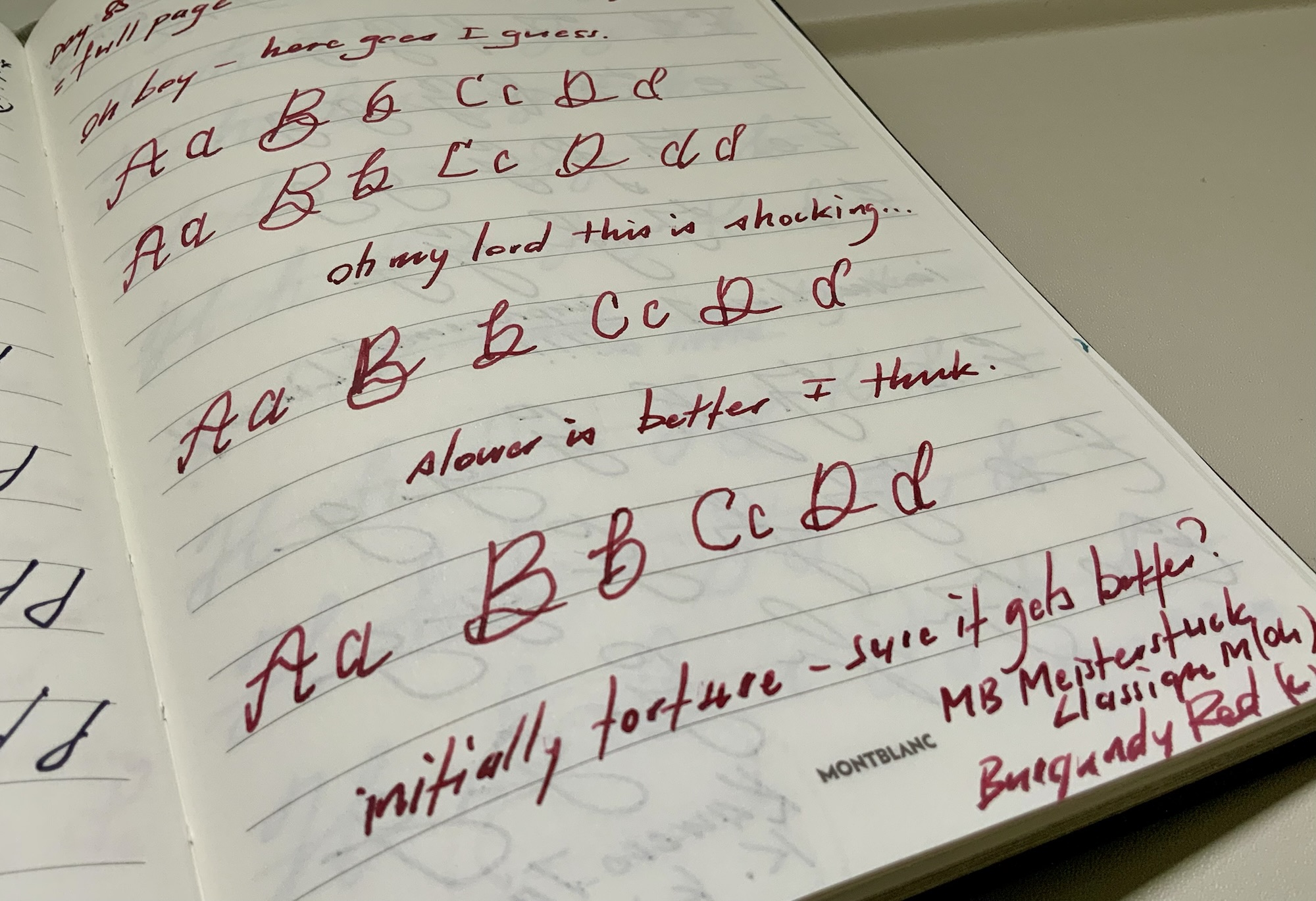
I find the stickers a great way to break up the blocks of text, and are certainly more visually pleasing than my shaky calligraphy efforts.

Speaking of which…

Challenge challenges

I have long held ambitions of becoming better at the more creative side of my writing, and by that I mean the visual side of said writing. Calligraphy is the most obvious choice here; however, I’ve never really had the motivation to start. What better way than rolling through days’ 84 to 93 of the challenge and working on a page a day of modern calligraphy?

Well, shaky at best, simply weird at worst. I’m happy I gave it a shot, although I’m not even sure modern calligraphy is a style I particularly enjoy. To that end, I’m not even sure that some older styles like Copperplate or Spencerian appeal to me either. To say I just need to find something that appeals to me would perhaps be a little flippant. I feel in the back of my mind, the truth probably lies more closely to the fact that I’ll never really get around to putting in enough time to get more proficient — regardless of the style.

As far as writing each day is concerned, that wasn’t difficult at all, and I’m sure anyone reading this is most likely a daily writer as well. Having the prompts? Well, that does make things easier, and is perhaps a lesson learned from me, as someone who never uses them and occasionally resorts to re-writing song lyrics to get something down each day.

Wrapping Up

In summary, the Montblanc 100 Day Writing Challenge was both enjoyable and a success. It does make me wonder why I don’t use more prompts in my journaling, and also why I choose some “challenges” and let others pass by. Whether that changes in the future is another matter, and I’m glad I chose this one — shaky calligraphy and all.

The Montblanc 100 Day Writing Challenge

Thinking back, perhaps I should have written about the Montblanc 100 Day Writing Challenge a little earlier, however having started myself a few days late, this post was always going to be a mid-challenge update.

With day 37 just completed, it is of course a fine time to tell us now… Well dear reader, you are indeed correct; however, this blog certainly isn’t known for its cutting edge hot takes on the stationery and writing communities, releases, or events.

Carrying on that tradition, things are going pretty well at a little over a third of the way through, and it’s been an enjoyable diversion in addition to my usual pen on paper ramblings.

The Challenge

I could say “never one to miss a marketing opportunity” about Montblanc, and while that statement is true enough — why would they? There is nothing inherently wrong with a business promoting itself or its products, and the emphasis on ”any tools will do” in the webinar sessions is certainly welcome (though of course you’ll see an array of Montblancs’ used on screen).

The writing challenge ties in of course with the 100th anniversary celebration of the Meisterstuck pen, which also brought a few new pens, other associated products, a Wes Anderson short film, and quite a few other events if social media is anything to go by.

Image courtesy Montblanc

A quick aside: the 100th anniversary pens? Well, nice enough yes, however never has my excitement peaked more than when I thought a re-release of the original versions may have been coming upon seeing some promo photos earlier in the year (for me, it’s the original green version from halfway down this page). To say my disappointment peaked even higher upon realising the anniversary release was simply a modern take paying homage to the originals, would indeed be accurate. Don’t get me wrong, the pens are indeed impressive, though not a patch on the aesthetic of the originals. Time marches on, I suppose.

Finally, the Wes Anderson designed Schreiberling pen does look intriguing, however at an estimated price tag of $2,500, is certainly not for me either.

Anyway, back to matters at hand. You’ll find details of the Writing Challenge through Montblanc’s Inspire Writing series, under Creative Writing Courses on the Montblanc website via the Discover menu (or more easily from the link above).

Having dabbled in some of these webinars in the past, and looked at others (with calligraphy I have intent, yet to date, no action), the 100 Day Challenge seemed both achievable and worthwhile at the same time. Catching up on the kick-off webinar in the “past sessions”, under presenter Brittany DeSantis, I came in a few days late, however quickly caught up given the writing prompts lead to as much or as little time investment as you like.

The Idea

On the surface, exactly as it says on the tin: to write daily for 100 consecutive days. Now for those of us who are well into the thousands of consecutive days writing (journaling, blogging, note-taking or the like), I generally consider the occasional challenge like this one as simply: 100 days of different writing.

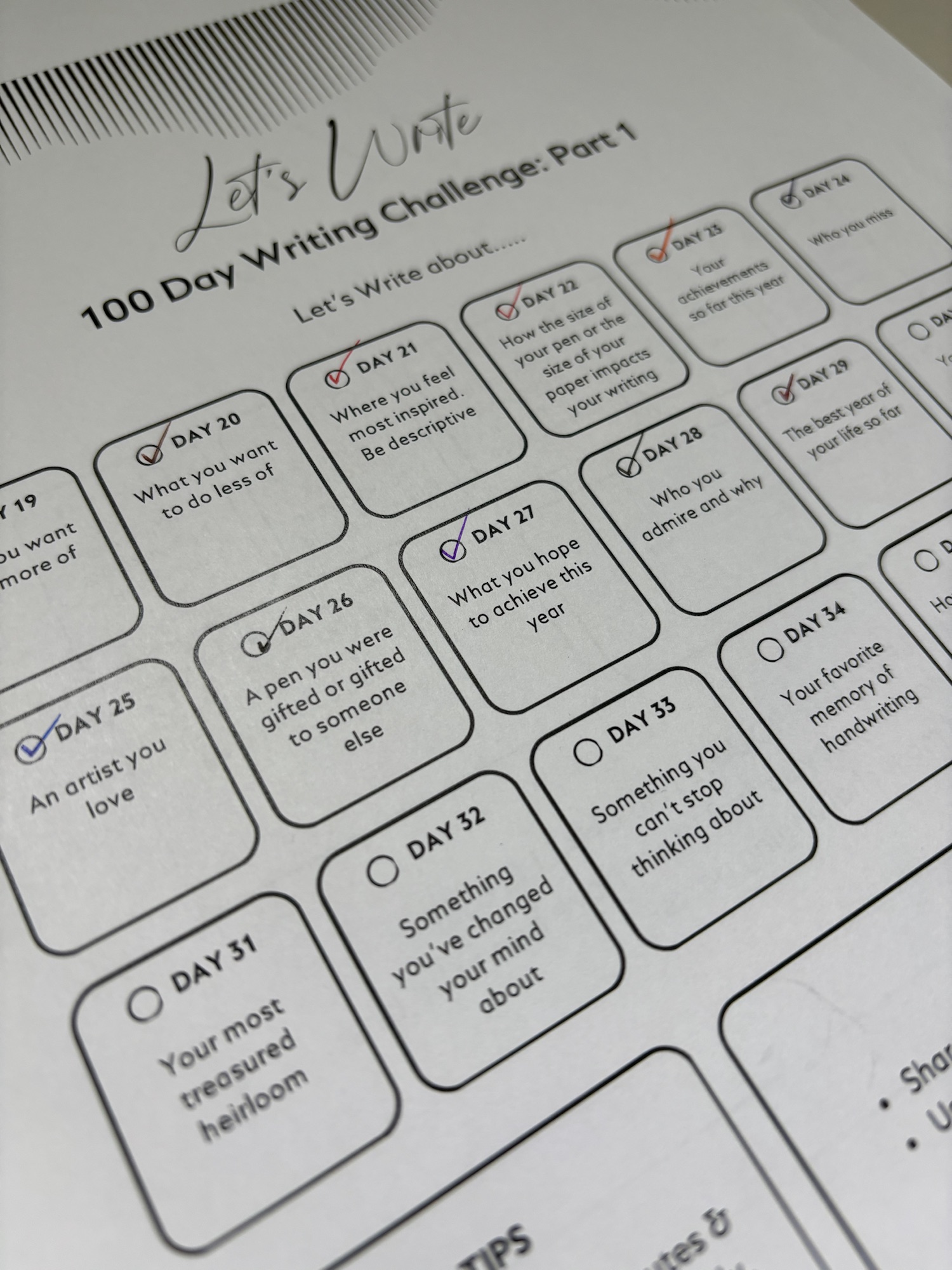
The challenge is divided into a couple of parts, the first being Your handwriting and history, comprising 43 days worth of daily prompts, mostly on writing and stationery habits, though also some general life themed questions as well. Part 2 will apparently be delving into lists to “discover more about ourselves and plan ahead” which I believe will begin at the next webinar taking place on July 10.

A daily commitment of about 5–10 minutes is the pitch, and I don’t find it overly burdensome, having limited myself to one page of an A5 Journal for each prompt. Accessible and achievable — always the best way to ensure those who start do a fair job of engaging, continuing, and finishing.

The Prompts

I’ve never been one to use journaling prompts, though at times when I sit in front of a blank page I think perhaps I should. Adding an extra A5 page a day as part of the challenge certainly provides no great impost, and given the fairly straightforward prompts, I’ve not found myself staring at a blank page.

Perhaps the secret is to take the prompts literally if that suits, or simply as a guide if there is a tangent you’d like to work through on a particular day. It really is a choose-your-own adventure. I’m sure if you are a prompt user, then you’ve likely seen them all, however a couple I enjoyed:

  • Your earliest memory of handwriting
  • How your handwriting changes based on what or where you’re writing
  • How your tastes in pen and ink have changed

There are also quite a few around “your favourite…”, along with more inspirational and life-themed questions, however the general Part 1 arc of Your Handwriting & history seems captured well enough through the prompts.

Signing off

Acknowledging I’m a bit late to the party in passing on the message out there about this challenge, there are still two remaining webinars and another two thirds of the writing days still to go. Perhaps it’s something to pick up now or even retrospectively complete at your leisure. I’ve certainly found it an enjoyable and worthwhile endeavour.

A Static Yet Evolving Fountain Pen Collection

2017-02-26-post-writing

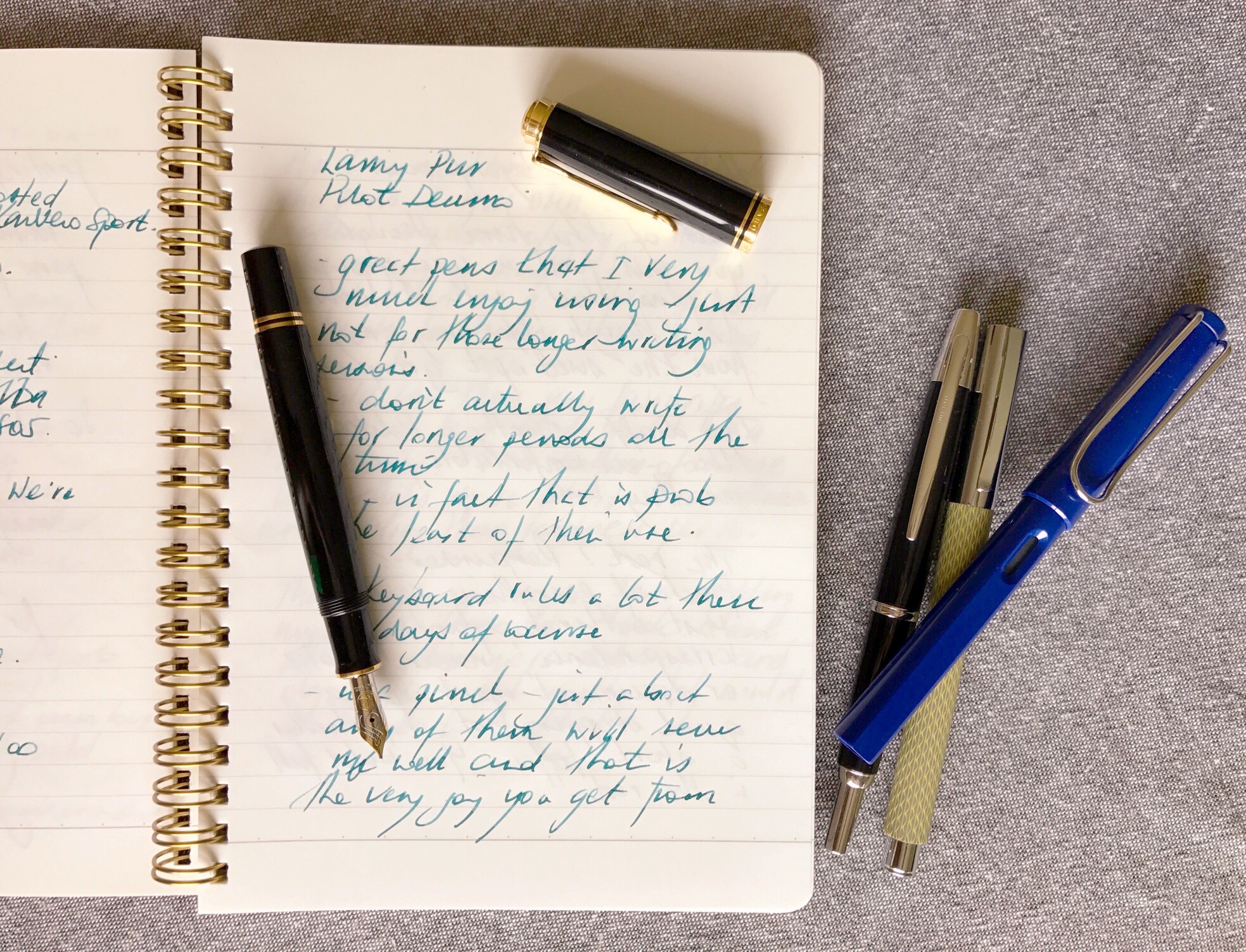
In use, a Pelikan M600. Looking on, a Pilot Decimo; Faber Castell Ambition; Lamy Safari

Anyone with a keen interest in fountain pens will eventually own more than one. The “more than one” will of course in all likelihood not merely duplicate the original. Most look towards having some variety of experience — different pens, nibs, sizes and designs. A cursory glance through any pen enthusiast’s social media feed will provide an insight into the amazing variety in many collections, be they developing or mature.

Usually, variety also comes with favourites. Those we might prefer to pick up just a little (or perhaps a lot) more than others. “Favourites” however — is not necessarily a category into which all of those great pens will fit into. Such a category is quite personal and subjective after all.

Perhaps “preferred” might be a better term. Horses for courses. Specific pens which may better for certain tasks than others. I’ll touch on this a little more below, however regardless of what title we put on, or how we define it, I think you get the idea.

An aside

There are times when I’m writing a post for this blog where I suddenly stop and think: why am I actually writing this? Who really cares about my personal experience or thoughts on x, y, or z? Something which occurs more often than you would think — and certainly more than I would like. This? Definitely one of those times.

When it does occur, one of two things generally happens: (i) The specific reason something might be of value to someone reading becomes clearer, generally resulting in a re-write with a more specific focus; or (ii) I feel like a bit of an idiot for spending so much time only to scrap the entire thing quite late in the piece.

Blog posts I find most valuable have a way of changing how you think about something — not simply make you think about it. How your own situation is — and will be — influenced by your approach to it, and your philosophy behind that approach. There are plenty of posts published on these pages which won’t achieve that, however hopefully on occasion some will.

Of course when I hit a point in my writing as I’ve described above, I tell myself it improves the overall quality of what does end up published here, though I’m not sure I fully buy that. Here’s hoping I’m onto (i) above with what follows.

Not a “favourite pens” post

So, I’m talking about what exactly?

Well, I can only speak from personal experience of course, however perhaps I’d call it the curious case of my static yet evolving fountain pen collection. It is evolving more with time, and as that continues, it is providing quite an intangible change in value — something that is as exciting as it is perhaps a little unusual (to me at least).

I have a fountain pen collection which has not been added to for well over a year now. For those who may be interested, a listing of said collection can be found here. For those unfamiliar with how much of that collection came together, it is explained here. To say I remain grateful for these pens every day I uncap one would be an understatement.

To explain the apparent incongruity in this same, yet different notion — this “evolution” I speak of, is not in the “I’ve moved on” sense of the word. Over time I’ve noticed an ebb and flow of usage and delight within this collection. Granted, not entirely unusual, however I’m talking about pens I had placed (somewhat firmly) in the unsuitable/not my style/not comfortable/just cannot seem to like it category, completely coming around.

This whole pen caper can be a complex one to think about at times. What’s that? Well if you make it complicated it certainly is. I don’t disagree with you. Just pick up a pen and write with it — simple. Again agreed. However that is precisely the essence of what I’m talking about here. Those we choose to pick up, and those we don’t, and what becomes of those we more often than not don’t.

My collection

Thinking back on previous pen posts here, most have always contained a few points on my usage patterns, a big part of which is dictated by the size of the pen, and how comfortable it may be over longer periods of use. Most I generally consider to be either shorter note takers, or long form writers. Of course long can be short — though short is usually never long.

Pens which fit into the long form writers category, and by default can of course handle the short stuff, tend to be those “favourites” or “preferred” pens of the bunch.

From a previously published post, my thoughts on the Faber Castell Ambition:

Over longer writing sessions, the Ambition is probably not quite as comfortable as some larger diameter pens with a tapered form, however here I am referring to a three or four A4 pages before I began to have those thoughts

Another, on the Sailor 1911 Large:

For me personally, the answer is just about perfect, both from a size and weight perspective. At 122 mm (unposted) the barrel has enough length to provide scope for a higher or lower grip on the section, which I will vary at times during lengthy writing sessions.

Finally – the Pilot Decimo:

For shorter writing sessions or quick notes, it is just about spot on. When in the zone and powering through multiple pages of a longer draft, I’d more likely pick up one of my other pens.

Perhaps some form of size/balance sweet spot or preference appearing over time?

In actual fact, I drafted the beginnings of this post some months ago. Seriously? What have you been doing? Good question for another time — actually no it isn’t. I don’t actually have an answer to that one.

In any event, that original post had a working title of A Pen Sweet Spot. In it I began to wax lyrical about how it wasn’t just about nibs. It was (and is) about weight, dimensions, and overall balance as well. That is often why I pick up what I do on any given writing occasion. About how it isn’t just about numbers and specs. How there is a good deal of the intangible.

It might help at this point to provide a little context of where I was headed with that post.

The original draft

A surviving excerpt from the original:

So, it sits about where this so-called sweet spot?

For reference, it’s around a Pelikan M600; a Sailor 1911 Large; or a Pilot Custom 912. Towards, but firmly within the lower (read smaller) end, it’s a Pilot Custom Heritage 92; a posted (of course) Kaweco Sport; or even a Pilot Kakuno. Aside from the Kaweco, all of the above are used without posting the cap, as are those towards the upper end of the window.

Towards the larger end we have contenders such as the Pelikan M800 series, my OMAS Ogiva Alba, and even the Platinum President.

There are also some notable omissions from that list. If we are simply talking approximate size, then it also should be the Lamy Safari, probably the Lamy 2000, and even the Pilot Metropolitan. To me that suggests there is more at play. Those and a few other pens I’ve never really gelled with. Great pens mind you — each of them, and I do enjoy using them — just not for any significant amount of time.

Some notable omissions? Probably the Pelikan M200 and 400 series, the Faber Castell Ambition, and the Pilot Decimo. Each probably a little on the slender side to keep things completely comfortable over the course of more than a few pages.

2017-02-26-post-sweet-group

L to R: Pilot Custom Heritage 92; Sailor 1911 Large; Pilot Custom Heritage 912; Pelikan M805; OMAS Ogiva Alba; Platinum President

Between writing those words in the initial draft and now, a few things happened which I have to admit surprised me. For one – I powered through a number of pages with the Ambition and wondered why I enjoyed it so much. I wrote a lot of the first draft of this very post with the Lamy 2000 – again stopping to think: what happened there? That is, with reference to the above, the short did become the long — and I thoroughly enjoyed the fact, and the pens. It changed my whole perspective on some of the pens I’d not used in a little while.

How did this magic occur?

The zone

A few pens with which I’d never managed to end up in “the zone” with, magically appeared there — and appeared there effortlessly. Though we might all have our own word or term, you know what I’m talking about when I refer to “the zone”.

Those writing days where everything just feels right. The pen sits truly in your hand — the nib gliding freely but with precision. The slope uniformly even, the tails curve in symmetry, and no matter how fast the page is filling — it’s all falling into place. You’re in the zone — and it will take a big nudge to bump you out of it.

Somedays it can be found in the first sentence. Perhaps late in the first paragraph or even over the page. Other, more frustrating days? Good luck finding it at all. It’s a Field of Dreams really isn’t it? Putting together a combination of perfect tools: pen, paper and a perfect position will see it somehow magically appear from the corn field. Other times? It’s just you sitting in the empty stand.

Your point exactly Pete?

This (sweeps hand above pen storage boxes) — all of this changes.

2017-02-26-powderfinger-quote

Powderfinger and a Lamy 2000

This is a journey that goes not from A to B. To borrow a phrase from legendary Australian band Powderfinger, it goes up and down and back again. It isn’t simply a linear spectrum or continuum — there is more to it.

As I mentioned – I’ve not acquired any new fountain pens for some time, yet somehow, I have what I consider a whole “new” group of pens patiently waiting for me. That is as weird to me as it is wonderful. I’d begun thinking a little about my longer term plans in relation to these pens, yet now it’s decided – I’m hanging onto them, for I’m sure those sitting patiently in that drawer are likely to have something more to offer when called upon.

I feel extremely lucky all over again.

Signing off

If you’ve made it this far I thank you, and apologies if what I’m trying to say remains unclear. The essence of the message is simply that it seems this whole fountain pen journey indeed evolves, however it is equally back to the old as it is on to the new.

So yes, buy on recommendations, however embrace what you own. Love your pens, look after them, and go back to them. You never know when that one at the back of the drawer might become “the one” — at least for a while anyway.

There you have it, over 1900 words that could have been summed up in a tweet. Long form writing though — with fountain pens.

Exactly. You get it.

A Pen Index Page

With the number of pens in my collection growing substantially over the last few years, I’ve put them all together in an Airtable database as an attempt to keep them in some sort of order. Although the database is far from complete, and will perhaps be the subject of a post in its own right — my thoughts came around to the blog and how things are organised in terms of the pens and reviews I’ve put up so far.

I’ve decided on at least creating a basic pen index list for the blog, which will hopefully provide readers with a general idea of where I’m coming from as far as my fountain pen thoughts and opinions are concerned, along with a simple index with links to the posts I’ve managed to get around to writing so far.

Looking at the list, I feel incredibly fortunate to have the pen collection I have, which was largely brought about by a very kind and generous friend downsizing his own collection at about the same time. Although I’ve thanked him many times, it is a generosity that I will never be able to fully repay.

There are certainly some pens in the list I find myself coming back to, filling, and using more often, though at the current time I’m not ready to either put them in rank order or into a best/top type list. Perhaps that might come at some point in the future.

At the current time I’ve also limited things to fountain pens, having not decided on the exact nature of how I might include other types of pens I own without the index becoming a little too all-encompassing and unwieldy. I also debated on whether to include budget pens such as the Pilot Petit1 and Platinum Preppy, however having written a post on the Petit1, the decision was made to include them as well. After all, there are some solid pens at this end of the market, particularly at the price point they sell for.

If you’d like to take a look at the index, it is sitting under the Analogue Tools category of the site’s menu, or click the following link:

Current Pen Index

As I’ve mentioned, the list contains links to posts I’ve written on some of the pens. If you are looking for other reviews around the web, the best place to start is the magnificent Pennaquod pen blog search site run and maintained by Ian Hedley, of Pens! Paper! Pencils!

And the Airtable database I mentioned in the introduction above? That’s not a database — check out the one David Brennan of Too Many Inks uses for his pen and ink rotation. Now that’s a database.

In closing, I do hope to slowly get around to transforming more of the index to links, however of course that means finding time to write the posts.

I’m sure I’ll get there — eventually.


Two of a Kind: Pilot Metropolitan and Tombow Object Fountain Pens

IMG_3427

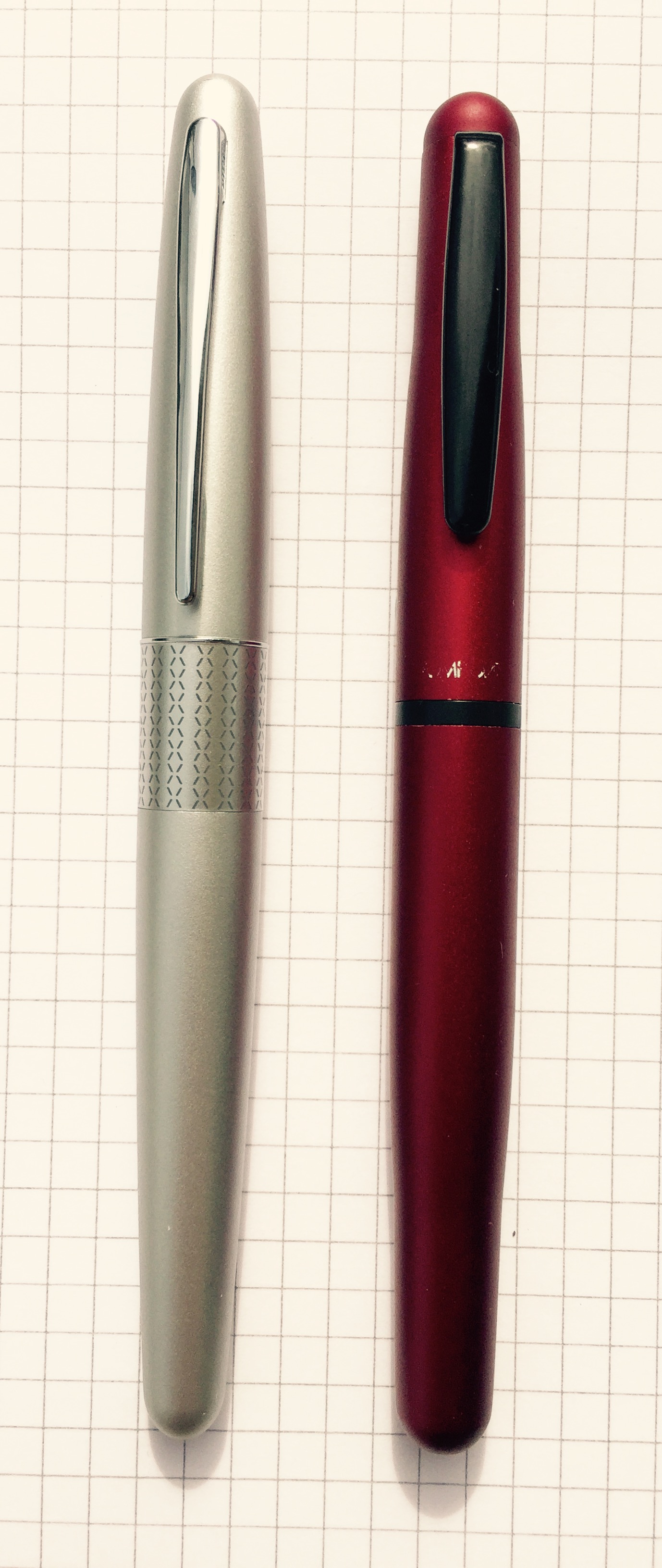
Silver Zigzag Pilot Metropolitan (L), and red Tombow Object (R)

With a Pilot Metropolitan having been in my collection for almost 12 months now, upon recently receiving a Tombow Object, I was struck by how similar these two pens actually are.

My original Metropolitan had a fine nib, which met its demise after about 11 months of use, when a very small part of the nib tip popped off while writing. Although I then had an instant stub nib, it was a little jagged for writing! The Metropolitan you see here came with a medium nib.

Both of these particular pens were received from the very kind gentleman I wrote about in a previous post.

Look and Feel

FullSizeRender 14The similarities in these pens were immediately apparent in relation to appearance; to some degree the design, and how both felt in the hand while writing — I see am not alone in thinking this.

When capped, both are of a very similar length and shape, tapering towards both ends. The Tombow remains a little larger in diameter at the end of the body and cap, whereas the Metropolitan continues to a slightly finer taper.

The Metropolitan is noticeably the heavier of the two, however both are quite well-balanced when putting pen to paper. Both have sturdy, well-functioning clips, with the Metropolitan sporting a feature band of decorative patterning around the centre of the barrel. This particular one being the Silver Zigzag model. A nice touch, however probably adds no more aesthetic value to my eye.

Both pens have a metallic, brushed aluminium looking finish on the entire exterior (with the exception of the zigzag addition to the Metropolitan) — a type of finish I do like, and particularly suits some of the more colourful options available in the Tombow Object series.

IMG_3433

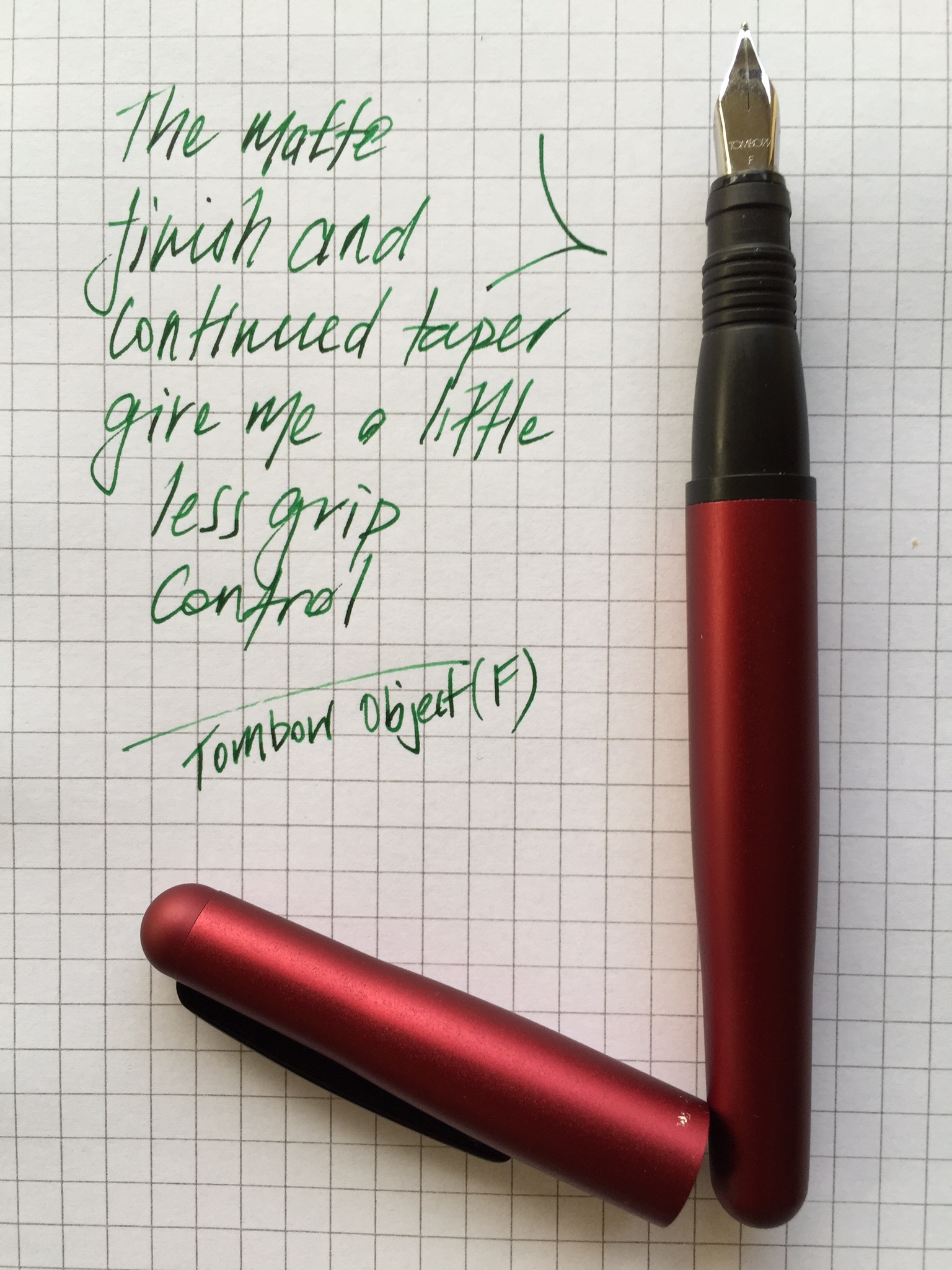
Differences can be seen in overall nib length; step at the junction of section and barrel of the Metropolitan; and the Tombow’s matte finish on the section.

You could say the similarities end once the snap on/off caps are removed and the grip sections are exposed. The Metropolitan’s shiny gloss plastic (resin?) grip section is immediately apparent, whereas the Tombow sports a more subdued matte finish.

Both have visible and palpable lines running the length of the grip section from the manufacturing process, and although virtually unnoticeable, are not evident on more expensive pens. Certainly not an issue and I only mention it as I analyse the grip sections a little more closely for comparison. The taper, length and step of the grip section is the biggest difference I find in these pens, and I will elaborate further in Writing Performance below.

Overall, I like the look of both for sturdy, everyday use pens, and given the similarity, if I like one, it goes without saying I like the other. On appearance alone, I really couldn’t pick a favourite between the two.

Specifications

Specifications below courtesy Jet Pens:

Pilot Metropolitan

  • Country of origin: Japan
  • Weight: 3.7 ounces (105 grams)
  • Grip diameter: 9.8 mm (max diameter 13.3 mm)
  • Length Capped: 13.8 cm
  • Length Posted: 15.3 cm
  • Length Uncapped: 12.5 cm
  • Nib: steel
  • Fill: international standard cartridge/converter
  • Price: Approximately $AU18.00 (Jet Pens US + shipping)
  • My pen: Silver Zigzag model; M nib

Tombow Object

  • Country of origin: Japan
  • Weight: 3.0 ounces (85 grams)
  • Grip diameter: 9.3 mm (max diameter 13.0 mm)
  • Length Capped: 13.8 cm
  • Length Posted: 15.6 cm
  • Length Uncapped: 12.2 cm
  • Nib: steel
  • Fill: international standard cartridge/converter
  • Price: Approximately $AU48.00 (Cult Pens UK + shipping)
  • My pen: Red model; F nib

As you’ll note from the lists above, it is certainly not hard to see why these pens are very, very similar in look and feel — the most obvious difference being of course the weight.

For overall balance, I honestly could not pick one over the other despite this obvious difference, however if you were someone who posted their pens — for me at least — this would make things a little top-heavy with the Metropolitan.

You’ll also notice both are sold as cartridge/converter fillers. Not being overly adept with the included squeeze mechanism converter included with the Metropolitan, I swapped in the CON-50 converter which I’ve always found easy to use and very reliable. I have only used a standard international cartridge in the Tombow.

Writing Performance

When putting pen to paper, it is again quite amazing just how similar these pens are, even more so with the medium nib of the Metropolitan and fine of the Tombow.

IMG_3428

Despite the Metropolitan’s M nib and Tombow’s F – the line characteristics were very similar.

From what I recall, this would certainly not have been the case with the fine nib of my previous Metropolitan. At times I found the fine nib a little scratchy on certain paper types, and overall it was probably too fine for my writing style. The medium nib on this model is a far better fit for me.

The line widths, nib feel and smoothness are very, very close. Both lay down ink very well, with the only real difference in feel the marginally stiffer nib on the Tombow. Even with slightly more flex to the Metropolitan, both pens showed minimal (and pretty even) line variation with changes in pressure. There is no doubt these are really great nibs — both of them.

I keep harping about the similarities in these pens, so we should probably have a look at some of the differences as well.

My standard grip as shown with the Metropolitan.

My standard grip as shown with the Metropolitan.

That grip section. Here is where the suitability of each pen might vary widely depending upon your particular writing grip and style. I believe I would call mine a fairly standard pen hold, and with that, the Metropolitan suits my hand better than the Tombow.

With the Metropolitan, there is a significant step down from the barrel to the section, which in itself may be a problem for some, however suits my grip perfectly. As my middle finger hooks around the step, it provides a perfect platform to balance the pen, with my index finger and thumb able to rest lightly on the top and side. I’ve found this facilitates a lighter grip nicely — particularly in someone who is making a conscious effort to be a little less heavy handed (remember that broken Metropolitan F nib I was talking about?).

With the Tombow, at that same point in the grip section, although there was no step, the continuous taper towards the nib and smooth plastic finish left me wanting a little more control most times I wrote with it. This was most evident early in the mornings when both hand and pen barrel/section were cool, and I found my fingers sliding around a little on section. Not a deal breaker, however I certainly had less control, and was forced to grip a little more tightly, something I am consciously making an efforts not to do.

IMG_3437IMG_3436

Of course I then began thinking how the Tombow would make a perfect summer pen, when the Queensland humidity would ensure the grip section became nice and tacky — and just like that my pens started to become seasonal. What has become of me?

Overall, I’d say these pens are quite similar (again!) in writing performance, particularly from the perspective of the nib. My preference simply comes down to the shape of the section on the Metropolitan being more suited to my particular grip.

Use case

The most obvious answer here of course, is anywhere you would use a fountain pen, although there are a couple of other points I’d like to add. Although I have differing nib widths for both pens (a reminder: M on the Metropolitan; F on the Tombow), as you can see from the accompanying writing samples, both are on what you’d call the finer side of line widths.

IMG_3424

In a Baron Fig Confidant Journal.

This allows these pens to function very well on paper where a broader, wetter nib might bleed and feather its way out of favour. A case in point being the Baron Fig Confidant notebook. Otherwise, my usual Rhodia pads have seen the most of both these pens for both meeting and general notes I have made at my desk in the office, a task for which I have found both pens well suited, given their understated look.

That said, it has been nothing to carry either one in my pocket or shirt placket for use in a coffee shop note taking or planning session either. True, I notice the Metropolitan’s extra weight in doing so, however I wouldn’t say enough for me to avoid doing so. Both have again performed well, whether it be a few quick words written between sips, or a few pages written when ideas are flowing a little more freely.

Either of these pens can be anything you need them to be.

Conclusion

Put simply these are both great pens.

The Pilot Metropolitan is widely recognised as one of the best value for money pens out there. That very statement ”value for money” typically infers compromise, yet I certainly do not necessarily see that to be the case here — for either pen.

For the respective price points, the materials are of course not high-end, however I think for both cases here, that simply adds to the satisfaction when using these pens. You have a great pen in either case and have spent only a modest sum for the privilege.

If I had to pick, it would be the Metropolitan. Largely based on the better suitability of the grip for my particular style, and the lower price point really hammering home the value for money aspect.

That being said, I would (and will) be happy to continue using both on a regular basis.