In Use – Vesper 2.0 for iPhone

Although I use Evernote for storage and archiving of longer notes, articles, web clippings, PDF’s and the like, many quick notes are just that, short and quick. The type of notes which don’t require any further action, sharing or archiving until I need to refer to them again. When I’m standing in a shop, I don’t want to be searching through my filing cabinet for the pen refill model number, I simply need the notebook in my back pocket where this information is written. To me, if Evernote is my digital filing cabinet, Vesper is the digital notebook in my back pocket.
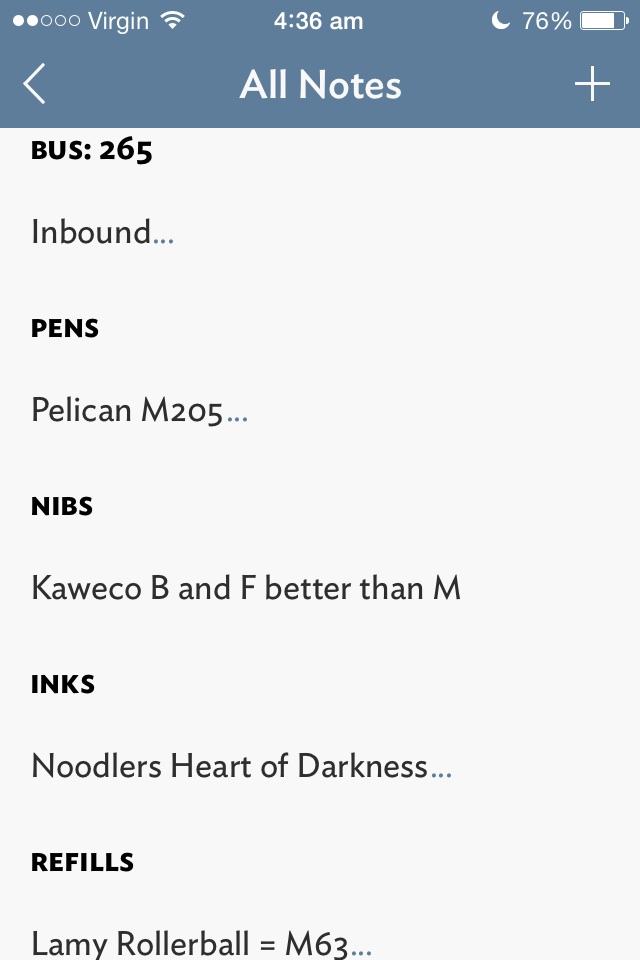
Vesper_Notes_ListVesper_home

I love Vesper, and it has been on my home screen for the past 4 months or so, being a fast and reliable way of taking quick notes with a minimum of fuss inside a great looking interface. If we go back to the notebook example above, Vesper is the book you grab when you may not necessarily need to write down a note, but simply enjoy writing in the pages with your favourite pen anyway. Yes – in my opinion the user interface is that good. I have never been a fan of Apple’s native Notes app, pre or post iOS 7, and if you are in any way similar, go and have a look at Vesper.

Vesper_settingsVesper_in_settings

Vesper supports tags, photo and text notes, has gesture based (L swipe) archiving, and the usual email/message or copy all actions. Notes can also be reordered or “prioritised” through a tap and hold to drag up or down the list.

Vesper_NoteVesper_Share

Have I mentioned Vesper is a beautiful app? From the design, colour scheme and font (love the smallcaps option for note titles), not to mention the understated icon on my home screen. The icon, incidentally, sits right beside Drafts, another app I use extensively for longer form note taking (e.g. notes while listening to podcasts; email drafts), which usually end up being archived to Evernote, Dropbox, or sent to other apps such as Omnifocus for further action. Of course, I acknowledge a great looking app is virtually useless if it does not have the functionality you require, however for the times I use Vesper, I don’t need anything else – and that is precisely it’s strength.

Why write about Vesper now? A recent free update to the app has now added Vesper Sync for your notes, a missing feature pointed out by any as a downside of the original release. Although the sync is essentially a back up as there are no Vesper iPad or Mac apps yet, Vesper will run at 2x on the iPad. Set up for a free (optional) Vesper Sync account is a simple process using an email address and password, and you are up and running. For those suspicious of a “free” syncing service, John Gruber on the Vesper blog:

Vesper Sync is not a free lunch, because Vesper is not a free app. Sync should be a feature, not something you have to pay extra for.

Although my note collection is very small, (I tend to delete or amend the 20 or 30 notes I have on the go), the syncing is fast and unobtrusive, both key aspects for my continued use of Vesper as a primary quick note/recall app (from what I understand the app scales well with larger note collections). This added feature now bodes well for the development of companion apps, and I believe the Mac app is first in line.

Read more on Vesper Sync and future plans on the Q Branch blog, and you can follow Brent Simmons engineering diary at Inessential.

Vesper 2.0 is currently available on the iOS App Store for AUD$6.49 (or the update is free if you already own the App).

Wiser Web Wednesday

Wiser Web Wednesday – a weekly link to posts of interest from around the web:

The Gentleman Stationer
I posted a few thoughts on some of the pen cases from Nock Co. myself, but a trilogy it was not. A great three-part “mega” series on these very products:
Nock Co. Three Part Mega Review: All the Cases, Part I
Nock Co. Mega Review: All the Cases, Part II
Nock Co. Mega Review Part III: Hightower and Brasstown

David Smith
Although I personally tend to seek out cafes to try when travelling, here is a nice in-room option if that is your thing (thankfully in Australia, kettle not required):
My Travel Coffee Kit

The Clicky Post
Although not unique to this AL Sport stone washed version, I have often thought about the shape of my Kaweco Sport and Ice Sport models in the same way:

Almost like you’re not sure whether it is “attractive” or not, but it draws you in and definitely has a beauty all it’s own.

In any event, some great images (and review) demonstrating a masterstroke (in my opinion) of pen body design and finish:
Kaweco Al Sport Fountain Pen Stonewashed Edition

Pens! Paper! Pencils!
Ahh…of course. The Retro 51 Tornado – a long time Pen Addict Podcast staple. A great review by Ian (as usual), which also reminds me I must seek out the Schmidt P8126 refill and given it a spin in my own Stealth model:
Retro 51 Tornado rollerball review

Macsparky
A reminder of times gone by and what the future might bring. My solution to solving the Rubik’s cube as a kid was unfortunately the pull apart and reassemble method:
Inconceivable

Asian Efficiency
It’s all about the OmniFocus 2 for Mac upgrade recently, and I have no hesitation in recommending the update if you currently use this task management programme. I much prefer the new interface, however perhaps this may come from using the iOS versions exclusively for 18 months prior to purchasing the Mac version.

In any event, for those who were not involved in the Beta testing (let’s face it, if you were, you wouldn’t be reading this blog) and OmniFocus 2 is all new to you, I found this 13 minute video from AE immensely helpful to point out the key changes, and the drag and drop workaround is a nice touch – definitely worth a look:
The Differences Between OmniFocus 1 and OmniFocus 2 for Mac

Simplicity Bliss
Speaking of OmniFocus, a nice round-up of a number of reviews and guides out there to help you on your way:
The Big OmniFocus 2 For Mac Round-Up

In Use – Rhodia No. 12 Ruled Notepad

Anyone with half an interest in pens and paper probably owns at least one Rhodia notepad, however my own usage has always involved the No. 16 size (14.8 x 21cm) and up. However on a recent trip to a local bookstore, my lovely wife recognised the familiar orange Rhodia cover, purchased a ruled No.12 notepad for AUD $4.95, and surprised me with this little pocket gem when she returned home. A win for me, as I had another notepad in my drawer, sans the guilt of buying yet another item of stationery.

I was keen to see how a notepad of this sized fitted my usual workflow.

Look and Feel

The Rhodia No. 12 is a small notepad (8.5 x 12cm or 3.3 x 4.7in) containing 80 sheets of acid free 80gsm paper. As with other Rhodia products, it is made in France to the same high quality usually associated with products bearing this name. Each sheet has micro-perforations across the top for easy removal, and everything is held together by a single reinforced staple.

Rhodia12_Cover

Rhodia12_Back

It is available with a black cover or the classic Rhodia orange, in the usual paper variants of Dot Pad, Graph or Lined paper.

Performance

As expected, writing is the smooth enjoyable experience reminiscent of the larger Rhodia variants. One of the real advantages of the paper used in Rhodia notepads is that pretty much all pen types and of course pencils, are well received by the paper. I often use gel ink or fountain pens, and it is a real joy to know that a quick note taken will be captured the way I intended – crisp and clear with no feathering or bleed, and will generally be dry by the time the cover is closed or the page is torn out. At the outside, fountain pen drying time was less than 10 seconds, most often closer to 5, with liquid or gel ink around 3 seconds or less.

Rhodia12_Note_1Rhodia12_Note_2

Although the size of the No. 12 puts it in the same use category (for me) as index cards, where it really shines is in allowing me to bypass such appalling paper as your standard Post It notes. Although my own use case rarely requires me to actually stick or post one of these notes, given their prevalence in the office and ease of scribbling a quick note for someone, they remain in widespread use by all – myself included. Despite the ongoing use of these tacky (yes I went there) pieces of yellow, I have always loathed the paper, the sticky strip on the reverse side, and the fact that when I write on them my pen invariably skips or doesn’t work on the top third where the glue resides underneath. Thank you Rhodia No.12.

The perforation across the top works flawlessly when tearing off each note, a Rhodia feature I found to be a godsend when undertaking InCoWriMo earlier in the year, with all correspondence for that challenge being written on No.16 Dot Pad. It is also nice to have both sides of each page lined, as occasionally the size dictates a second page for a single note.

Use Case

I must admit I don’t purchase many notebooks this size, however this may now change as I have become accustomed to having this little Rhodia with me and put into use for a good many tasks.

It has clearly become a superior option to the dreaded office Post It note referred to above, providing a much nicer writing experience, and removes the need to fold the notes in half to avoid the sticky portion clinging to everything in its immediate vicinity. Here we are talking short notes for colleagues, phone numbers, ideas “filed” in to my Nock Co. Maryapple for later processing, or quick lists if I am going out to the shops in my lunch break.

Rhodia12_MaryappleRhodia12_Maryapple_Close

Rhodia12_GrindersSpeaking of the Maryapple, as this notepad has become more entrenched in my workflow, I have found this case to be a perfect home for the No 12. When carrying between the office and home, my standard Maryapple case formation now consists of 2 Field Notes and a few index cards on one side and the Rhodia No. 12 in the other. With the cover folded back, the lip across the top fold keeps the notebook perfectly above the top of the case pocket. The more I use the Maryapple, the more uses I find for it, and the more I like it.

When sitting on my desk at home, the size of the No. 12 notes again suit quick lists if I’m heading out to the shops; as reference markers in books or magazines (with notes); for notes on my coffee grinders containing coffee type and grind information; and even a few quick sketches if the notepad was closest to hand when an idea struck.

Conclusion

One aspect of this Rhodia No. 12 Notepad which surprised me a little was seeing just how many more notes I have written since adding it to my workflow. Clearly not having a decent notebook of this size in the past decreased the amount of notes I produced this way – never a good thing! This has certainly changed now, and I can see the No. 12 being put to good use for some time to come. I am still using my Field Notes heavily, which will continue, as the two serve distinctly different purposes – the Field Notes unsuited to producing a quick tear out note of this kind.

Things I would change? Probably going for the Dot Grid option, particularly as many notes I write on a notepad of this size are oriented diagonally corner to corner; perhaps a 40 page option would be nice, as writing certainly becomes more comfortable without the large drop from the page to whatever surface it may be resting on, however this is taken care of soon enough by simply writing more notes!

By now it should be fairly clear I am rather taken by the No. 12 sized offering from Rhodia. Having used the No. 16 Dot Grid pads extensively for some time now, the question was never going to be about the paper, but the uses I may or may not have for the size. Over the past few weeks any doubts about when or where I may use notes of this size have certainly been put to rest, with the answer being anywhere and everywhere, which I must admit was a pleasant surprise.

At less than the cost of a cup of good single origin filter coffee, the Rhodia No. 12 is fantastic value for money. If you are a long time Rhodia user of the larger sized notebooks, you may be surprised by how often this smaller size comes in handy. For someone wishing to test out Rhodia paper and see what all the fuss is about without having to purchase a larger size? Perfect.

Me? I’m off to pick up a few No. 12 Dot Grids to leave lying around wherever I might need them.

Wiser Web Wednesday

Wiser Web Wednesday – a weekly link to posts which piqued my interest from around the web:

JimSeven
James Hoffmann’s thoughts on creating a new occasional coffee magazine:

…most publications were more focused on the trade side of things rather than trying to tell the stories we have to the interested members of the coffee drinking public.

Though the print copy looks fantastic, I ordered the eBook version and believe me, this publication is a great read (independent writing; no ads). Check out more details and links to ordering options here:
Introducing Longberry Magazine

The Cramped
Continuing a recent stream of thought on penmanship, might I say ease up on the grip and pressure people! Your stone paper notebook in particular will thank you:
Penmanship for the Heavy Handed

Pens! Paper! Pencils!
If you are looking to get some reasonably priced vintage fountain pens, Parker is a decent place to start. A great review from Ian and some really impressive photos as well:
Parker 45 fountain pen review

Inktronics
Speaking of reasonably priced pens, a new best entry-level pen? Now available in an F as well as M nib, the Pilot Metropolitan makes a play for this title. A well-balanced , well written review:
Pilot Metropolitan Fountain Pen Review

The Well-Appointed Desk
If you need any more convincing, another favourable review of the Metropolitan:
Pilot Metropolitan Fountain Pen Review

Quotebook
Originally I’d planned to give the final word to The Cramped (who you should really follow on Twitter), for one of my favourite quotes of recent times:

Should I lose all my important writing, I’d prefer being able to say it died in the flames of an unquenchable fire, or the merciless gusts of a tornado, or rapids of river water beating down the front door during a flash flood. If the writing matters at all to me, it deserves something a little better than, “I forgot to press Ctrl-S.”

However in saving the above to my Quotebook (a fantastic app for doing just that – saving quotes), I noticed some exciting news – Quotebook 3 is on the way, which is a complete redesign by developer Lickability for iOS7 (iPhone and iPad). You can sign up to be notified, however I will most likely write-up my impressions here once it is released. In the meantime, the current version has been pulled from the App Store:
Quotebook 3: Coming Soon

Life by Alt+Tab

Alt+Tab (Or CMD+Tab as the case may be depending on your platform).

For the purposes of this post we’ll go with Alt+Tab, given my office job ties me to a Windows PC. Alt+Tab being the keyboard shortcut which instantly takes you to another open programme, and one I use dozens of times per day.

I mentioned in a previous post how the concept of work life separation resonates with me far more than that of work life balance. All day, five days week, I sit and peer into two monitors, hopefully make a difference, get up and go home. I’m certainly not alone in this. Whether or not you sit, stand, walk or crawl(?!) around all day, you also get up, go home, then come back and do it all again.

How do we separate the work day from everything else? More importantly, how quickly and how often can we switch off from work and into…well, something else. It may seem counterintuitive to suggest my iPhone and iPad mini help me switch off from work. They’re just another screen right?

Not so much.

Morning

My morning commute generally involves listening to my favourite podcasts and a bit of music prior to walking through the office doors.

[Alt+Tab]
Once I hit my desk it all begins, with my focus on work and generally not much else. Though my iPhone is close at hand, it is rarely used, other than to reply to an occasional text message or to check either my calendar or Omnifocus.

Whatever you may think of “multitasking”, or the fact that replying to a text message only takes a few seconds (please tell me you realise how long it takes to regain the same level of focus you had prior to a minor disruption) – tasks that are not work and disrupt focus are the true productivity killers of the modern office. Don’t even get me started on the design flaws of the modern open plan office where “collaboration is king” – well yes, if you accept that 90% of all collaboration occurring is about the latest concert, Game of Thrones episode or why someone just needs to get out of that relationship.

I digress, so let’s just say I’ve been hard at work for a couple of hours by this point.

Middle

[Alt+Tab]
I exit my office building at approximately 11am for a mid morning coffee, call my wife to see how things are going, then open Tweetbot and catch up on my Twitter feed, check Instagram, or what my family are up to in Path. I may search or stumble across some articles to save for later in Pocket or ‘flip’ into my Brew magazine on Flipboard.

That is, an immediate transition from my office role into another virtual space where the interactions are all about my other interests and passions. Family, pens, coffee and technology being some. Some of these interests lead to interactions over the web and social media, with like-minded individuals both in other parts of the country, and around the world. There is nothing quite like providing feedback to a pen blog in the UK, or backing a Kickstarter project in the USA to instantly take your mind off the emails, phone messages or Excel spreadsheet waiting back at your desk.

[Alt+Tab]
Coffee break over – back into work for another couple of hours through to lunch time.

[Alt+Tab]
Lunch time. Again I leave the office. With iPad in hand, walk for bit, order some of the finest filter coffee you will find, sit, and draft the next post for this site. Once I’ve given a fair effort to something productive such as a blog post, then it’s on to personal emails and social media.

[Alt+Tab]
Lunch break over, and my focus switches back to work for the long haul through to the end of the day.

Done

[Alt+Tab]
Once I physically “clock off”, again it’s a quick switch back to my iPhone at the bus stop (usually a quick catch up on Twitter and Instagram whilst keeping half an eye out for the bus), and once on it, sink into watching a TV series on my iPad until home.

An Easy Escape

Each change of focus outlined above involves a physical change in my environment. The coffee break, the lunch break, the bus stop – all times I have left my desk and escaped outside, not simply to another screen. I suspect it is not by chance that these physical location changes greatly contribute to switching my thoughts away from work and into my personal areas of interest so quickly. Heading into the lunch room at work with my phone or iPad has no appeal to me.

Not only is it great to have outside interests, it is amazing the ease in which we can access them – whether on a break or walking across town to a meeting. It is this instantaneous shift in thinking which not only keeps me sane, but also provides the break I need to sharpen my work focus on returning to my desk. To me, the personal technology I use is therefore not simply another screen, but a powerful way to delineate work and personal boundaries, much like Alt+Tab is a powerful keyboard shortcut to access another programme in an instant.

Closing Thoughts

Are we really all slaves to technology?

Perhaps at times, however depending upon how you use it (I admit we are not all lucky enough to exert total control), it can be an extremely powerful means of breaking out of the mundane work mindset at various points during the day, and escaping into something that allows you to feel that each weekday is not just work. There is a portal to your world of other interests, communities and knowledge, and if used wisely, can add a significant amount of value to your life.

Outlined above is the digital perspective of my day. Any interaction with my digital devices is trumped (and often is) by human conversation. If you find me on one of these breaks feel free to chat – just don’t ask me to talk about work.