Pilot Prera Fountain Pen

Much of what I see online through blog posts, forums and social media forms my initial opinion on a pen, however sometimes I wonder why the reality differs to such a great degree upon having it in my hand. There are of course many times where my perception and the reality are entirely congruous, yet this was certainly not the case with the subject of this post — the Pilot Prera fountain pen.

prera_cap_nib

Maybe it was because I haven’t seen a lot of Prera reviews, or perhaps I simply wanted it to be a certain way. In the end, it was simply an erroneous assumption on my part.

What exactly am I talking about here? Well, although pen dimensions are readily available on just about any retail site you care to visit, I had not realised just how small the Prera line of fountain pens are.

The pen you see in this post was passed on to me by a kind reader downsizing his pen collection, after some email correspondence from myself which mentioned I was thinking of buying one. I was therefore lucky enough to add this pen to my collection at no cost. Had I proceeded down the path of purchasing one myself and gone through a more detailed research process, I would have likely ruled it out as a pen for me.

The reason? Well, as I have mentioned in other posts, I prefer to use the majority my fountain pens without the cap posted, and of course a smallish pen likely to render posting a necessity has some convincing to do if I’m going to buy it. To finish up this point and get on with some more details, suffice to say I love this pen, and use it often — posted. Go figure.

Look and Feel

As I’ve mentioned above, the Prera would be classed more so as a “pocket” pen, rather than a “mini” as such, and given its stature, I’d say this is an accurate description. As you’ll see from my post about the Pilot Custom Heritage 92, I do like a pen with blue, silver and transparency in it’s styling.

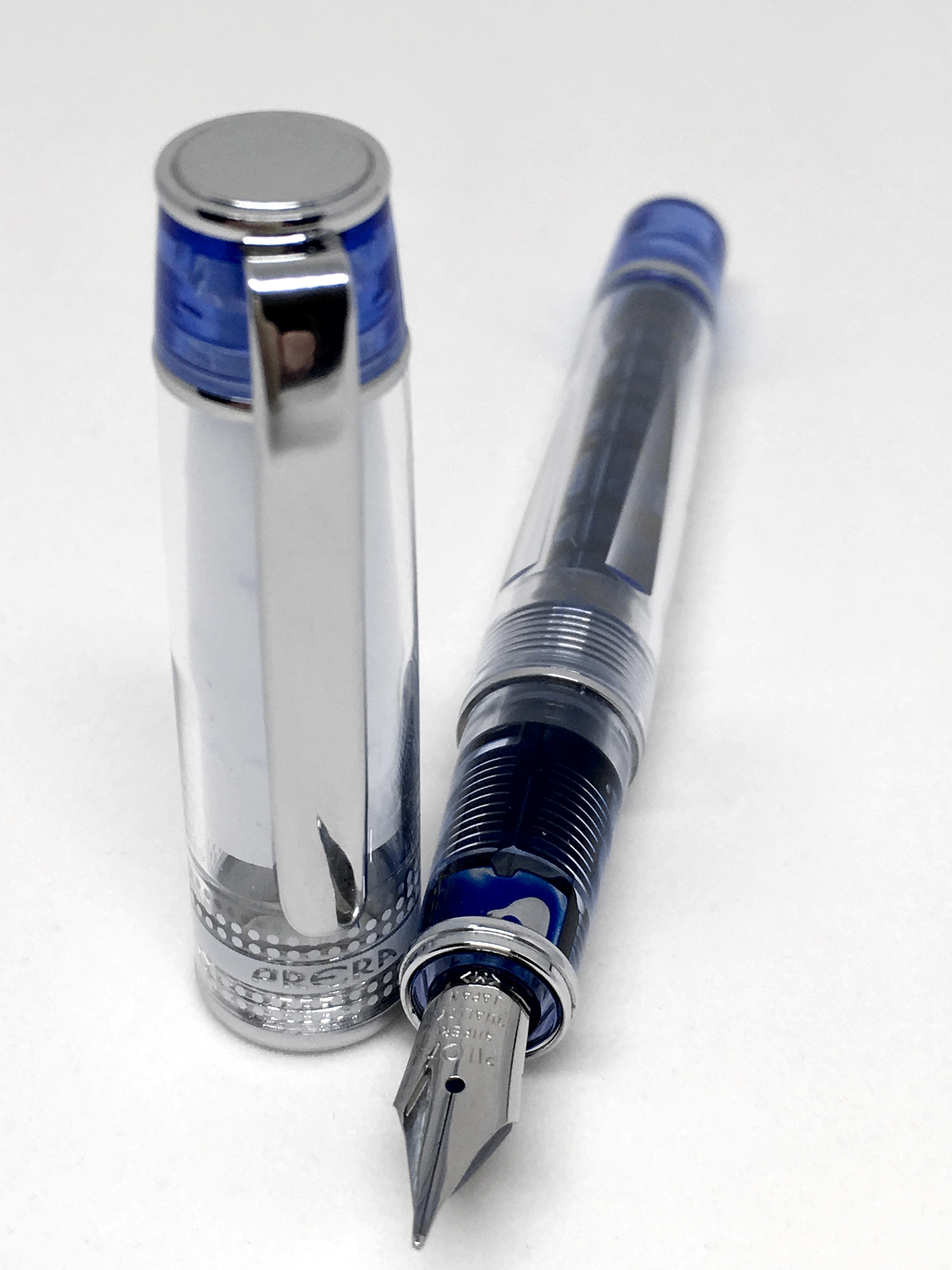
Given the size of the pen, it’s no surprise the cap and clip are proportionally short. The metal clip is only 40 mm long, which is equivalent in length to the white inner cap sealing the nib, visible through the transparent outer cap. Though not a major issue, it is a pity this prevents the nib being on show through the cap as well.

prera_under_nib

If you are someone who prefers clean simple lines on a pen, the overall appearance of the Prera may not suit entirely, and I think this is a combination both of design — and indirectly — its size. As you can see, the trim, accents and labelling create what is a fairly “busy” looking cap, and with its short stature, may seem a little cluttered for some. The body itself is somewhat less so, however with the cap posted of course you end up with the same look simply on the other end of the pen (a statement straight from the files of the bleeding obvious if ever there was one). I wouldn’t say this bothers me, however for some it might.

The overall aesthetics of the pen in relation to the distribution of accents at each end, metal bands along both cap and body, and transparent demonstrator barrel provide an interesting, yet not over the top look to the Prera. A great looking steel Pilot nib rounds out the pen, complementing the metal clip and banding nicely.

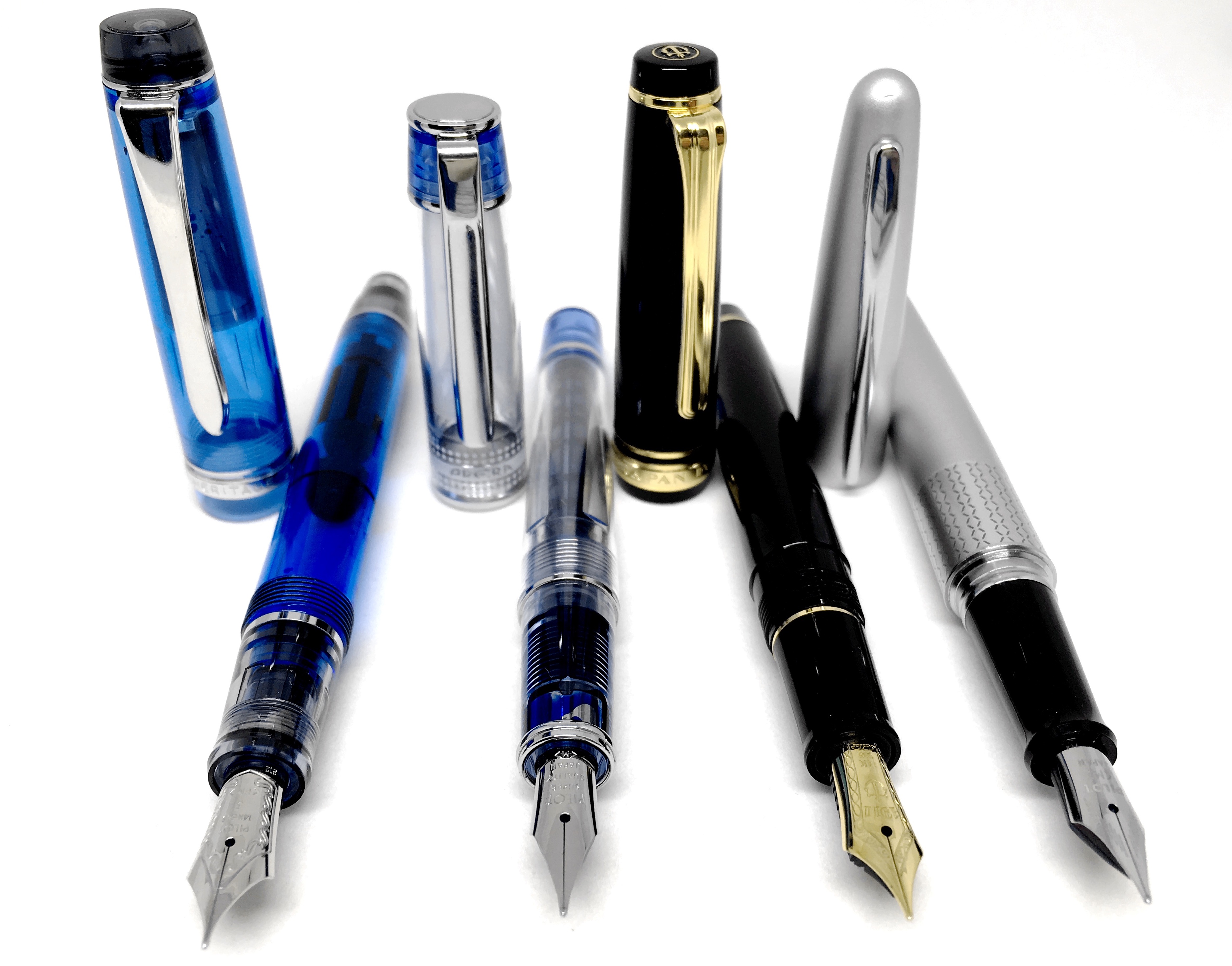
prera_v_sapporoI must admit I do find the sizing and proportions of the Prera to be a just little odd. I have it sitting next to a Sailor Pro Gear Slim (Sapporo) as I write this, and although the two are very similar in size, the truncated finial at the end of the Prera’s cap throws the proportions a little out of balance. With just a couple of mm more after the end of the clip ring similar the Sailor, the entire pen would look a little more — well…balanced.

That said, a good question to ask at this point is why should all pens look the same — a very valid one for of course they shouldn’t. If we all preferred the same style of pens what a boring world it would be.

Key Specifications

Courtesy Jet Pens

  • Manufacturer: Pilot
  • Model: Prera
  • Weight: 0.6 ounces (17 grams)
  • Body Material: Acrylic
  • Cap: Snap On
  • Clip: Metal
  • Diameter Grip: 10.6 mm
  • Diameter Max: 12.0 mm
  • Filling Mechanism: Converter, Cartridge – Proprietary Pilot
  • Grip: Plastic
  • Length Capped: 12.0 cm / 4.7 inches
  • Length Posted: 13.4 cm / 5.3 inches
  • Length Uncapped: 10.8 cm / 4.3 inches
  • Nib: Steel

Prices at time of writing:

  • JetPens $US38.00 ($AU52.00)
  • Cult Pens £33.29 ($AU70.00)
  • Engeika $US29.70 ($40.00)
  • similar prices to be found with eBay sellers

Writing performance

I made mention in a recent Wiser Web Wednesday post about the positive aspects of a nib that simply writes perfectly (in that case a review of the Pelikan P200 on the Pelikan’s Perch), and does so each and every time you pick it up. I’ve typically found Pilot nibs are generally part of this group.

prera_writingIt is for this very reason (and the snap on cap), I have found the Prera to be a fantastic day to day office pen1. In a daily writer, I need something reliable (no false starts, skips, ink blobs or leaks), which I can keep capped (to ensure it remains reliable), yet is quick to pick up and use — which pretty well ensures my go-to’s will be caps of the non-threaded variety. As you can imagine, the domain of the Prera, Pilot Metropolitan, and Lamy 2000 (a joyful every day pen if ever there was one). The rotation here also includes an ever-changing roster of gel pens, rollerballs and my trusty P8126 filled Retro 51.

prera_nibI don’t really have a great deal more to say specifically about the medium, steel Pilot nib on this Prera, apart from the fact it is a beautiful writer and performs straight out of the blocks every time. As you’d expect, the medium nib is somewhat finer than those on my European pens, and although quite resistant to flex, there is just enough “give” to make it extremely comfortable to use over longer periods.

There is a very small step down to the section from the barrel, however the absence of threads given the snap-on design of the cap ensures a very smooth grip. Personally I feel the surety of the grip is enhanced by this step, as well as providing a feedback point to align your fingers and thumb. I cannot see this being an issue regardless of your preference or grip style.

Whether or not a pen will work for me posted, is of course about balance rather than overall weight, though a very heavy pen will take its toll over a longer writing session. I’d say I have a fairly broad range of pen weights I find comfortable, with only very, very light or overly heavy pens a problem.

The Prera is well weighted at 0.6oz (17 grams), and reasonably well-balanced when posted — a necessity given its size. A point to note here is a good proportion of the weight is distributed fairly high on the pen with the cap posted, given its metal clip, final, and rings. As a result, the centre of gravity seems a little high, so depending on your particular style of grip and pen alignment, is something to keep in mind. In its favour here though is the short overall length, which places most of the pen down in the hand of the user rather than out the top — the main reason I found the Prera quite a useable pen when posted.

A final note on the size and posting brings us back to the Sailor Sapporo I mentioned earlier — a far better balance for me when posted, despite weighing in at 19.7 grams. Ok — time to move on.

L to R: Pilot Custom Heritage 92; Prera; Sailor Sapporo; Pilot Metropolitan

L to R: Pilot Custom Heritage 92; Prera; Sailor Sapporo; Pilot Metropolitan

A couple of days ago I returned to the Pilot Metropolitan (M Nib) after the cartridge in the Prera ran out, and the change was probably a little telling.

Hands down I find the Metropolitan is a far better pen for me, fitting my preference for use without posting the cap, having a nib essentially the equal of the Prera’s, and of course the price. The Metropolitan can be picked up for less than half the cost of the Prera, and for me, is a better overall pen. So if you are looking for value for money without needing to compromise, I think the Metropolitan is definitely the way to go.

Closing thoughts

My advice if you are thinking about picking up a Prera? Know you will be buying a high quality fountain pen — just know it will be on the small side when comparing to many others in your collection, and if you are a strict non-poster, this pen most likely won’t be for you.

As I’ve mentioned above, for me, and I’d argue for many potential buyers, the Pilot Metropolitan is an equally good pen and offers much better value for money. The two pens could not be more different in size and appearance however, and it is your own particular preferences here that the real choice will be made.

Again just remember (note to self) — the Prera is on the small side.


  1. The paper? At my desk unusually enough are the standard A4 bulk buy Staples legal pads. Miraculously they hold all but the wettest, broadest nibs — and certainly all of the pens listed here. ↩︎

Wiser Web Wednesday

Wiser Web Wednesday – a semi-regular link to posts of interest from around the web, by those far wiser than myself:


Three Staples
I’ve also found the Delfonics Rollbahn notebooks great at handling all types of pens — fountain included, and some of the cover designs are fantastic, with this off white version no exception. I agree with Jinnie in not being overly fond of super large spirals – I find they often just get in the way:
Delfonics Rollbahn Textured Notebooks


Too Many Inks
What can I say – Brisbane pen nerds rule. The 14K gold Lamy nib is one of the smoothest I have in my collection, and it teams up pretty well with the Studio here as part of combination number gazillion in David’s rotation:
Lamy Studio Black, 14K Z50 Medium, inked with Private Reserve DC Supershow Blue


Anderson Pens
My pen learning continues, and thanks to great resource posts such as these, will never cease:
Beginners Guide to Nib Markings


The Finer Point
There is nothing better than the swollen pages of a well used journal, planner or notebook. Yet another positive review of the Hobonichi Techo and its Tomoe River goodness.

Myself? I don’t trust me to be consistent enough to do such a fine journal justice. Maybe one day:
10 months in with the Hobonichi Techo – final thoughts


The Pen Addict
Suffice to say the Tactile Turn Gist Kickstarter campaign has gone gangbusters and well and truly funded with 23 days still remaining. Indeed this is a great looking fountain pen, and although I tell myself I’m not in the buyers market at the moment, that’s quite a few days to maintain that position.

Brad takes an initial look and offers up some helpful advice in choosing from the many combinations available:
First Look: The Gist By Tactile Turn


Ed Jelley
Speaking of the Gist, Ed Jelley, the man behind the campaign photos also provides an initial review of sorts. Ed’s post has recently been updated to include some comparison shots for size reference.

Looking at the adjacent Lamy 2000 in Ed’s photos which I use unposted, I wonder if I’d get away with using the Gist the same way. Helpful comparisons:
Tactile Turn Gist Fountain Pen / Kickstarter Launch (Updated w/ Comparison)


Distiller
Having sampled offerings from Nant, Bakery Hill, and Sullivan’s Cove (along with a distillery tour many years ago), I can vouch for these offerings from Australian Whisky producers. With the reviewer noting it is “best taken on a warm summer’s day” — ’tis the season for some Starward malt I believe (well close enough):
Playing by Australian Rules


Sprudge
Currently about a third of the way through drying some coffee in my own little natural process experiment, I was interested to hear the thoughts of Timothy Hill, an expert in such matters.

They’re fermented. You’d be lying to yourself if you don’t think that there’s some fermentation happening and being incorporated into the coffee itself. The question is, how much of that is a problem?

I must admit there are quite a few variables at play which I won’t really be able measure or assess beyond how it turns out in the cup. The again, these unknowns are part of the allure in having a go and seeing how things turn out with my own small batch.

A very interesting read:
What Is Natural Coffee? Let’s Find Out From Counter Culture Coffee Expert Tim Hill


Perfect Daily Grind
Coincidentally, the man at the subject of the link above — this time on blends:

We don’t believe in hiding the information; great blends simply come from great coffees, not some secret recipe

My own attempts at blending have been a little hit and miss, so I’m looking forward to learning a little more in part two of this series:
Everything You Need to Know About Coffee Blends – Part 1


Wiser Web Wednesday

Wiser Web Wednesday – a semi-regular link to posts of interest from around the web, by those far wiser than myself:

Today we’ll take the approach that somewhere in the world, it is indeed still Wednesday.


Adam Metelmann’s Tumblr
Sprinkled throughout a few previous posts and links, you will find references to this barista, from whom I have the honour of ordering my coffee each and every day as I sit and write much of what you read on these pages.

A consummate professional and master of his craft, I am always amazed when I ask a question around a technical aspect of coffee, at not only the extent of the information I receive, but Adam’s willingness and excitement to share it.

The first post appearing on Adam’s new Tumblr blog: Extractions, Expressions and Some Other Stuff to me, is one of the more exciting pieces of recent news. If you are at all interested in coffee, be sure to keep an eye on what is posted here — I guarantee you will learn something. The only thing bigger than the knowledge this man carries in his head is the heart and soul he puts into his industry and craft.

Anticipating great things to come:
The first post and hopefully not the last.


The Gentleman Stationer
Great choice for an EDC pen in my opinion, though I do not own a ballpoint version of the Lamy 2000 myself. Yes, we all love our fountain pens, however I generally don’t take them with me out to the shed or with a pocket notebook to the shops. For those times you’ll most likely find my Retro 51 or Kaweco Sport Classic (both currently sporting Schmidt P8126 refills) in my hand.

The one Joe features here is not your average Lamy 2000 either:
Lamy 2000 Ballpoint: My Go-To EDC Option


The Pelikan’s Perch
Although I have no doubt it works perfectly, I admit I too have always been a little ambivalent about the cartridge mechanism in the P series Pelikans. This is a great post from Joshua, as it also highlights the positives of a fairly standard, yet very reliable nib — and really, there is nothing inherently wrong with that:
Review: P200 Black (2014)


The Clicky Post
With the exception of a few recent images — every photo you see in these pages has been taken with an iPhone. Not because I wish to prove any sort of point — simply because I have never really been “into” photography, and therefore never really owned a camera that was any better. Although that has changed a little, I can still see the ease of using my iPhone as a big drawcard — plenty of tips here in Mike Dudek’s excellent post on taking macro photos wth this capable device.

Let’s see those nibs in all their glory people:
Macro photos on a budget: what you’ll need to shoot with your iPhone


The Pen Addict
I think there are two ways to approach things if you have an inkling towards getting into fountain pens.

You could read very carefully through a fantastic post such as this one — or simply read point 1., and then go for it — coming back for the remainder later. Either approach in my view is valid, but the most important thing? Just get in and try it — go on…you won’t look back:
The Beginner’s Guide to Fountain Pens (By a True Beginner)


Study Hacks – Cal Newport
I have never been great at planning a day in time blocks, generally looking at what is on my list and just hacking through it like some sort of animal. Somewhat pleasingly, the emphasis of this post is not so much a rigid plan, but at least a lack of drift.

The key, instead, is to make sure that I am intentional about what I do with my time, and don’t allow myself to drift along in a haze of reactive, inbox-driven busyness tempered with mindless surfing.

Always enjoy seeing how others work:
Deep Habits: Three Recent Daily Plans


The Guardian
An enjoyable read about the recent Coffee Masters event in New York. Great to see an Aussie come out on top, and in the typical fashion of a high-flying international barista:

Asked what he was going to do with the $5,000 prize money, he shrugged and said: “I guess I have to buy my ticket back to Australia.”

Inside the world of coffee obsessives: baristas compete at New York festival


Matt Gemmell
I have been reading with interest many of the opinions on ad blockers, and the subsequent blocking of such blockers. It is, and will continue to be, an interesting time in the life of the internet.

Ad-serving sites are being faced with a crisis entirely of their own making. They defined their own value — and their terms of engagement — right from the start.

I agree, and it reminds me in some ways of supposed self-regulated industries which invariably cross what many would consider a “reasonable” threshold in behaviour. Of course, who or what could step in and regulate the internet? Only consumer behaviour of course.

This is a great piece as usual from Matt on a somewhat hot topic, dealing with a deeper level of thinking on the subject, yet also explaining what is actually happening with these transactions — a lot more than the superficial “ads are annoying” level of understanding by what I’m sure is the view of many (meaning no disrespect — I simply believe most in the general internet community have not thought beyond this aspect).

I’d encourage just a little deeper understanding of the issues at hand:
Negotiations


Reckoner
Whether or not Apple’s revamped Notes app will satisfy my requirements in the long-term remains to be seen, however with each passing month, migrating the notes from my Evernote account seems like the right decision — for myself at least.

I just didn’t really ever gel with Evernote:
Evernote got troubles


Using Day One to Track Coffee Processing

hero-dayone-icon@2xSometimes I get the feeling Day One is used by many as everything but a standard journaling app — and I certainly mean that in a complimentary way. I’ve previously written about how I use the app for logging workouts (the recent regularity and frequency of which we won’t talk about if you don’t mind). Since that time, Day One has been refined and updated, yet retained its core features and attractive UI which so many users have come to love.

As the title of this post suggests, this is not a review of Day One as such — more so another in that long list of use cases I’ve linked to above, in which the app excels at being used for a specific purpose.

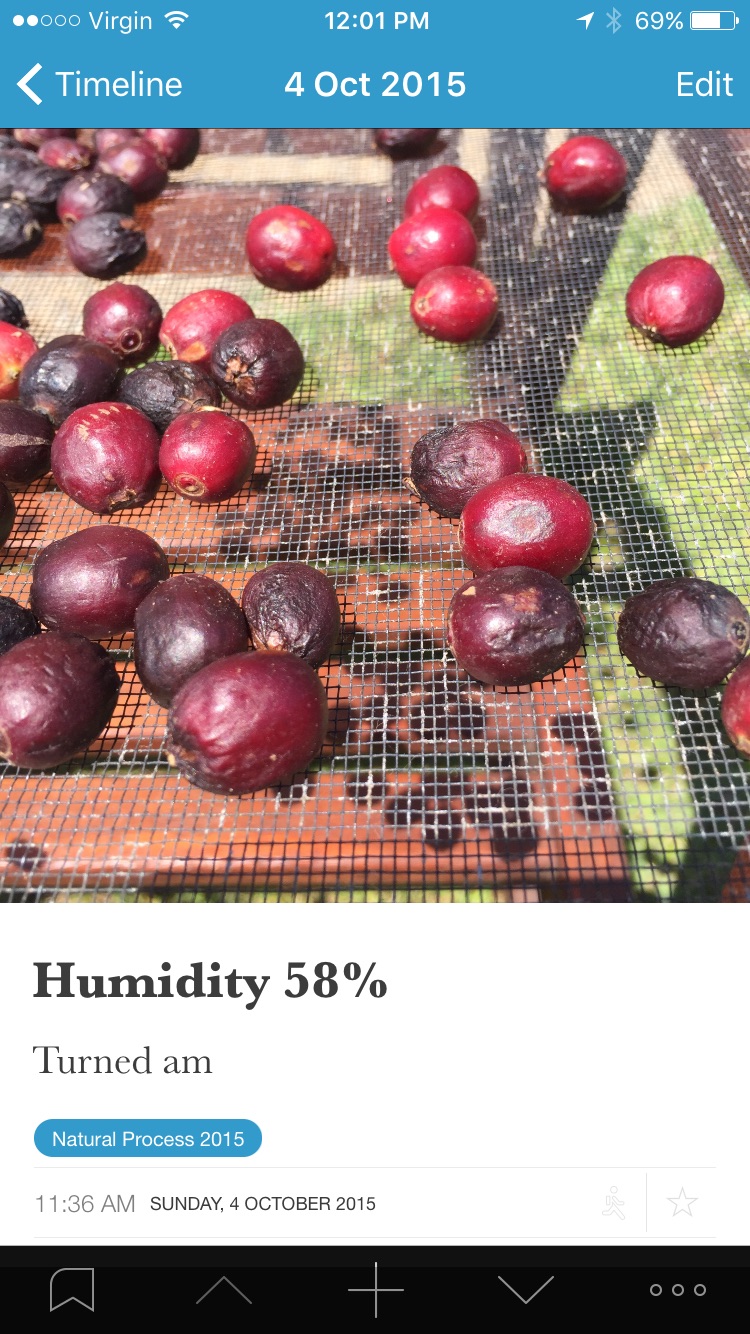
Exactly two years ago I ran a little experiment on coffee processing using the wet or washed method, and documented the experience in a series of posts titled Crop to Cup.. I am currently in the very early stages of a follow-up experiment to see how a small crop of coffee tastes after I process the fruit using dry processing methods. Clearly an undertaking which requires monitoring and data collection along the way — enter Day One.

What is Day One?

Although I am sure most readers are well aware of this beautiful Mac and iOS App, however for those perhaps not yet acquainted, the developers is summed up by the developer as follows:

Day One is a journaling app for the iPhone, iPad and Mac. Record life as you live it. From once-in-a-lifetime events to everyday moments, Day One’s elegant interface makes journaling your life a simple pleasure.

I’d certainly agree with that sentiment, though I’d encourage you to see what the fuss is about for yourself if you haven’t already. Of course there is a significant amount of information on the Day One website, however for a review about as beautiful as the app itself, there is none better than this one over at The Newsprint.

The project

Nat process_publish

As I mentioned above, coming up in a post or two in the near future will be my attempts at a small experiment in dry processing of some coffee grown in the yard of my parents house in northern NSW. The coffee will be sun-dried with either the entire cherry intact (“Natural” process) or with the outer flesh removed first(“Pulped Natural” or “Honey”) process. More on this in future posts.

Although hardly a large-scale endeavour (or an overly professional one for that matter), I will need a record of how things progress over the course of approximately a month as the coffee transforms from its current state to something resembling being done1.

In considering my options here, when thinking about recording recurring data over a number of days, my thoughts invariably turn to spreadsheets. Immediately thereafter my thoughts then turn to the fact that I am buried in spreadsheets on a daily basis and considering combining an enjoyable hobby with this type of data analysis makes my stomach turn a little. If a spreadsheet was by far and away the best solution I would of course use it, however when other options are available I’d prefer to head in another direction.

Why Day One?

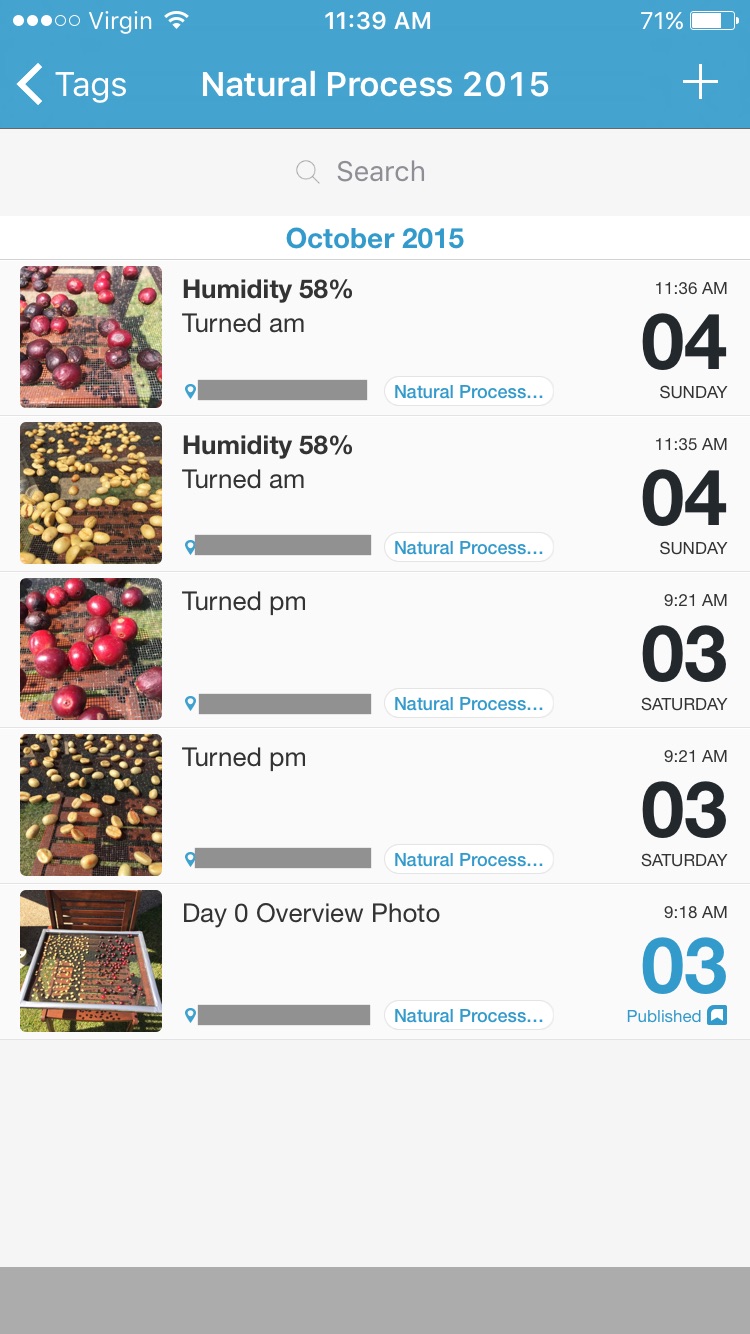
Ideally, I’d prefer something much more attractive and enjoyable to use for recording this data. Upon thinking about the sort of information relevant to my aims, the first items on the list are a daily photographic record and weather data, and therefore Day One was the obvious choice. The Day One About page provides a list of the data providing context to each entry:

Each Day One entry automatically tracks:

• Photo EXIF data

• Temperature and weather data

• Locations

• Time and date

• Activity data – Motion and step count

• Music playing

All well and good (with the bottom two from the above list not required here), however what about relevant data not automatically captured by Day One? Probably the key here is the relative humidity (the number one enemy of dry processing), over and above simple temperature data. I assume Day One simply pulls in the system weather information, which in itself, does not include humidity. Manually entering this as not a major issue, with the advantage of having what is recorded automatically by Day One providing a significant head start over a manually maintained spreadsheet.

Regardless of which system I use, there is the requirement for some sort of “Additional Comments” section, and it is here I will simply add the humidity reading (easily obtained with one tap from the best iOS local weather app there is: Pocket Weather Australia), along with information on how often I turn the drying beans (hint — it’ll be often), and anything additional worth commenting on for that particular day.

I don’t anticipate capturing a lot of additional information, as things will be fairly standardised day-to-day, however any significant changes or data outliers/modifiers will be noted specifically. As this additional data will in itself be fairly similar day-to-day, a customised template using Launch Center Pro might also be on the cards.

Nat process entriesNat process sing entry

Of course the non project-critical feature of sharing through Day One’s Publish feature will allow me to Tweet daily updates of the drying beans for your viewing pleasure. No — of course I won’t! Ever watched paint dry? Perhaps the occasional one… maybe. The benefits of organisation by tag, along with rock solid sync and export options (PDF, with entries for export selectable by tag on iOS), will also keep my data organised, safe, and allow a better overview of how things went when the processing is complete.

One feature which would have been nice is the ability to upload multiple photos per entry, thus keeping each day to a single entry2. No real complaints here though, as the Day One Newsletter tells me this is coming (along with refinements to the interface and multiple journals) in version 2.0, which will hopefully arrive before the end of the year.

Conclusion

Overall, Day One is just about perfect for what I require in terms of data collection and handling for a project of this nature and size. It’s a pity there is no “taste guarantee” built in to the app — for that I’ll just have to take my chances.

Irrespective of how things turn out, the entire process will be far more tasteful using Day One for recording purposes than the bitterness of nibbling on another spreadsheet every day.

Here’s to an enjoyable (and hopefully successful) journey, with a glorious cup of “natural process” coffee at the end. Wish me luck.

  1. More detail on this in a future post, for in my typical fashion I am learning as I go here. ↩︎
  2. I could of course merge two photos into one using another app, however this adds additional steps compared to simply opening Day One and snapping away. ↩︎

Wiser Web Wednesday

Wiser Web Wednesday – a semi-regular link to posts of interest from around the web, by those far wiser than myself:


Fountain Pens Australia Facebook Group
Have you heard? There’s a giveaway happening!

The fine people at Bookbinders Online have kindly provided a bottle of Iroshizuku Syo-ro and a Tomoe River notebook for one lucky Australian based member of the group.

To enter, leave a comment on the giveaway post by 4pm this Thursday (24 September). If you are thinking of joining the group there is no better time:
Fountain Pens Australia


Fountain Pen Economics
Some posts have a way of keeping at you until you write them, and this appears to be one of those.

A very touching account of family, and the resounding influence they have on us and our lives. I don’t believe this could have been any better written — thanks for sharing Jonathan:
Memento Mori


Nib & Ink
Continuing on with the theme of the post above — another post fortified with emotion. This time intertwined with the author’s love of pens, resulting in a truly unique custom-made writing instrument by a very talented pen maker.

Thanks for writing about a great pen Matthew, and more than that, sharing the story of the great person behind it:
Review: Newton Pens “Moody”


Dave Rea
A couple of things about this: Firstly, I am always amazed at the thinking of others and the subsequent nerdery which often ensues. Second, Dave writes really, really well. Always highly enjoyable to read. Time will tell if there is any way to predict the longevity of the TWSBI Eco – however this is not a bad place to start.

After you’ve read the following, be sure to check out Dave’s fantastic notebook indexing web service Indxd.

But first:
The Polarizing Truth: Why Your TWSBI Eco Won’t Break


The Pencilcase Blog
As I worked my way through this excellent review, I found myself coming around to the finish and overall design. There is certainly no shortage of places to look for a new pen. We really are spoiled for choice:
Edison Collier Fountain Pen Review


Executive Style
So our 29th Prime Minister signed one of his first agreements with a fountain pen. I cannot fault his taste. Apparently he also wears an Apple Watch and listens to The Pen Addict and Connected. Ok fine — so I made that last bit up — though you never know right?:
A fountain pen: crucial tool of trade or pretentious affectation?


The Sydney Morning Herald
A little on the back room machinations which resulted in Australia waking up to a fifth Prime Minister since 2010 earlier this week:
How it happened: Inside the Malcolm Turnbull leadership coup


The Huffington Post Australia
A NSW senator on why the government should take a hands-off approach in dealing with something government is apparently finding difficult to understand: the sharing economy. Of course the example at the forefront of all this is Uber, with the Australian Tax Office determining there should be different rules for Uber in order to “level the playing field” for taxi drivers.

It begs the question though: more regulation for Uber – or less red tape for the taxi industry? I’m not really sure where the answer lies:
Hands Off The Sharing Economy


David Hewson
Currently on Android or the web, my message here is not about the platform or service specifically — more so the brief outline of how a successful author keeps track of a work in progress.

I keep book diaries simple, direct and honest (if you think you’re writing crap you need to say so).

Honesty is clearly tantamount to success:
A book diary in action


Ulysses Blog
One to file in the “just because you can doesn’t mean you should category”. That said, a few simple steps from idea to iBook:
Self-Publishing for Absolute Beginners


Perfect Daily Grind
Although the specific details might vary in the eyes of some — a timely reminder to keep that espresso machine clean:
Espresso Machine Maintenance: The Essentials


CRS Coffeelands Blog
One of my favourite coffee blogs with another enlightening piece on what occurs at the heart of the industry — the farms.

By the time we collected baseline data in Nariño in 2012, Nespresso and Starbucks were buying more than 98 percent of the region’s coffee.  This is generally a very good thing for growers.

This post has a focus on the remaining 2% of growers who wished to explore third-wave opportunities directly with buyers looking for smaller, high quality, traceable coffee.

I tip my hat to those working tirelessly to improve things at the ground level:
Nariño’s Third Wave