What’s Brewing: Nicaragua Jaime Molina – Honey Process

Flag_of_Nicaragua.svgBefore snapping this up a month or so ago, I had not bought and roasted any coffee from Nicaragua, and was keen to try this offering from Ministry Grounds, my ever reliable green bean supplier. In addition, it was also processed using the honey or pulped natural method — that is, where the skins are removed but the beans are dried with all or some of the fruit flesh or mucilage still present. A good proportion of the coffee I roast tends to be of the washed variety, and I am keen to broaden my experience as much as possible.

The Region

A little on Las Sabanas from Wikipedia:

The Central American country of Nicaragua borders Honduras to the north and Costa Rica to the south, both very prolific coffee producers in their own right, along with other close neighbours El Salvador and Guatemala. Las Sabanas is a municipality in the department of Madriz, which lies in the northern aspect of Nicaragua, close to the border with Honduras.

The municipality itself has a varied climate, which in the lower parts is a little drier, however more humid in the higher mountainous regions, with an annual rainfall between 1,200 and 1,400 mm. Nicaragua has a variety of vegetation, with predominantly pines, coffee, oak, guasimo, eucalyptus, and cedar.

The Coffee

Information Courtesy Ministry Grounds

Coffee: Nicaragua Jaime Molina
Region: Sabanas
Town: Mira Mar
Farm:  Monte Cristo
Altitude: 1300-1450 m
Varietal: Red Bourbon
Processing: Honey

Tasting notes: Chocolate, red berry, juicy, coating, balanced, medium body

In researching a little on this coffee, I came across a little on the producer, and his active role in the 5 de junio collective in Nicaragua:

Don Jaime and his family have shared their coffee processing methods with other members of the cooperative, fostering innovation in the name of quality.  During the 2010/11 harvest, 5 de junio implemented a successful pilot project for semi washed or “honey” coffee based on new technologies learned from Don Jaime.

The full post can be read on the CRS Coffeelands blog – incidentally a site which I highly recommend for great insights into the lives of coffee farmers and farm workers, including many harsh realities that come with such an existence in many of these countries.

The Brew

Terra Bella LatteI’m now through roasting the kilogram of green beans I originally ordered, and the coffee has been roasted for filter, espresso, and added to a couple of blends along the way. As usual, I’d have to say not all of the roasts were perfected — though by the last, things seemed to come together well. The last roast? Espresso, which is what I will describe here.

Brewed as precisely that — espresso, I’d describe it as one of the more balanced coffees I’ve had in recent times. The dry aroma on grinding teases of a little strawberry, however the cup didn’t back that up in any great measure — very subtle to say the least. More so the chocolate notes, with a medium body.

Where it really shined was with milk. My typical morning brew being a 5.5oz single shot latte (brew parameters from this morning were 19.3g dose; 46g yield – split between espresso and the latte; 27 second extraction time).1 As smooth as silk, with more chocolate, a little caramel, and a nice strawberry layer to boot. My pick for this coffee would definitely involve milk, however you prefer it — be that cappuccino, latte, flat white or something a little shorter.

The Finish

Perhaps not one of my standout favourites, however to kick off the day it will take some beating. I’d happily recommend, and buy this coffee again. The more I write about the coffees I roast and brew here, the more I’m convinced some sort of spreadsheet tracking system is called for, lining up roast and brew parameters, and in some way perhaps correlating the resulting outcomes.

Something for another day perhaps, however I’m certainly ready for another brew while I think about it — and for this Nicaraguan — just make it with milk is all I ask.


  1. Given I have been looking a little more closely into weighing and measuring dose and yield with my espresso lately, I figure it is worth documenting here, for those who might be interested. Of course my learnings around these parameters are slated for their own post, which I will get to in due course. ↩︎

What’s Brewing: Panama Baru Indian High Estate Geisha – Natural

You might notice this coffee originates from the same region which has produced my most enjoyable coffee to date — bar none — about which I wrote in a previous post. The reason is obvious of course — I was looking to capture some of that magic, figuring I would either be very happy once again, or find that perhaps I had been spoiled by the quality of that previous experience. My fingers were tightly crossed for the former.

The Region and Producer

Here, I again refer you back to that previous post, which outlines a little about the Boquete region in Panama.

There is also extensive information available (link below) on the Saurez family history of growing coffee in the region (beginning in 1920), and the Baru Indian High brand. A snippet on their philosophy I reproduce here:

Image courtesy Baru Indian High

Image courtesy Baru Indian High

The growth and success experienced throughout the years is due to the enforcement of basic principles when managing the farms: maintaining the same coffee varieties that our parents started growing since the birth of the business, promoting a high degree of social commitment with our partners and employees, applying a sustainable agriculture that respects the environment and investing in technology to constantly develop the latest trends in farming.

These paired up with the special micro-climate that Boquete brings, makes that at the end we can present you a product that is consistently the same — if not better — quality than the year before. This consistency provides our clients with an interesting volume and also a very attractive cup profile of the highest quality.

Courtesy Baru Indian High – About

The Coffee

Courtesy Ministry Grounds Coffee

  • Panama Baru Indian High Estate Geisha – Natural
  • Price at time of writing $AU26.00 for 500g (green)
  • Region: Jaramillo, Boquete
  • Farm: Anselmito Estate
  • Altitude: 1550 Meters above sea level
  • Variety: Geisha
  • Processing: Natural
  • Producer: Noberto Saurez
  • Tasting notes: Light body, sweet and bright with floral notes and a presence of jasmine, cherries, stone fruits, strawberries, dry banana & plums

The Brew

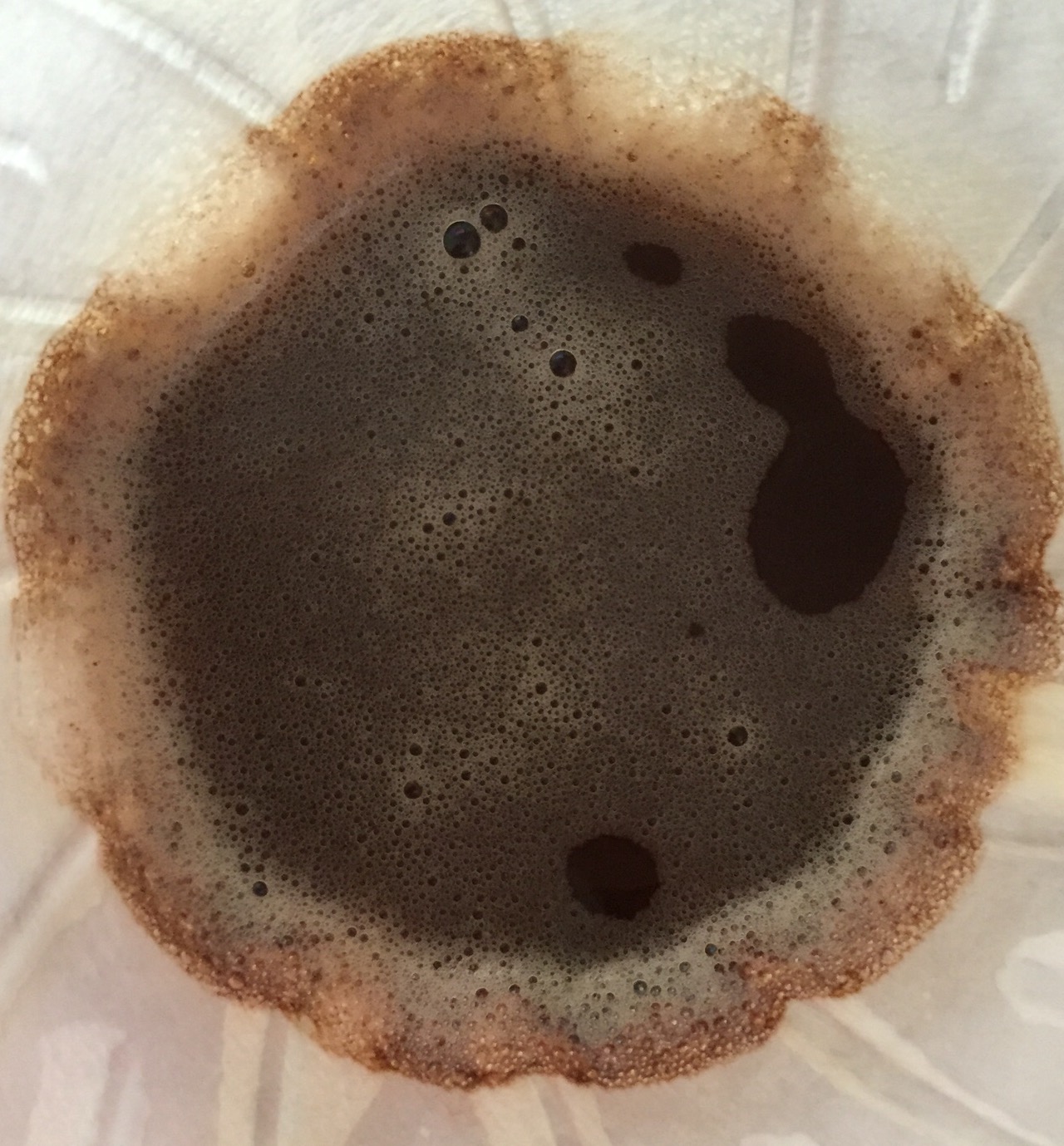
IMG_4114The result? Brewed with the Hario V60, I’d describe it as a very fine coffee indeed, however probably not quite to my initial expectations. It was indeed quite light in body, however not as bright in the cup as I anticipated. As far as the overall flavours were concerned? To me, there was an abundance jasmine, an almost candied-like berry flavour, and yes, a hint of dried banana, as the tasting notes above suggest, though of course I would not have necessarily picked that up myself.

Roasting side note

IMG_4319As you can see from the bullet points above, this coffee was double the usual price I pay for my green beans (that is, the usual per kilo price for a 500g lot), clearly reflecting the higher price initially paid at auction and the quality of the product. In an attempt to do justice to any subtle flavours, my initial roast was aimed squarely at light to medium, with an eye to filter brewing. Without a large amount to play with, roasting was done in two 250g batches to allow for some “correction” in a second attempt if need be.

Yes, that second attempt was indeed required, with a slightly longer development time, yielding much the same results1. I must note here I indeed found the roasting a little challenging, perhaps due to the fact this coffee had quite a large bean, with my small-scale set up not behaving with its usual roasting profile.

The Finish

Overall, I would not deny this coffee every bit of its price tag. Sometimes it would be nice to taste the same crop roasted by a professional roaster, to assist me in determining whether the coffee was slightly below my expectations, or whether my roasting skills resulted in me arriving at this point. Were I a betting man I would suggest the latter is most likely at play here.

In any event, the Panama Baru Indian High Estate Geisha (Natural) is a wonderful coffee indeed, and if you enjoy a brew with flavours a little more complex than your standard “mmm that’s fruity”, then this is well worth a try. To get the full value for your money, perhaps don’t have an amateur roast it in his back yard.

I do however — live and learn. On to the next roast… and cup.

  1. For those interested in further detail, the two roasts were (i) total time 11:00 mins; development 18%; and (ii) total time 10:10; development 21%. ↩︎

Press app for iPhone – logging your coffee journey

App IconFirst things first. If ever there were an app icon that encapsulates the predominant themes of this blog — surely this has to be it.

Brilliant. Er…except that I didn’t think of it first.

After coming across Press a few months ago, I have begun to slowly add some coffees into the database for future reference.

As is the case with many great independent apps, Press was borne out of one man’s frustration — from the App developer’s contact page:

I’m Jeff Hatz, the sole developer of Press. I was frustrated with the lack of quality coffee apps on the App Store, so decided to write my own. I hope you love it as much as I do.

Love it? Indeed I do sir — indeed I do.

What is it for?

Press is an app which contains a number of features to assist you in both brewing and logging notes about the coffee you drink:

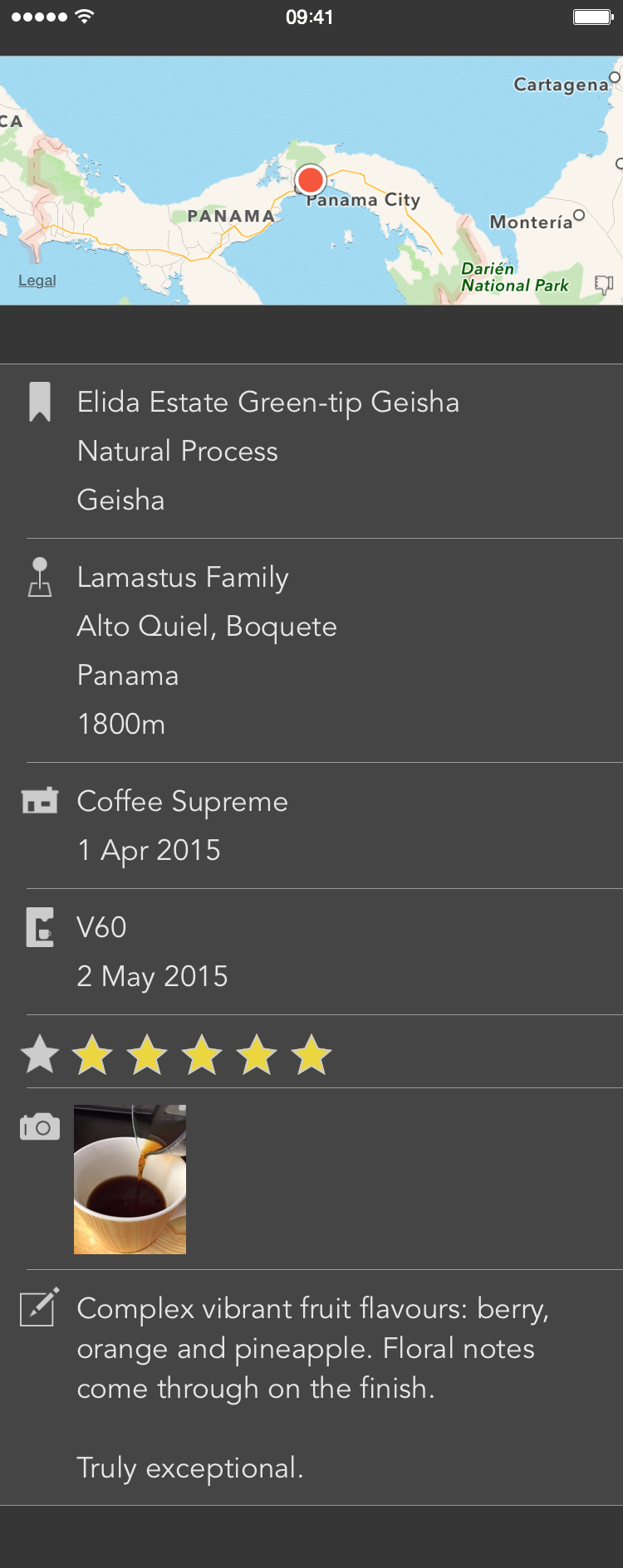
IMG_4267Log detailed notes about the coffees you drink, and see a world map with pins for each if the coffees you enter. Use the built in brew timers courtesy of Corvus Coffee Roasters, or add your own, to brew a perfect cup every time. Expand your knowledge of coffee in the Resources section.

Features:

IMG_4275In list form, Press has the following features:

  • Coffee Notes
  • Brew timers
  • Map
  • Today Widget (quick brew; last coffee added)
  • Advanced Options
  • Resource page (links to books, blogs etc)
  • Share sheet integration (export and sharing options)

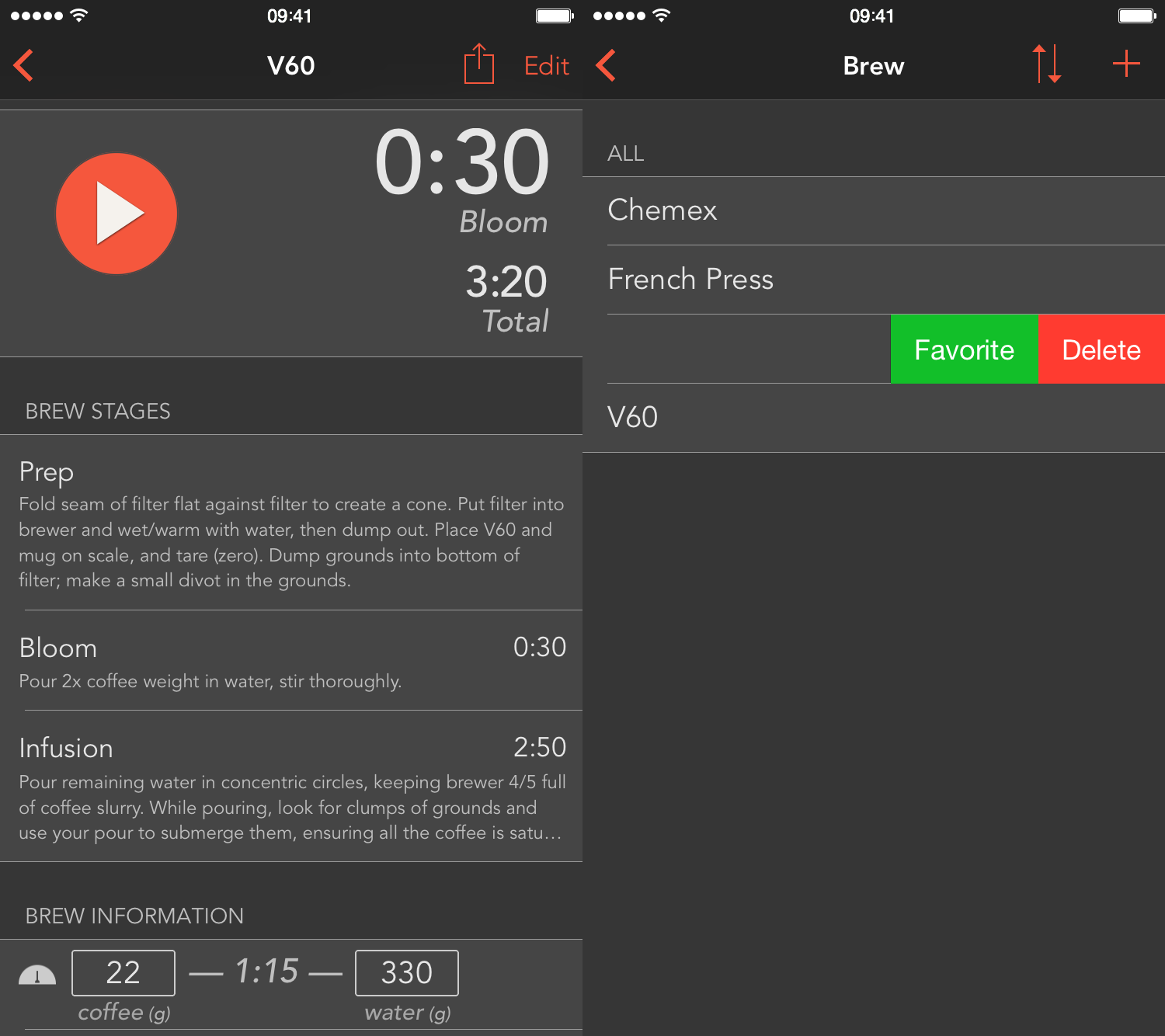
As lovers of all things coffee, I am sure we all have our own methods of brewing with our various devices, so I must admit I have not really used the built-in brew timers.

I would note however these are customisable, and you are able to add your own, featuring the timer name, coffee/water ratio (allowing calculations based on changes in dose), dose, grind, temperature, notes, and brew stages.

IMG_4296IMG_4293

Overall, the app has a really nice UI, which is attractive to look at, yet functional enough to get the job done very smoothly, with a few extras such as Markdown formatting and a custom URL Scheme for users on the geekier side of the spectrum.

Perhaps it is worth mentioning longevity and storage. Although each coffee logged is merely a text file, adding numerous photos I expect would add to the data storage requirements of the app. Were I to use this over a few years, with say, a few hundred coffees and associated photos, I wonder about the storage requirements then, and perhaps cloud support might come in handy. For now, this is not an issue.

In terms of longevity and back up options — exporting to Day One or Evernote works like a dream, with the resulting output reminiscent (minus the associated photo) of some Drafts app templates for coffee logging I have seen around the web.

IMG_4284

Output to Day One


My favourite features

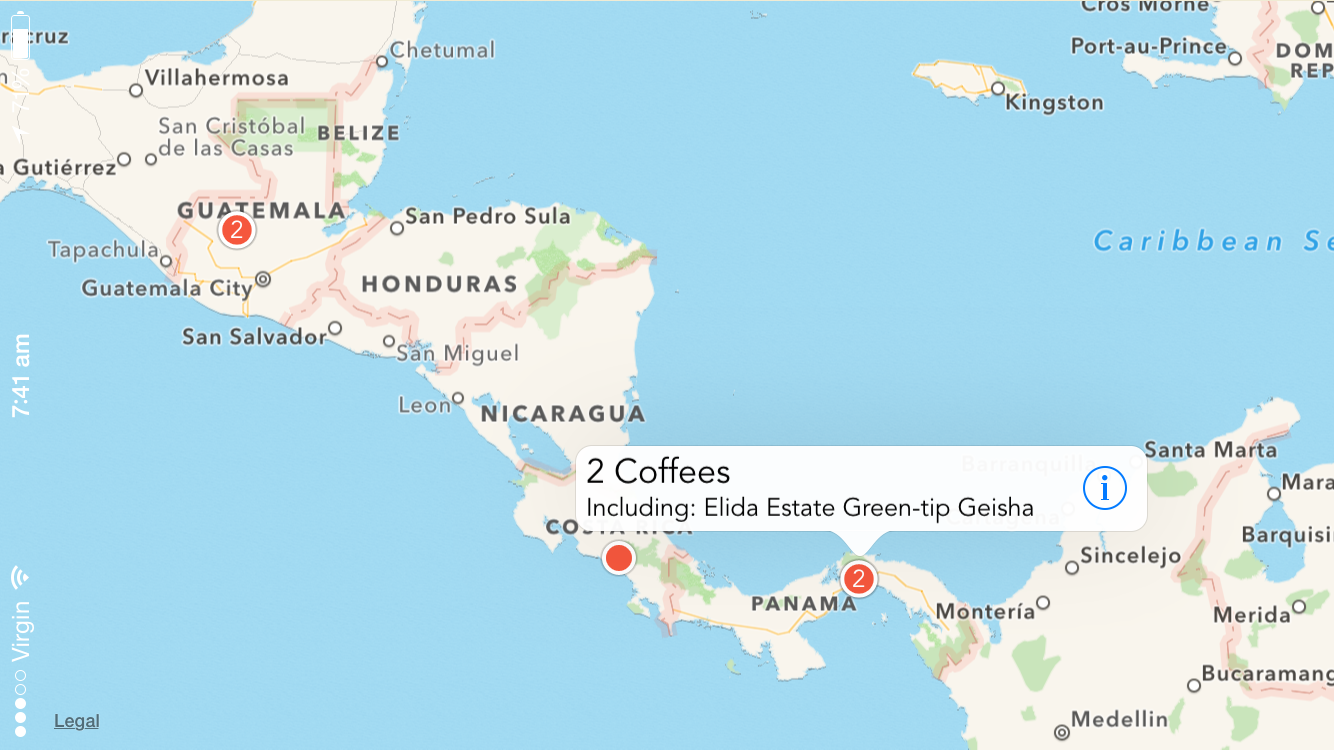
There is a lot to love about Press, though my favourite features (and reasons for downloading the app in the first place) are definitely the integrated map and notes sections. Locations of origin appear on the map once the region is added to an entry, allow zooming, and have an info button which changes to a popover noting the particular coffee featured in that location.

IMG_4271

Other great features include the customisable notes fields (through the settings pane), auto-capitalisation throughout the notes input fields, and a next button during text input which avoids the need for scrolling and tapping into the subsequent field.

Beyond the specifics, I’d say it is great to have an attractive, well thought out and extremely functional app which allows me to track coffees I have tasted when out and about, or those I have roasted myself at home.

Photo support was also added in March of this year, and has added a whole new dimension to how I plan to use the app going forward.

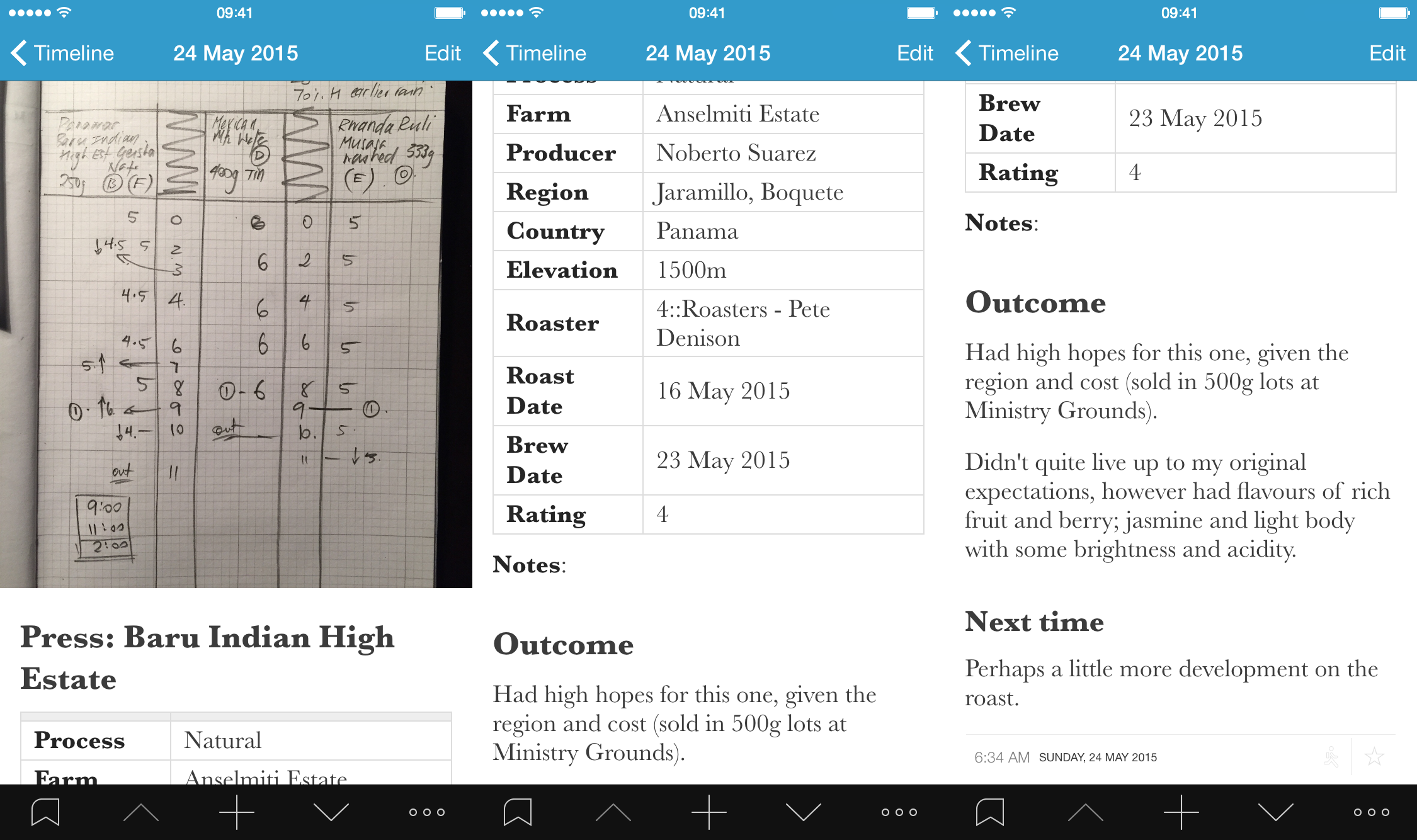
As my home roasting involves pencil and paper1 for recording time, temperature and any notes commenting on particular aspects of the roast, linking this IMG_4298data to particular coffees after brewing and tasting involves collating the data together in a spreadsheet — which I admit is not always updated. With the photos feature in Press, I have begun to snap a photo of the roast notes page which I now keep right inside the app with the tasting notes and rating of the particular coffee — perfect!

In conclusion

As you can gather, I do believe this is a great app for logging many aspects of your coffee journey over time.

Yes, I can link in my roast data to the brewing and tasting profiles through the photos feature, but I can also see this used for capturing those moments when sharing a wonderful brew with a partner or group of friends.

Press strikes what I believe is a perfect balance between allowing the recording of “enough” data and the flexibility to add more, in a beautiful and highly efficient way. With ongoing support, the developer has laid the groundwork for perhaps even more features in the future.

Oh and how about that icon?

Press for iPhone is available from the App Store, and is well worth the $AU3.79 you’ll pay.

  1. Currently the Science edition of the Field Notes Arts and Sciences seasonal release, and a Blackwing 602 for those interested. A perfect combination for the purpose I might add.

What’s Brewing: Panama Elida Estate Green-tip Geisha

Having recently published a post on generosity, how I came to brew some of this amazing coffee also fits that exact sentiment.

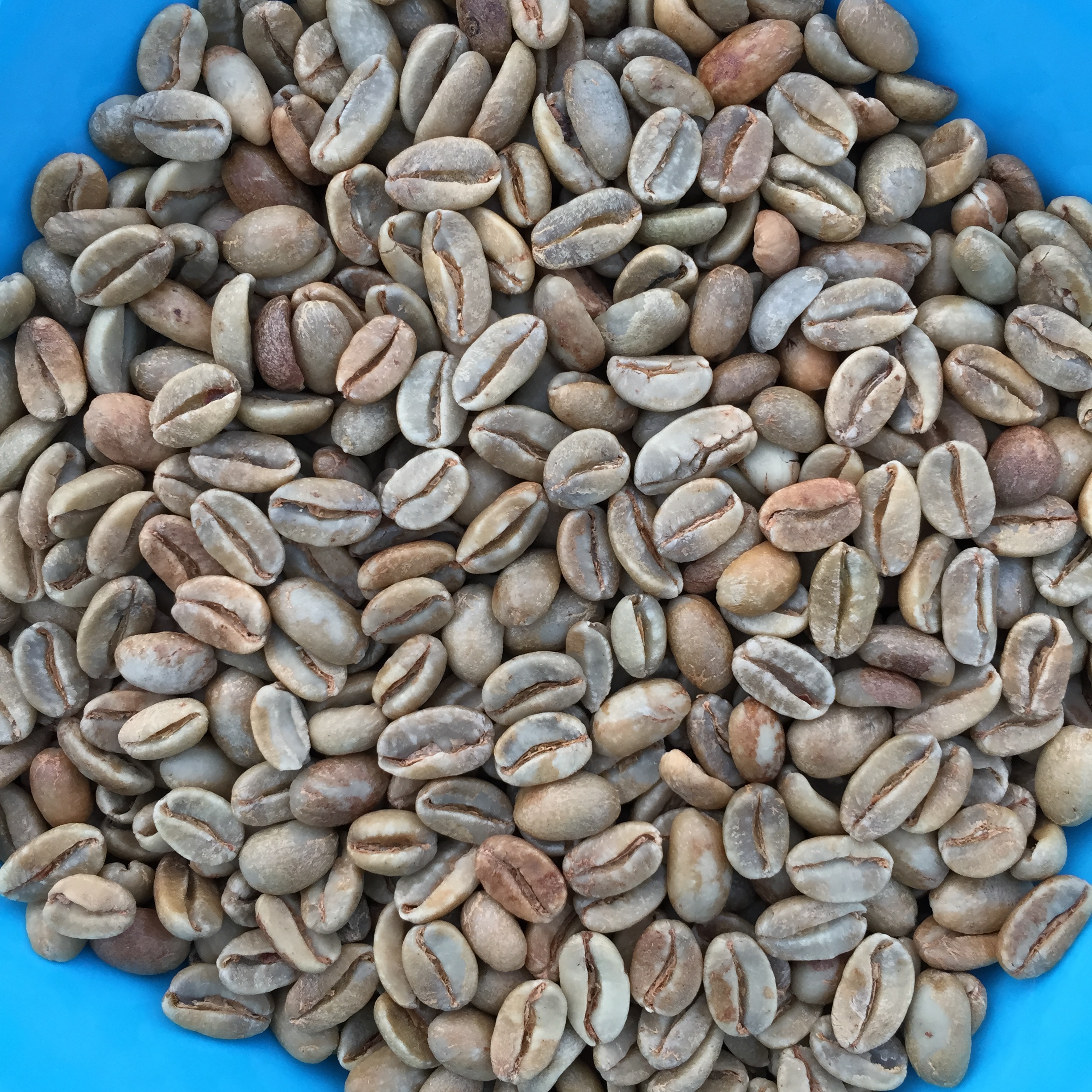
I was kindly given 100 grams or so of this coffee from the award-winning Elida Estate in Panama by current 2015 Queensland Barista Champion Adam Metelmann (Twitter, Instagram). To say I have been pretty lucky lately is somewhat of an understatement.

What follows is a little about this great region, farm and coffee, along with an attempt at describing how the best coffee I have had to date tasted in the cup.

The Region

The Boquete region of Panama is, according to Wikipedia: “in the green mountain highlands of Panama, in western-most Chiriquí Province, about 60 kilometres from the border with Costa Rica. Because of its elevation … its climate is cooler than that of the lowlands. Its scenic location, temperature, and natural environment make it popular with Panamanians and attracts tourists from all over the world”.

Lonely Planet calls it the Napa Valley of coffee(?!):

Boquete is known throughout Panama for its cool, fresh climate and pristine natural setting. Flowers, coffee, vegetables and citrus fruits flourish in Boquete’s rich soil

Onto the farm and coffee itself:

The Coffee

Elida Estate is of course located in the Boquete region of Panama, and lies in the shadow of the active Baru volcano (3475m). At 1700 – 2500m above sea level, it is the highest coffee farm in Panama.

Because of the high altitudes where the coffee is grown the beans are very dense and uniform and they are mild with a medium body, good aroma and high acidity. These estate coffees are considered among the best in the world.

The Lamastus family have been farming coffee in Panama since 1918, of whom three generations continue to run the farm (and nearby El Burro Estate) today.

Sun drying in drying screens (bastidores) has been a Family Tradition.  Robert Louis Lamastus (dark clothes, 4th from left) and Elida (sitting) owners of Elida Estate, picture taken in 1932. Image courtesy Boquete Coffee.

Sun drying in drying screens (bastidores) has been a Family Tradition.  Robert Louis Lamastus (dark clothes, 4th from left) and Elida (sitting) owners of Elida Estate, picture taken in 1932. Image courtesy Boquete Coffee.

The details:

  • Farm Name: Elida Estate Coffee
  • Coffee Name: Elida Geisha Natural
  • International Jury Cupping Score: 91.90
  • Crop Year(s): March 2014
  • Variety: Geisha
  • Process: Natural
  • Elevation: 1800m (farm up to 2,200m)
  • Growing Region: Alto Quiel, Boquete
  • Owner/Exporter/Mill: Lamastus Family

Information above courtesy Stoneworks Specialty Coffee Auction

An interesting detail on how the “green-tip” came to be, from Verve Coffee Roasters:

Verve’s green buyer, Colby Barr, determined that the coffee from the green-tipped plants produced a far superior cup compared to those of the bronze-tipped plants. Subsequently Thatcher Lamastus separated these premium beans, and by doing so, the advent of an entirely new cultivar.

I’d bet on the fact the “bronze-tip” wouldn’t be too bad in the cup either!

The Brew

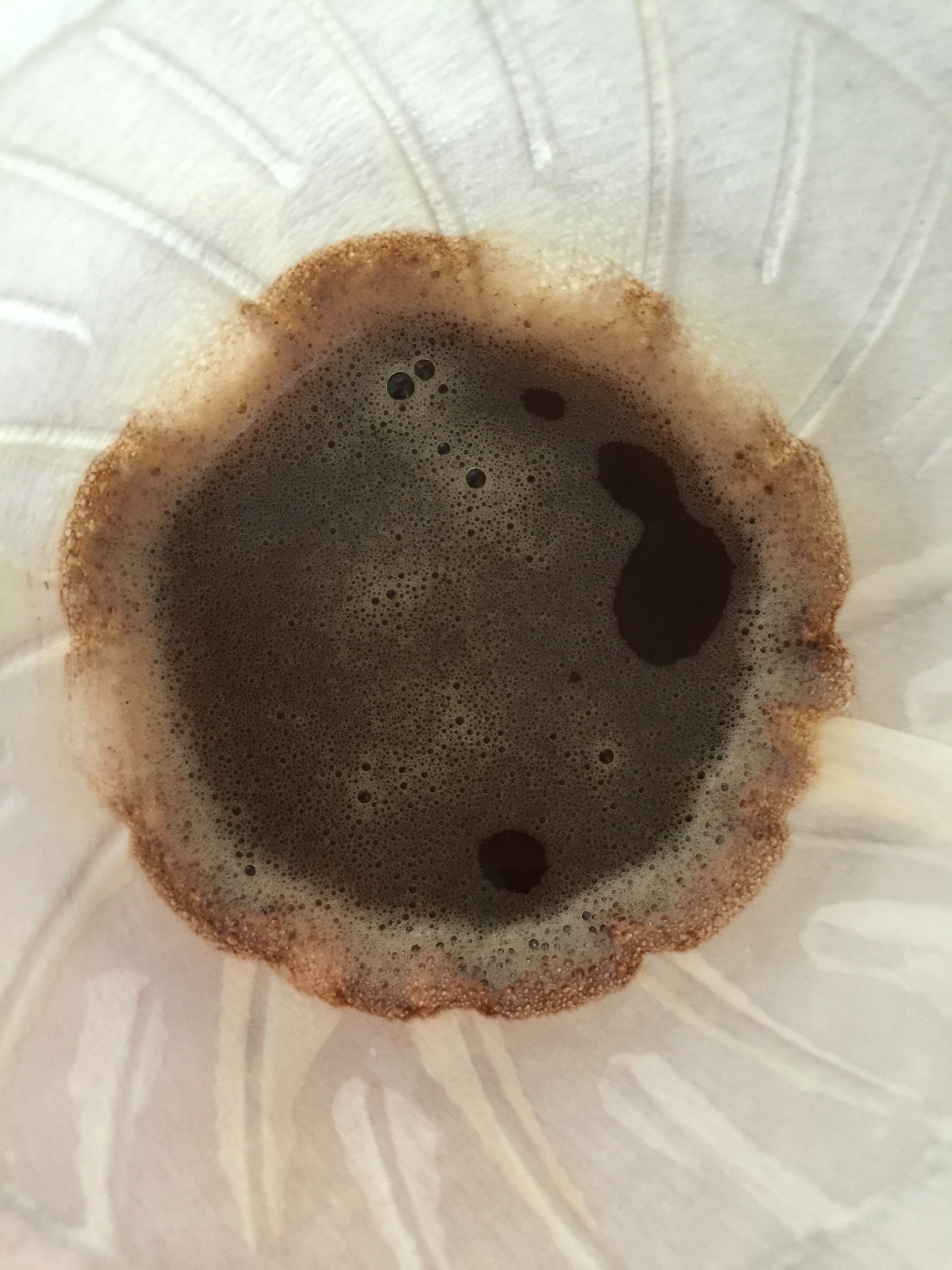
FullSizeRender 12The coffee Adam so kindly provided me with was a filter roast, and as such I brewed through the Hario V60 drip filter. Although I have been writing these posts and sampling many different coffees over the past few years, the following probably isn’t as technically sound a description as you’d get elsewhere, however I think I’ll get the message across.

This is simply the best coffee I have ever had — bar none.

Opening the bag was like sticking my face into fresh fruit salad, let alone the aroma after grinding (complex fruit and berry notes).

In general, medium in body, with the complexity, richness and depth of flavour the first thing to stand out, yet maintaining a clean, crisp character at the same time. As for specific flavours, the most prominent in my limited range was pineapple, perhaps a little orangey citrus, with some smooth berry notes coming through as well.

If I compare it to some of the better coffees I have had in the past, probably the most noticeable aspect was in relation to the flavour change over time as the brew cooled. Most of the coffees I try routinely change as this occurs, some quite substantially. The green-tip? Not so much, and rather than peak in what is sometimes a fairly narrow range, maintained the same rich complex flavours all the way through — an absolute joy from start to finish.

The Finish

I think it is quite apparent how much I enjoyed this coffee, and remain thankful for the opportunity to have tried it. Reading a little about the farm and family, it is no surprise such high quality comes out of Elida Estate on a consistent basis.

IMG_3309I’d highly recommend a little further reading for the full Elida Estate Story:

The Lamastus Family Estates

Best of Panama 2014 Grower Profile

Speciality Coffee Association of Panama Member Profile

With cupping underway in the Best of Panama 2015 at the time of writing, I am sure more fantastic coffee will be coming from the region — the only problem will be getting your hands on some.

A very special thank you to Adam Metelmann for generously providing me with both the opportunity to try this wonderful coffee, and happily sharing his knowledge about the farm and its owners. Adam can be found serving what I would consider the best coffee in Brisbane at Strauss in Elizabeth St in the CBD


What’s Brewing: Guatemala El Zapote

I have generally always enjoyed coffees from Guatemala, with most having a solid flavour profile, yet enough subtlety to separate one farm from its neighbours – here I emphasise variety – not my ability to name the various farms by taste of course!

The Region

Information courtesy Wikipedia

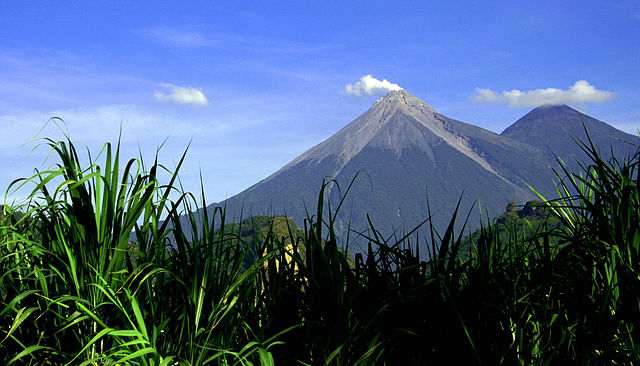
Acatenango is a stratovolcano1 in Guatemala, close to the city of Antigua, in the central highlands of Guatemala. The volcano has two peaks, Pico Mayor (Highest Peak) and Yepocapa (3,880 m) which is also known as Tres Hermanas (Three Sisters). Acatenango is joined with Volcán de Fuego and collectively the volcano complex is known as La Horqueta.

Volcano de Fuego in the Acatenango region in Guatemala. Photo courtesy Javier Ruata.

Volcano de Fuego in the Acatenango region in Guatemala. Photo courtesy Javier Ruata.

Fair enough to call it a volcanic region I’d say!

The Coffee

Information Courtesy Ministry Grounds

  • Guatemala El Zapote
  • Region/Town: Acatenango
  • Altitude: 1200-1950 meters
  • Area: quarter of one hectare
  • Varietal: Yellow Bourbon
  • Processing: Wet processed; 100% sun-dried
  • Harvest time: January/February
  • Producer: Julio Melendez
  • Tasting notes: classic and beautifully balanced; notes of lemon, melon and stone fruits

The Brew

Having roasted for both espresso and filter, I was able to enjoy the El Zapote across a wide range of brew methods.

As espresso, it produced a fresh, bright cup, demonstrating a little citrus tang, along with notes of honey and chocolate. With milk, it kicked off my mornings really well, with similar flavours working well, however I’d say even a little better when blended with a some Brazil Fazenda Aurea – also roasted on the same day. This blend, containing about 30% of the Brazil, added a little more depth, and brought the flavour through the milk just that little bit more.

The filter roast provided a very clean, crisp and bright cup when brewed with the Hario V60. The body and acidity nicely balanced, with refreshing notes of citrus. Also perfect in an iced pour over, with summer not really wanting to let go just yet here in Brisbane.

The Finish

Whenever I am browsing the offerings from Ministry Grounds, rarely do I overlook the Central America section, with Guatemala always high on my list. These coffees always seem to work really well in blends, yet also stand happily on their own – the El Zapote is another to add to the list.

Unfortunately at the time of writing this coffee is now out of stock, however was purchased from Ministry Grounds for $AU19.55 per kilogram (green).


  1. A stratovolcano, also known as a composite volcano, is a conical volcano built up by many layers (strata) of hardened lava, tephra, pumice, and volcanic ash.