Coffee Roasting: Development-time Ratio

Although not for everyone from either a time or inclination perspective, one of the benefits of roasting coffee at home can also be it’s simplicity. True, there are many variables to consider (and hopefully control), however, if a few core principles are followed, it is certainly a process achievable to many.

In saying this, I mean no disrespect to the many professional specialty roasters out there. My point is simply this: for the home roaster, there are a few key inherent markers which occur when roasting, providing the ability to roast by “sight and sound” (as opposed to computerised tracking), without the necessity for complicated equipment. If you have a suitable means of applying enough heat to green beans, they will crack, you pull them out some time after that, and assuming this is done within a reasonable time, you end up with drinkable brew.

I have previously written about my home roasting set up, which although needs updating in a new post, is beyond the scope of what I wish to talk about here. The remainder of this post will look at one element of roasting which I have recently read about, and decided to apply myself: the development-time ratio.

Development-time ratio

One aspect of my roasting I have always tried hard to achieve is some level of consistency between batches. I was therefore particularly interested to read a guest comment on the Cropster blog by Scott Rao, who is highly regarded in the coffee industry, and has published numerous books on many aspects of coffee preparation, and most recently, roasting.

From the post:

Roasters have traditionally referred to the time from the onset of first crack until the end of a roast as “development time.” Lengthening development time to mute acidity or increase development is a common practice, especially when roasting coffee intended for espresso. However, adjusting development time without considering it in the context of the entire roast profile often destroys sweetness and creates “baked” flavors.

Rao goes on to say:

After collecting roast data of over 25,000 batches over 20 years, I noticed a pattern among the very best batches: in all of them, first crack began at between 75%–80% of total roast time. Alternatively, development time was always between 20%–25% of total roast time.

I recommend reading the original post, which also demonstrates the concept graphically with a typical roast profile.

Upon reading the article, it became clear the development-time ratio might provide a means of achieving the level of consistency I had been aiming for, or at the very least, give some indication my roasting criteria approximate some accepted parameters.

Application to my home roasting

Reading Rao’s post may at first seem to refute my point that home coffee roasting can be a simple process, however I am not suggesting we all need to rush for our calculators either. I would also note the above percentages are saying the same thing, so if you have the inclination to look at your own data, there is no need to calculate both.

In searching for some element of consistency in my roast batches, I have typically been a little uncertain around exactly which variables were the most important. Total roast time, time to first crack, development time, or a combination?

The principle of development-time ratio provides a consistent approach to every roast batch, notwithstanding changes in other variables. It requires no additional equipment, nor recording or measurement beyond the data I currently have in a log of my previous roasts.

My historical roast data

Given I have recorded sufficient data about my past roasts to assess the development-time ratio retrospectively, with the assistance of a spreadsheet, I proceeded to analyse 30 of my most recent roast batches. My initial thinking was along the lines of “these roasts will mostly fall within the 20–25% parameter”.

The result could not have been more different, and highlight the inherent flaw in assumption. Of those 30 roasts, only 11 fit Rao’s recommendation for a development-time ratio of 20–25% of total roast time (range 9.8 – 33.3%). Although the average was 21.6%, this is not particularly relevant when we are considering individual batches. A couple of things to point out here. One, I am an amateur remember! Secondly, further 17 batches were within a band of + or –5% (that is either 15–20% or 25–30%), and a number of these were pretty close to the 20 or 25% cut-off.

You will note from the data these figures are based on varying batch sizes, with considerable variation in overall roast time. As I roast outdoors with an open “drum”, I have found variation exists due to ambient temperature, time of day and the cumulative heat of the drum with successive roasts.

As expected, considerable variability in the cup was evident in relation to differing origin, processing method, roast level and brewing technique. Naturally, some were better than others, and I have not had the opportunity to compare the development-time ratio findings with my tasting notes on the particular coffees in this sample. I do not plan to spend a significant amount of time on this, as any valid results would rely on assessing the same coffee roasted in separate batches, standardising the variables from the previous paragraph. I doubt I have any current data fitting this criteria.

I have included a snapshot of the data below. As you can see, it contains both time of first crack as a percentage of total roast time, and development time as a percentage of total roast time. As I have noted above, there is no need to measure both, however for completeness I have included them here. Roasts falling within the criteria (by either measure) are shaded green.
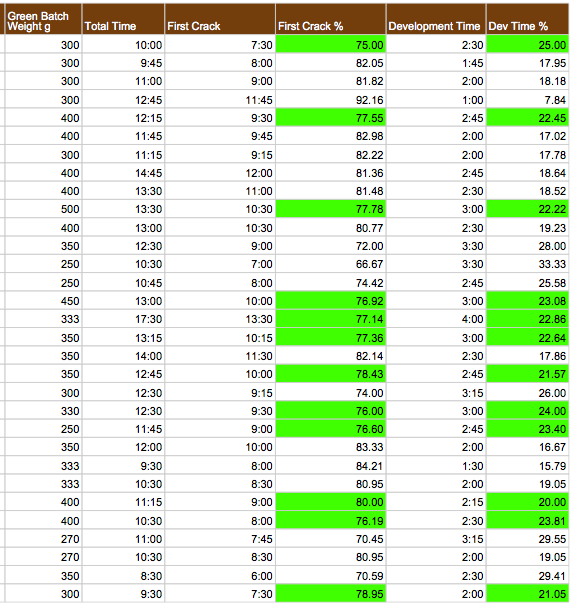
Table 1: Development-time ratio (historical data).

Table 1: Development-time ratio (historical data).

Where to next?

There are probably a few answers to this question, the first being further reading, with Scott Rao’s The Coffee Roasters Companion high on my list. Although a good deal of the content may relate to far more sophisticated setups than mine, I find the science behind coffee roasting quite a fascinating topic. A review of the book can be found on James Hoffmann’s blog.

I thought I would also use the development-time ratio to standardise the total roast time in future batches, and determine whether this influences the overall quality of my roasting, and ultimately, drinking. Yet another spreadsheet here, this time to avoid the need for any complicated maths during the critical part of a roast (a printout of which is fixed firmly inside my roast record notebook).

The table below uses time to first crack (column 1), to produce the range of minimum (column 2), and maximum (column 3) roast times required to fall within Rao’s criteria for the ideal development-time ratio.
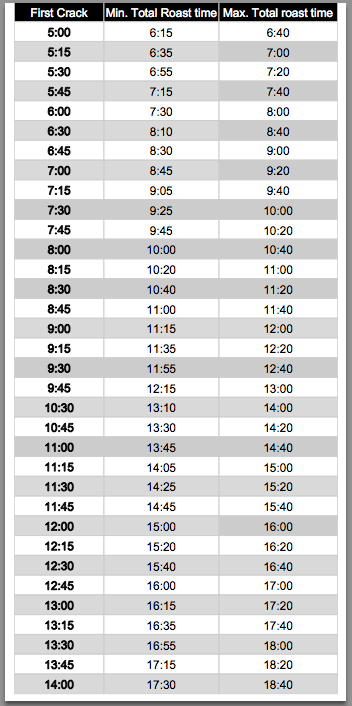
Screenshot 2014-09-07 21.03.35

Table 2: Total roast time guide based on time to first crack.

Finally, the weekend’s roast data utilising the above prediction chart (Table 2) to cease the roast based on desired development-time ratio:

RoastData_2

Table 3: Roast data from 6 September 2014 using Table 2 prediction chart.

Conclusion

Although this post is a little more lengthy than originally planned, the development-time ratio is a concept well worth exploring. In finding additional ways to assess, influence and standardise my roasting parameters, my skills in this area can only improve.

In the end, the proof will be in the cup, which I am looking forward to testing out.

Wiser Web Wednesday

Wiser Web Wednesday – a weekly link to posts of interest from around the web by those far wiser than myself:

NoteMaker
Although the Melbourne Writers Festival has now come and gone, some interesting insights into the art itself from one of Australia’s best, Nick Earls. Discussion turns to the new novel Analogue Men, and Nick’s penchant for Moleskine notebooks and a good pencil:
Interview with Analogue Man, Writer and Endless Story Starter Nick Earls

Brett Terpstra
Taken some notes as a plain text list and wished it were a mind map? Develop them further by way of a handy script for converting indented Markdown or plain text to a mind map application of your choice. I also love the integration with popclip, a handy Mac application I use heavily for one click copy and paste (which itself now has 126 different extensions):
Converting Markdown to a mind map

The Weekend Edition
In some decidedly local news, Brisbane is set to see the launch (October 1 this year) of the worlds first NEXT Hotel, on the site of the old Lennon’s on the Queen St Mall. Should we be excited? Maybe, maybe not, however sounds as though there is a nice little bit of tech thrown into the mix:

…guests can download the NEXT Hotel Smart App, using it to adjust lighting, room temperature, music and television channels without needing to leave their super comfy bed.

A perfect place to stay (awake) after the next Strauss coffee cupping evening:
World’s first NEXT Hotel launches in Brisbane

A Penchant for Paper
Although I certainly don’t need an excuse, here are 10 reasons to use pen and paper and get writing by hand. Sketching always seems such a noble and therapeutic undertaking, however it is such a pity I have the exact opposite to a ‘dab hand’, for such an activity:
10 Ways To Use Your Pens and Write By Hand More Often

The Clicky Post
Although perhaps not an everyday colour, the Iroshizuku Yama-budo (Crimson Glory Vine) ink looks fantastic in this Pilot Custom Heritage 92 Demonstrator. A great review by Mike Dudek, and as usual, great photography to match:
Pilot Custom Heritage 92 Demonstrator Fountain Pen – M Nib

Pens! Paper! Pencils!
Speaking of fantastic looking inks, there aren’t too many more striking than the subject of this post by Ian Hedley. If you like your orange with a good measure of substance, check out the link, or alternatively search for “deep orange ink” in Ian’s fantastic new pen blog search engine, Pennaquod:
Diamine Cult Pens Deep Dark Orange ink review

Finer Things in Tech
David Chartier with an elegant piece on…well, the inelegant state of inter app communication and integration courtesy of the walled gardens currently in existence:

But even on OS X, where apps have always had ways to work together, I had to manually copy and paste the title and body of this piece from the Evernote, erm, note where I scribbled my initial ideas into Write. Like an animal. As much as I am a fan of Evernote, it’s a tedious, hindering experience that makes me curious about alternatives.

This is hopefully all about to change with iOS 8 and OS X Yosemite – not long to wait now:
iOS, Mac App Extensions offer some hope for walled gardens

Austin Kleon
Not commandments per se, though a list of ten nonetheless. Manifesto?, Declaration? Creed? Call it what you will, though Notes to self was the author’s choice. My picks – numbers 1 and 10:
Notes to self

Quotebook 3 for iOS

The sign of a great app? It does what it sets out to do, does it reliably and efficiently, and looks great while doing it.

Icon SmallWhen news of a major update to the iOS app Quotebook appeared in my Twitter feed recently, it made me realise what a great app Quotebook is. Why? Because it fits all the above criteria, and made me immediately think “an update, that’s always most welcome, but it didn’t really need one”. Further, though I was happy to retweet this news noting it was one of my “favourite apps”, I could not recall specifically the last time I had used it. Oh, it will never be deleted, and contains some of my favourite quotes, however again the sign of a great app – it is there for a purpose, and there when I need it.

What initially drew me to Quotebook (probably a couple of years ago now) was the specificity of it’s purpose. Sure, I could have saved some quotes in a notebook or with a tag in Evernote; kept them as text files in Dropbox or Drafts; or even tabled them in a spreadsheet, which I have also done in the dim distant past. Quotebook seemed like the perfect solution to keep these pieces of text together with their author and source if necessary.

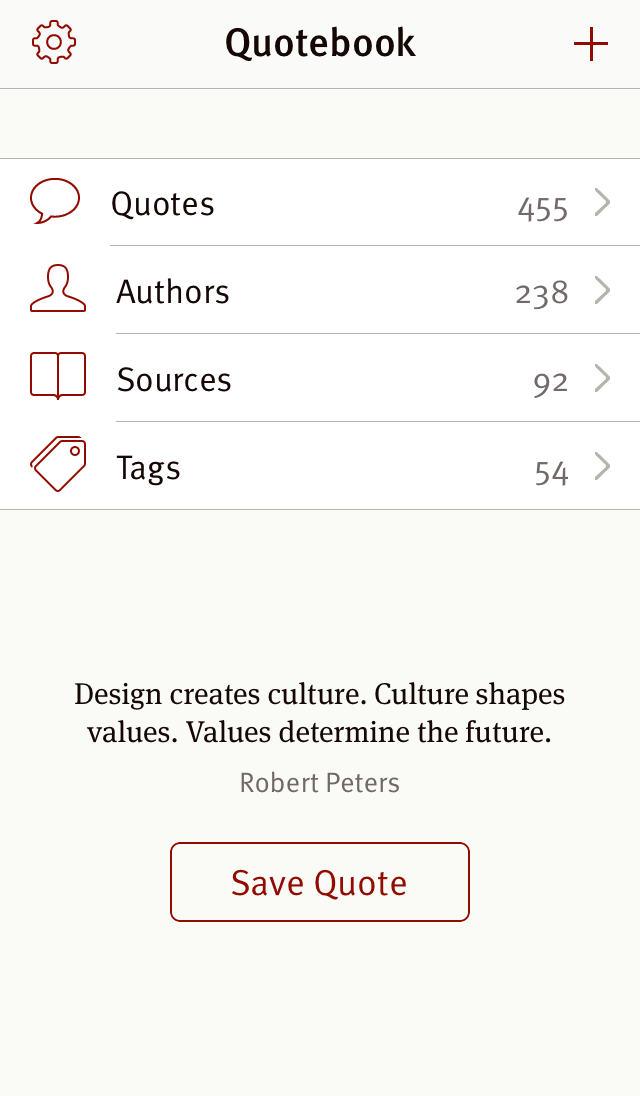
I admit, at times specificity in an app can be limiting, however in this case it is spot on. Look at what you need after all: the quote; the attribution for the author or speaker; the source; and tags to group quotes should you desire. Add a great looking interface and seamless syncing between my iPad and iPhone, and there you have it – a favourite app. Remember, that was before the update.

We now welcome Quotebook 3, which has been completely redesigned from the ground up, by developer Lickability:

Quotebook 3 is our biggest release ever. We’ve completely redesigned and rewritten the app, making it easier than ever to collect your favourite quotes and give them context and personality.

  • Fully rewritten iCloud syncing
  • Add images and descriptions to authors and sources
  • Information about your authors and sources is automatically downloaded from Wikipedia
  • Auto-complete authors, sources, and tags from within the app, your contacts, and your music library
  • Import quotes from your Tumblr posts and Facebook profile
  • Tap into any author or source from the quotes screen to see more quotes from them
  • Discover and save random quotes from the app’s main screen
  • Share quotes to Tweetbot, Tumblr, and Day One
  • Improved Auto-Detection of quotes on your clipboard (including from iBooks)
  • x-callback-url support for the Quotebook URL scheme so other apps can add quotes seamlessly
  • Simplified settings

As you can see from the above list, the update is indeed a big one. I must admit the most pleasing thing I have found in using Quotebook 3 in the couple of days since the update is the fact that it works equally as reliably and consistently as the previous version, but is faster, looks better, and I agree, has a little more personality, to quote the developer. Although I guess consistent and reliable only gets you so far, as (searches Quotebook):

“Consistency is the last refuge of the unimaginative.”
— Oscar Wilde

See – there when I need it, just like I said.

54

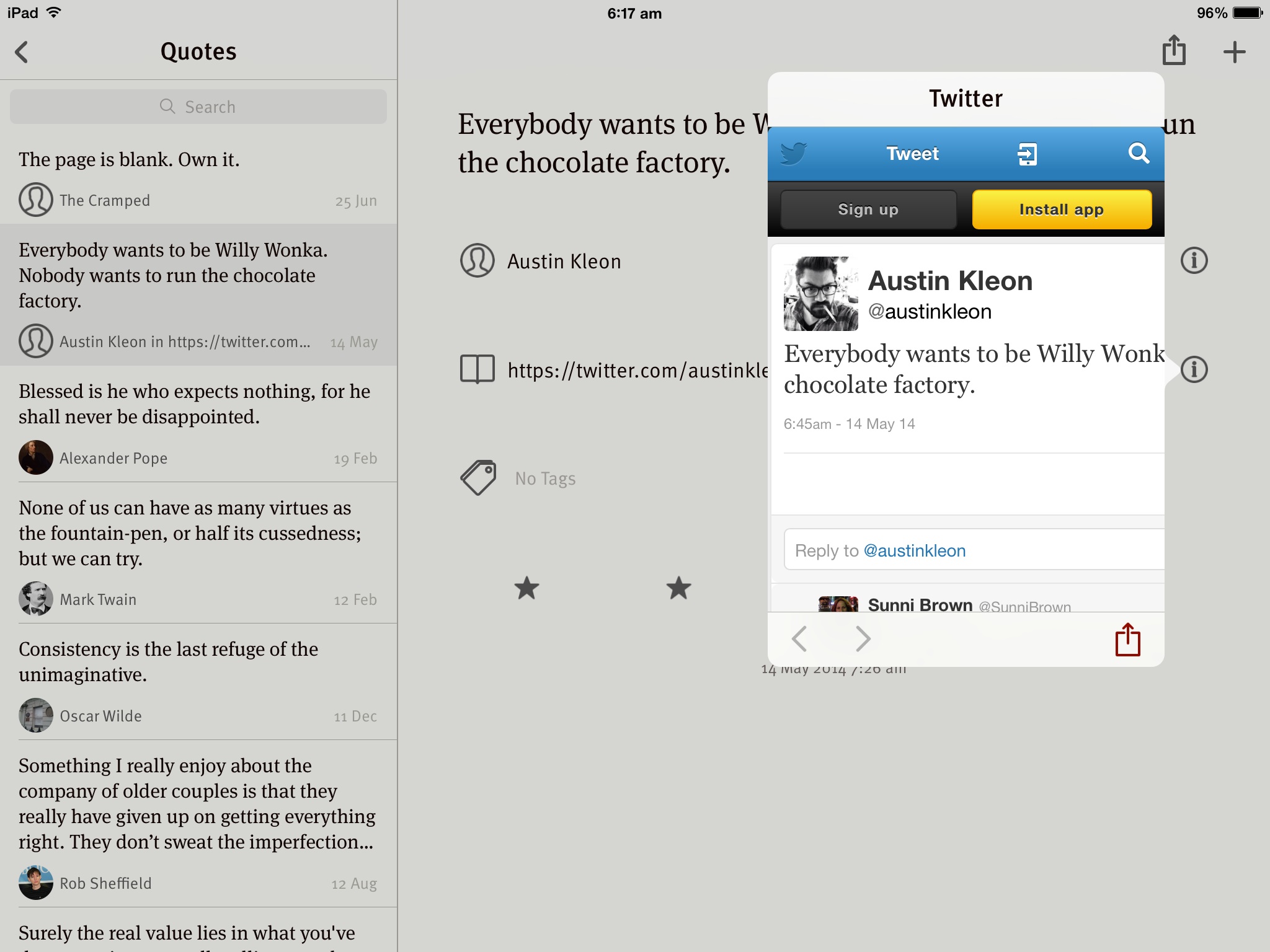
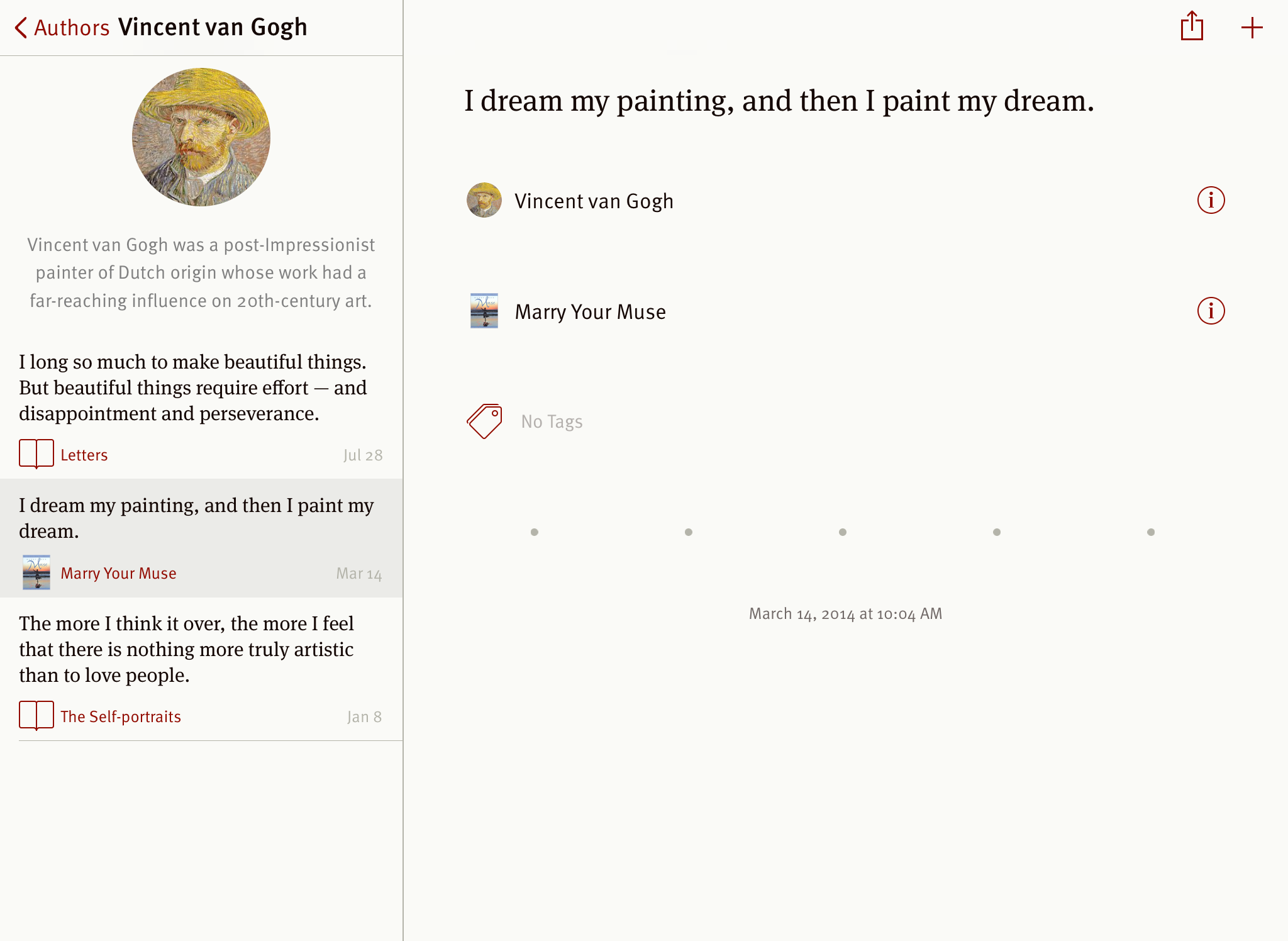
Probably my favourite aspects of the update include the complete overhaul of the user interface, which is elegantly minimal; direct sharing to Tweetbot and Day One through the standard sharesheet; the ability to see information and other quotes from an author, or the information popover from the source (see screenshot below); also, the functionality of the clipboard auto-detection seems to have improved. A nice touch is also the ability to save random quotes now appearing on your main screen.

Quotebook_pop

Quotebook 3 is a beautiful, yet highly functional app which appears to be in for the long haul. Lickability have added enough bells and whistles with the new update to please many a power user, however have repackaged and improved the robust and delightful features that worked elegantly and efficiently all along.

3

Developers say many things in press releases, however on this point from Lickability I most certainly concur:

Lickability has been and will always be concerned with all the small details that make apps great.

Must save that quote somewhere…


Also be sure to check out the review of Quotebook 3 by Federico Viticci at Macstories.

Quotebook 3 is available on the App Store for AUD$6.99, and is a universal app for both iPad and iPhone.

Recommended Reading: Raw Materials – Matt Gemmell

My favourite writer on the internet is Matt Gemmell, by far. How does a former software engineer who now writes full-time write so well? Significant talent and untold amounts of effort and hard work most likely play a large part.

61e6rBgR4sL._SL1000_Gemmell has recently published an eBook titled Raw Materials, comprising selected essays from his personal blog, updated with authors notes and includes an additional piece written specifically for this collection. After picking up (well…downloading) the book on the day of release, a rainy Saturday seemed perfect to proceed from cover to digital cover.

Many of these intensely personal essays recount memories of a childhood perhaps not unlike many others. Where the real power lies in this collection is not from the content alone, rather, the feelings which inevitably surface as you read. Some may make you squirm a little; perhaps say “ah…yes!”; some may change your entire mood – and to me, that is great writing.

Although the specific events, family situation and upbringing described in these stories could not have been further from my own, similar feelings, emotions and fears were (are) all there, somewhere, though manifest differently in adulthood.

Gemmell sure knows they are still there, as he writes in Paths:

And if you glance over your shoulder, well… you won’t see anything. But your own memories are there nonetheless.

Believe me, many times during Raw Materials, you will find yourself glancing over your shoulder. Not intentionally, but inadvertently, sometimes surprisingly so. With these glances come fear (Staying Afraid); sensory engagement through smells of “dryness and age” (Stories); and innocent optimism where your wish might just come true – just this once (Wishes). Then there is the physical or emotional pain we all feel and recall all too readily (Relative).

It’s. All. There. And this man knows exactly how to write about it. In an utterly compelling way. Every time.

It matters not that our childhoods were markedly different, a decade or so apart, on opposite sides of the world. We are not so different Matt and I, nor are we different to countless others who grow up with memories so indelibly burned into our consciousness (or subconsciousness as the case may be).

Those memories are always there, whether we allow ourselves to engage them or not.

I highly recommend this short but powerful collection of essays. They are written with such clarity and precision, you cannot help but join Gemmell on his “travels” back to those moments where these very memories were made. It is also inevitable your thoughts will turn to the end product of such memories. You. Today.

Years whip by when your back is turned, leaving you standing on familiar streets that are nevertheless unsettlingly different. We all have troubling experiences hidden inside, and they shape us more than we realise. The news brings us fresh fears every day. The future is uncertain, and it’s coming whether you like it or not.

Authors notes – Whispers

Raw Materials is available now from Amazon, though I’d suggest first visiting mattgemmell.com, adding it to your bookmarks or RSS feed, then clicking through to Amazon for your copy of the collection (AUD$3.72).

Matt Gemmell’s debut novel Changer will be published later this year, and if there were already a queue, I would be in it.

A Pilot G-2 Experience

G2_FullThe Pilot G–2, one of the most widely available and affordable gel ink pens on the market, which, according to the Pilot USA site, is America’s “best selling gel ink pen”. It would be reasonable to therefore assume the G–2 is quite a good pen. Many would no doubt say it is, and I do not necessarily disagree, however would suggest things are not quite as simple as that, with affordability and availability playing a big part here.

My issue with this assumption is best explained in terms of other markets, for example, is the best-selling album necessarily the best album? The best-selling app necessarily the best app? More often than not the answer is no. Best selling – the sales numbers don’t lie (though it can depend on when, what and how you measure them). Best – a whole other argument, where subjectivity, personal preference, opinion and emotion often rule the day. And rightly so, we are the consumer putting our hard-earned down for a product. Personally I’ll only keep doing that for something I really enjoy using.

Background

I first wrote about my impressions of the G–2 some time ago, in a post comparing it with the uni ball Signo 207 and Jetstream. At that time, the comparison involved 0.7mm models, and I had always planned on testing out the finer end of the G–2 spectrum at some point in the future.

A month or so ago I found myself standing in an Officeworks store wondering what my answer might be if asked: What is the best pen I can buy here, right now? Would I suggest a Pentel Energel, uni ball Jetstream or 207, a Pilot G–2 or something else? To be honest, I never really answered the question (though it would most likely not have been the G–2), however gave further thought to which tip size I might then suggest. Unsurprisingly, the G–2 was available in four sizes, not so any other pen in the store (in fact no others had more than two sizes available). What was I saying about affordability and availability above?

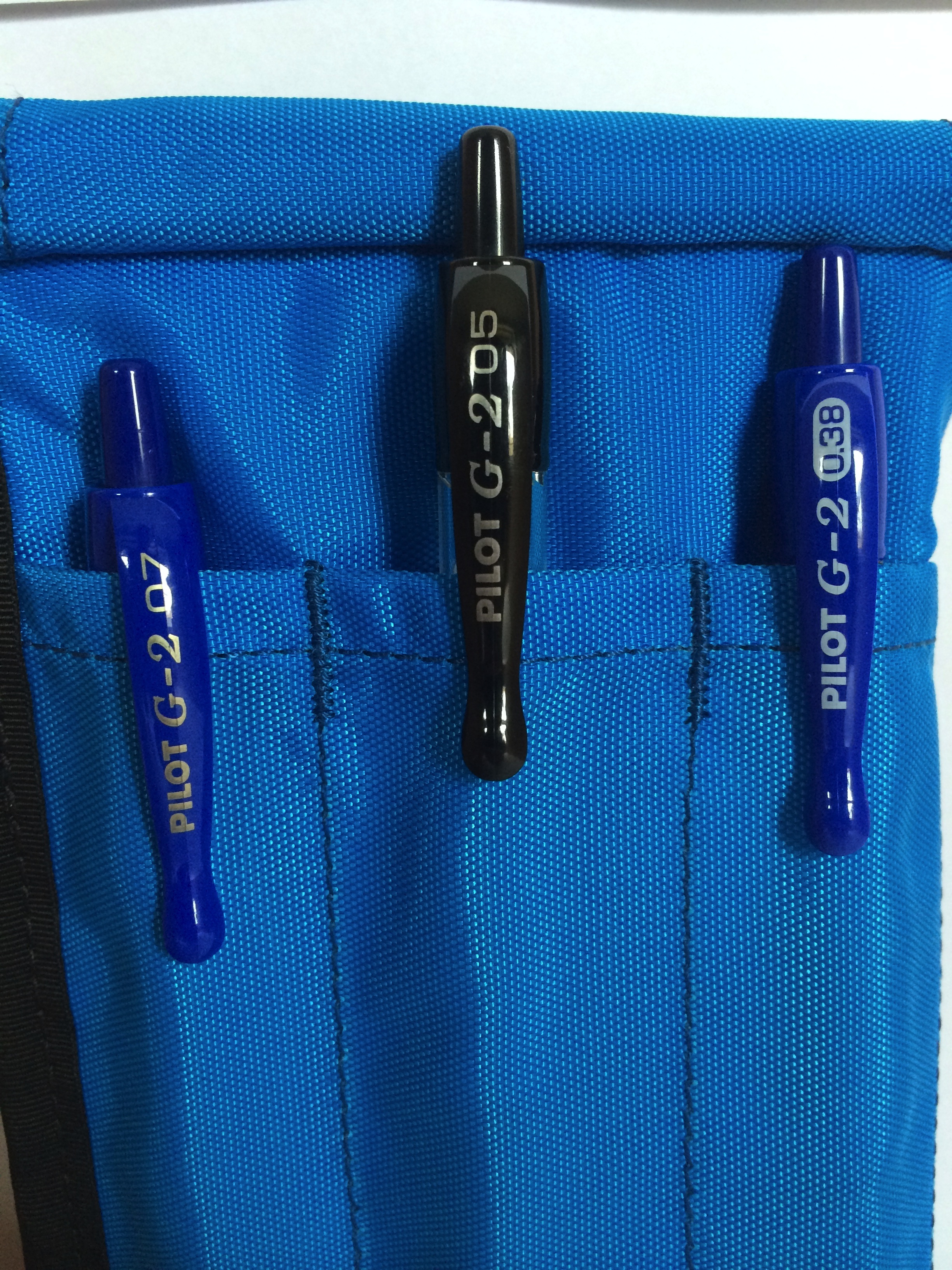
For the price, the G–2 is undoubtedly a reasonably good pen. One of my favourites? No. In spite of this, upon arriving home from the store, I filled one side of my Nock Co Sassafras with the 0.7mm (blue), 0.5mm (black) and 0.38mm (blue) G–2 models. Having previously used the 0.7mm, there was no need to include the 1.0mm in this comparison, having ruled out using anything broader then the 0.7mm. The next two weeks would then determine which size G–2 I preferred, and whether this would sway my previous opinion on the G–2 in general.

Look and Feel

Looking back on that original post, I had written the G–2 was “not the best looking pen out there”. I’d have to say that view still stands. Look, I am under no illusion that a sub $5.00 pen will necessarily end up as an icon of design, however some models at this end of market definitely look better than others to my eye.

IMG_4386

L to R: Jetstream, Signo 207, Pilot G-2

When viewed alongside a Jetstream or Signo 207, aesthetically, the G–2 probably ends up last in line. When placed alongside a Pentel Energel? The contest is much closer, however I still find the G–2 in last place. What is it in particular? I would say the majority of my dislike is both the clip and knock at the top end of the pen. The combination of a clip which reminds me of dripping candle wax, and the long, tapering knock on the end of the pen are just not to my liking. Compare that with the sleek lines of both the Jetstream and 207 in the image at right. The remainder of the pen I have no major aesthetic issues with.

Lets face it though, the simple aesthetics of a pen are so subjective, and a few photographs in a review are probably the last thing that should sway your own opinion.

How the pen feels in my hand? Another matter entirely. I absolutely love the G–2’s very slight taper at the rubber grip section. Having a quick look at some of the other pens on my desk here right at this moment, all of which I love using – a nice taper on the section is present in all. Although only a few millimetres of taper is enough, pens without one I find pretty uncomfortable and generally struggle where the size of the barrel and section are uniform through to the taper at the very tip.

Performance and Use

How does the G–2 perform when writing? The answer to that question lies, I believe, in your particular style of writing. It is here the variation in tip size has the potential to make all the difference to your writing experience. I find the broader tips more forgiving, whereas those on the finer end not so. My writing style is one where the pen is approximately 45º to the page (fountain pen or otherwise – this is standard for me). I have often found such a position not suited to finer tip pens, particularly when reasonably speedy writing is required. At times my slightly heavy handedness does me no favours, however again, that’s me, and my pens need to perform within that set of conditions.

G-2_Compare

Needless to say, I have at times challenged myself to use a finer tip pen, with the aim of somehow(?!) encouraging my brain to note down relevant points only, however mostly end up simply scratching out the same amount of text anyway, resulting in a less than enjoyable writing experience.

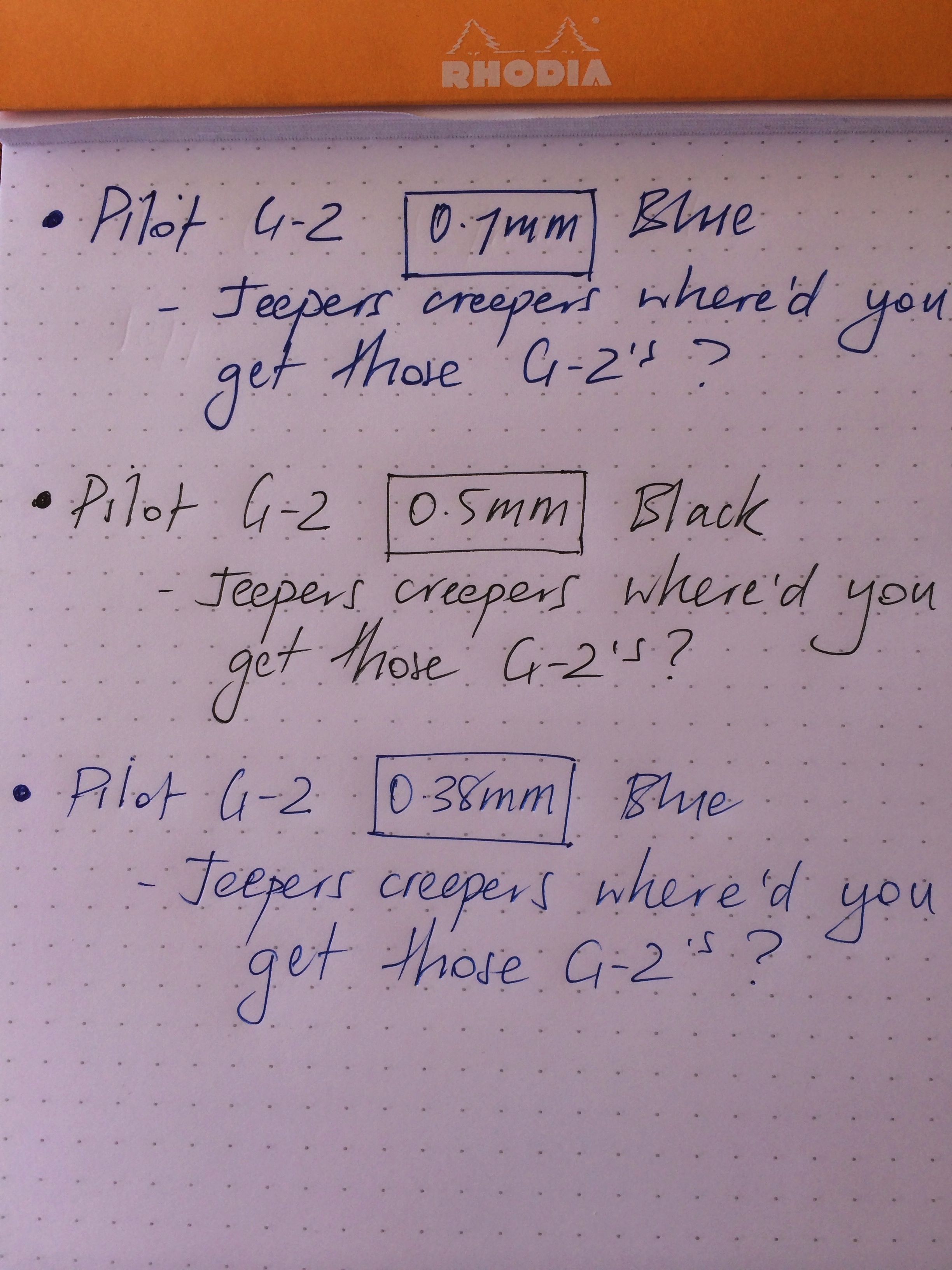
The main issue I had here was the amount of feedback from the paper with the 0.38mm, ranging from fairly minimal (Rhodia No. 16 Pad), to a moderate degree (office copy paper, Field Notes Shelterwood) to an annoyingly high degree (office supply spiral bound notebooks).


Completed_ETPStaples pic

Whilst my use of copy paper and office supply note books may be seen as heresy, I am sure I am not alone in using these types of items, for without going into great detail, there are certain office based workflows that simply require them in my current role. A story for another day perhaps.

G-2_TripointTo that end, I don’t believe the 0.38mm G–2 is necessarily inferior to the 0.5mm, however the fit with my writing style is not as good. If I am entirely honest though, at times the 0.38mm was my preference, for example when taking a few quick notes in my Field Notes (Shelterwood at the time) or on a tear off shopping list. It just wasn’t as good for slightly longer form writing.

As you would expect, the line production and inkflow of all three sizes performed flawlessly. There were no skips or false starts, and the ink produces a nice, vivid line, however given the fineness of its output, the blue 0.38mm occasionally seemed to fade a little “into” certain shades or even sizes of paper (for example when taking notes in an A4 sized office supply notebook).

Though also blue, the 0.7mm laid down far more ink, yielding a much more vivid line which stood out on the page. The 0.5mm is perhaps where the science of my comparison falls down a little, having only the black in this size, however I found no issues with the ink output and line production.

Conclusion

Medal ceremony. Unofficially brought to you by Nock Co.

Medal ceremony. Unofficially brought to you by Nock Co.

So, was there a sweet spot for me across the range of G–2’s? I’d probably say the 0.5mm overall. Though I didn’t reach for it quite as much as the 0.38mm. I think I shot myself in the foot a little by having the 0.5mm in black, as for some reason I have been enjoying using blue ink a little more recently. Were I to have a 0.5mm blue at my disposal, I’m sure this would have been the one to see the most use.

A photo I posted on Instagram recently with the three G–2’s in my Nock Co Sassafras, drew a few comments and suggestions recommending the Pentel Energel 0.5mm and the uni ball Signo 207. Funnily enough, both are two pens I do prefer over the G–2 (“taperless” sections aside).

I can understand why the G–2 is such a popular pen, however, always in the back of my mind is the fact that there are pens of equal cost and specs out there that are better. Some of these I have tried (Signo 207 and Energel), some I have not (Zebra Sarasa). I suspect affordability, availability and market awareness are the main reasons for the popularity of the G–2, however I cannot discount the fact that people do really like them.

To sign off, this past couple of weeks was an experiment in tip size as much as a G–2 “experience”, and probably brought me to the conclusion 0.5mm (or perhaps 0.4mm) is as fine as I’d probably go. For my writing style, anything beyond a couple of bullet points in a list became hard work with the 0.38mm G–2. Perhaps a similar sized pen with a smoother inkflow may sway me to go finer, and if anyone has any suggestions along these lines I will certainly give them a try.

What happens with the G–2’s? Retired. Probably for good I’d say.