Wiser Web Wednesday

Wiser Web Wednesday – a semi-regular link to posts of interest from around the web, by those far wiser than myself:


Bloomberg Business
There are certainly some interesting concepts here. Clearly the environmental benefits are without question and it looks like a beautiful and smartspace to work.

For all of the technology and advancement on show, two things which stand out to me are:

Since workers at the Edge don’t have assigned desks, lockers serve as home base for the day… Employees are discouraged from keeping a single locker for days or weeks… to break people away from their fixed locations and rigid ways of thinking.

So, its 2500 workers sharing 1000 desks:

The concept is called hot desking, and it’s supposed to encourage new relationships, chance interactions, and, just as important, efficient use of space

Neither are new concepts, however upon speaking with colleagues in other companies, talk often turned to wasting up to half an hour or more a day finding a desk, setting things up, clearing it at the end of the day, and repeating the whole process day after day.

The open plan office? Chance interactions and discussion? Yes, just perfect — no need to try to sell me on that one. When I’m sitting trying to work out exactly which data was deleted from the pivot table in the shared excel spreadsheet and all I hear at high volume is how long its been since the Ben & Jerry’s van was giving out free samples down the street at lunch time?

Chance interactions, discussion, inadvertent collaboration. We’ll just leave it to you to somehow find a way to focus in the mayhem surrounding you. What do you mean? Of course that is what we expect you to do. We’ll promote the former by opening things up, over to you for the latter — can’t be that hard can it? (Apologies — mini rant now over)

Concepts are great, my point is simply there need to be significant resources on hand to make them work. That certainly appears to be the case here.
The Smartest Building in the World


David Hewson – Medium
I like this idea. A shorter, more thoughtful writing challenge to offset the crash and dash of NaNoWriMo (which does feel like trying to sprint a marathon). Twelve, 800 word pieces submitted each month over the course of a year:

…a good short story is to be cherished. It’s also bloody hard to write.

Once submitted at the end of each month it is locked. Perhaps a few details to be sorted out, however I’d certainly be interested:
After NaNoWriMo how about NaNoSloMo?


Nib & Ink
Matthew Morse takes a look at the Karas Kustoms EDK just released as a Massdrop exclusive. I do not own any of the Karas pens, and this one certainly appeals both in form and intended function.

I agree the P8126 refill is a winner, however funnily enough, I also have a bit of a “thing” for how far a refill extends at the tip of a pen. That said, I think the only thing I’ll really have to decide on is which finish combination:
First Look: Karas Kustoms EDK Retractable Pen

And why stop there:

Ed Jelley: Karas Kustoms EDK Everyday Carry Pen Review
Pens! Paper! Pencils!: Karas Kustoms EDK Pen Review
The Pen Addict: Karas Kustoms EDK Review
The Clicky Post: Karas Kustoms EDK Pen – Massdrop Exclusive


Pens! Paper! Pencils!
The sets of 3 mini Iroshizuku bottles on offer from various retailers simply present me with a conundrum. Reviews such as these certainly help my cause:
Pilot Iroshizuku Asa-Gao Ink Review


Sprudge
I’ve never been there, and only see what you see in these images, however certain designs and layouts just grab me. This being one of those:
Verve West 3rd: The Latest Coffee Bar From Verve Los Angeles


DR Wakefield
As my natural coffee processing experiment rolls on, I am beginning to collate some information for an introductory post to kick things off. Outlining the various types of processing methods is obviously part of that:
The difference between semi-washed and fully-washed methods


The Guardian
I enjoy the application of nerdy concepts to some of my every day things, however could I humbly suggest before you consider adding a pinch of salt to coffee you consider overly bitter — perhaps take steps to avoid ending up with a bitter brew in the first place. It isn’t as difficult as you might think:
A chemistry teacher’s guide to the perfect cup of coffee


Lucky Peach
Speaking of nerdiness — away we go on another beverage I am somewhat fond of — in moderation of course. Those flavours in your whisky? To a large extent they depend on plant matter in the peat which is broken down when burned to dry and halt germination of the barley:

More lignin and you’ll get spicier, vanilla-ier, smokier flavors; more cellulose/hemicellulose and you’ll get more caramel-y, toasty flavors.

Cheers:
The Science of Scotch


Chambers Daily
Following up on last week’s link from Bradley Chambers about leaving Evernote, here he offers a few thoughts on what might fix the ailments. Not surprisingly, a greater focus on what made it successful in the first place permeates the list:
Fixing Evernote


Pax Coffea
This is a great viewpoint on taste descriptors in coffee. I often find I can detect certain flavours from a description, where I may not have been able to put words to the flavours myself. The power of suggestion? Perhaps, however with experience, I think it becomes more like Rule 1 in this post:

If you describe it, I better taste it

I’d also agree that this can often be the case:

People who feel alienated by tasting notes react in a variety of ways, many of which lead people away from great coffee rather than toward it

Very much enjoyed this post:
A Meditation on the Importance- and Danger- of Tasting Notes


November is Coming


Have you got 50,000 words in you?

You might say you don’t. Personally, I’m inclined to disagree, and I’m sure those committed to undertake NaNoWriMo for another year might be on my side of the fence.

Yes, it’s that time of year again, and here I am with another post about National Novel Writing Month. Although not participating this year, having managed some twelve months ago to come up with a 55,000 word tale I was fairly proud of (albeit a little less so upon re-reading), it seemed timely as we near the end of October to share a few thoughts on some of the things that helped me stumble across the line in 2014.

I offer these observations clearly not as a seasoned novelist, with a bio inclusive of numerous published works, but perhaps like some of you. Someone who thought: ”you know, I think I might be able to do that… but that’s over 1600 words a day for a month… but… ohh… gee… maybe I can’t — no, damn it, I actually think I can. Wait… I’m really not sure… ahhhhh!

That of course, is exactly my point.

Although every seasoned novelist started somewhere (perhaps even with NaNoWriMo), it can sometimes be a little difficult to conceptualise expert tips and tricks into your own situation, as valid and well-tested as they are.

So, after reading two posts recently containing such tips from a professional author, I will endeavour to pass on some advice of my own, in the hope they might assist in some way to lead you headlong into NaNoWriMo greatness.

The Expert

I have previously mentioned author David Hewson and his book Writing a Novel With Ulysses. The book itself is about creative writing using text editor Ulysses for Mac and iPad, in which I wrote my 55k words in last November (the Mac app at least, with the iPad version coming later from developer The Soulmen).

Ok, to get this out of the way. Firstly, Ulysses. I absolutely love it, and use it for every piece of writing I do for this blog. The above guide by Hewson provides fantastic advice guiding the efficient use of Ulysses in a fairly large writing project (certainly larger than anything I had attempted at the time). While there are cheaper word processor/text editors out there (at the time of writing: $AU69.99 on the Mac app store; $AU30.99 on the iOS app store), Ulysses worked for me and I have not looked back.

ulysses_nano

Image courtesy Ulysses

Ulysses currently has a free trial running through to December 7 for the brave souls who may want to embark on NanoWriMo with it, and there is no better time to give it a run – NaNo or not. I remember thinking to myself half way through the free trial last November, if I manage to finish this damn thing and get to 50,000 words — I’m going to reward myself and buy this app. Just a thought.

Now, remember the three paragraphs immediately above when we come to the tip “the tools don’t matter”. Let’s get to it.

The tips

I’d encourage you to read the two posts by Mr Hewson, which I found myself nodding along with as I read, and if you’ve done any writing yourself you will probably do the same:

8 Tips for Writing a Novel this November – The NaNoWriMo Blog

Five ways to help you finish that book – Medium: David Hewson

However the stimulus for this post comes because, as well as reading and nodding, I also found myself thinking: yes I’d agree with that, however as a complete amateur, I’d also add…

So here I am… ”also adding”, to a small few of the thirteen tips contained in those original posts.

(Unless stated otherwise, quoted text is from either of the two posts linked above)

On considering your book as a journey

Hewson points out:

Yes, it’s a story with a beginning, middle, and end. But it’s also a journey, from life to death, ignorance to knowledge, love to hate or vice versa.

and:

When you think of a book as a journey you then realise you need waypoints, movement, progress.

Of course a lot more detail and a good example of the above can be seen in the 8 Tips post, we see how an “inciting incident” and a further seven or eight scenes might provide 10,000 words.

To that I say boom! You’re a fifth of the way there! Well, perhaps not, although I do agree that a journey with a few stops along the way is a great way to look at it. Further, once you get rolling, it can be surprising how quickly the words tally up.

On sticking with the right tools

Here I’d add, this is really only going to work with the right tool(s) for you. I don’t necessarily mean Ulysses, Scrivener (also a 30 day free trial available), Byword, or heaven forbid even Word. It might be anything.

I get it — the tools matter, but not as much as the words.

However, remember you will need to be writing — a lot, over the course of November. Where will that writing take place? Will it be one place? Your desk? Many different places? Set yourself up to work whenever and wherever you can.

Are you going to need a companion iOS or Android app, or at least something that can access your Dropbox, iCloud or Google Drive easily and efficiently — and more importantly do so reliably? Or perhaps you will be writing on the one device you can take anywhere with you.

I think a some planning here might make things just a little less stressful if you are well set up to pick up your story just about anywhere you are.

However, if things aren’t quite working in the first few days and you do have an epiphany about changing something that will see things work far more effectively — I say go for it. Within the first few days my iOS solutions were not quite where I needed them, and a little tweaking of apps and syncing worked a treat.

So, tweak a little if needed, but please, have back ups and just don’t keep tweaking.

On time management

Manage your time effectively — you won’t have as much as you want or need. Keep the book alive by making notes … when you have spare moments.

Of course in relation to the previous point about the right tools — it is great to be able to work anywhere, but you most likely won’t be able to work everywhere. When you are not specifically writing is often when the best ideas come to you. Notebooks, a sheet of paper, a phone — all perfect tools for that killer scene, idea, or great line from one of the main characters. Anything you’d really prefer not to forget.

One of the main benefits in taking notes one my iPhone is the ability to send text to whatever digital tool you might be doing your writing in (assuming it is digital — I acknowledge some brave souls do this with pen and paper in longhand). I found this useful on a couple of occasions where a note became several hundred words, and it was far more efficient to drop them into the story than rewrite from handwritten notes.

Whatever you use here doesn’t matter. Just get those thoughts down.

While we’re talking about managing your time effectively, I would also add a comment about the lead in to the November 1 kickoff. Only making the final decision to participate in last years event a couple of days before it commenced, left a less than ideal lead in as far as planning and organisation are concerned. I had the bare bones of a plot outline in my head, however my point is, even if you are feeling rather less than prepared — it can be done. The rest of my planning and organisation came along as the story progressed.

When in doubt and the calendar clicks over to November 1 — just get going and let your characters take you at least the first part of the way. Now is a good time to glance at your calendar though — see that? There are still a few good planning days left before this mayhem begins.

On writing your way out of it

Mr Hewson sir, if only I had enough talent to write my way into it in the first place!

But here’s the hard truth: the most dangerous place any writer can find him or herself is the moment you think, ‘I can find out what I want to write by writing it.’

All right then — point taken. I guess the last thing you want to do is waste a few thousand words on a scene which takes you in entirely the wrong direction. Perhaps something to remember from our expert about taking a break to reassess:

Writing’s also sitting in a bar with a beer daydreaming about the book

Is it? Is it really? Of course it is — remember what we said about when those great ideas are going to come to you?

Probably wise words indeed. Just don’t make that the thicker end of the writing wedge — sit in that bar for too long and those ideas eventually will make no sense at all. Might I suggest a calming single malt could be an even better way to go about it, however I restate one of the original points — the tools don’t matter!

Back on track with my two cents here: Resist the urge to rewrite at all costs! Mostly. Absolutely, stop, think and perhaps head in another direction — but do anything you can to avoid rewriting too much as you go along.

Just remember — this is NaNoWriMo, and if it is your first, perhaps this is also your first full draft. You will likely write more words in the coming month than perhaps you’ve written in the past twelve — maybe longer. You just don’t have the time to make this perfect. This is not putting the finishing touches to your life’s work. It is not your masterpiece — not yet.

In the words of six-time participant/three-time winner Katie Maguire on her blog I Have Things to Say:

First drafts are shit

And there it is. The honest truth. If you’ll pardon me repeating that, my first draft is sitting in a draw with a couple of initial annotations made, and is still, well… shit (apologies again, I’m done with the language — it’s just that sometimes there is only one way to describe something, particularly if that is also the very word I said aloud upon first reading back over my draft).

If you get part, half or just about all the way through and begin to think: you know, this probably really isn’t that great. Guess what? Probably half of the other millions of WriMos are thinking the exact same thing. Others might be lying to themselves, and still others might (after many revisions) get published, however as the month goes on, everyone’s eyes are on the same prize — that 50k finish line.

Just. Keep. Going. Get it done.

On simple being better

Written in bold, with the suggestion to print out and keep, Hewson gives us the following:

Simplicity is always harder than complexity.

The point here is simple. A story told in a simple, straightforward way is far easier to understand than something overly complex simply for complexity’s sake. How to recognise it? Try this example:

You’ve just decided part way through this is actually a two-era story, part of which will take place in the modern day and the rest in Regency England featuring a mirror cast.

Thank you Mr Hewson, with that laugh out loud example above, we are just about done.

I would add here that the same rules apply to individual scenes or pieces of dialogue from your beloved characters. That said, sometimes you just need complex. An example? I give you, that classic piece of cinematography, Wayne’s World, where one of our heroes, Garth Algar hatches the “simplest” of plans:

OK… First I’ll access the secret military spy satellite that’s in a geosynchronous orbit over the Midwest. Then, I’ll ID the limo by the vanity plate “MR. BIGGG” and get his approximate position. Then, I’ll reposition the transmitter dish on the remote truck to 17.32 degrees east, hit WESTAR 4 over the Atlantic, bounce the signal down into the Azores, up to COMSAT 6, beam it back to SATCOM 2 transmitter number 137, and down on the dish on the back of Mr. Big’s limo… It’s almost too easy.

Complexity, when used for effect, can be quite powerful, however unless you have a real knack for clarity, it can certainly weigh things down over time.

My advice? Just write it as you’d think it or say it. Speak the scene out loud — even just in your head. Simple just works, and is an efficient way to plough on with the story. It also makes the whole thing much more readable for those who might eventually be on the other side of this situation. That’s right — your readers.

In conclusion

Truth be told, I’ve probably written almost as many words about NaNoWriMo as I’ve written in it. Who knows, last year may have been my one and only shot. If so, I am happy with how it turned out, and is something I would recommend to anyone considering having a go. It is indeed an exhilarating ride.

If that is you, then I hope some of what I’ve written here might help a little, or a lot. Perhaps it won’t help at all, and you’ll get “stuck in” and come out a winner in precisely your own way. In all honesty it will likely be the latter, given how different we all are, which is of course the best part of it. I’ll look forward to hearing how you went, what you found most useful, and if you don’t mind, perhaps use a few of your tips next time I find myself knee-deep in words one November.

So, November is indeed coming, and so is a flurry of words. Good luck with that word count, have fun, and be sure to raise your arms when you pass the 50,000.

I’ll certainly be cheering for you.


Decent Human Beings

Two nights ago I stood during the opening of my children’s high school awards night.1 During the convocation by the school chaplain, we stood in prayer, which included: “we pray that we shall walk with integrity and act as decent human beings”.

Those familiar with a certain disagreement recently played out online may immediately conclude this is simply another post about such matters. In many ways I guess it must be about that — yet at the same time it isn’t. While the impetus for this post may in some way be related to those events, it is in large part due to the simple, yet powerful message I relayed in the introductory paragraph.

Every day I am thankful for the wonderful people I interact with online through the communities I am lucky enough to be a part of. I wouldn’t say I know those I interact with in the traditional sense of the word. Lets face it, most of them live on continents distant from my own, although thankfully at least a few are a little closer than that. We pop in and out of each others timelines, in boxes and lives. We offer and receive advice, encouragement, maybe a little ribbing — and are perhaps even set straight about things every once in a while.

This is all in a way which conveys the utmost respect for each other. We act with integrity. We act as decent human beings.

I cannot imagine turning up to an online world in which I am constantly in conflict with others in it. Perhaps that is in large part why many opinions I keep to myself. That is a personal decision. If you can make your point well enough in 140 characters for example, by all means do so. The number of draft tweets I delete suggests there are many times I don’t believe I can — or at least be clear enough about what I am intending to convey.

Speaking of what I am intending to convey, I can sense I am now heading towards where I did not intend to go with this post, so let me finish by saying this: I teach my children to act with integrity and as decent human beings, and the school I choose to send them to shares those values. In my own life, whether online or off, surely — surely, the very least I can do is the same.

So I am grateful to those of you who make this online place a positive one for me. Those who also share these same values. Thank you for acting as decent human beings.


  1. A proud father indeed, both earning academic excellence awards for their efforts throughout the year. ↩︎


Wiser Web Wednesday

Wiser Web Wednesday – a semi-regular link to posts of interest from around the web, by those far wiser than myself:


Covered Podcast Blog
Covered is bi-weekly podcast about writers and their books.

In this post, creator and host Harry C. Marks reflects on what he has learned over the past year in producing what is easily one of my favourite podcasts.

There are six great points here, most relate to podcasting, however there is also one about reading and writing — Don’t Just Read What You Know. My attempts to get back into reading more over the past 12 months have been in no small way influenced by Covered, and for that reason, I am especially grateful.

A fantastic, tightly edited and superbly produced show — very much looking forward to Season 2:
One Year Later


TOW Centre For Digital Journalism
As I’m sure regular readers will know — the Lore podcast by Aaron Mahnke is another of my favourites. Following along on Twitter (and the iTunes charts) over the past 6 months or so, it has become clear that Lore’s popularity has trended upwards fairly sharply.

If you’ve listened to the show yourself, you’ll know there is nothing curious about Lore’s success, however in today’s podcast market, it is indeed rare:
The Curious Success of Lore: A Case Study


512 Pixels
Stephen Hackett with some good points to consider, if, like myself, you are moving from Evernote to the native Mac and iOS Notes apps (also check out the follow-up piece here).

Given the major overhaul of Notes which occurred with the introduction of iOS 9, I am hopeful of further improvements coming in the future. I can live with the UI, however it would indeed be great to have better sorting options and tagging.

Having never quite been 100% happy with Evernote, I am particularly enjoying the ability to efficiently send notes to the app from anywhere which has access to the share sheet, along with the ability to add what I am sending to a current note.

I am also hopeful (and somewhat optimistic) Apple will never repeatedly yell at me about features within the app which I had repeatedly declined (read the footnotes):
Notes on Notes.app


Chambers Daily
There is also this:

Evernote hasn’t added a feature in a long time that I cared about. It was a platform that was standing still for me. It was a platform that I was invested in with my time and my money, and I felt less and less confident about its future.

Not an insignificant move from someone who wrote Learning to Love Evernote a few short years ago:
Learning to Leave Evernote


Fountain Pen Economics
You know a post is going to be interesting when my name is mentioned in it. Ha!

In all seriousness, you know a post is going to be interesting when you think to yourself — wow, that hits the nail on the head about many of the reasons why I write this blog, but I had never really thought about in that way.

Another great post yet again from the pen community’s resident economist:
Blogging and Human Capital


Brewing Coffee Manually
Hat tip to Brian Renshaw for this one.

A list of terms worth scanning through if you are inclined to increase your coffee vocabulary. For example:

Cascara – Spanish for “husk,” cascara refers to a coffee tea that is made from the dried coffee fruit that is removed from the green coffee seed.

While you’re there, be sure to click on the Mugshots menu at the top of the page:
Manual Brewing Coffee Glossary


The Pen Habit
The publication of this great review by The Pen Habit coincides with my own post from a couple of days ago on the Pilot Prera. Whenever I read reviews on pens I have written about, I invariably tend to see all of the things I’ve left out of my own.

In considering that point though, experience and time in this game count for much, and I’m happy to tell you about what I like or don’t like — leaving some of the finer points for those more expert than myself, as is the case here.

By the way – I liked the Prera too:
Pen Review: Pilot Prera


Pens! Paper! Pencils!
More than simply another great review of a pretty attractive pen. With the reference to another review of the same pen (the link to which I highly recommend clicking), Ian highlights the variations in opinion which occur in something like pen reviews. I say this not as a negative — but something to be expected, and why there are always enough links to share around.

This one has a price tag which is a little more than I’d be prepared to pay:
Bespoke British Pens Conway-Stewart Winston Fountain Pen Review


Alt. Haven
This is a truly impressive looking pen. From the matte black finish, the 21K nib, right through to the name.

I mean, it even sounds impressive:
Review: Sailor Pro Gear Imperial Black


Pax Coffea
Although seemingly obvious on its own:

The point of all this is that our perception of coffee and our description of coffee flavors is very dependent on the culture we learn about tasting in. Two tasters, tasting the very same thing, will use different language to describe it.

This is a fascinating read about why the blackcurrant and blackberry flavour descriptors exist in the UK and the US respectively, and what role White Pine trees have in all this:
Why Kenyan Coffee Tastes Different in the UK and the US – or How the Government Controls Your Flavor Descriptors


Matt Gemmell
I have written, rewritten and subsequently  scrapped links to, and short posts on what has been going on regarding this online “discussion” around app pricing and business models — well, that is what it should have been about, however quickly turned to people, not issues.

I strongly recommend reading this, and clicking the links contained therein for context. In the absence of linking to posts documenting the whole saga here, this is a considered piece which sums up much of my thinking as I looked on at developments over the past week or so.

Putting anything together even half as eloquent as the words in Matt’s piece being well and truly beyond me, you should definitely read the post. Me? I’m just enjoying Pocket Casts again:
Responsibility


Pilot Prera Fountain Pen

Much of what I see online through blog posts, forums and social media forms my initial opinion on a pen, however sometimes I wonder why the reality differs to such a great degree upon having it in my hand. There are of course many times where my perception and the reality are entirely congruous, yet this was certainly not the case with the subject of this post — the Pilot Prera fountain pen.

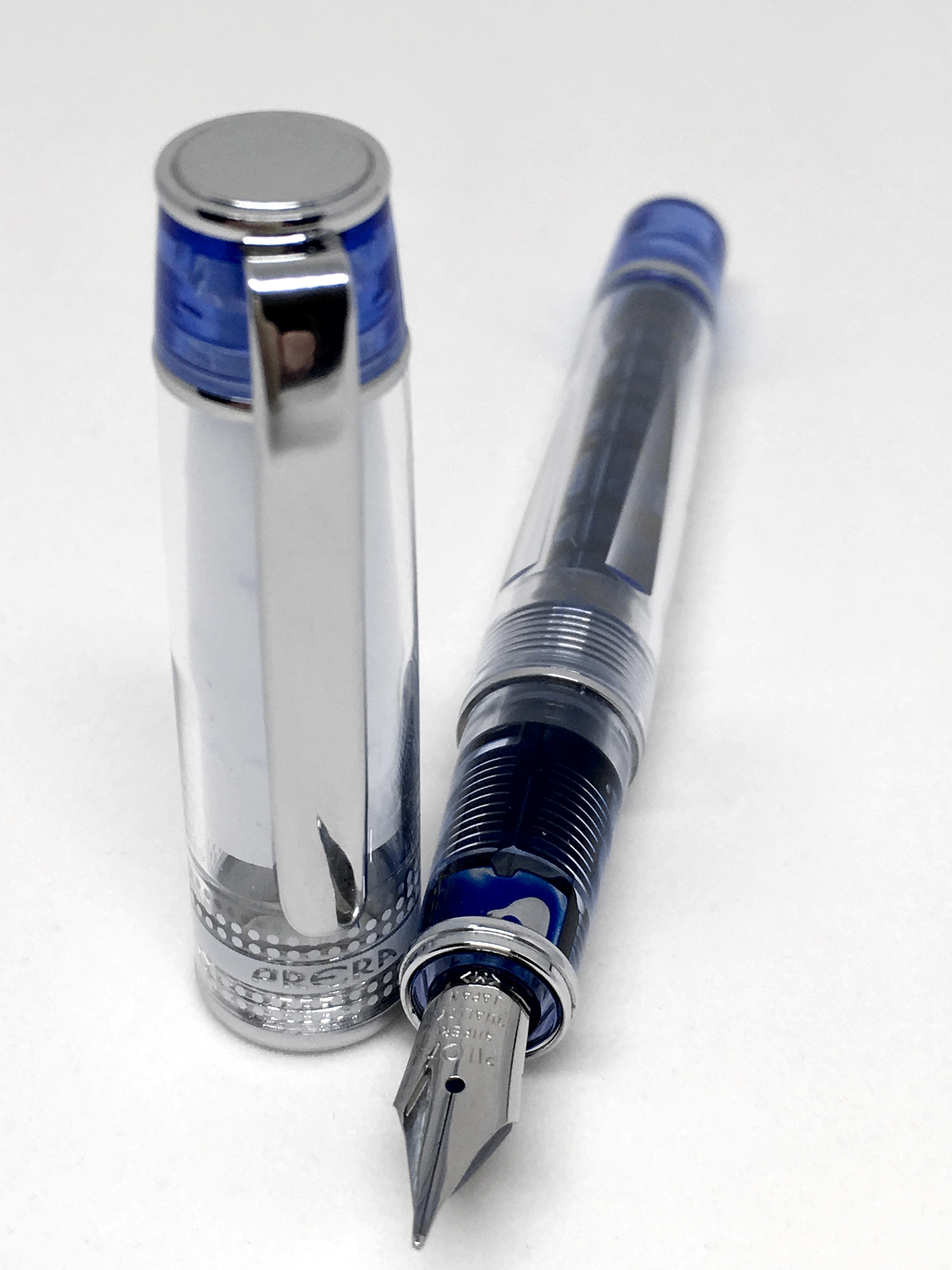
prera_cap_nib

Maybe it was because I haven’t seen a lot of Prera reviews, or perhaps I simply wanted it to be a certain way. In the end, it was simply an erroneous assumption on my part.

What exactly am I talking about here? Well, although pen dimensions are readily available on just about any retail site you care to visit, I had not realised just how small the Prera line of fountain pens are.

The pen you see in this post was passed on to me by a kind reader downsizing his pen collection, after some email correspondence from myself which mentioned I was thinking of buying one. I was therefore lucky enough to add this pen to my collection at no cost. Had I proceeded down the path of purchasing one myself and gone through a more detailed research process, I would have likely ruled it out as a pen for me.

The reason? Well, as I have mentioned in other posts, I prefer to use the majority my fountain pens without the cap posted, and of course a smallish pen likely to render posting a necessity has some convincing to do if I’m going to buy it. To finish up this point and get on with some more details, suffice to say I love this pen, and use it often — posted. Go figure.

Look and Feel

As I’ve mentioned above, the Prera would be classed more so as a “pocket” pen, rather than a “mini” as such, and given its stature, I’d say this is an accurate description. As you’ll see from my post about the Pilot Custom Heritage 92, I do like a pen with blue, silver and transparency in it’s styling.

Given the size of the pen, it’s no surprise the cap and clip are proportionally short. The metal clip is only 40 mm long, which is equivalent in length to the white inner cap sealing the nib, visible through the transparent outer cap. Though not a major issue, it is a pity this prevents the nib being on show through the cap as well.

prera_under_nib

If you are someone who prefers clean simple lines on a pen, the overall appearance of the Prera may not suit entirely, and I think this is a combination both of design — and indirectly — its size. As you can see, the trim, accents and labelling create what is a fairly “busy” looking cap, and with its short stature, may seem a little cluttered for some. The body itself is somewhat less so, however with the cap posted of course you end up with the same look simply on the other end of the pen (a statement straight from the files of the bleeding obvious if ever there was one). I wouldn’t say this bothers me, however for some it might.

The overall aesthetics of the pen in relation to the distribution of accents at each end, metal bands along both cap and body, and transparent demonstrator barrel provide an interesting, yet not over the top look to the Prera. A great looking steel Pilot nib rounds out the pen, complementing the metal clip and banding nicely.

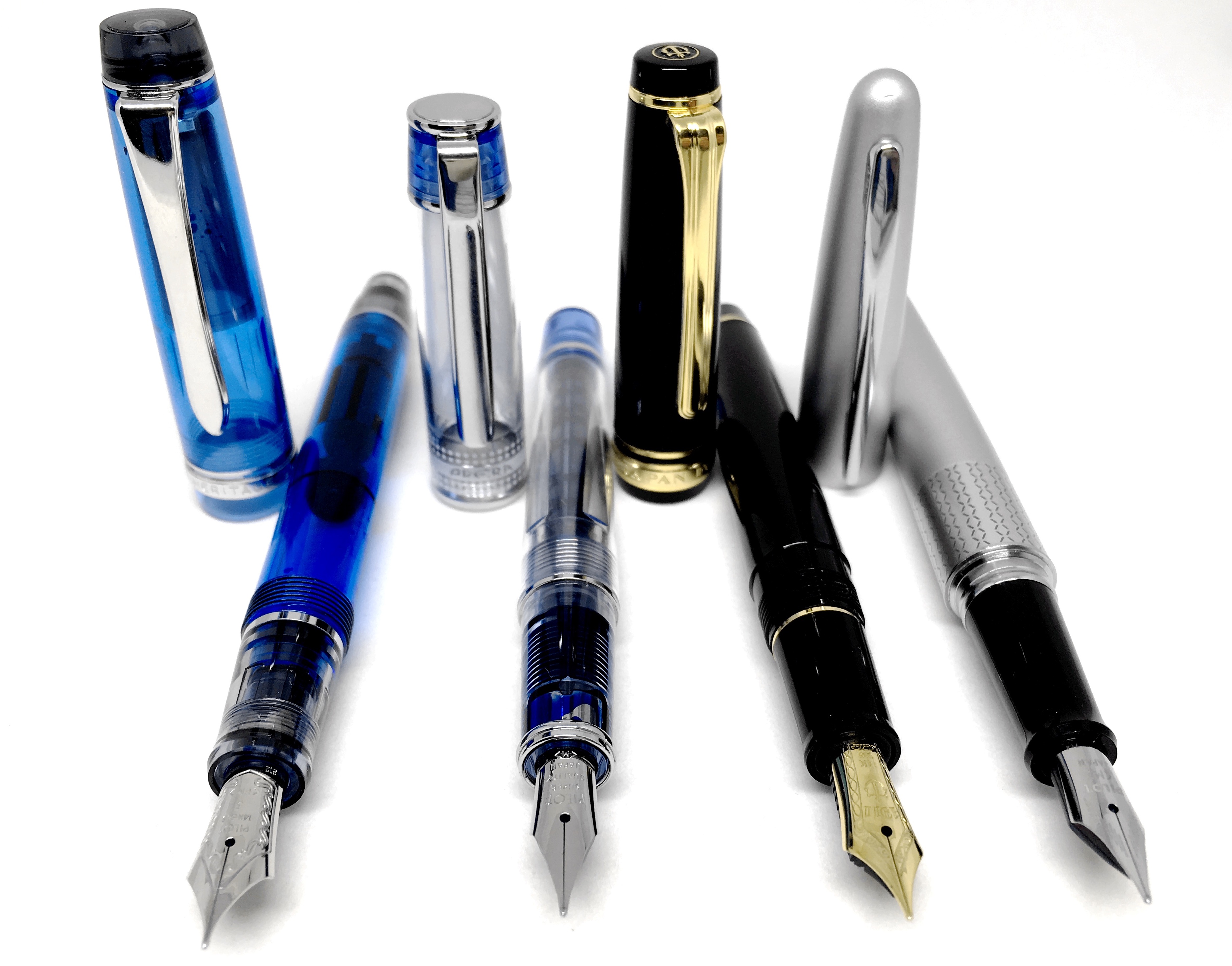
prera_v_sapporoI must admit I do find the sizing and proportions of the Prera to be a just little odd. I have it sitting next to a Sailor Pro Gear Slim (Sapporo) as I write this, and although the two are very similar in size, the truncated finial at the end of the Prera’s cap throws the proportions a little out of balance. With just a couple of mm more after the end of the clip ring similar the Sailor, the entire pen would look a little more — well…balanced.

That said, a good question to ask at this point is why should all pens look the same — a very valid one for of course they shouldn’t. If we all preferred the same style of pens what a boring world it would be.

Key Specifications

Courtesy Jet Pens

  • Manufacturer: Pilot
  • Model: Prera
  • Weight: 0.6 ounces (17 grams)
  • Body Material: Acrylic
  • Cap: Snap On
  • Clip: Metal
  • Diameter Grip: 10.6 mm
  • Diameter Max: 12.0 mm
  • Filling Mechanism: Converter, Cartridge – Proprietary Pilot
  • Grip: Plastic
  • Length Capped: 12.0 cm / 4.7 inches
  • Length Posted: 13.4 cm / 5.3 inches
  • Length Uncapped: 10.8 cm / 4.3 inches
  • Nib: Steel

Prices at time of writing:

  • JetPens $US38.00 ($AU52.00)
  • Cult Pens £33.29 ($AU70.00)
  • Engeika $US29.70 ($40.00)
  • similar prices to be found with eBay sellers

Writing performance

I made mention in a recent Wiser Web Wednesday post about the positive aspects of a nib that simply writes perfectly (in that case a review of the Pelikan P200 on the Pelikan’s Perch), and does so each and every time you pick it up. I’ve typically found Pilot nibs are generally part of this group.

prera_writingIt is for this very reason (and the snap on cap), I have found the Prera to be a fantastic day to day office pen1. In a daily writer, I need something reliable (no false starts, skips, ink blobs or leaks), which I can keep capped (to ensure it remains reliable), yet is quick to pick up and use — which pretty well ensures my go-to’s will be caps of the non-threaded variety. As you can imagine, the domain of the Prera, Pilot Metropolitan, and Lamy 2000 (a joyful every day pen if ever there was one). The rotation here also includes an ever-changing roster of gel pens, rollerballs and my trusty P8126 filled Retro 51.

prera_nibI don’t really have a great deal more to say specifically about the medium, steel Pilot nib on this Prera, apart from the fact it is a beautiful writer and performs straight out of the blocks every time. As you’d expect, the medium nib is somewhat finer than those on my European pens, and although quite resistant to flex, there is just enough “give” to make it extremely comfortable to use over longer periods.

There is a very small step down to the section from the barrel, however the absence of threads given the snap-on design of the cap ensures a very smooth grip. Personally I feel the surety of the grip is enhanced by this step, as well as providing a feedback point to align your fingers and thumb. I cannot see this being an issue regardless of your preference or grip style.

Whether or not a pen will work for me posted, is of course about balance rather than overall weight, though a very heavy pen will take its toll over a longer writing session. I’d say I have a fairly broad range of pen weights I find comfortable, with only very, very light or overly heavy pens a problem.

The Prera is well weighted at 0.6oz (17 grams), and reasonably well-balanced when posted — a necessity given its size. A point to note here is a good proportion of the weight is distributed fairly high on the pen with the cap posted, given its metal clip, final, and rings. As a result, the centre of gravity seems a little high, so depending on your particular style of grip and pen alignment, is something to keep in mind. In its favour here though is the short overall length, which places most of the pen down in the hand of the user rather than out the top — the main reason I found the Prera quite a useable pen when posted.

A final note on the size and posting brings us back to the Sailor Sapporo I mentioned earlier — a far better balance for me when posted, despite weighing in at 19.7 grams. Ok — time to move on.

L to R: Pilot Custom Heritage 92; Prera; Sailor Sapporo; Pilot Metropolitan

L to R: Pilot Custom Heritage 92; Prera; Sailor Sapporo; Pilot Metropolitan

A couple of days ago I returned to the Pilot Metropolitan (M Nib) after the cartridge in the Prera ran out, and the change was probably a little telling.

Hands down I find the Metropolitan is a far better pen for me, fitting my preference for use without posting the cap, having a nib essentially the equal of the Prera’s, and of course the price. The Metropolitan can be picked up for less than half the cost of the Prera, and for me, is a better overall pen. So if you are looking for value for money without needing to compromise, I think the Metropolitan is definitely the way to go.

Closing thoughts

My advice if you are thinking about picking up a Prera? Know you will be buying a high quality fountain pen — just know it will be on the small side when comparing to many others in your collection, and if you are a strict non-poster, this pen most likely won’t be for you.

As I’ve mentioned above, for me, and I’d argue for many potential buyers, the Pilot Metropolitan is an equally good pen and offers much better value for money. The two pens could not be more different in size and appearance however, and it is your own particular preferences here that the real choice will be made.

Again just remember (note to self) — the Prera is on the small side.


  1. The paper? At my desk unusually enough are the standard A4 bulk buy Staples legal pads. Miraculously they hold all but the wettest, broadest nibs — and certainly all of the pens listed here. ↩︎