Eleven Lines of Fury

Reflection. Gratitude. Pondering. All noble and valid uses of a well-defined journaling space. I therefore wonder whether it’s good or bad for some days to simply result in eleven lines of fury.

Why would I even consider…

How can you possibly think…

Why can’t you seem to get yourself to…

Surely, you must be joking…

Sorry, no…

etc…

Does it work? Maybe. Sentiment directed externally generally goes unheard — as intended, of course.
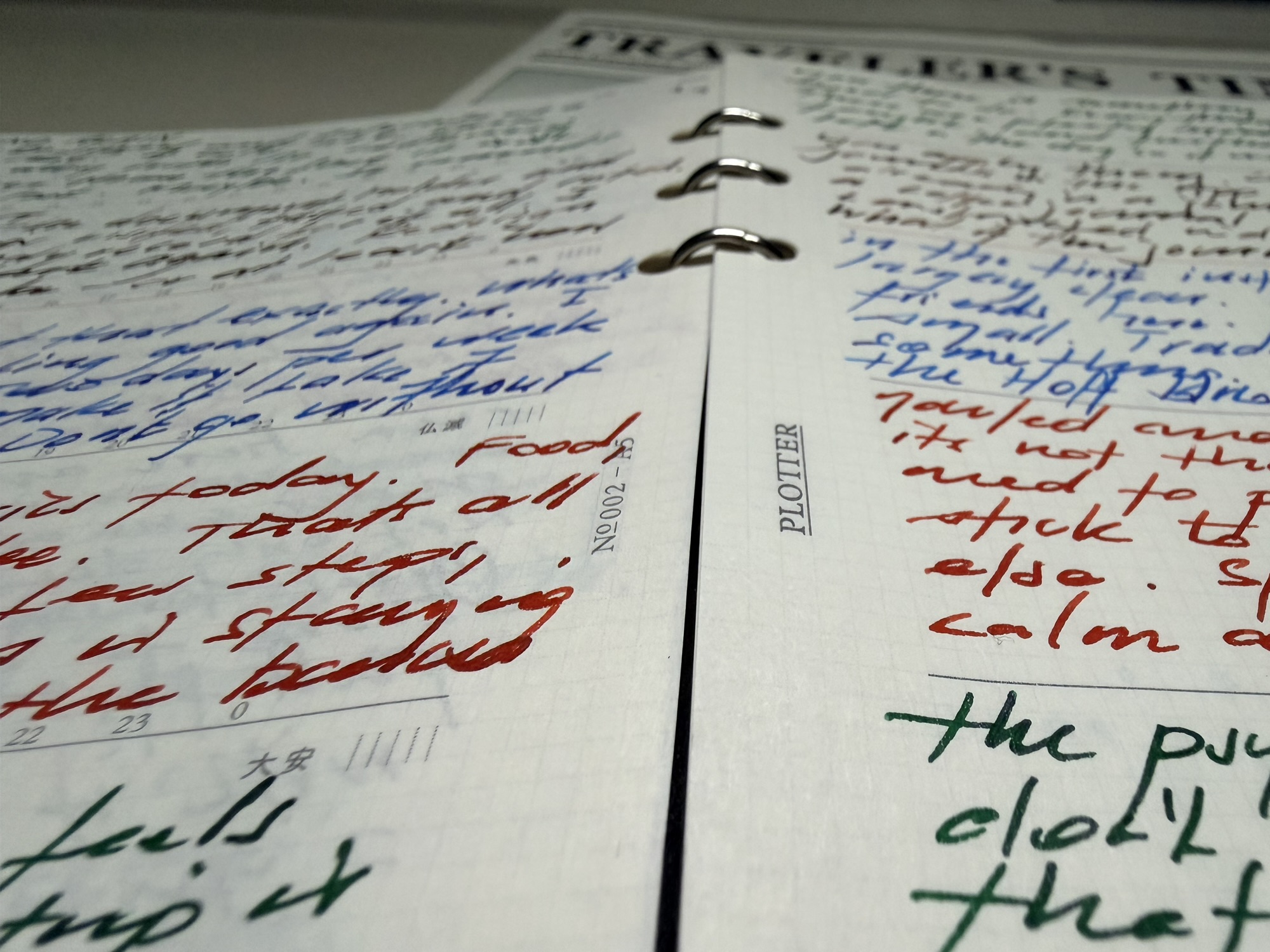
The journal is an A5 Plotter in the Weekly Schedule Refill (PLT0002) which spans a double page spread. A title, 5 lines on the left, 6 on the right. Every day.

The internal monologue? A different story, and a suggestion to berate yourself on a daily basis this post is certainly not. Personally, I sometimes need some stern words if I’ve fallen off whatever path I’d planned to be on at any given time. Or it might simply be that someone has brought me to the point of words on a page, rather than, say, shouting verbal obscenities in the workplace.

So what is the purpose of this post exactly? Well, simply to say that fury constrained to a short journal entry is fury expressed, processed — and hopefully — left behind. It’s out there (or on the page at least). I’ve said it. Done.

Constraints

I’ve mentioned before how a small, A6 page-a-day is a great way to get into a journaling habit if that is your goal. Well, I’m here to tell you, eleven short lines will do it as well. Whilst I’m all for an expansive journal or larger notebook, sometimes enforced constraints can at least provide a conclusion and early completion of one of my daily tasks.
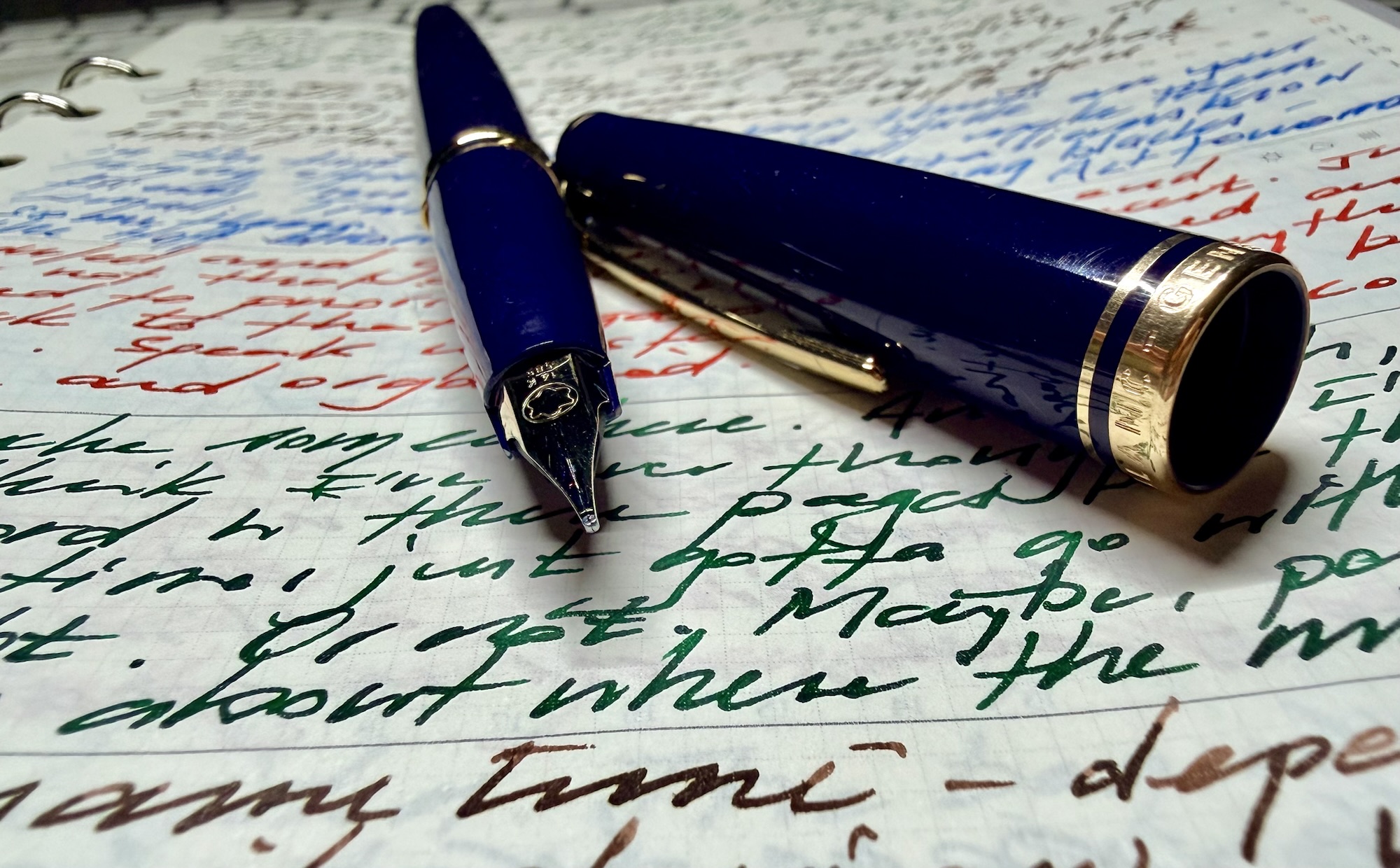
A splendid Montblanc Generation carrying the duties of the day

I find it also forces a certain clarity of thinking. What do I really want to say here? You don’t have long to say it, so get to the point. Yes, some days I’m flat out thinking of something to fill that small space, however a mindful reflection on the taste, texture, and warmth of the first cappuccino of the day? Perfect.

Maybe that’s the quiet power of constraints — whether you arrive with gratitude or grievance, you show up, say your piece, and move on. Eleven short lines — or whatever you’ve got — will do that.

A little context and perspective

I am so sick of organising stuff, it annoys me that I have to do this all the time.

Or so went my pitiful little whine one morning last week to my wife about a particular aspect of my job. A particular aspect that, all things considered, really isn’t overly difficult. But this morning, no, I wasn’t particularly happy about it, especially since there were many other “more important” tasks I needed to get done. The exact nature of my gripe – not important, however in the context of my life at that very moment? Just not fair.

The next 24 hours posed a fairly blunt question (as life often does) about whether I really had anything to complain about. And yes, of course – I didn’t.

Those 24 hours started with Episode 5 of the Analog(ue) Podcast on the fantastic new Relay FM Network. Titled The Only Way Out is Through, discussion centred around the extent to which our personal struggles are played out (or not) in the public forum that is the internet, and if so, how much.

The main two stories recounted?

Guest Stephen Hackett spoke of his son Josiah’s ongoing battle with brain cancer, and the family’s personal pain and struggle which continues to this day. Next was host Casey Liss discussing his and wife Erin’s long struggle to have a child. The usual “when are you two going to have kids” jibe from friends and family described as “ripping our hearts out” every time it was said.

Later that day, I listened to a medical practitioner discuss experiences from working in war zones, about seeing the best and the worst in people. How, in a certain culture, the value of a goat was higher than a farmer’s daughter. The result? The death of two young girls with the farmer’s plan to have more sons.

Finally, some 24 hours after desperately battling with my minor grievance, came Episode 37 of John Chidgey’s Pragmatic podcast, in which Macstories founder Federico Viticci discussed at length his battle with Hodgkin’s lymphoma, diagnosed at the age of 23.

Although never far from my mind, listening to these stories also provides a strong reminder of my own family’s experience with illness, both the devastating loss of those before their time, and those who have been more fortunate, through a combination of medical care, the grace of God, and a good dose of luck.

Over the past 24 hours, and a few decades before that, there have been things which have annoyed me. Things that seem unfair, or perhaps could have turned out a little better. Problems or challenges which needed solutions and decisions which had to be made.

At times, dealing with challenges day after day can make it seem as though life is hard. For some it is, devastatingly hard. For the seemingly unjust lot I had to deal with that morning? A little context and perspective goes a long way.