Genetics – coffee’s saviour?

Coffee. Black coffee.

Could there really be anything more natural? Lacking additives, chemicals or other compounds, save for those perhaps used in managing pests and/or disease when growing crops on the many farms around the world.

A seed grown; a crop harvested; the fruit processed; the ‘bean’ roasted; the coffee brewed. Ground coffee and hot water. The extent of any additions? Perhaps milk in espresso based drinks.

Much of the green coffee I buy is organic – some certified, some not. I am generally happy in the quality, traceability and again, for want of a better word, “purity” of the coffee I buy, roast and brew.

Science typically plays a significant role in large-scale agriculture, and the idyllic view (or misconception) of the small-scale coffee farmer producing the crop for my humble brew perhaps requires re-thinking.

Saving Coffee, an article published in the October 2014 edition of Scientific American (paywall), either carries a sensationalistic title, or perhaps is legitimate cause for concern:

Scientists are now hurrying to introduce helpful new genes into the crop through crossbreeding methods. They are mining gene banks and wild plants for as wide a variety of genes as they can find to fortify the crop against looming trouble.

What exactly is the hurry? Why are men in white coats scurrying about the lab to save coffee from impending doom?

Saving coffee?

Firstly, the above article, upon which this post is based, is but one viewpoint on some of the issues facing the future of coffee. It is, however, worth highlighting for anyone with more than a passing interest in the industry.

Further, it is not my intention here to debate the merits of organic and non-organic farming, nor, more specifically related to the topic at hand, the benefit or evil that may exist within genetic modification techniques in agriculture.

My interest in this type of article runs more towards gaining a better understanding of the coffee industry as a whole, beyond simply which beans I buy, roast and consume next. Also, reading about the next unique brewer, or the coolest new cafe or roastery in town does interest me, however these are merely the superficial facade of something that runs much deeper, and affects the livelihoods of many people far less fortunate than you or me.

The subject article by Hillary Rosner outlines four main threats to the coffee plant, and therefore the industry itself:

  • Disease (for example the recent coffee rust or roya epidemic in Central America)
  • Insects (the coffee cherry borer, whose range is now increasing due to climate change)
  • Deforestation (mainly affecting wild coffee trees and is reducing the possible genetic diversity which may be critical to fortify cultivated crops)
  • Climate change (both excessive rainfall in some regions and drought in others affecting global yield)

Coffee’s susceptibility

Although the impression of the coffee industry is often one of robust invincibility, those coffee producing countries through the “bean belt” which exists around the world between the tropics of Capricorn and Cancer, appear very much in the grip of an “eggs in one basket” susceptibility.

As Scientific American describes:

Coffee crops around the world are incredibly alike genetically. This homogeneity leaves cultivated coffee particularly susceptible to threats from diseases, pests, and shifts in temperature and rainfall.

It is this lack of genetic diversity which poses the greatest threat to the coffee industry. With almost all of the world’s cultivated coffee originating from a small number of plants in the birthplace of coffee – Ethiopia, there is an inherent lack of resilience in many of the crops grown around the world to disease and/or climate inconsistency or progressive change.

Learning more about diversity comes through genetic research, however identifying strains currently known, will of course do nothing to improve the diversity which will ultimate be coffee’s saviour. Unfortunately, where the real diversity exists – in the wild, up to 70% of plants are already endangered, mostly due to clearing of forests.

Time it would seem, is of the essence.

The way forward

Clearly, there is much to be done to ensure coffee’s long term future. Should the situation worsen, it may significantly influence not only the price of a cup for the average customer, but the very existence of some of our favourite single origin coffees.

Will the increased involvement of science in any way impact on what myself and many others consider to be so “natural”? Perhaps. Though when looked at objectively, it appears to be a necessity for at least the health of, if not the very survival, of such an important industry.

Whether or not researchers are able to harness the diversity they are seeking, and “develop a plant that has the flavor of C. arabica and the temperament and yield of C. canephora” (robusta) remains to be seen. Whether they will be able to overcome other barriers, such as the Ethiopian government’s refusal to grant access to a large collection of unique coffee plants, or the fact that coffee seeds cannot survive to be studied, rather, must either be grown or cryopreserved.

We should therefore be thankful for organisations leading the charge in this research, for example those at World Coffee Research, and the agricultural university CATIE in Costa Rica, with it’s 10,000 strong arabica plantation providing a “living gene bank” for use in research.

Final thoughts

Genetic modification of crops for human consumption can be a very emotional topic, and one I have traditionally observed from a passive standpoint. Although that is unlikely to change, perhaps when the crop involved is one I am quite passionate about, I should take a little more notice – and most likely will.

The final word should belong to Ric Rhineheart, executive director of the Speciality Coffee Association of America, as quoted in the article:

If we don’t start today, every day that we wait is more time. And we could be facing an existential threat.

Also on scientificamerican.com:
Coffee Crisis Spurs Hunt for Helpful Genes (Slide Show)

What’s Brewing: Guatemala Don Antonio

Whilst things seem to have been all Santa Clara lately in terms of Guatemalan coffees, this offering from the Don Antonio farm in the Huehuetenango region has certainly been no less enjoyable in the cup.

There have been some fine central American varieties on offer at Ministry Grounds in recent times. The latest newsletter being no exception, containing no less than fifteen coffees, largely from El Salvador, Guatemala and Panama, with a few Cup of Excellence varieties to boot. Choosing which one or two (or few) to buy will be the next challenge.

The Region

The Huehuetenango municipality lies in the highlands west of Guatemala City, towards the Mexican border (map below courtesy Worldlink). Huehuetenango (originally called Xinabahul in the Mam language) was originally a Mayan settlement.

guatemala_map

Many people of Mam descent still live in and around Huehuetenango, and the nearby ruins of Zaculeu have become a tourist attraction. These ruins are markedly distinct from other Mayan archeological sites; the original unearthed stones, comprising only a small portion of the original structures, were coated with plaster during restoration works carried out in the 1940s. There is also a small museum at Zaculeu which includes statues and small artifacts found on the site.

image.php

Information and Image above Courtesy Wikipedia

The Coffee

  • Coffee: Guatemala Don Antonio
  • Altitude: 1700 – 2000 mtrs
  • Crop Year: 2013
  • Varietal: Bourbon
  • Processing: Washed

The Sanchez family commenced their coffee business in 1966, with current owner Antonio (Don Antonio) taking over from his father and continuing to run the farm, located in the district of San Pedro Carcha, Huehuetenango.

Information courtesy Ministry Grounds Coffee

Brew Methods

Aeropress, Hario V60

Impressions

I had originally planned on roasting this a little darker for use in the espresso machine, however the planned filter roast that day (an Ehtiopian Yirgacheffe) got away from me a little and inherited the espresso roast somewhat by default. Therefore, to avoid filter withdrawal, a lighter roast for the Don Antonio it was. I cannot say I am overly sorry, as the Yirgacheffe has made a great morning latte (good body, hint of chocolate with a nice berry finish) this past week.

As for the Guatemalan? More below.

There are times when I feel like a good, full-bodied brew. Sure, the Don Antonio is certainly not as bright nor clean as the Santa Clara was, and perhaps suits a diner mug more than a stylish glass, though for me, there is certainly nothing wrong with that. Overall, through the aeropress or the V60, this is a very well-balanced, enjoyable cup of coffee.

The flavours are quite subtle, with a little caramel and brown sugar, a hint of apple, and perhaps a some stone fruit, though I could not get any more specific than that. Whilst some were no doubt downing 6-packs during the recent Australian Rules Football Grand Final over the weekend, my viewing was accompanied by a jug of Don Antonio, brewed through the Hario V60

As I have noted in the past, the Aeropress probably blunts some of those subtle flavours a little, however this coffee was a welcome daily addition to kick off the 4pm hour of power at the office through to knock-off time.

Final Thoughts

Probably the impression I have given above is that this Guatemalan Don Antonio coffee is a less than subtle variety perhaps better suited to a filer pot. That could not be further from the truth. The fact is, each and every cup brewed (with a few left to go), has been thoroughly enjoyable, and if I were given this as the only coffee I could drink for a year, I would not be disappointed, perhaps just a little uninspired – eventually.

Coffee Roasting: Development-time Ratio

Although not for everyone from either a time or inclination perspective, one of the benefits of roasting coffee at home can also be it’s simplicity. True, there are many variables to consider (and hopefully control), however, if a few core principles are followed, it is certainly a process achievable to many.

In saying this, I mean no disrespect to the many professional specialty roasters out there. My point is simply this: for the home roaster, there are a few key inherent markers which occur when roasting, providing the ability to roast by “sight and sound” (as opposed to computerised tracking), without the necessity for complicated equipment. If you have a suitable means of applying enough heat to green beans, they will crack, you pull them out some time after that, and assuming this is done within a reasonable time, you end up with drinkable brew.

I have previously written about my home roasting set up, which although needs updating in a new post, is beyond the scope of what I wish to talk about here. The remainder of this post will look at one element of roasting which I have recently read about, and decided to apply myself: the development-time ratio.

Development-time ratio

One aspect of my roasting I have always tried hard to achieve is some level of consistency between batches. I was therefore particularly interested to read a guest comment on the Cropster blog by Scott Rao, who is highly regarded in the coffee industry, and has published numerous books on many aspects of coffee preparation, and most recently, roasting.

From the post:

Roasters have traditionally referred to the time from the onset of first crack until the end of a roast as “development time.” Lengthening development time to mute acidity or increase development is a common practice, especially when roasting coffee intended for espresso. However, adjusting development time without considering it in the context of the entire roast profile often destroys sweetness and creates “baked” flavors.

Rao goes on to say:

After collecting roast data of over 25,000 batches over 20 years, I noticed a pattern among the very best batches: in all of them, first crack began at between 75%–80% of total roast time. Alternatively, development time was always between 20%–25% of total roast time.

I recommend reading the original post, which also demonstrates the concept graphically with a typical roast profile.

Upon reading the article, it became clear the development-time ratio might provide a means of achieving the level of consistency I had been aiming for, or at the very least, give some indication my roasting criteria approximate some accepted parameters.

Application to my home roasting

Reading Rao’s post may at first seem to refute my point that home coffee roasting can be a simple process, however I am not suggesting we all need to rush for our calculators either. I would also note the above percentages are saying the same thing, so if you have the inclination to look at your own data, there is no need to calculate both.

In searching for some element of consistency in my roast batches, I have typically been a little uncertain around exactly which variables were the most important. Total roast time, time to first crack, development time, or a combination?

The principle of development-time ratio provides a consistent approach to every roast batch, notwithstanding changes in other variables. It requires no additional equipment, nor recording or measurement beyond the data I currently have in a log of my previous roasts.

My historical roast data

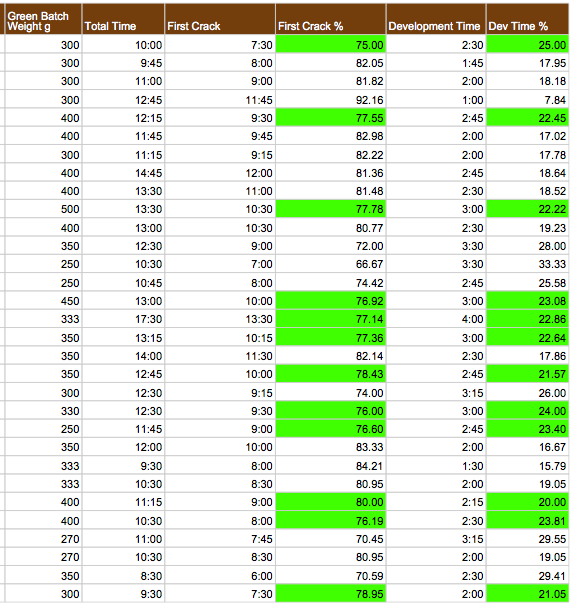
Given I have recorded sufficient data about my past roasts to assess the development-time ratio retrospectively, with the assistance of a spreadsheet, I proceeded to analyse 30 of my most recent roast batches. My initial thinking was along the lines of “these roasts will mostly fall within the 20–25% parameter”.

The result could not have been more different, and highlight the inherent flaw in assumption. Of those 30 roasts, only 11 fit Rao’s recommendation for a development-time ratio of 20–25% of total roast time (range 9.8 – 33.3%). Although the average was 21.6%, this is not particularly relevant when we are considering individual batches. A couple of things to point out here. One, I am an amateur remember! Secondly, further 17 batches were within a band of + or –5% (that is either 15–20% or 25–30%), and a number of these were pretty close to the 20 or 25% cut-off.

You will note from the data these figures are based on varying batch sizes, with considerable variation in overall roast time. As I roast outdoors with an open “drum”, I have found variation exists due to ambient temperature, time of day and the cumulative heat of the drum with successive roasts.

As expected, considerable variability in the cup was evident in relation to differing origin, processing method, roast level and brewing technique. Naturally, some were better than others, and I have not had the opportunity to compare the development-time ratio findings with my tasting notes on the particular coffees in this sample. I do not plan to spend a significant amount of time on this, as any valid results would rely on assessing the same coffee roasted in separate batches, standardising the variables from the previous paragraph. I doubt I have any current data fitting this criteria.

I have included a snapshot of the data below. As you can see, it contains both time of first crack as a percentage of total roast time, and development time as a percentage of total roast time. As I have noted above, there is no need to measure both, however for completeness I have included them here. Roasts falling within the criteria (by either measure) are shaded green.

Table 1: Development-time ratio (historical data).

Table 1: Development-time ratio (historical data).

Where to next?

There are probably a few answers to this question, the first being further reading, with Scott Rao’s The Coffee Roasters Companion high on my list. Although a good deal of the content may relate to far more sophisticated setups than mine, I find the science behind coffee roasting quite a fascinating topic. A review of the book can be found on James Hoffmann’s blog.

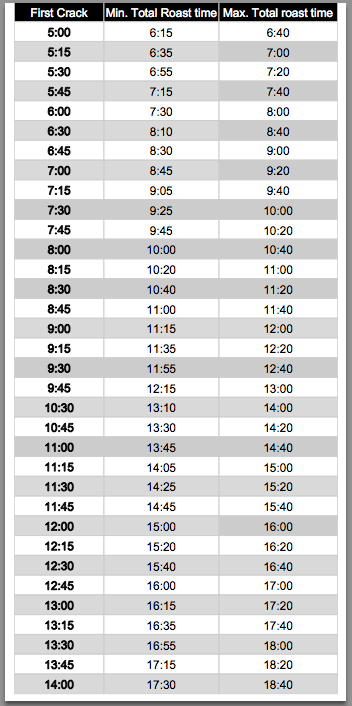
I thought I would also use the development-time ratio to standardise the total roast time in future batches, and determine whether this influences the overall quality of my roasting, and ultimately, drinking. Yet another spreadsheet here, this time to avoid the need for any complicated maths during the critical part of a roast (a printout of which is fixed firmly inside my roast record notebook).

The table below uses time to first crack (column 1), to produce the range of minimum (column 2), and maximum (column 3) roast times required to fall within Rao’s criteria for the ideal development-time ratio.

Screenshot 2014-09-07 21.03.35

Table 2: Total roast time guide based on time to first crack.

Finally, the weekend’s roast data utilising the above prediction chart (Table 2) to cease the roast based on desired development-time ratio:

RoastData_2

Table 3: Roast data from 6 September 2014 using Table 2 prediction chart.

Conclusion

Although this post is a little more lengthy than originally planned, the development-time ratio is a concept well worth exploring. In finding additional ways to assess, influence and standardise my roasting parameters, my skills in this area can only improve.

In the end, the proof will be in the cup, which I am looking forward to testing out.

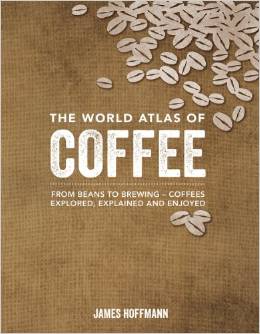
The World Atlas of Coffee – James Hoffmann

Upon first hearing of the upcoming release of this book by renowned barista and coffee mind James Hoffmann (Twitter), I immediately went to Amazon looking for an ‘eBook’ version, which, had one been available, I would most likely have purchased (or at least pre-ordered, as the title is published in October 2014) there and then.

WorldAtlasofCoffeeHowever the more I think about it, the more I realise a collection of electronic pages would not do the subject matter of The World Atlas of Coffee justice. Whilst it is not my intent to dismiss the eBook format, my point is simply this, coffee is such an organic and sensory product, I feel it would be a shame to read about it without holding a physical, hard copy of this book in your hands. I simply believe it would add to the reading (read, my) experience.

The content of the book? From Amazon:

Taking the reader on a global tour of coffee-growing countries, The World Atlas of Coffee presents the bean in full-color photographs and concise, informative text. It shows the origins of coffee – where it is grown, the people who grow it; and the cultures in which coffee is a way of life – and the world of consumption – processing, grades, the consumer and the modern culture of coffee.

I have mentioned on one or two occasions before that James Hoffmann’s blog is one I especially enjoy reading, noting I am the typical end consumer, with a viewpoint decidedly external to the industry itself. For that reason, I was particularly happy to read the following from Hoffmann himself referring to the content of the upcoming book:

More than both of this, I wanted to write something for all our customers – the people who go out and buy, brew, drink and enjoy coffee every day. I believe that understanding something more can make it more enjoyable, and I wanted to make more of coffee accessible rather than make it more mysterious and exclusive. I want to help people to understand what they like, explore what they don’t know yet, and feel more confident in the somewhat intimidating world of specialty coffee.

At the end of the day, is there anything better than a coffee table book about coffee? Why of course, a high quality coffee table book about coffee.

The Bean Brewding Walking Coffee Tour

A brisk August Saturday morning, with many Brisbane locals headed to the Ekka. My wife and I? Something much bigger. The date had finally rolled around for the Bean Brewding Walking Coffee Tour of Brisbane’s Fortitude Valley. Both my legs and palate were ready for a big morning ahead.

Background

Glenn, George and Ben of Bean Brewding describe their website as “the collaboration of three Brisbane coffee drinkers”. In addition to reviewing various independent coffee establishments (league table on the site), they also aim to “to promote the Brisbane coffee scene with quality, quirky and ethical establishments”.

I have been a regular reader of the blog and enthusiastic Twitter follower for some time now, and was keen to get on board with the latest coffee tour, after reading about the tours that had been run in the previous 2 years. I also find I tend to become ‘local’ to one or two establishments, and probably don’t visit and experience as many great coffee destinations around town as I should, and this was a chance to do just that, with a few other like-minded individuals.

What follows is not intended to be an in-depth rundown of the tour, however highlights what you might expect to experience should you decide to join the guys on one in the future.

The Coffee Tour

1. Bear Bones Espresso – Exploring coffee roasting

Tour assembly at Bear Bones Espresso

Tour assembly at Bear Bones Espresso

The first stop for a pre-tour pick me up and breakfast fuel-up was Bear Bones Espresso in McLachlan St Fortitude Valley (whom deserve a special thank you for opening on a Saturday just for the tour). A quick meet and greet from our guides, along with receipt of our tour “passports” and itinerary began the day smoothly. It was the responsibility of owner Trent and the Bear Bones team to educate these ‘tourists’ on the key principles of roasting the humble green bean.

A pre-tour chat and slideshow from their visit to Ethiopia also provided a fantastic background into the growing, harvesting, processing and buying which occurs in a typical coffee country at origin.

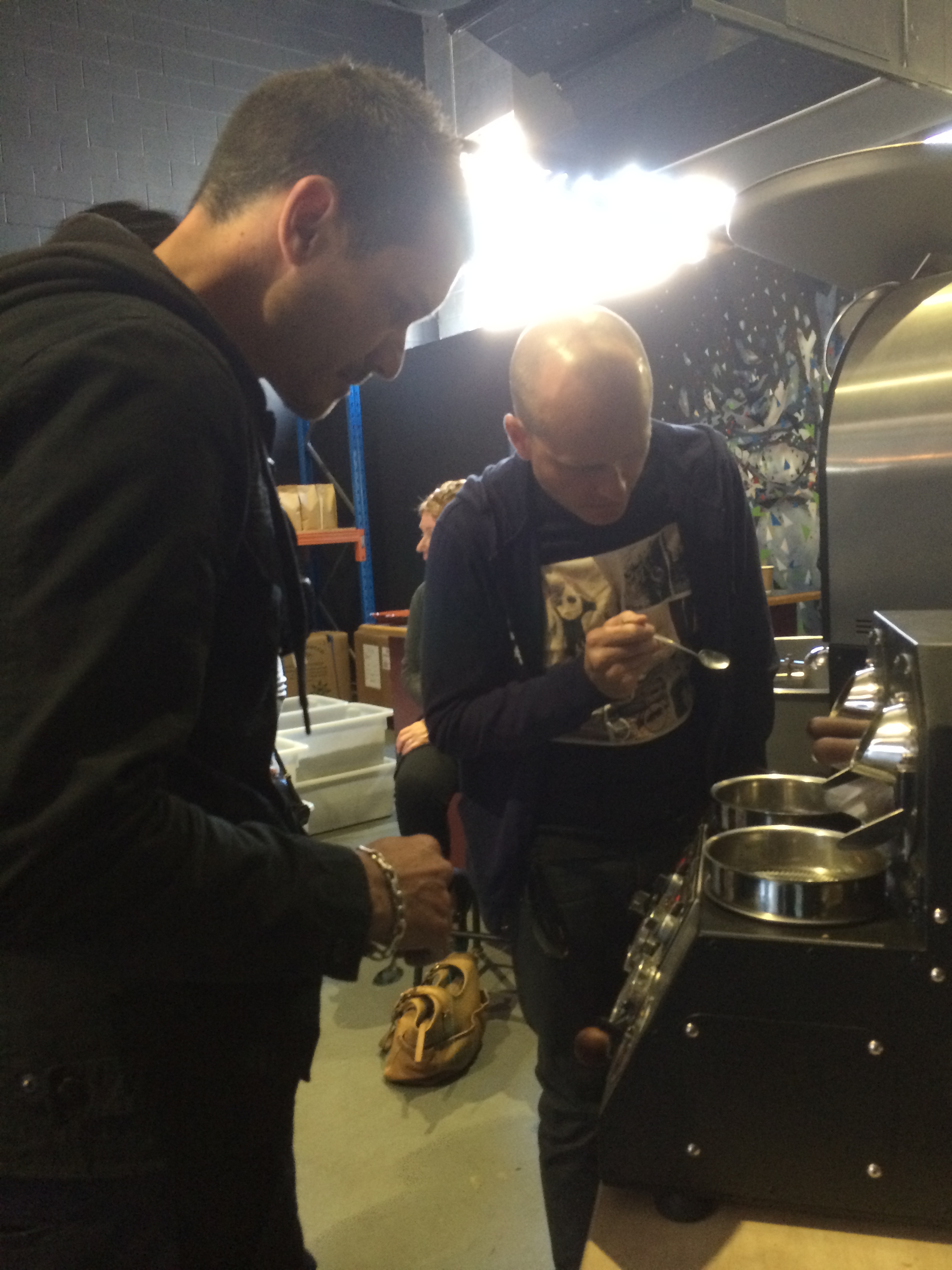
This was followed by a demonstration of a couple of roasts through the sample roaster on the premises, and I was grateful for the opportunity to put some green beans through myself. Somehow the whole process seemed a little more sophisticated than my breadmaker and heat gun roasting set up in the backyard at home.

It was great start to the tour, and also gave me some ideas for improving the roasting profiles I use at home, and introduced some concepts I had been unfamiliar with, for example the “double roast”, where the beans are pulled out early and cooled, before being reintroduced to the roaster to continue the process (the aim being to allow the outer surface of the bean to contract by cooling; locking in more of the flavour producing compounds). Interesting – though perhaps a little sophisticated for my skill level.

Roasting at Bear Bones Espresso

Roasting at Bear Bones Espresso

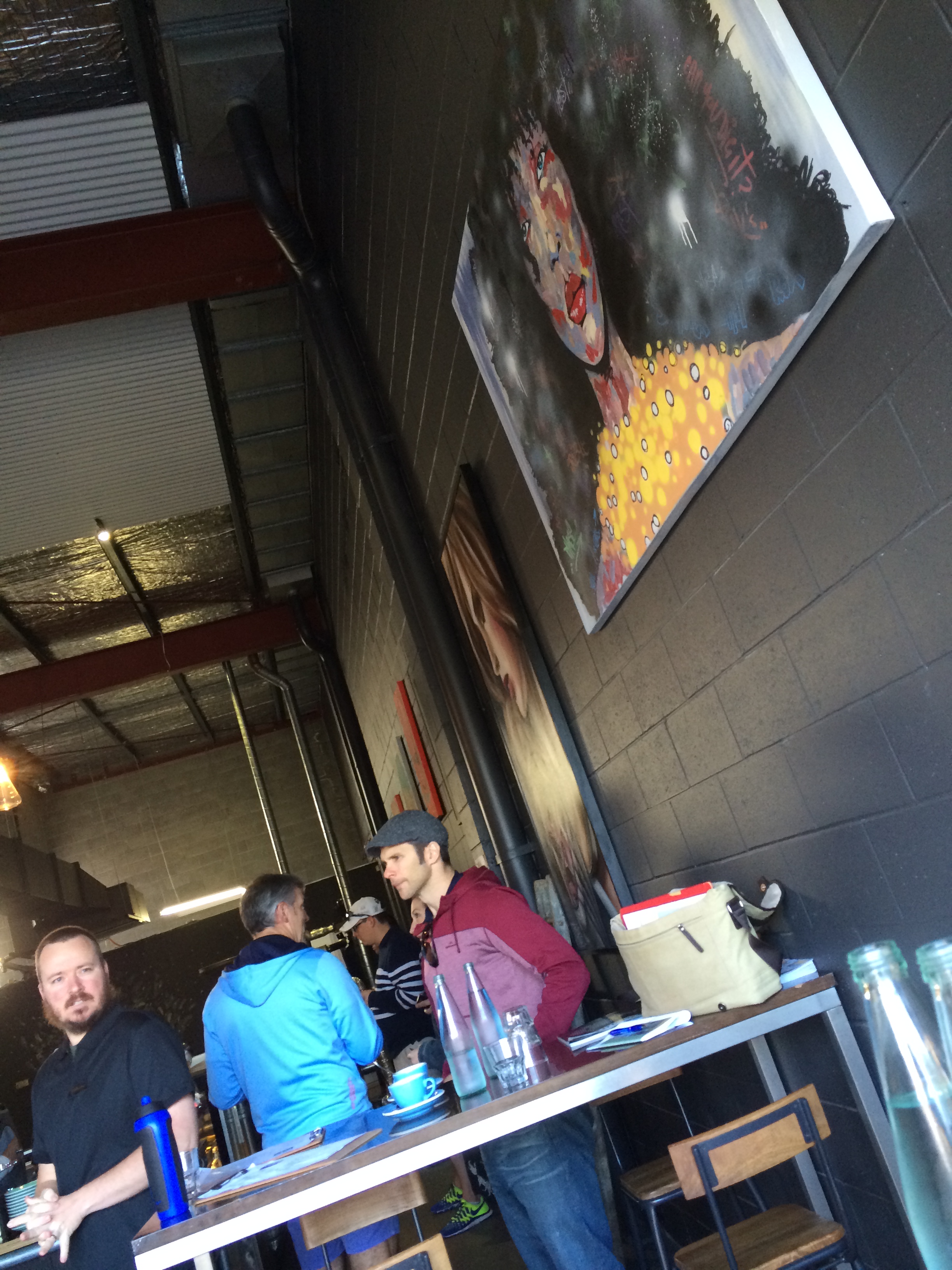
A few final words, bagging of the beans I had roasted to take home, a Bear Bones bag of coffee for each tour member, and we were on our way. A great way to start the tour, and if you are ever in the area, go and have a chat to the guys and have a look at the fantastic art on the walls while you’re there.

Bear Bones Espresso
2/66 McLachlan St
Fortitude Valley
Web: bearbones.com.au
Facebook: bearbonesespresso
Twitter: @bearbonesbris
Instagram: @bearbonesespresso

2. Bellissimo Coffee – The art of espresso based coffee

A leisurely few minutes of walking saw us arrive at the bustling Bellissimo Coffee in Wandoo St. Thankfully a dedicated space was set up to accommodate the tour so we did not disturb the regulars enjoying their Saturday morning cup or two.

Here we were provided with a background on the principles of making great espresso at home, a demonstration, and the chance to step up and give it a go ourselves. As both a manual brew drinker and user of a home based espresso machine for many years now, it was nice to hear most of the principles and techniques I follow are still considered best practice, and I can happily continue to work on improving my consistency at home.

Further discussion ensued around the merits of spending your hard-earned cash on home equipment, and on which specific aspects of a home set-up this should be spent on. Thankfully the conclusions were generally in line with the advice I often give when asked, which is, to save a bit of money on the machine to put towards a decent grinder. I am sure “grind on demand” is firmly etched into a holy tablet somewhere.

To finish we received an information sheet containing a 10% discount voucher for Bellissimo and a round of takeaway orders to keep us on schedule. We then sipped a beautiful creamy Bellissimo blend all the way to our next destination.

Bellissimo Coffee
30 Wandoo St
Fortitude Valley
Web: bellissimocoffee.com.au
Facebook: BellissimoRoast
Twitter: @BellissimoRoast
Instagram: @BellissimoRoast

3. Blue Sky Coffee – Alternate coffee brew methods

Next!

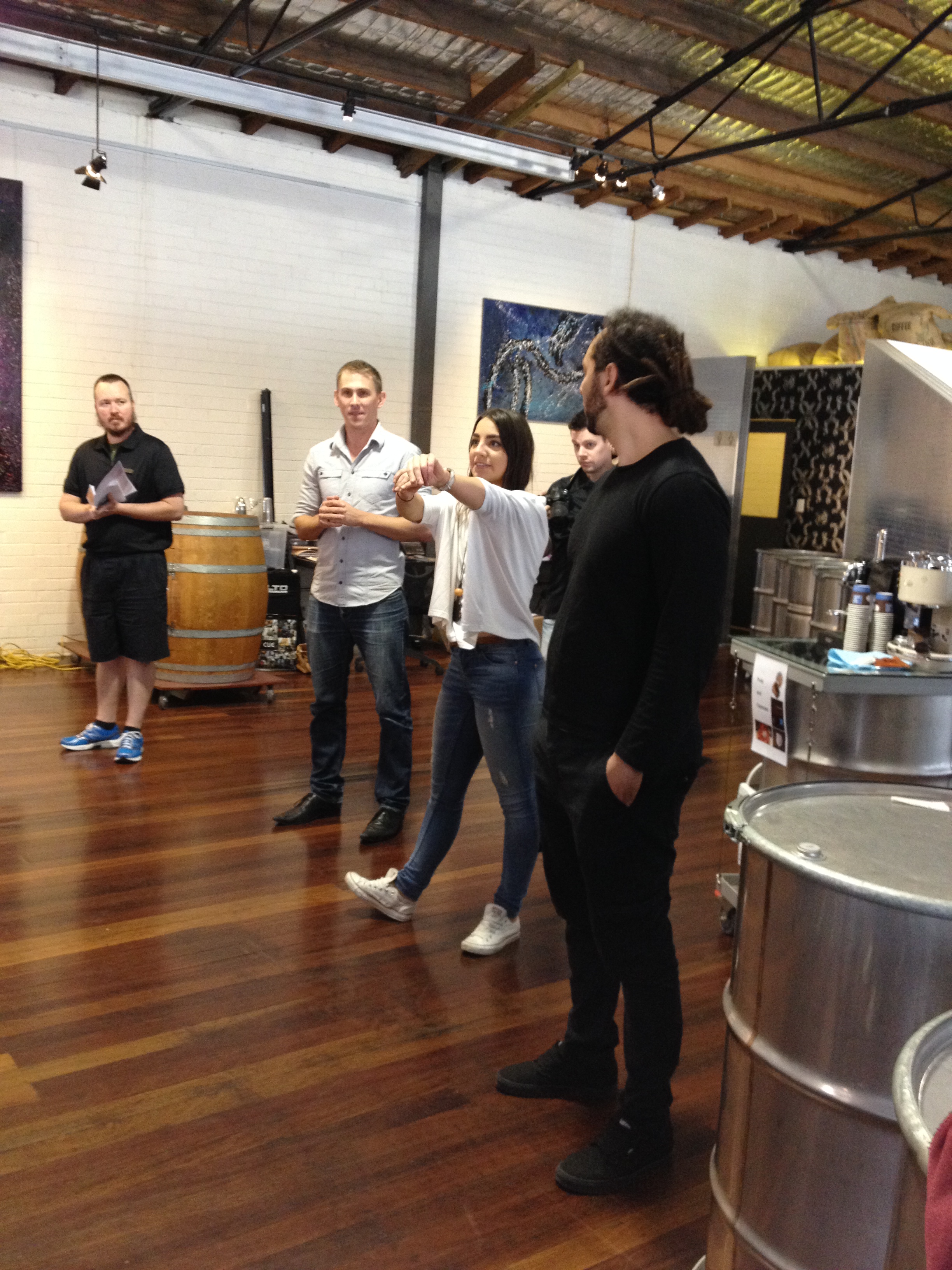
Blue Sky Coffee is certainly an impressive space, with a cafe fronting Commercial Rd, roastery at the rear, and enough space in between to set up some brewing stations for events of high importance such as coffee tours and the like. Danny and the Blue Sky team had three separate stations set up where we learned techniques, and sampled coffee brewed from the V60 Pourover, Espro Press, and Capsule/Pod machines.

As you can imagine, two of those three stations resulted in great brews, however you cannot dismiss the burgeoning capsule market, nor deny the merit in efforts by specialty roasters to provide alternatives to the current mass-produced capsules.

The Blue Sky Team

The Blue Sky Team

A favourite of mine was the V60 lesson, as the majority of my manual brewing at home is done with this device, and I am always keen to see how professionals brew using this technique. I generally never leave without managing to pick up a few hints, and this occasion was no different.

With a view to finishing the tour with a bang, I managed to discuss a few more details on brewing equipment with the staff, and purchased a set of Hario scales to enhance my home brewing endeavours. In addition, I downed an espresso made on a beautiful Ethiopian single origin, and picked up some Kenya Gattina beans to brew at home. All this, along with the $5.00 Blue Sky Credit given to each member of the touring party and some complimentary food, lead me to conclude I had done pretty well for the day.

Blue Sky Coffee
32 Commercial Rd
Newstead
Web: blueskycoffee.com.au
Facebook: BlueSkyCoffee
Twitter: @blueskycoffee
Instagram: @blueskycoffee

In Conclusion

What can I say? My wife and I had fantastic morning out with a bunch of like-minded coffee tragics/nerds/enthusiasts (however you would like to describe us), along with our friends from the Wired Owl Coffee Co. Yes, the tour was primarily about coffee, however to me, events like these are as much about support and appreciation as they are about learning and fun.

The three ‘beans’ of Bean Brewding all hold full-time jobs, and it is no mean feat to get something like this up and running, let alone have the day go so smoothly and run to time as planned. In addition to a great learning opportunity, I derive just as much satisfaction from being able to support small, independent operations, whether they are blogs, tours, writers, or podcasts, and have a mountain of Teespring shipping receipts that will attest to this.

The Bean Brewding guys have shown a great deal of commitment, organisation, effort, and ultimately courage to pull the trigger and say “the tour is on” – and hopefully then sell enough tickets required to make it a success. Believe me, it was the best $35.00 I have spent in some time. Congratulations guys, your effort is much appreciated.

The bonus here? An exploration into something I am just a little obsessed with; a local, easily accessible event; and a fantastic bunch of industry folk happy to get behind the tour, who generously gave up their time to provide something pretty unique, and are not only passionate about their craft, but extremely willing to educate those far less knowledgable than themselves. A big thank-you to all those from Bear Bones, Bellissimo and Blue Sky who made the day such a success.

Keep an eye on the Bean Brewding blog for upcoming events, particularly the Coffee Tour page, or follow Twitter or Instagram for snippets and great photos of their travels around the Brisbane coffee scene. Thankfully there are future tours planned, and should I have the opportunity for another, I hope to see you there.