Stirling Gooseneck Kettle — a middle aisle gem

Every journey has a destination…

An example of Aldi’s middle aisle at its finest. You know, a come for the barbecue sauce and leave with a cordless tyre inflator type of purchase. You’ve got to grab them while you can.

When an Aldi catalogue appears with some coffee items, as you can imagine, I’m likely to take a look when next in store. On this occasion, it was a special trip for one of the Stirling Gooseneck Kettles. Why? Well, first and foremost you can never be sure how popular any particular item might be, yet the remainder of the answer needs a little more explanation.

As an enthusiast (of anything), I’m sure we’d all agree the likelihood of owning (or at least having owned) quite a few iterations of similar products is quite high. Coming along before the subject Aldi kettle were stovetop versions of the Hario Buono Drip Kettle, followed by a Fellow Stagg Pour-Over Kettle. To date though, I had not yet had the pleasure of owning a dedicated electric, temperature controlled model to boil (or near boil as the presets allow…) and hold my water at temperature. Not specifically being in the market for a replacement, this had to be decidedly within the “non-significant purchase” price tag to comfortably be an incidental pickup.

Overall, I find kettles an interesting part of the whole coffee journey, as they of course all do the same thing. They heat water. It’s difficult to find any sort of perceptible way they each do that particular function differently. Sure — faster, quieter, stovetop, or electric — but the result is the same. It therefore becomes very difficult to justify a higher price tag. At $59.95? Justified. A week later, a little further down the aisle in the clearance section at $49.99 — even more so. A bargain indeed. At the time of publishing? Still there…

You’ve still got a shot if you’re quick

What it does well

Boils water. In fact, from a room temperate 24 degrees Celsius to 100 degrees boiling in 3 minutes and 20 seconds. I assume this is not the fastest by any stretch, however gets the job done. It certainly doesn’t feel slow. Though quieter than our larger, more traditional Russell Hobbs kettle, it is however perhaps a tad louder than my Stagg Stovetop. That said, I have no qualms about using it pre-dawn when the rest of the household are fast asleep.

It maintains the set temperature for up to an hour before automatically switching off. For someone who had not owned a kettle where the default setting is to stay “on” once boiled, this took a little getting used to, however now I cannot imagine it any other way.
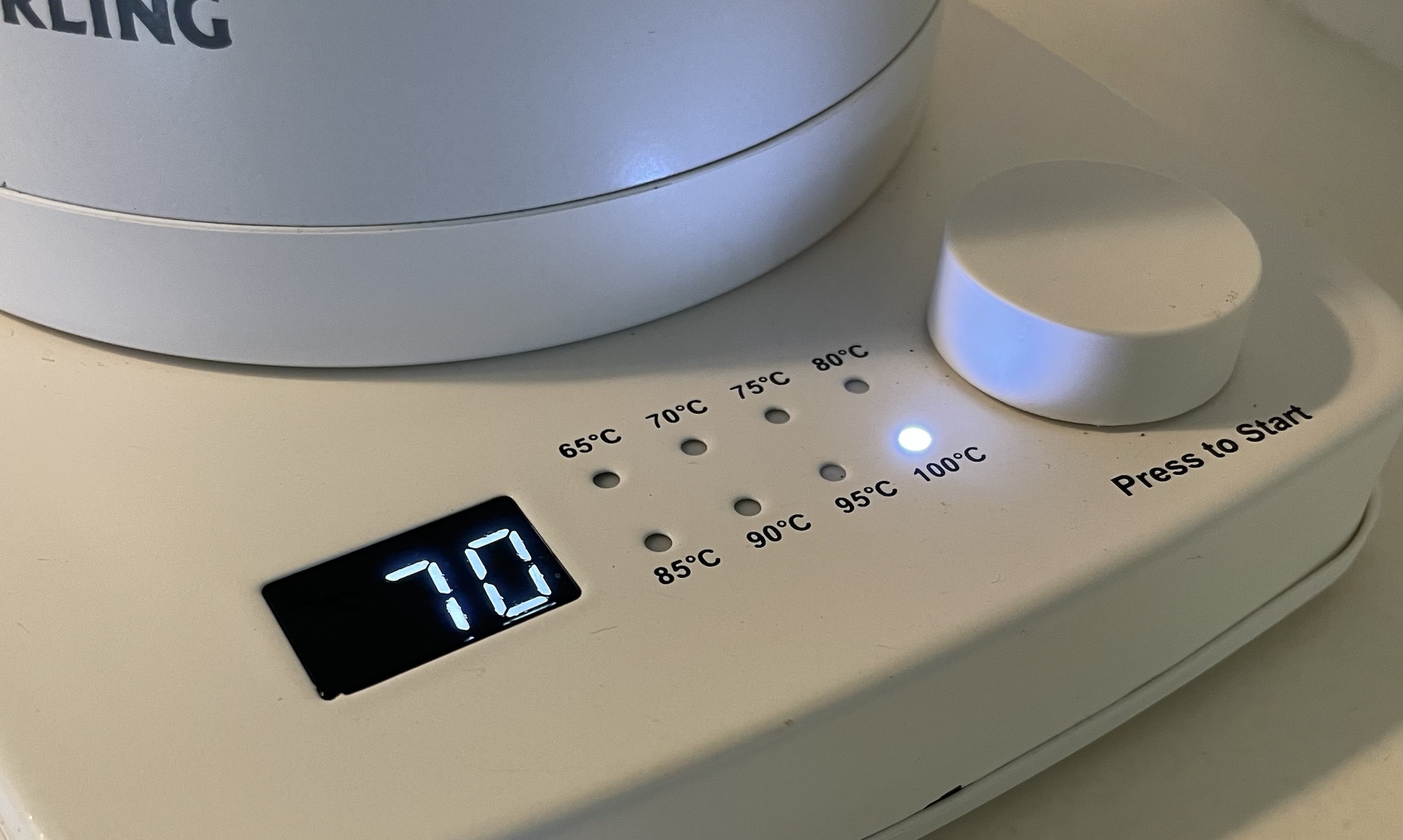
The presets aren’t infinite though certainly more than adequate

It looks similar to many other more expensive kettles. While purchased in my preferred coffee bar colour of matt white, a black version was also available. Once on the kitchen bench top, it has a similar shape and baseplate style as the Fellow EKG to a glancing eye.

So, while the specs are available for viewing in the attached images, I’m simply here to say it looks reasonably good and completes the task at hand perfectly. All for the princely sum of $59.99, compared with 4–5 times that for the Fellow Stagg EKG upon which it would appear to pay homage.

What could be improved

Certainly not the price — that’s the point here. You get what you pay for, and what you get is a great, functionally adept kettle. However in getting what you pay for, there certainly are compromises which I wouldn’t pay $100+ for, but $59.99? Absolutely worth it.

Build quality will always be a factor here, and it is evident. Generally, a cheaper version will feel as though it is just that. While that’s the case here, I’ve no issues with that affecting performance, you can simply feel it. The slight flex in the plastic handle when the kettle is full; the good but not great click of the on/off dial; the lighter weight lid and baseplate.

The only other areas I’d mention here are perhaps aesthetics, which are again pretty good, though not quite up to something like the Fellow Stagg, particularly when viewed side by side. That said, it isn’t far off. A couple of other considerations include the volume and pouring. Whilst no one in our household ever said: ”make a large pot of…” — at 600 ml it’s not the most efficient way to boil a large amount of water at once, whereas both the Hario and Stagg are 0.9–1.0 litre at maximum fill.

I’ve had a couple of instances of a slightly scalded foot from tipping the kettle a little too far and drips escaping the lid, though I’d emphasise this is most certainly in the category of user error. Come to think of it, so is overshooting the far edge of a cup a few times whilst becoming familiar with the angle of water exit when the kettle is particularly full.

Wrapping up

Is it the world’s best built kettle? No, but it’s solid enough. The best looking? Perhaps not, though it’s comparable to most others, and I’d say an improvement on some. Does it boil water and maintain it at temperature for up to an hour? Perfect, and arguably equal to any other kettle at any price point for what it does.

I make a daily V60 into my Fellow Carter mug to take to the office, and had long given up on bothering with my stove top Fellow Stagg Kettle. It was simply easier to boil our standard electric kettle and do my best to control the flow when pouring from a standard spout.

That has all changed now, and while the Aldi Stirling Gooseneck Kettle may not be the star of the bar (though it could be), for boiling water it’s perfect (well it is a kettle, you could rightly say…). Whether looks, build quality, or brand name carry much weight in your purchasing decisions is a matter for you to decide — I certainly wouldn’t disagree if they did. Heck, they do for me, and I’m delighted with this kettle given what I paid for it.

So if you are any way inclined to consider picking up one of these the next time they hit the middle aisle, you won’t be disappointed. Given I’m only a couple of months along, an opinion on long-term durability will have to wait, though for now, it’s perfect.

I will, however, continue to occasionally check in on Fellow’s “smoke green” Stagg EKG. Which incidentally (and perhaps somewhat tantalisingly…) I’ve also found on sale locally here.

Coffee equipment, where purchases quickly turn from the objective and rational, to the emotive and starry-eyed…

Happy brewing.

Optimising coffee brewing water and the Peak Water Kickstarter campaign

In a haphazard though never-ending quest for consistently better coffee quality at home, recently I have found myself tinkering with some brewing water recipes.

Why think about the water you brew with?

Whether espresso or filter brewing, if you think about what is actually occurring – water breaking down ground coffee particles, thereby extracting flavour compounds and solids from the coffee into the water you are about to drink – it makes sense that tweaking the water not only to provide an optimal extraction and also taste better makes a whole lot of sense.

The more you read and research, it is clear a more scientific approach is being taken to many aspects of brewing, and thankfully resources exist which help the consumer at home apply at least some of them to improve the standard of our coffee. One such resource being Barista Hustle, where you can find instructions and recipes for optimising brew water at very little cost.

Why would you want to do that? Well, for very little money (ultrapure or distilled water, sodium bicarbonate and epsom salts), you can test for yourself whether you notice any difference in your coffee from the water you are currently using. Let’s face it, delving further into the science around optimal coffee brewing can at times lead to the choice between either an expensive purchase or a dead-end for the home tragic who doesn’t carry an unlimited budget for such tweaks.

My advice? give the recipes a try, and experience for yourself the astonishing difference in flavour and cup quality that using tailored brewing water provides. Again, think about what is occurring during coffee extraction and the proportion of water in the final beverage in your cup. Believe me, it is definitely worth it – particularly when you go back to basic filtered water after running out of the supply you prepared earlier!

A timely Kickstarter campaign

Maintaining my water supply is precisely why I find the Peak Water Kickstarter project so compelling, and now eagerly await the day the jug arrives on my doorstep. As I mentioned above, using a recipe and making the water yourself isn’t overly complicated – keeping enough distilled or ultrapure water on hand sometimes can be. Water can be bulky to store and buy – filter discs not so, and I’m excited at the possibility of even more easily optimising the water I use for brewing at home.


From the project page:

At the heart of Peak Water is our innovative disc filter, combining precisely calculated flow dynamics with our new ‘filter maze’ system — ensuring that your water is completely treated, every time. The filter utilises highly specific ion-exchange resins to control and manipulate bicarbonate — the variable with the greatest impact on a coffee’s cup quality — while balancing the water’s ph level and retaining crucial minerals required for great brewing.

Check out the Kickstarter page for yourself, and as with any campaign, check the FAQ’s and comments as well, however I’m pretty confident in the product given the team behind it, and their history in looking at this aspect of coffee brewing.

I guess this post is part encouragement to experiment with the water you use to brew coffee with, and part suggestion to perhaps do so in the next few weeks before the Peak Water Kickstarter ends – just in case.


What’s Brewing: Indonesia Bunisora Honey Processed

Two of the more common taste characteristics I find with Indonesian coffee are those of floral and spice, and their cousins, earthy and herby. What was I expecting with the Bunisora? Much of the same I guess, which I have to say was pretty much spot on.

Whilst I am not suggesting this as a negative necessarily, at times the overall flavour profile was perhaps just a touch underwhelming in the cup.

The Region

Firstly, a little on coffee in Indonesia (from Wikipedia):

Indonesia is the worlds fourth largest producer of coffee, with the island origins micro climate well suited to growth and production. Just over half the production is consumed domestically.

In general, Indonesia’s arabica coffees have low acidity and strong body, which makes them ideal for blending with higher acidity coffees from Central America and East Africa.

The islands of The Sunda Region are divided up between four countries: Brunei, East Timor, Indonesia, and Malaysia, with much of the territory Indonesian.


Image courtesy Wikipedia

Image courtesy Wikipedia


A great article on Sprudge about Indonesian Coffee would be well worth reading for a little more understanding about the region and its coffee production and processing. From “Always An Exception”: Inside The Rising Tide of Indonesian Coffee:

Since Indonesia consists mostly of smallholder farms, change is bound to be gradual; but this isn’t stopping some producers from stepping up, changing quality, and differentiating themselves. With their continuing effort, we can expect to see more and more exciting coffees coming out of Indonesia.

The Coffee

Information courtesy of Ministry Grounds:

  • Region: Sunda
  • Producer: Small Holding Farmers
  • Varietals: Typica and Bourbon
  • Processing: Honey processed
  • Altitude: 1400m
  • Tasting notes: floral bouquets and sweet spices

This particular coffee from small holding farmers in the region of Sunda is named after an ancient Indonesian ruler Prabu Bunisora.

The Brew

The coffee was roasted as two separate batches, one for filter and one for espresso in my trusty backyard roasting setup.

The espresso roast came out pretty well, a lovely even roast if I do say so myself – I had high hopes for this one. The filter roast? That one got away from me just a little, and therefore ended up somewhat darker than intended. Never mind, it was never likely to go to waste.

With milk in my morning latte, the Bunisora produced a nice full-bodied cup, with notes of spice, cocoa and a hint of honey to the profile. As espresso, again, similar spices, however the floral notes were more pronounced with perhaps a hint of jasmine here? With milk or without, this coffee was big on body, which probably blunted the subtle flavours just a little.

Brewed using the V60 or Aeropress was perhaps a little surprising, as to be honest, some Indonesian coffees I have brewed in the past were more reminiscent of “earthy” as in “forest floor”. Here though, I had written in my notes: black tea (perhaps a little jasmine), floral, and to a lesser extent, earthy with a little chocolate (more so than the espresso roast).

I must admit however, during the couple of weeks I have been sampling this coffee, I began running my filter grind through a fine sieve prior to brewing. To say it transformed the brew is an understatement, however that is a post for another day.

The Finish

As any regular reader of these What’s Brewing posts will know, rarely do I complain about what I have consumed – and I am not about to start now.

The Indonesia Bunisora is a very enjoyable coffee, and what it perhaps lacks in subtlety, makes up for in body, and would also therefore make a solid blending partner with perhaps a fruitier Kenyan or Guatemalan single origin.

Overall, a very enjoyable coffee, and currently available at Ministry Grounds for $AU16.78 per kilogram.


ChefSteps Coffee Class

I created a ChefSteps login a little while ago, on the assumption I would find some coffee related goodness along the way. This just released offering, the ChefSteps Coffee Class, with world-renowned experts James Hoffmann (former World Barista Champion and founder of Square Mile Coffee) and Ben Kaminsky (US Cup Tasters Champion) looks the business.

For a very reasonable $US14.00, you can avail yourself of:

  • Unlimited Access
  • 12 HD Videos
  • Step-by-step techniques for the best French Press, Chemex, Aeropress, and Cold Brew coffee ever
  • Amazing tricks for smoother coffee
  • 4 recipes for cooking with coffee

Alternatively, you might like to start with the free Espresso Course (12 HD videos).

Either way, get watching – and thereafter – brewing!

What’s Brewing – Fifty K Christmas Blend

With another year having come and very almost gone, it was time to create the annual Christmas Festive Roast Blend for distribution to family and friends. Mind you, with things getting a little hectic towards the end of the year, the creation of this years blend was completed just a little close to the line.

Although not helped by a last-minute change to the composition of the specific coffees I’ve put together for this year, it was preferable to wait a little longer and produce something, which I feel, is a little more well-rounded and nicer in the cup. So without further ado, the details.

The Name

The finished product heading out the door.

The finished product heading out the door.

“What on earth is the Fifty-K reference in the name?” you would be well within your rights to ask. Although only the third time I have done this, the idea of putting together a festive Christmas blend with a specific name is based on two things.

First and foremost, given my own interest in roasting and brewing coffee, it is nice to give something to family and friends who take that little bit more care in how they brew theirs, whether through a home espresso machine, french press, Aeropress or other manual brewing methods.

Secondly, coming up with a name for the blend which reflects either the year I’ve had, other events of interest, or something which has perhaps captured my thoughts in the previous 12 months.

This year, as regular readers (and without a doubt my immediate, and very understanding family) will be well aware, November was a big month, swallowed up entirely by my participation in National Novel Writing Month, or NaNoWriMo. Managing to meet the 50,000 word deadline by the end of November certainly wasn’t easy, however I was pleased to get there, and finished with a small novel of just over 55,000 words by months end, along with the inspiration to name this years blend in honour of that very challenge.

So, without further ado, what makes up this years festive roast, and how does Fifty-K Blend taste in the cup?

The Coffee

As usual, the green beans were sourced from Ministry Grounds, with the plan to put together a blend worthy of the season, with berry, stone and dried fruits, along with nuts and honey the key components of this year’s tasting notes list.

IMG_3294

Green bean selection

IMG_3300

Roasted bean blend testing

Finalised on December 21 - just made it!

Finalised on December 21 – just made it!

Searching through the many single origin coffees on the Ministry Grounds site, after a false start with the Guatemala Las Illusiones (a fine coffee in its own right, however wasn’t quite right in the blend), the individual coffees below made the final cut, and make up Fifty-K Blend in equal one-third portions.

Ethiopia Sidamo Bulga

  • Region: Oromiya – Southern Bale Mountains
  • Area: Bulga
  • Variety: Various heirloom cultivars
  • Processing: Fully Washed

Rwanda Nyarusiza

  • Region: Nyamagabe district, Southern Province
  • City: Between Butare and Cyangugu
  • Altitude: 1,935 metres above sea level
  • Variety: Red Bourbon
  • Processing: Fully washed, sun-dried on African raised beds

El Salvador San Cayetano

  • Region: Ahuachapán, Apaneca Ilamatepec Mountain Range
  • Altitude: 1,500 metres above sea level
  • Variety: Bourbon
  • Processing: Honey processed and greenhouse dried

The Rwanda Nyarusiza returns, having been part of last year’s Keeper’s Blend, however the above combination is a departure from the red berry dominance of the 2013 blend.

Individual tasting notes and further background can be found on the Ministry Grounds website by clicking on the above links, however as far as the blend itself tastes, below is what I have found.

The Taste

A standout - the AeroPress

A standout – the AeroPress

When combined with milk in a flat white or latte, it is a lovely rich and creamy drink, with the dried fruits and honey at the forefront, and a mild, nutty aftertaste. Overall, the honey really carries through when consumed with milk. Perhaps it may have gained something from a little more “fruitiness”, however overall I think it works well to kick things off in a morning latte.

A little surprising to me was how well the blend suited the AeroPress, and had I not been running dangerously low on filters, would have consumed a lot more through this type of brew method. Whilst remaining rich and creamy with a lovely mouthfeel, the AeroPress really brings out the stone fruit and black tea flavours which hide a little in the milk based drinks. A pleasantly robust blend, which holds up really well in this form of brewing.

Upon brewing through the Hario V60 filter, the taste profile is similar in nature to that described above with the Aeropress, however I would not necessarily say it was any better, which is not what I usually find when comparing the two. As espresso (think green apple, a little honey again), well, you can’t please everyone, and let’s just say when consuming the Fifty-K black, a longer form of brewing is probably the best option, as it is probably a little too bright to be considered a really good espresso.

In Conclusion

With another year and another festive roast blend all but complete, perhaps it is time to reflect on the year gone by, and what might lay ahead for you in 2015. Or, as is the case with me, simply enjoying a few days off with family, the cricket and a some new toys to play with, courtesy of some thoughtful gift givers.

Thankfully, no one gave me a fountain pen for Christmas. As someone who does love a good fountain pen, why would I be thankful for this? Well, there are a few reasons, and tomorrow (29 December), you can read about what those are in a guest post I wrote for one of my favourite pen blogs, On Fountain Pens. The article is one in a series of 12, which began on Christmas Day, and I’d encourage you to head over and read them – it’s a great series of posts (and yes… if I do say so myself!).

I do hope you have had a Merry Christmas, thanks for stopping by, and best wishes for the coming year.