Wiser Web Wednesday

Wiser Web Wednesday – a weekly link to posts which piqued my interest from around the web:

Pens! Paper! Pencils!
Fancy a new stylus in the shape of a trusty Retro 51 style mini pen? Read about here and then win one in Ian Hedley’s giveaway:
Retro 51 Tornado Touch Ballpoint Review and Giveaway

The Pen Addict
Brad Dowdy takes a look at a blue-black ink from Pilot’s Iroshizuku line. A nice looking shade now on my shopping list:
Pilot Iroshizuku Shin-Kai Ink Review

The Newsprint
“Sign the paper like you give a damn”. Enough said:
Penmanship

Pen Paper Ink Letter
In an age of technology, and a generation seemingly growing up with nothing but, probably a fair question from Heath at PPIL:
The Ramble: Why Are There So Many Young Pen Bloggers?

Macworld
David Sparks of Macsparky fame, with a few tricks for managing your calendar just that little bit better:
Scheduling success: Four tech tricks for planning meetings

Leancrew
Dr Drang with a proposal for more meaningful dialogue about the role of and uses for the iPad:
Revisiting the iPad checklist

For the most part, the pens have it this week. Hope you enjoy some of the above.

In Use – Nock Co. Pen Cases

The guys at Nock Co. have certainly had their work cut out fulfilling the orders of over 2000 backers since the Kickstarter funding goal was reached at the end of October last year. As a backer of the “All the Cases” level (one of each case manufactured), my order was shipped towards the end of the process, however was well worth the wait.

For a little background, Nock Co. are Brad Dowdy from The Pen Addict blog and podcast, and Jeffrey Bruckwicki. From my original post last October about the project:

Brad has teamed up with Jeffrey Bruckwicki of Old Fourth Tailoring to design and manufacture pen cases (all hand-made in the USA), and in a nice touch, we see notebook case integration into some of the designs as well. The two appear to be a great fit (pardon the tailoring pun), and have created some fantastic designs which you really should check out for yourself, as any attempt at describing the products to you in words will not do the cases justice.

After posting one final update in late October on the progress of the Kickstarter funding drive, it was a case of waiting patiently for the goods to arrive.

NockCo_LabelUpon receiving the cases (seven in total) last week, I immediately filled The Brasstown, a zippered case with a six pen internal “tongue” rollout which emerges from the centre of the case; The Maryapple, a bifold notebook case, and both Chimneytop cases (more of a traditional type pen/pencil case shape).

As far as the construction and materials are concerned, these are high quality cases, made with 1000D nylon, lined with pack cloth (unless otherwise stated) to provide a nice protective housing for those precious pens, the closures finished with YKK zippers. The design of the cases and materials used ensure each keep their shape, yet are pliable enough to be tucked into the corner of a bag or backpack with no problems.

There is no question they are built to last and to be used – not sit on a shelf or in a drawer. These are your favourite denim jeans, not a tuxedo to be kept for special occasions. This is freedom for the pens you might otherwise have to leave at home – get out and use them.

How have the cases themselves performed? Pretty well so far.

The Brasstown

Probably my favourite case of the lot. Design genius, catering for up to six pens, each within their own pocket, in an internal pen roll. There is also room for pens, pencils, spare inks, erasers etc in “general population” within the main barrel of the case. It is nice and compact when closed, however unfurls to provide a nice open display of the six pens in the rollout section. For me? This case provides both protection for any pens I would prefer not to have banging around together, however is equally useful to house whichever pens are in high rotation at the time, providing easy organisation and convenient access, ensuring I never have to dig around looking for a specific pen.
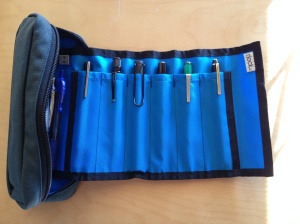
The Brasstown

The Brasstown (above and right)

NockCo_Brasstown_2

The centre roll accommodates all pen sizes, with the shorter and clipless Kaweco Sport disappearing down inside its pocket, however is easily extracted by simply sliding my thumb up the front material of the pocket and popping it out the top. All other clipped pens will simply sit securely in the pockets suspended by their clips in the usual manner. I can see this being my most used case, as it is the simplest way to carry my pens to and from work, knowing I have the six in the roll, along with any others (currently a further six disposable gel ink/rollerballs and a USB stick) in the main barrel of the case. As you can see from the image, my colour of choice was the Steel Exterior/Blue Jay interior combination.

The Maryapple

The Maryapple - interior

The Maryapple – interior

The bifold notebook case that is the Maryapple was also put to immediate use, given my usual practice of carrying two Field Notes notebooks along with the pens in my messenger style bag to and from the office. Why protect a Field Notes notebook? Are they not meant to be bruised and battered, showing the scars of heavy use, and then retired once full? Absolutely, and for myself, this will continue to be the case when carrying one in my pocket, however more often than not they are in my bag whilst commuting, and this is a great way of keeping them together.

Why two? One is used as a general catch-all for notes, ideas and numbers etc. The other is my coffee notebook, containing my roasting and tasting notes, along with any other coffee related information (blog post ideas, beans to try etc). Although my roasting is obviously all done at home, a good deal of tasting is done when out and about, or through my Aeropress brewing which occurs at the office.

The Maryapple - exterior

The Maryapple – exterior

Although two notebooks is generally my limit, this case would comfortably hold four Field Notes sized (approximately 9x13cm) books (two each side), or a couple of notebooks on one side, and a few pens in the other.

I made a similarly conservative colour choice here, going with the Midnight Exterior/Foliage Interior.

The Chimneytop(s)
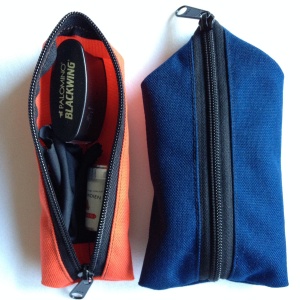
The Chimneytop mini (L) and standard (R)

The Chimneytop mini (L) and standard (R)

These pop-up cases are my everything else cases, with the orange mini containing my Palomino pencil sharpener, a J. Herbin ink cartridge tin containing a selection of cartridges, and a screen cleaning cloth should my phone or iPad mini require it. I love the size of the mini, as it sits in my bag taking up essentially no room, however I can be sure of where those bits and pieces are should they be required.

The standard size Chimneytop currently houses my master store of ink cartridges, which, although sitting in my desk drawer, is a nice way of keeping them together.

Both Chimneytop cases are unlined, which to me is not a problem, for if they were to be used for pens, they would be those pens you would be happy to have all in together, and if this were acceptable, I don’t believe the lack of lining would be a concern.

Conclusion

Whichever way you look at them, Nock Co. cases are high quality, highly functional products that fit a specific niche in the market perfectly. I have often looked at other pen cases, however never really found anything to suit. More rigid leather pen holders seemed a little over the top, whereas the Nock Co. products provide a level of protection and functionality that I believe are unsurpassed, and they look pretty good too (though I acknowledge opinion on the aesthetics of such products is a highly subjective matter).

I am certainly spoiled for choice, having received one of each case manufactured, and believe me, they will all be put to good use. The remaining cases? Most likely to be filled as my pen collection grows, and of course backing the All Cases level was simply an investment in the future scale of both my pens and their cases – very wise!

I’d highly recommend considering these cases if you or your pen collection desire (or need) them. With the Nock Co. online store yet to open (sign up to be notified when that occurs here), there will be a short wait, however as I can attest – it will be worth it, and your pens will thank you.


Wiser Web Wednesday

Wiser Web Wednesday – a weekly link post of articles or sites of interest to me from around the web:

Jim Seven
A view from James Hoffmann, well qualified to comment on what it takes to progress within the coffee industry. Arguably these principles are not unique to coffee:
How To Progress in the Coffee Industry

Dymaxion
A response to the above post with some equally well qualified additional thoughts:
A Response and a Contribution to James’ Post on How to Progress in Coffee

Pens! Paper! Pencils!
Ian Hedley reviews the darkest of the Blackwing pencil trilogy, and demonstrates a pretty fine sketching hand in the process:
Palomino Blackwing pencil review

The Cramped
If you are at all interested in the analogue writing world, Patrick Rhone’s latest venture is the site for you. This particular post by Harry Marks I can relate to. Given my keen interest pens, I often feel an unruly scrawl does not do them justice:
My Journey to Better Penmanship

Ed Jelley
As noted in this post, although designed to assist with the age-old flash card method of learning, there are many more possibilities for these cards, not the least of which to create a written index of fountain pen ink. An idea originally pilfered from The Pen Addict, (link within the review):
Maruman Mnemosyne Word Cards Review

Apple Talk
Benny Ling, a guest on this weeks Reckoner podcast, outlined his new project – a site for all things Apple, to include opinion pieces, forums, reviews and how to’s; here it is, and it looks pretty slick (and, like Reckoner, is a local Aussie site to boot):
Welcome to Apple Talk

Coffee Cupping – a new experience

As someone with a keen interest in coffee not working in the industry, it can be difficult at times to know exactly what information to seek out and where to find it, when looking to further develop my knowledge and understanding of methods and techniques to obtain the best results from my home roasting and brewing. Passionate baristas and café owners are always willing to chat, however understandably only have limited time when working in busy establishments.

Coffee Cupping at Strauss

Oliver Strauss (L) and Josh Russell

Oliver Strauss (L) and Josh Russell

Although learning the coffee “cupping” process has been on my to-do list for some time, to date it hadn’t been ticked off. So when my ‘local’ cafe/bar, Strauss launched their consumer nights recently, I jumped at the chance to put my name down for the coffee cupping. Not experienced in the intricate nature of such techniques, I was hoping for a little assistance in this regard.

There was certainly no need for concern, with the evening expertly run by Josh Russell, of local Brisbane speciality roaster Cup Coffee, who supply the Strauss House Blend along with an ongoing rotation of featured single origin coffees served through the espresso machine or by filter, with roast profiles to match.

Tools and techniques

We were given an introduction into cupping techniques and tools (cupping bowls for the coffee; spoons for the slurp; take away cups for the spit). Firstly, the dry aroma, then breaking the crust and taking in the wet aroma, and finally onto the tasting. On offer were five different single origin coffees from South America, Central America and Africa, showcasing a diverse range of flavour profiles, which no doubt assisted our amateur palates in detecting some of the differences between each. Three of the five were familiar to me, having been served at Strauss in the recent past, however of particular interest was the difference between the flavour profiles when cupped, compared with brewing through filter or espresso based techniques. Some being similar, another very, very different. A final couple of runs along the cupping table to sample the changing flavour profiles as the brews cooled rounded off a very enjoyable evening.

What did I learn?

With an educational component to the evening, and participants recording tasting notes and encouraged to discuss our (somewhat limited) findings, this initial foray into the cupping process proved a valuable one. It has given me a better understanding of flavours, profiles (well-balanced vs higher acidity; different finishes), and how various descriptors apply to what I am tasting. The techniques? Well that will take further practice, however let us just say for this first event, I was pleased all the slurping and spitting didn’t simply coat me in what I was trying to taste, which going into this was a very real possibility.

The most important things I took away? Probably the confirmation (which was expected) that despite continuing to learn more and more about this coffee caper, there is still far more I do not know, which only makes the process that much more enjoyable. Secondly, events like this, while a little daunting at first, when run well by those passionate about their craft, pique my interest even more, pretty much guaranteeing my attendance at similar events in the future – this was one such occasion.

Information and links

A highly informative and enjoyable evening, and if you get the chance to attend one of these events, I highly recommend it. For information on any upcoming events, keep an eye out on the Strauss Twitter and Instagram feeds.

Finally, as coffee cupping is a standardised process, the links below explain the specifics in more detail (a quick Google search will provide many more):

What’s Brewing #11 – Costa Rica Terra Bella

Terra Bella LatteIt has been a little while since the last What’s Brewing post, however back we are today, having roasted another batch of Costa Rica Terra Bella (Honey) last weekend. Having picked up a kilo of this coffee from Ministry Grounds a few weeks ago, this was my second roast batch, which seemed to do a better job at bringing out the flavours than the first attempt.

On with the review:

What
Costa Rica Terra Bella Villa Sarchi
– Altitude: 1450–1500m
– Crop Year: 2013
– Varietal: Villa Sarchi
– Processing: Honey

 Terra Bella Estate is located in the West Valley region of Costa Rica, about 35km west of the capital city of San Jose. This is one of the most classic coffee regions of Costa Rica and the one with the highest coffee production in the country nowadays. The reason for this is the excellent conditions to produce coffee that are prevalent here: deep, rich volcanic soils, high altitudes, moderate and well-distributed rainfall, cool temperatures, etc.

Information courtesy Ministry Grounds via The MTC Group

A little more on the Honey processing method, courtesy of The Coffee Review:

“Honey” is a relatively new term describing coffee that has been dried with all or some of the sticky fruit pulp or “honey” (miel in Spanish) still adhering to the bean. Those familiar with coffee processing methods will, of course, recognize this practice as a kind of compromise between two more familiar processing methods: the dry or “natural” method, in which the beans are dried while entirely encased inside the fruit, and the wet or “washed” method, in which all of the soft fruit residue, both skin and pulp, are scrubbed off before the coffee is dried.

How
Latte, V60 Filter, Aeropress, Espresso

Assessment
Through milk in a latte or flat white, this coffee performed extremely well and resulted in a creamy, sweet brew with subtle apple and caramel flavours. When brewed as an espresso, I couldn’t help but think perhaps I should have let the roast run a little darker, as the acidity overpowered things a little. Not undrinkable by any stretch, however not quite as pleasant as some of the other varieties I’ve roasted and tried recently.

Which brings us to the V60 filter and Aeropress methods, which seemed well suited to both the coffee and the roast profile, producing a very well-balanced cup from either method. The V60 probably outshines the Aeropress slightly, with a cleaner, brighter cup, again containing sweet apple and a caramelly, honey like layer, with a nice long finish.

Conclusion; Know This
I really enjoyed the Costa Rica Terra Bella, with my preference being either as a milk drink, or on its own through the V60. As I mentioned above, this was my second roast batch, and definitely an improvement on the first. Looking back through my notes, the second time around was a slightly larger batch (450g vs 300g), which probably slowed the roast down a little, although I used the same heat ramp profile. In any event, if you get the chance to try this coffee, you certainly won’t be disappointed.

Rating: 3.75/5