A trip to a foreign city? What an opportunity to get out and explore as much as you possibly can, the sights, sounds, and culture. As the recent post on my stationery adventures in Japan suggests, we certainly did get around and explore.
I’m a somewhat routine oriented person, which can itself cause certain limitations, however also has the ability to bring untold joy and contentment, over and over again. Life often becomes a constant search for the next thing — whether that be doom-scrolling, the next great pen, even a perfect espresso. Always the search. Contentment? That’s another world, and one which definitely exists on a higher plane.
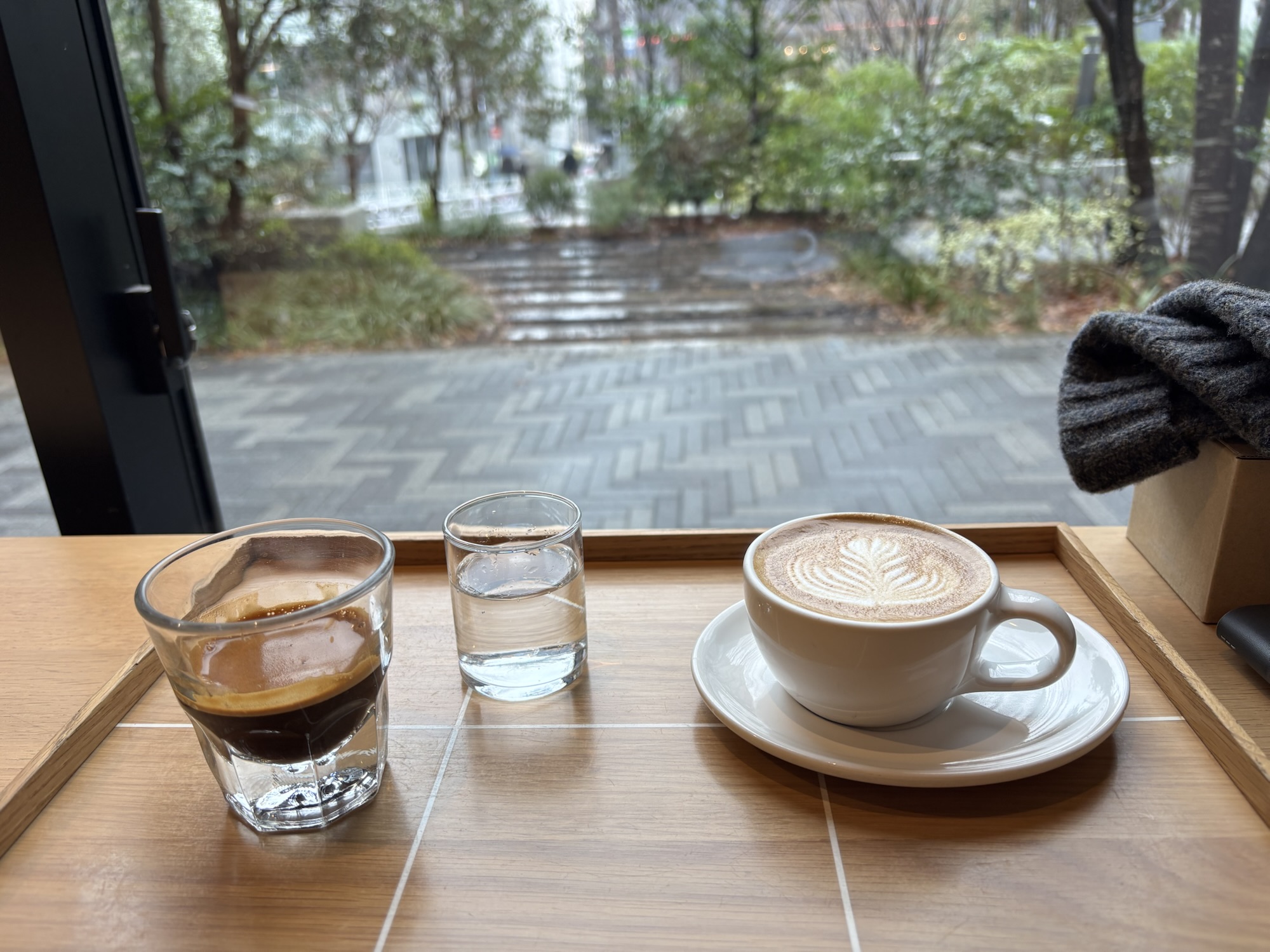
Visiting another country is not the first thing on a list of “how to be quietly content”, with exploration and new experiences inherent to the very act of visiting a foreign city. Nevertheless, during our recent trip to Tokyo I found myself returning each morning to the same café, sitting quietly and considering the day ahead.
Located about a three-minute walk from our hotel, Blue Bottle in Shibuya would probably not be your idea of immersing yourself in the traditional culture, given its typical Blue Bottle menu.
A counterpoint which I’d most likely make though: the attention to detail, architectural aesthetic, and wonderful staff are quintessentially Japan, granted, without perhaps the deep tradition. Though if you look, it is present in touches.We have over four thousand photos from the 11-day trip in our shared iCloud photo album. A way to mark the start of each day? My coffee photo of the morning from Blue Bottle. As I retrospectively fill out the travel journal of the trip, I can confidently scroll to the next tabletop coffee photo and begin the days’ review.
None of this is about Blue Bottle, Shibuya, a trip to Japan, or even the coffee — great as it all was. It’s the fact that for a brief moment, you are a local, going about your daily routine with an untold level of joy, spirit, optimism, and excitement about what the day exploring will bring. In reality, that is of course pure fantasy, with a vacation removing the daily grind of your working existence, something those kind souls walking by each morning on their way to work knew all too well.
For that small snapshot in time, though? I’ll consider myself a local, and fondly recall everything about my days spent walking to this calm, majestic space. Content to the very last sip.
An example of Aldi’s middle aisle at its finest. You know, a come for the barbecue sauce and leave with a cordless tyre inflator type of purchase. You’ve got to grab them while you can.
When an Aldi catalogue appears with some coffee items, as you can imagine, I’m likely to take a look when next in store. On this occasion, it was a special trip for one of the Stirling Gooseneck Kettles. Why? Well, first and foremost you can never be sure how popular any particular item might be, yet the remainder of the answer needs a little more explanation.
As an enthusiast (of anything), I’m sure we’d all agree the likelihood of owning (or at least having owned) quite a few iterations of similar products is quite high. Coming along before the subject Aldi kettle were stovetop versions of the Hario Buono Drip Kettle, followed by a Fellow Stagg Pour-Over Kettle. To date though, I had not yet had the pleasure of owning a dedicated electric, temperature controlled model to boil (or near boil as the presets allow…) and hold my water at temperature. Not specifically being in the market for a replacement, this had to be decidedly within the “non-significant purchase” price tag to comfortably be an incidental pickup.
Overall, I find kettles an interesting part of the whole coffee journey, as they of course all do the same thing. They heat water. It’s difficult to find any sort of perceptible way they each do that particular function differently. Sure — faster, quieter, stovetop, or electric — but the result is the same. It therefore becomes very difficult to justify a higher price tag. At $59.95? Justified. A week later, a little further down the aisle in the clearance section at $49.99 — even more so. A bargain indeed. At the time of publishing? Still there…
You’ve still got a shot if you’re quick
What it does well
Boils water. In fact, from a room temperate 24 degrees Celsius to 100 degrees boiling in 3 minutes and 20 seconds. I assume this is not the fastest by any stretch, however gets the job done. It certainly doesn’t feel slow. Though quieter than our larger, more traditional Russell Hobbs kettle, it is however perhaps a tad louder than my Stagg Stovetop. That said, I have no qualms about using it pre-dawn when the rest of the household are fast asleep.
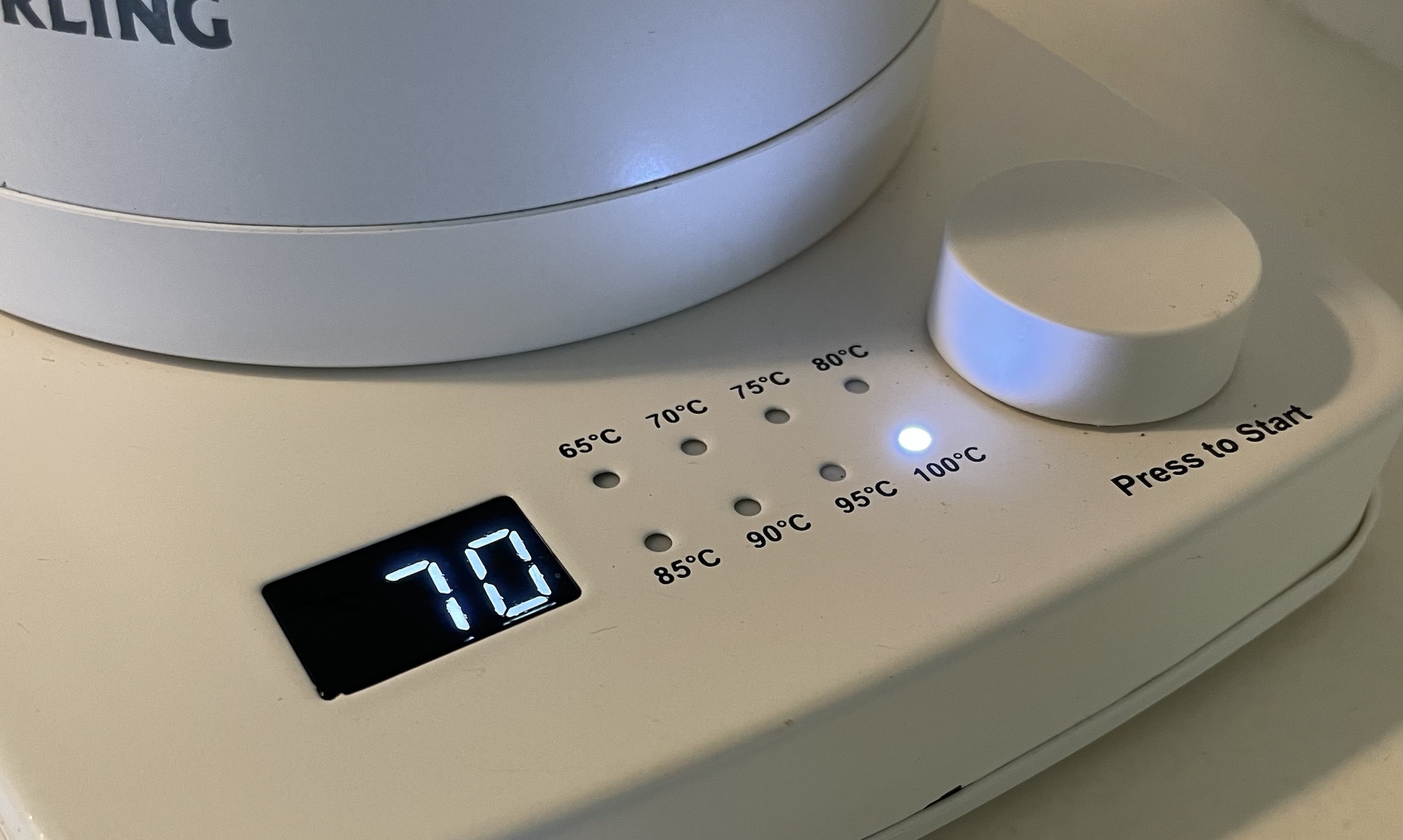
It maintains the set temperature for up to an hour before automatically switching off. For someone who had not owned a kettle where the default setting is to stay “on” once boiled, this took a little getting used to, however now I cannot imagine it any other way.
The presets aren’t infinitethough certainly more than adequate
It looks similar to many other more expensive kettles. While purchased in my preferred coffee bar colour of matt white, a black version was also available. Once on the kitchen bench top, it has a similar shape and baseplate style as the Fellow EKG to a glancing eye.
So, while the specs are available for viewing in the attached images, I’m simply here to say it looks reasonably good and completes the task at hand perfectly. All for the princely sum of $59.99, compared with 4–5 times that for the Fellow Stagg EKG upon which it would appear to pay homage.
What could be improved
Certainly not the price — that’s the point here. You get what you pay for, and what you get is a great, functionally adept kettle. However in getting what you pay for, there certainly are compromises which I wouldn’t pay $100+ for, but $59.99? Absolutely worth it.
Build quality will always be a factor here, and it is evident. Generally, a cheaper version will feel as though it is just that. While that’s the case here, I’ve no issues with that affecting performance, you can simply feel it. The slight flex in the plastic handle when the kettle is full; the good but not great click of the on/off dial; the lighter weight lid and baseplate.
The only other areas I’d mention here are perhaps aesthetics, which are again pretty good, though not quite up to something like the Fellow Stagg, particularly when viewed side by side. That said, it isn’t far off. A couple of other considerations include the volume and pouring. Whilst no one in our household ever said: ”make a large pot of…” — at 600 ml it’s not the most efficient way to boil a large amount of water at once, whereas both the Hario and Stagg are 0.9–1.0 litre at maximum fill.
I’ve had a couple of instances of a slightly scalded foot from tipping the kettle a little too far and drips escaping the lid, though I’d emphasise this is most certainly in the category of user error. Come to think of it, so is overshooting the far edge of a cup a few times whilst becoming familiar with the angle of water exit when the kettle is particularly full.
Wrapping up
Is it the world’s best built kettle? No, but it’s solid enough. The best looking? Perhaps not, though it’s comparable to most others, and I’d say an improvement on some. Does it boil water and maintain it at temperature for up to an hour? Perfect, and arguably equal to any other kettle at any price point for what it does.
I make a daily V60 into my Fellow Carter mug to take to the office, and had long given up on bothering with my stove top Fellow Stagg Kettle. It was simply easier to boil our standard electric kettle and do my best to control the flow when pouring from a standard spout.
That has all changed now, and while the Aldi Stirling Gooseneck Kettle may not be the star of the bar (though it could be), for boiling water it’s perfect (well it is a kettle, you could rightly say…). Whether looks, build quality, or brand name carry much weight in your purchasing decisions is a matter for you to decide — I certainly wouldn’t disagree if they did. Heck, they do for me, and I’m delighted with this kettle given what I paid for it.
So if you are any way inclined to consider picking up one of these the next time they hit the middle aisle, you won’t be disappointed. Given I’m only a couple of months along, an opinion on long-term durability will have to wait, though for now, it’s perfect.
I will, however, continue to occasionally check in on Fellow’s “smoke green” Stagg EKG. Which incidentally (and perhaps somewhat tantalisingly…) I’ve also found on sale locally here.
Coffee equipment, where purchases quickly turn from the objective and rational, to the emotive and starry-eyed…
The decaf drinker to me is the top-tier coffee drinker. They are the purest of all coffee drinkers because they’re just drinking it for the taste. They just like the taste of coffee, and they’re willing to drink decaf — disappointing decaf, often, to get there, and that feels very sad.
I must admit I’ve never really understood why decaf coffee, and by association, decaf coffee drinkers draw so much derision in the coffee community. You know, the whole death before decaf mantra. I’ve never found it amusing, nor understood what you’re trying to tell me.
Is it that you aren’t talented enough to source great decaf, roast it well (it can be challenging), or perhaps don’t really understand the nuances around brewing and serving it? Or, most fundamentally — you don’t understand the customer.
Look it’s ok. We often fear what we don’t understand.
The top-tier coffee drinker in my life? My wife, whom, until we met, was not a coffee drinker at all (what a surprise…). She did, however, push through many of the annoying effects of caffeine for some time before choosing to switch to decaf. Yes, I agree — top-tier wife.
Since that time many years ago, together we have seen most of, if not all of it. The pre-ground supermarket bag of decaf pulled from a cupboard and tipped into the portafilter. Being told in various ways (often politely, though not always) why decaf is not served at a particular establishment, including a bizarre mansplained monologue to my wife and daughter on why the style of roast is the issue — not the caffeine. Standing outside those “destination” cafés I’ve always wanted to visit, with my wife saying, “I don’t think we ask if they have decaf — I don’t want to embarrass you.”
How did it come to this…
Don’t get me wrong. We’re more than happy to be politely told decaf is not served and offered options (as you would for alternative milks, for example). It isn’t necessary, however, to go further and provide a diatribe on why you, as the consumer, are somehow too naive to know what is best for you.
Anyway, enough of that. A salute to all the cafés out there who serve a fantastic decaf. Seeing that measured dose thrown into an EK43? Perfect. A dedicated grinder? Wonderful — thanks for the acknowledgement. Taking up the challenge to serve something truly amazing when it can be a little more challenging? Hats off to you for having belief in your expertise. I’m sure there are more than a couple of us who appreciate you taking the time and making the effort. We’ll certainly be back.
Incidentally — the YouTube video I’ve linked to above provides a great overview of the various methods of producing decaf coffee and is worth a look if you are interested.
Finally, here’s to all the top-tier coffee drinkers out there, my door is always open, where the decaf doses are measured, ready, and ground on demand.
Alternatively, try some of my Brisbane favourites if you want service with a smile, minus the caffeine:
There is always a periodic “refresh” in just about every hobby or passion you could turn your mind to. Every so often I think we rationalise to ourselves that the “things” are outdated or not functioning as they once did and we somehow need new ones.
The reality is more akin to the purchases being small enough to justify a reasonable cadence of replacement, but at the end of the day, satisfying the need for something new. Plain and simple, we want them. “New” is not necessarily essential to keep things ticking along, however will it bring significant enjoyment? Absolutely yes. Further, will it result in incremental improvement? Perhaps. Sometimes we’re just after new — sometimes better as well.
For your tech, it might be new apps. Your pens? Well, a new refill or ink never goes astray. Whatever you might be into, the “accessories” menu on any website is where you’ll find them. It might be an absolute necessity to “add to cart” to stumble over the line for free shipping, or conversely the: ”well if I’m going to pay shipping, I may as well throw in…”type of purchase.
Or it can be significantly more than that…
The humble cup
I cannot think of a more notable and deserving member of the accessories club than the coffee cup. No, I’m not talking about the myriad of takeaway style reusables out there, as important as they are for both the environment and our daily brew, but actual ceramic and glass. The OG’s if you will. Something you can actually wrap your hand around which will give you some warmth and love right back, rather than the apathy returned from an insulated reusable — or worse — a disposable takeaway cup.
One of the earliest “slow-living” enablers, rather than something you hastily fill, close and ram into your car’s cupholder.
Think about it: You. That early morning filter coffee or perfectly crafted cappuccino. Sunrise. A full-to-the-brim companion at your side. What could be better?
Depending on where they sit (atop an espresso machine, hanging on a hook, or sitting on a shelf), they are largely a decorative piece when not in use. The vibe might be one of blending in, or serving as somewhat of a statement piece, adding colour to your bar or kitchen.
As decorative as things may be, function is key. My earlier remark about the cup being the perfect accessory was probably a little flippant — for without careful consideration of material, shape, and design — we are simply left with all style and no substance. A red sports car isn’t just a red car…
You might say the humble coffee cup only has one job, and sure, you could say that, however holding liquid is merely the gateway into showcasing everything preceding that point in time. Long-held coffee wisdom tells us that once a coffee cherry is picked from the tree, we cannot improve on it — only do our best to stop the degradation of flavour and inherent characteristics that make it something special. A critical component of that final expression? The cup it is served in.
Minimum requirements
Now, of course brewing coffee at home will require a few things in addition to your basic consumables. The brewing equipment itself runs the gamut of the entire complexity and expense continuum, from a simple plastic brewer through to an expensive espresso machine. Often, though not always, a cup collection tends to be relatively proportional to that up-sloping curve.
Because as you can imagine, to even function as a human, I absolutely require the following to cater for the various beverages made on my espresso machine:
your typical 3oz (90ml) demitasse espresso cups and saucers in both traditional shape and branding, contrasted by some with a modern twist (100ml)
5oz (148ml) cappuccino cups to hold the best type of morning beverage (traditional cappuccino) in the best sized cup;
standard 8.5oz (250ml) for those who choose ”mug” when offered the choice
Anything larger than that for a milk-based drink, and we have no business writing a blog about coffee in any way shape or form. In this house, a 12oz beverage will only be achieved through two sixes, or hey, I’ll throw in a bonus ounce with an eight and a five.
The exception here? Filter coffee, where the diner mug or larger sized cup really comes into its own. For those, yes — we go large. Otherwise, stay classy people.
Really the whole story. Things of beauty, serving a function superbly. A joy to (be)hold. Within the realms of modern, unique, vintage, retro or timeless, with a bit of searching and perhaps luck, you really can get anything that takes your fancy.
Could you use an old jam jar for the same purpose? Well, yes you could. If that purpose was simply to hold liquid, however, I’d argue that isn’t really the purpose at all. For me, beautifully made cups and glasses add to the entire experience of making and consuming coffee at home.
It’s not only how they look on the table in front of me, but also on the cup warming tray atop the espresso machine. It’s the weight, texture, and size as I pick them up to begin brewing. It’s the design aimed at maximising the sensory experience and retaining the heat, body, clarity, and texture of whatever I have just brewed or poured into the cup. Ultimately, it’s what I look at, what draws me in, and what I wrap my hand around at the table.
In the same way many hands have gone into producing, processing and roasting the coffee that now sits in the cup, if I’ve “bought well”, then many hands and design decisions have also gone into manufacturing the cup that particular coffee now fills. There is nothing quite like a beautiful, functional, well-designed piece of drink ware, and it’s something I will not stop putting considerable thought and attention to.
In closing, I do hope your preferred cup is full, and may it bring as much enjoyment and warmth to your soul as the coffee you have carefully placed in its care.
When it comes to my espresso-based coffee consumption these days, I find myself drinking predominantly blends. There are a few main reasons, largely related to the challenges of consistent home espresso, however to be honest, I cannot say I’ve really missed chasing the next great single origin to any great degree.
I do like the inherent optimism in online dictionary definitions of blend, which go beyond the humble to mix:
to form a harmonious combination; to be an unobtrusive or harmonious part of a greater whole…
Sounds good to me, and that really is the key — while not all blends work, the ones that do result in something greater than the sum of its parts.
With every industry entrenched in social media and the internet these days, as coffee consumers we are often guided down the path of new and different. That’s often chasing a single origin, and increasingly these days it is produced using any number of unusual new processing methods.
While niche and interesting are great, and yes, I drink my fair share of those as well, might I suggest a well crafted specialty blend is equally as good, and in many cases better in certain ways than their component single origin parts. As always, flavour and enjoyment in the cup are paramount regardless, of blend or single origin coffee, however I think blends sometimes have an edge in getting there — particularly when brewing espresso at home.
The challenge of home
Brewing espresso at home is met with inherent challenges around consistency, particularly when the same coffee might only be intermittently consumed throughout any given week. It’s not so much the fact that a blend is necessarily more forgiving to dial in (though that indeed may be the case — even more so in a milk drink), rather the pattern of how I consume them.
As an aside, I thought this was a succinct and accurate definition of “dialling in” from Bean Ground:
Dialing in espresso is the act of calibrating your machine and grinder to follow a particular brew recipe. By manipulating the dose, time, yield, and grind size, you can align the parameters needed to pull the perfect shot of espresso with the coffee beans you’re using.
Sounds pretty straightforward right? Well maybe, maybe not…
So what does my typical coffee-day look like? It starts with one or two traditional cappuccinos before work, a pourover brewed into a Fellow Carter travel mug (for the mid-afternoon pick me up), and a trip to the office cafe mid-morning. Generally that’s a four day a week routine. Espresso? Well, apart from sneaking one in after work very occasionally, that leaves the remaining three days: a work from home day and the weekend when espresso itself is firmly on the menu as well. More below as to why this presents a challenge (though I also refer back to my intermittently consumed comment above).
The crux of the matter
Consistency, less waste, and no sacrifice in flavour or enjoyment. Noble aims in any coffee brewing endeavour. Thinking about my typical day above, being a milk is for morning type of drinker, a blend roasted for espresso lends itself well. The main development over the past year or so being I have increasingly used these blends for straight espresso as well.
Again it comes back to consistency, and the ability to tweak the grind and brew settings incrementally from day to day rather than having to dial in a single origin from scratch again on a Friday when I’d last done so the Sunday before. While aging is mostly the enemy here (the coffee, but ok… me as well I guess), other factors like the weather (I’m looking at you Brisbane humidity), and subtle changes in how the grinder might be behaving are at play. Depending on how those factors combine, that Friday can soon end up in the awkward: I’ve used more dialling in here than I’ve consumed scenario. Particularly when it’s taken three shots to dial in only to consume one, and repeat that over two or three weeks and watch that bag of coffee rapidly empty.
Now, although the espresso brew ratios differ for the morning cappuccino (1:1.8) and afternoon espresso (1:3), as the week progresses and tweaks need to be made with grind settings, by the time the weekend rolls around, I have a fair idea where to start once its time for one of those 1:3 lungos to exit the spouts. It’s an incremental adjustment rather than a baseline beginning from where I was a week before.
Consistency and less waste in brewing is one thing, what about quality and flavour? Well you’ll certainly find no arguments from me here. Of course, it depends on what blends and from whom you purchase them, however most specialty roasters are offering a number of blend flavour profiles, and its as easy as sampling each to find what you are looking for. Now although there is a view that a daily driver blend aimed at milk based beverages may not shine as an espresso on its own, I’ve generally found that not to be the case, and I don’t think specialty roasters really approach them that way either. To be honest I hadn’t really explored as many options as I should have prior to this point. There is something out there you’ll really enjoy, trust me.
Also, to acknowledge blends also can have their downsides (hiding cheaper or lower quality coffee, some may be uninteresting, not all coffees work well together) however I think most can be avoided if you purchase well. You know what? Ultimately it comes down to personal preference and your particular taste, as it always does.
So have I moved exclusively to blends as a result of the high praise above? No, not entirely, but I’m certainly drinking more (and more as espresso) than I ever have in the past, and I’m thoroughly enjoying them.
In wrapping this up, all I’d really like to highlight is that a well balanced, rich and complex blend has a lot going for it. While we all like to explore the tastes and styles of single origins and left field coffee processing methods, often times good and consistent over interesting might be exactly what we are after.










 Pete Denison