A reviewer — or not?

I have posed the title of this post purely with reference to my own writing about pens — a genuine question as to whether I should be considered a “reviewer”. My immediate answer is no, however I realise that is perhaps incorrect.

The Oxford Dictionary definition (insert “pens” if you will):

a person who writes critical appraisals of books, plays, films, etc. for publication

For publication – I guess writing on a blog satisfies that. Where I originally thought I differed slightly is that I do not set out to “critically appraise” pens — rather, I write about the pens I own and what I like or perhaps dislike about them. The reality is though, that is probably a reasonable definition of what it is to “critically appraise”.

First though — a little background. The stimulus for posing this question (mainly to myself — albeit now aloud through this site), was a post on Fountain Pen Economics (FPE) calling on reviewers to review bad pens. Although I have had some thoughts on this numerous times before — mainly when deciding how I want to write or what my “style” should be when writing about pens — now seems a good time to put them down.

A couple of prominent pen bloggers or reviewers were mentioned in the FPE post, which coincidentally came at a time when there has been a little — shall we say — “unrest” in the pen community regarding negative YouTube/blog commenting or online “trolling” – which is absolutely appalling and should be (and thankfully often is) widely condemned.

That said, I wonder if there is ever really a time where behaviour of such a nature is not occurring to some degree. I do applaud those who push on in the face of it, and add my encouragement for them to continue doing so.

Objectively based opinion and discussion — even of the “robust” variety — I believe, is valuable for the growth and maturity of any industry, community or even small working team. Of course not everyone has to agree, but if we are all working from roughly the same set of rules and respect each other, then theoretically there will be no problems — right. Right?

I simply want to say here that I do not think there is anyone in the pen community who would disagree with the sentiment that reviewers should be honest and transparent, and as a whole, I am comfortable with the current landscape relating to this. To be fair in relation to the FPE post, it is also made clear the author believes this to be the case. Speaking in broad terms, regarding the possibility of false positive reviews for “product”, FPE notes:

Now, I’m not saying that any reviewer in the community does this at the moment, simply that the potential exists.

A reviewer?

Here is where I believe things are a little less clear. Not simply in reviewers neutrality, but in what constitutes a “reviewer” in the first place. Back to what I mentioned above — all working from the same set of rules.

Here I am very much referring to myself, however perhaps there are others who see themselves in the same light. The very site you are reading was not set up to “review” pens — nor anything else for that matter. My About page indicates I started this blog for two reasons:

to share some experiences and ideas, and to continue further down the road of personal development and knowledge acquisition

Although the page probably requires some updating, I believe the above remains accurate today. I must admit though, at times I still don’t know exactly what this blog is for to be honest, but I do enjoy writing here. Therein lies the point. I enjoy writing here, and I enjoy the things I write about — one of which is the subject of pens.

So in relation to pens, does that make me a reviewer?

I say no — but is that simply because I say I’m not? Conversely, what if I do describe myself as a pen reviewer? Back to the Oxford Definition above — do I not critically appraise my own pens in some way?

Further, is there really any meaningful distinction?

To officially be classed as a reviewer, would I need to receive products for free — specifically for the purposes of a review. Would I get to keep them, return them, hold giveaways or on-sell them? Must they be from a manufacturer or a retailer — does it matter? Is my site reliant on page views and ads, and/or affiliate links or sponsors to generate some form of income? Do these relate to the suppliers or products I am also reviewing?

If it is reliant on one or all of these factors, when do I become a fully accredited reviewer — when my monetary return from the blog reaches a certain level? If so, what is that level?

Further, at what point do I then seek out pens to review which I know I am not likely to enjoy writing with, to ensure a balance of good and bad pen reviews appear on my site? That is, at what point do my responsibilities to readers outweigh the responsibility to myself to buy the things I enjoy — and perhaps write about them along the way. Do I have an obligation to review every pen I buy?

Or – more simply, as is often the case — am I one of the large number of people on the internet who buy pens with money from their own pocket, and write about their experiences, joys and excitement associated with their hobby? Simply someone who bought their first fountain pen 18 years ago — then not another for 15 years — only to again become hooked in the past three? Who, due to this renewed interest, stumbled onto a massive online community who write and share information about these things, and felt the urge to do the same.

I’d say this is exactly what I am — however does it really stop there?

What are my responsibilities?

Do I even have a responsibility that is defined by a certain set of parameters when I write about pens? I believe I probably do.

What exactly are those responsibilities?
I probably need to understand that anyone reading what I write might be influenced in some way by my opinion. In re-reading that statement it is hard not to laugh — from the point of view of: who do I think I am that my opinion counts enough to sway someone’s purchasing choices. Therein lies the very point doesn’t it. How is any first time reader of this site to know if I have absolutely any idea what I am talking about?1 Even if I do, how are they to know whether I know enough to warrant them taking heed of any of it.

Should my about page have a pen bio:

  • Year of first fountain pen;
  • Number of pens owned;
  • Number of forums active in;
  • Pen blogs regularly read;
  • Syringe experience;
  • Nib preference;
  • Number of custom nib grinds;
  • Pen shows attended etc

Of course not (well — at least I don’t think so), but you get what I mean. So, at first glance, or perhaps coming in at a random post on my site, none of the above will necessarily be obvious to a first time reader. Nor will it — in actual fact — to long time readers necessarily.

Therefore, I need to make sure each post or opinion is well written enough (hopefully) to get my point across clearly and concisely, with good, objective reasoning — again a difficult proposition in what I find to be such a subjective topic area2. I’m a firm believer in the theory that if you give someone enough information, they can at least make their own mind up from what you have provided.

Facts and opinion — with one the basis for the other, regardless of the pen or where it came from. Beholden to no-one other than myself to write honestly about what sits in front of me.

So what on earth am I trying to say here?

When I sat down to write this post I had several key points in my mind that have somehow blurred, bleeding out like De Atramentis Permanent Blue on the cheapest recycled office notepad.

A few things to finish if I might ask for a fraction more of your time.

I wholeheartedly agree that transparency and honest reviews are a vital part of the pen community. Where I find things a little more difficult, is in suggesting fellow bloggers (particularly those who buy the products they write about) get their hands on some bad pens to review. I say this, mainly because with so many items on my wish list, I’m not about to waste a cent on something I am probably going to dislike. Again, in fairness the FPE post, I think the perspective there was perhaps related more so (I think) to items specifically received “to review” from sellers.

After all, in doing so, I would then be left with something I rated poorly, didn’t like, and would either have to accept the monetary loss or try to sell it. But to whom? “Here, this is a really bad pen — please buy it from me, and then when you hate it — see if you can then flog it to someone else”.

Let’s not even start on how you might review a pen you may not like that was given by a family member as a gift for example. To avoid offending the giver, there is every likelihood the review would either overlook some of the negatives, or perhaps not be done at all. In this particular case we are back where we started aren’t we.

In conclusion

That’s it – I’m done.

I fear that in highlighting some of the difficulties in actually coming to a definitive conclusion about all of this, I may have simply come across as being argumentative or a bit of a contrarian. This is not my intention.

To those who love writing about their pens — be they bloggers or reviewers or both — please continue. We love reading about this great hobby of ours. While you’re at it, make sure you remain transparent and objective — but you already do that, so here I’d also simply say — please continue.


  1. Of course there are the usual criteria of blog longevity, update frequency, number of ads and overall style to go by – but again – how does that make me any more knowledgable about pens?
  2. I highlight the subjectivity of pens thinking of one of my favourites, which I never would have bought if I had read a couple of reviews prior to clicking “checkout”.


My Lamy Safaris: Fountain Pen and Rollerball

Although discussed here together, these two Lamy Safari pens have been in my collection for vastly different lengths of time. Similarly, on the like/dislike spectrum they tend to be placed fairly widely apart.
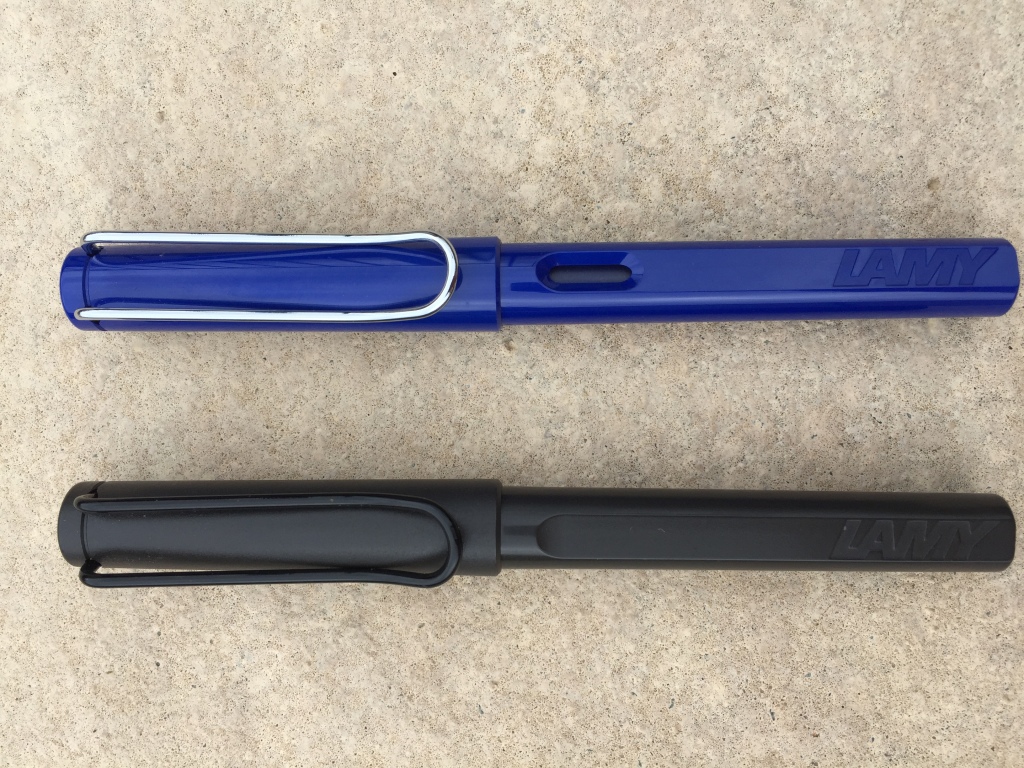
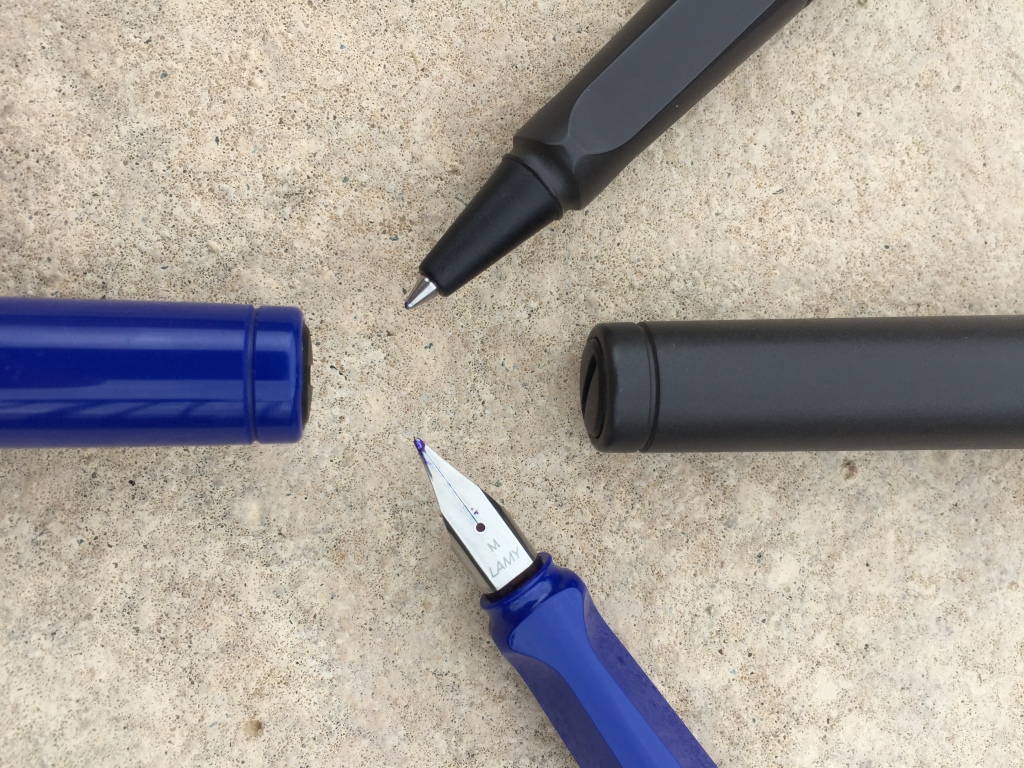
Top: Lamy Safari Fountain Pen - Blue; Bottom: Lamy Safari Rollerball - Matt Charcoal

Top: Lamy Safari Fountain Pen – Blue; Bottom: Lamy Safari Rollerball – Matt Charcoal

The rollerball was purchased about 2 years ago, with the fountain pen becoming part of the collection last October. Which do I prefer? I could say “read on and find out”, however to cut a long story short – though not one of my favourites, the fountain pen I do enjoy using, whereas the rollerball I have never really taken to.

Over and above the most obvious difference between the two, the reason for the disparity ironically lies in the grip section – a part of the pen which is very similar (though not identical) on both pens. However again if we cut to the chase – the grip section will rule me out of buying another of either type – it’s just not suited to my writing style.

Look and Feel

I’d have to say the Lamy Safari (or AL Star) range would surely have to be one of the most widely recognised pen designs around. The brand has enjoyed pride of place in the pen and stationery section of many Australian department stores for some time. I tend to find if a retailer stocks Moleskine, you will invariably find the Lamy stand not too far away.

Personally, as far as the design of these pens is concerned, I again have mixed feelings. I wouldn’t say I don’t like the design – but I don’t love it either. Although similar in size to many of my other pens – to me – they look bigger, which I expect is mostly to do with the circumference of the cap, and size of the metal clip.

On the official Lamy website, the Safari range is listed in the Young Writer section, and a handy timeline listing all of the Lamy pens indicates the Safari was introduced in 1980. Although the Safari is popular these days in the entry-level market segment across all ages, Lamy were clearly aiming at the younger demographic1:

The new LAMY safari is a school fountain pen like no other. It is in a class of its own. At the beginning of the 1980s this is the message which quickly spreads in the new, young Lamy target group: the ten to fifteen-year-olds.

On reading the above excerpt from Lamy, I now realise this probably best describes my own thoughts.
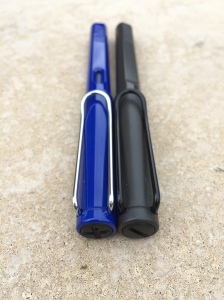
IMG_4047Overall, I feel the design lacks some of the more classic touches demonstrated in other pens, and is somewhat reminiscent of a learners pen – that is, the size; contoured grip to encourage correct technique; large clip which won’t catch or snag; and a variety of colours to appeal to many different tastes. I honestly do not mean this in a negative sense, as my opinion here probably is more an overall feeling than an objective list of facts. You would also be correct in suggesting my design credentials are a bit thin on the ground!

None of this of course detracts from the overall writing performance, and the Safari is not an ugly pen by any stretch. The design was clearly very well thought out and aimed at a specific market, and continues to be very successful today – it is simply not a favourite of mine.

Specifications

Courtesy of NoteMaker:

Lamy Safari Fountain Pen

  • LENGTH: 13.8cm
  • REFILL: LAMY T 10 giant ink cartridge or a Z 24 LAMY converter and bottled ink.
  • MATERIALS: Stainless steel, sturdy plastic & chrome
  • SOURCE: Made in Germany. Designed by Wolfgang Fabian.
  • PRICE: $AU49.00

Lamy Safari Rollerball

  • LENGTH: 13.8cm
  • TIP: Medium 1mm
  • REFILL: M 63 LAMY rollerball refill
  • MATERIALS: Stainless steel, sturdy plastic & chrome
  • SOURCE: Made in Germany. Designed by Wolfgang Fabian
  • PRICE: $AU35.00

Writing Performance

As I’ve already mentioned, of course any discussion on the Lamy Safari range would be nothing without addressing the triangular contour of the grip section. Widely – it is either loved or loathed – generally with not much in between.

Somewhat surprising to me was the difference in opinion I have about the rollerball and the fountain pen versions of what is almost the same grip section. The rollerball? Loathe it. The fountain pen? Here is where I land somewhere in the middle. Generally I have no real problem picking up the fountain pen and writing – in fact, I do enjoy it.

I say the grip sections are almost the same in the paragraph above, for there is a key difference if we compare the rollerball and fountain pen. True, both have flattened areas in this section of the pen, however the rollerball contains three (thumb, finger and underside); whereas the fountain pen has two only (thumb and finger), which assists in orienting the nib correctly if held at these points. The underside of the fountain pen remains curved, in the natural contour of what would be a round barrel. This ultimately results in a slightly larger overall circumference at the point of your grip when compared with the rollerball.

So, after putting the fountain pen to good use over the past couple of months, I again tried very hard to like the rollerball grip, but alas – not so. On thinking about this, I put it down to a couple of things.

One, and I expect the main difference, is the fairly major variation in the dynamics of my grip and downward pressure when writing with rollerballs (or anything other than fountain pens really). Although I have made efforts to ease up on the pressure I apply, I generally begin to drift into old habits when the pen allows, and it is with this increased pressure I find myself wanting to adjust my grip ever so slightly, and the triangular nature of the Safari prevents this.

Perhaps I am wrong, however the two (fountain) versus three (rollerball) flattened sections did not feel as though it were the difference here.
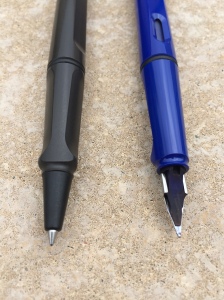
Round underside of fountain pen grip section (R)

Round underside of fountain pen grip section (R)

To a lesser degree, the subtle differences between the finishes on the two pens is also quite noticeable to me. The gloss finish on the fountain pen seems to provide a crisper edge and a nicer feel. The matt finish of the rollerball is a little softer on the edges – and for want of a better description – seems to encourage me to feel for a different grip constantly. This is obviously dependent on which particular model and finish of the pen you may be using.

I realise these are quirks perhaps unique to me, however is probably the best I can come up with to explain my feelings on the differences in the grip between these two particular models.

To sum up this point though, what I really need to be asking myself is – if, given the grip – I would buy another (of either) in future, particularly with the many enticing Limited Edition colours rolling through the line up periodically. In all honesty, the answer is no. Don’t get me wrong – I am not suggesting these aren’t great pens – they simply aren’t great pens for me.

The fountain pen itself is a very smooth writer, and although the medium stainless steel nib is fairly stiff, it performs well with no skips or false starts – generally. However on the odd occasion it can take a little “warming up” for want of a better term, with the uniformity in ink laid down a little inconsistently.
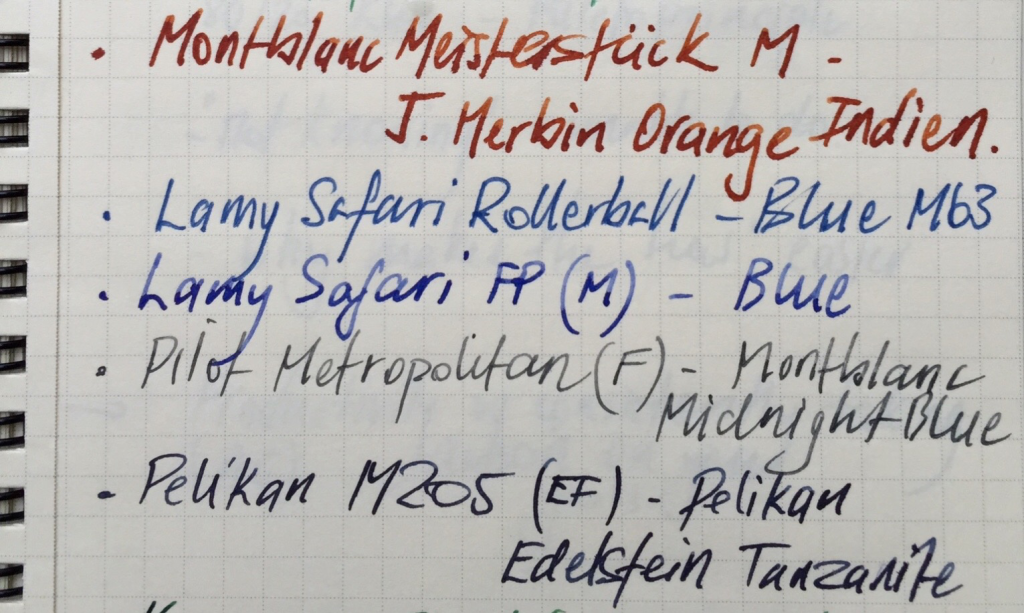
Rollbahn Writing

Comparisons on Delfonics Rollbahn notebook


This was certainly apparent as the paper absorbency increased (e.g. Baron Fig Confidant), though as expected, was far less evident on Clairefontaine notebooks or Rhodia note pads.
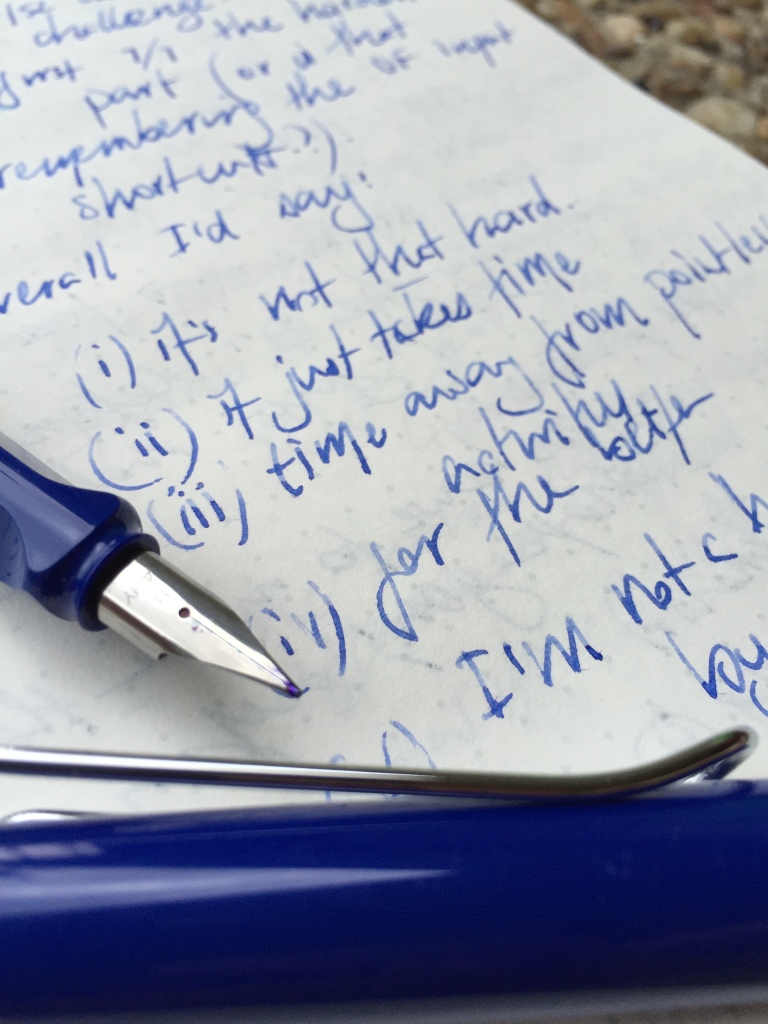
Fountain pen example in Baron Fig Confidant

Example in Baron Fig Confidant

The rollerball, with its 1.0mm M63 refill writes as well as any refill I’ve used (note here I have not used them all of course) – with the only notable exception being the Schmidt Retro 51 (P8127) which I believe is the medium 0.7mm (I have not tried the finer 8126, which many have high praise for).
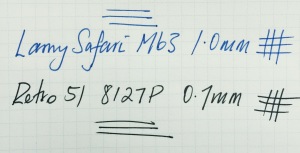
Retro 51 and Lamy Safari Rollerball comparison

Retro 51 and Lamy Safari Rollerball comparison

On comparing the two in consecutive writing tests, I expect this is due to the Retro 51 laying down a little more ink for the size of the tip – so by extrapolation the M63 should probably serve you a little longer before needing to refill. Head to head – the Retro 51 provided a far smoother writing experience, with much more feedback from the paper felt through the Safari.

Both are quite light and well-balanced in the hand, with my preference to use both unposted. Depending on what you are used to, the rollerball perhaps might feel a little too light for some, however I did not necessarily find this to be the case.

In summary then, I enjoy writing with both of these pens from the perspective of the tip or nib – though as I have already said, my main issues are with what lies above – and write well they might, however this will not overcome the lack of suitability in the grip for my particular style.

Use Case

As you’d expect – the answer here will vary for each of these two pens, however the distinction is perhaps not as wide as I might have expected.

The Safari fountain pen worked well during the time I tested it as a journaling pen when on a beachside holiday in January; as an EDC type pen to jot down notes in a Field Notes pocket notebook or similarly sized Baron Fig Apprentice, and also as a meeting notetaker on a couple of occasions in the office.

The Safari rollerball – well – was much the same, seeing use in all of the above situations, with the added advantage of not having to worry about what paper I might encounter, which might need a signature or markup of notes (mainly with reference to meetings here).

Overall, both pens performed just about equally well in all of the above situations. The construction and stainless steel nib of the fountain pen in particular certainly gives an air of robustness that makes it equally useable as an EDC type pen, providing the paper you use is suitable – and of course I am mindful of the size if you were planning to carry one on a daily basis for this purpose.

Conclusion

If you’ve made it this far, then it is pretty clear I do believe both the Lamy Safari Fountain Pen, and Rollerball, are two fine pens – particularly for the price points at which they are sold.
"What's your point?' | "That's just how I roll"

“What’s your point?’ | “That’s just how I roll”

Did the grip section make or break them for me? Of course it did – as it has for many others. I certainly find the fountain pen more forgiving here, however if given the choice of other pens at similar price points, I would pick up my Retro 51 before the rollerball, and my Kaweco Ice Sport before the fountain pen.

That said, these pens are a great entry point into a more stylish and better quality rollerball or fountain pen for many, and I expect this will stay that way for some time to come. For those more experienced who either love or at the very least have no issue with the grip? They will simply continue to buy a high quality, well performing pen – and the impressive Limited Edition Colour releases continue to sweeten the deal.

Overall, I’d happily recommend either of these pens for beginners or the more experienced fountain pen user (though I probably wouldn’t have to), safe in the knowledge they would perform well with little trouble. My advice – try them first or at least be prepared the grip might not quite be to your liking – though for many – it clearly is.
  1. A reasonable aim, given the fact certain European countries (I believe) use fountain pens in the early stages of students learning to handwrite.


Pilot Petit1 Fountain Pen

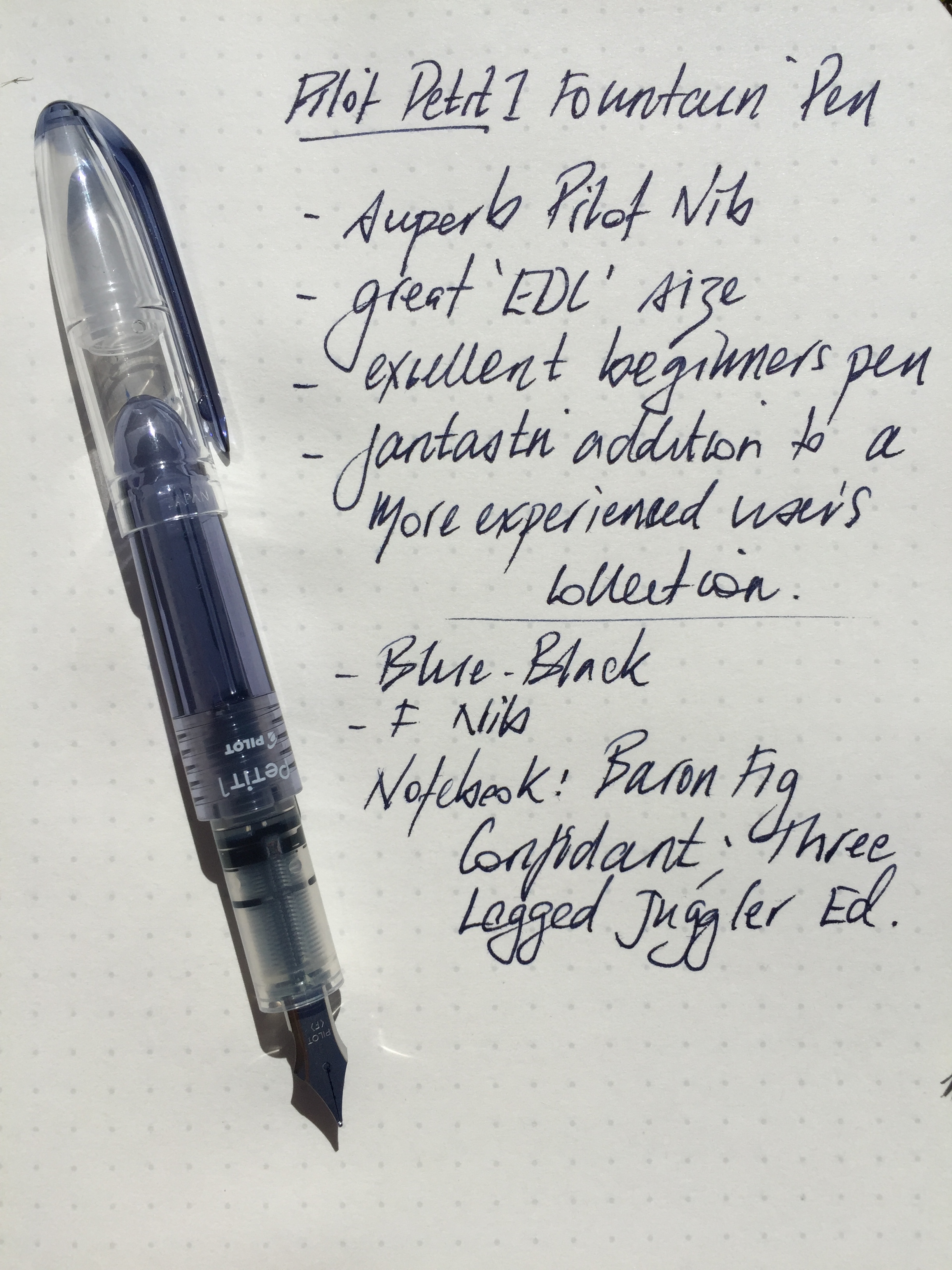
The Pilot Petit1 made my JetPens shopping cart late last year in the form of a bundle of eight in different colours (the order also included a ten-pack of the 0.5 mm Zebra Sarasa Clip) to be included in Christmas gifts for friends. Thankfully, I kept a couple, and as I’ve found with most Pilot nibs, for the price, the Petit1 certainly punches well above its weight.

So much to love about pen and paper when it comes to gift giving.

So much to love about pen and paper when it comes to gift giving.

Look and Feel

The Petit1 is a compact or almost “half-sized” pen, and requires posting to achieve a regular length for writing. Like a Kaweco Sport, once posted, I find these types of pens no less comfortable for writing than those of standard size.

With the Kaweco Ice Sport

With the Kaweco Ice Sport

For those who may be more familiar with the Kaweco Sport range, this is indeed a good comparison, as the two pens are identical in size, and with the exception of the clip on the Kaweco (assuming you are someone who uses the clip), the plastic construction is very similar in both as well. Though admittedly the Petit1 does not feel as robust as the Kaweco, which given the price, is to be expected.

A full list of specifications for the Petit1 can be found on the JetPens site, however in summary:

  • plastic body, cap and clip
  • metal (presumably steel) nib
  • length capped 10.6 cm; uncapped 9.4 cm; posted 13 cm
  • cartridge fill type
  • variable body and ink colours
  • refill cartridges available
  • eyedropper convertible

Once the sticker is removed (which explains the method of cartridge insertion for anyone unfamiliar with this), the remainder of the body is fairly clear, save for the Petit1 and Pilot branding in the centre of the body. This provides a nice view of the ink from the cartridge down through the feed.

In the wild - a great EDC pen.

In the wild – a great EDC pen.

The clip is moulded plastic arising for the tip of the cap, and although has a little spring to it, I fear is a prime candidate for snapping off. With a pen of this size, a clipless body may find it’s way to the bottom of a pocket, making extraction a little more fiddly than you might otherwise like. Conversely, it is precisely pens like this which I often throw in the bottom of my pocket rather than clip, so in my mind this really doesn’t detract from the pen itself. I suspect if you prefer parts not snapped off your pens it may be an issue.

There is an absence of any taper to the grip section with a significant step down from the body itself, however the plastic construction inherently provides a certain softness to the feel in this particular part of the pen, and I found the step not sharp enough to bother.

The nib construction is described on JetPens as metal, and I can only assume is therefore steel (however this does leave the door open to it being some kind of cheaper alloy, though I’ve no reason to suspect this is the case). Pilot branding and nib size are the only embellishment on an otherwise minimalist looking nib. For the price, this is a fantastic nib.

Writing Performance

What is there to say here really? The nib is as good as any Pilot nib in this price segment of the market (read fantastic), I have used of late, and perhaps even a little better than the fine nib on my Pilot Metropolitan1, which is not quite as smooth on paper with a little more tooth, such as the Baron Fig Confidant notebook.

IMG_3824

Having just completed a 31 day journaling challenge to kick off the year, I found myself picking up the Petit1 on quite a number of occasions during January. It is indeed a joy to write with. Feedback from one of the Christmas gift recipients also indicated a preference for writing with the Petit1 over the Lamy Safari they already owned – another big rap for the nib.

As expected, there is minimal flex in the steel nib, and on smoother paper such as a Rhodia No. 16 pad, is as smooth as any fine steel nib I’ve used. Regardless of storage (often on its side in my pocket), the Petit1 started immediately every time, with a full flow of ink, and no skips.

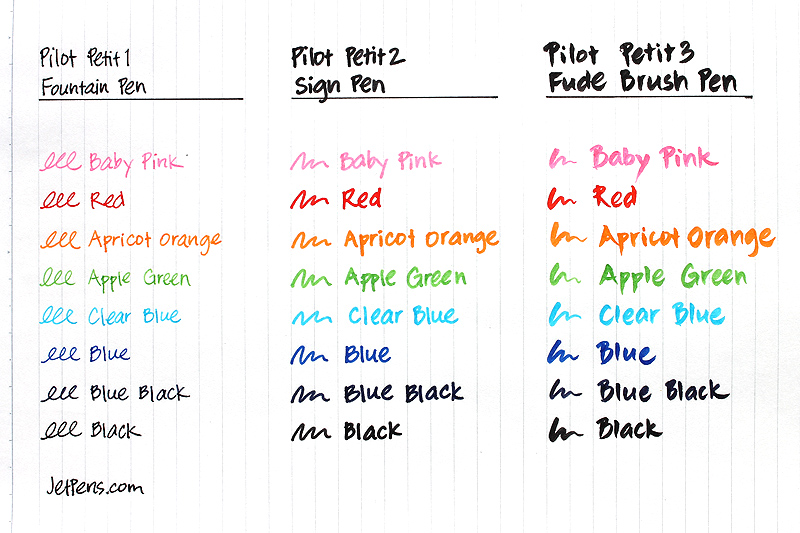
The Petit1 is a cartridge filler, and refills in any of the eight available colours are just $US1.90 for a pack of three. I plan to add a few to my next (and probably each) Jet Pens order for some time to come. One thing to note — the Petit1 only takes the proprietary Petit1 cartridge refills — standard short cartridges do not fit. Something to bear in mind, though with the colours available (and those of you with syringes for refilling out there), I don’t see this as a problem.

Image courtesy JetPens

Image courtesy JetPens

It appears the Petit1 is also convertible to an eyedropper pen, however I’ve not done this myself — perhaps for another day. Should you wish to undertake such an endeavour, JetPens has a tutorial for you on exactly how to do it. Also, as you can see in the image above, the Petit1 is part of a series from Pilot, which also includes sign and brush pens.

Conclusion

For the price of $US3.80 (or a bundle of 8 for $US30.00) on JetPens, there is no better value for money fountain pen out there for the writing experience you get with this nib. Whether or not the shape and size suit you might be another matter, however I wouldn’t consider it a waste of money to find out.

Really, the way this pen performs, I would have no hesitation in recommending it as an entry into fountain pens for someone who has not tried them (my fear of course is in recommending something too cheap which sours the entire experience). In fact, given the price, a pen such as the Petit1 is perhaps more likely to be tried if someone is not prepared to spend $US30.00 on a Lamy Safari or even the $US14.50 for a Pilot Metropolitan.

I have not personally used the Platinum Preppy (currently $US3.00 on JetPens), however find it hard to believe the writing experience would be better than what this Petit1 achieves.

Overall, a great little pen with a big writing experience, and one I will continue to throw in my pocket for some time to come.

  1. Incidentally, the nib gods did not look favourably on a recent slightly heavy-handed upstroke while using my Pilot Metropolitan. The tip of the nib “popped”, a filament of metal came off and I had a somewhat uneven instant stub nib. I’d thought about simply grinding it smooth, however perhaps will simply swap in another nib. A cautionary tale for those who might also apply a little downward pressure!

Cursive – cursed again?

On the same day last week, two very different points of view on cursive writing appeared in my Twitter timeline. The first, yet another news article suggesting the demise of hand written cursive in schools, and in contrast, a Kickstarter project purporting to have developed a new and more efficient means of teaching the very cursive supposedly on the way out.

You can probably guess on which side of the fence my allegiance was on, however after calming down and scrapping my original plans for a “that’s ridiculous” post here, I came to realise the views were not necessarily diametrically opposed.

The downstroke

The first, and of course, most striking piece to me, was an Australian ABC News story titled Finland scraps cursive writing lessons, sparking discussion over future of handwriting in classrooms. The discussion in question, was of the Australian curriculum, and the future of hand writing which may, or ultimately may not, be taught in Australian classrooms.

For someone who loves pens, and fountain pens in particular, I have mixed feelings about an article such as this. Australia’s board of education was noted to have said:

…learning to type was “more relevant to everyday life”, a skill that Australian experts agreed was a better use of school time.

Before you begin quoting the numerous studies showing the benefits of handwritten note taking in learning, many of the education experts quoted made the distinction between teaching children to write, and teaching children the style of cursive handwriting.

Senior lecturer in English and Literacy Education at the University of Queensland, Dr Eileen Honan agreed that while the Australian curriculum put emphasis on both handwriting and keyboard skills, cursive writing was irrelevant.

Being able to write in beautiful script has got nothing to do with the ability to read and write productively, creatively and intelligently

Thankfully, the conclusion made was for further discussion on the matter in relation to the Australian curriculum, as here in Australia, we were unlikely to “follow Finland’s lead” — well not yet anyway.

The upstroke

The next, and infinitely more positive piece in my timeline was first shared by two pen and stationery bloggers I follow (Doug at Modern Stationer, and Ray at Fountain Pen Quest) — the CursiveLogic Kickstarter project.

Of course after looking at the Kickstarter project page myself, I also instantly shared the link, and began planning my rant post, thinking ”I’ll show you — just try to get rid of cursive”.

As I sat and thought a little more, I realised something like the CursiveLogic programme goes a long way towards solving one of the main issues many of the experts raised as a problem in continuing to teach cursive writing — that of the time spent with students practising the correct formation of letters. Senior lecturer in Language Literacy at the University of Canberra, Dr Misty Adonious:

I just don’t think it’s worthwhile spending school time teaching kids … cursive writing.

In the CursiveLogic programme, we have the makings of a solution. A way of learning cursive writing more efficiently, and therefore much faster than standard methods of instruction, through two key features — letters grouped by shape:

By teaching all of the similar letters together, CursiveLogic captures the natural synergy of the alphabet itself, allowing each letter in the series to reinforce the proper formation of all the others.

and letter strings:

CursiveLogic’s letter strings teach students to connect letters from the first lesson, allowing students to internalize the flow of cursive handwriting even before they have learned all 26 letters.

Both the project page and the CursiveLogic website have further information and the scientific basis behind the programme. I’d also encourage you to watch the inspirational video of Josh, a 23-year-old student with learning disabilities who wanted to learn cursive to be able to sign his name.

My thoughts

If the argument against maintaining cursive in the school curriculum is as much a time based one as it is a relevance one — then let’s teach it faster.

To me, a system or programme such as the one proposed by CursiveLogic which aims to teach cursive in a more efficient way, seems like the perfect starting point for keeping alive such an important aspect of educational development in the classroom.

The assumption here is that the methods and outcomes of the CursiveLogic system are as reported on the project page and website, and I have no reason to believe otherwise. Of course I acknowledge I have not had any experience with the methods of CursiveLogic, nor seen it used first hand.

One other aspect I find interesting in all of this, is that although most agree cursive writing is outdated, children will still be taught to write. If this is the case, and the writing is not cursive — then what will it be? Surely it must be based on some form of script to maintain a standardised curriculum does it not? To date I have found the mention of any alternative to cursive completely absent from the discussion.

I see it like any skill — learn the foundations and deviate with your own style from there. My own handwriting has drifted far from its humble beginnings in primary school, however when attempting to produce some better quality handwriting (say for an invitation or card), the slope, letter formation and overall style certainly reverts closer to the cursive I learnt as a youngster.

I’m hoping that if the handwriting component of the curriculum does change, we do not simply see a generation of children who can perfectly reproduce by hand the stock standard upper case letters we see on a keyboard.

Finally

While this post is clearly too late for Finland – Australia, not so. Although the CursiveLogic project is based in the US, and may not necessarily directly influence any discussion locally, the project creators aims of raising public awareness about a more time efficient means of developing the skill of cursive writing is surely worth supporting.

Head over to the Kickstarter page and consider backing the CursiveLogic project. It is time to reinforce that stake in the ground and ensure the passage of certain skills through the generations continues.

A final point from the ABC News:

We actually don’t use fountain pens and ink anymore, so maybe we should think differently about where we put our attention now.

Says who?

Delfonics Rollbahn Spiral Bound Notebook

IMG_3485

In my ongoing quest for a quality spiral bound notebook, I decided to pick up a Delfonics Rollbahn recently, during a free postage promotion on Notemaker, one of Australia’s best online stationery stores.

Since then, I have also seen new stock arrive at the Dymocks Brisbane CBD bookstore, and the Rollbahn metallic covers (silver, gold) look absolutely fantastic. How do they perform? The most apt description here is also fantastic, and I have put together a few thoughts on this below.

The Notebook

The particular model purchased was the large (14 x 18 cm or 5.5 x 7 inches), which is a little more square in form than say, an equivalently sized Moleskine, which measures 13 x 21 cm (5 x 8 inches). I must admit, I do like the square format of the pages, as my writing is often not on the small side when jotting down a few quick notes, a list, or even something a little longer.

Specifications (from Notemaker):

  • PAGES: 180 (90 sheets)
  • RULING: 5mm x 5mm Graph / Brown-Grey coloured ruling
  • PAPER WEIGHT: 70gsm
  • PAPER COLOUR: Off White/Ivory
  • DIMENSIONS: 14cm x 18cm
  • SOURCE: Made in Japan

Look and feel

Looking more closely at the design, the binding is double spiral for added strength, with the cover made of extremely stiff, robust semi-gloss card stock (also described in the product specifications as splash-proof, however I did not specifically test this).

IMG_3466IMG_3468


At the rear of the notebook are five, top-opening, clear plastic sleeves between two thick yellow dividers matching the front cover. As with the front, thick card stock forms the back cover — this time in kraft, complete with a small letter-pressed Delfonics branding. An elastic closure strap in navy blue (matching the contrasting logo on the front cover) completes the picture.

IMG_3470IMG_3465


The overall look of these notebooks is quite striking, and I am quite drawn to the styling, quality and attention to detail applied to both the design and manufacture — not surprising given two factors: it is stationery, and it is made in Japan.

As I mentioned earlier, the silver and gold metallic covers are even more impressive, and nothing can beat seeing them first hand in a store. In fact, I have no doubt my accompanying photos would have been of the silver model had I seen them in-store prior to my online order.

As far as I am aware, the Rollbahn series come in 5 x 5 mm graph paper only, however the rulings are so faint I did not find it dramatically different to a dot grid type of paper, nor should those who find graph ruling a little “busy” for their tastes. At the very least it is worth a look, even if graph ruling is not your thing.

All sizes in the Rollbahn series contain 180 pages (90 sheets), with every page perforated for easy removal, however a little care is required when initiating the tear. I would note here I am always loathe to criticise a notebook for this, as my technique can be a little, how shall we say — “cumbersome”, at times.

Writing

Of course the best design components of a notebook pale significantly if the paper is not up to expectations.

A note here about the paper first up. It is yellow. Pale yellow, however yellow nonetheless. The specifications on Notemaker describe the paper as “off white/ivory” with “brown/grey” coloured ruling for the 5 x 5 mm graph paper design. Is the paper colour a deal breaker? I’d say no, however if you are someone who uses a lot of subtle colours or shades of inks, it just might be.

Not a great photo, however top to bottom: Clairefontaine, Rhodia, Moleskine, Rollbahn

Not a great photo, however top to bottom: Clairefontaine, Rhodia, Moleskine, Rollbahn

Just to confirm — it’s definitely yellow. There is no way I can be convinced this is merely off white or ivory, and if the performance of this paper were not as good as what it is, I may not have enjoyed using it as much as I did. I simply prefer paper towards the whiter end of the spectrum — particularly for those types of inks.

IMG_3474IMG_3514

That said, upon putting down some samples on a page, (see accompanying image above) most of my comments above might appear unwarranted or a little harsh — comments which I almost removed (the sample page being written after drafting the post). More vibrant, colours such as Montblanc Irish Green and J.Herbin Orange Indien were fairly true to their white paper appearance (the orange perhaps losing a fraction of nuance), however I have also added a shot below of some Montblanc Daniel Defoe Palm Green, where most of the green tones can only be seen in a smudge. Conversely, I have found a nice, consistent shade of earthy green when the same ink is used on whiter paper.

IMG_3475

See for yourself in the accompanying images, and the only reason I highlight this aspect in particular, is that for me, were this paper white, I would be telling you it would be pretty much perfect. It is that good.

The usual characteristics such as bleed through, show through or feathering are handled perfectly by the 70gsm paper — that is, pretty well none of these are demonstrated in the writing I have put down so far. This is great paper for note taking — fountain pens included, with dry time certainly on the quicker end of the scale compared with other brands of paper.

I find it a little less “slippery” for want of a better word than say Rhodia paper, my go to for fountain pens typically. The little bit of extra feedback suits my writing style perfectly, as I sometimes find a really smooth nib more difficult to control on very smooth (e.g. Rhodia) paper.

One minor qualm I noted when writing was the small amount of “wiggle” or movement of the page if not held with your opposite hand, mainly due to the large squares cut in the paper for the double spiral binding. Most likely not a problem in the extra-large size, however in a notebook of this size, I often rest my hand on the left page or off the notebook completely. Not a major issue however the movement was noticeable and something I thought worth mentioning.

Use case

For me, this large size notebook — my first Rollbahn, is best suited to shorter note taking given the size of the pages, however would hold up well for longer form writing. In a larger size, I can see this working extremely well as an office meeting note taker or “day book” of sorts, which is where I find the spiral bound books to work best for me.

Many of the notes I take during the day relate to meetings, general thoughts/ideas on processes, procedures or projects, and rough working, mind mapping or outlining these very topics.

Why does the spiral binding suit here? Simply because I prefer a notebook at work which opens flat, closes flat, and can be turned back on itself to allow notes to be taken on a somewhat stable and rigid surface if I choose to rest the book on my lap. This I find to be a common scenario, either for comfort reasons in a long meeting, or to jot down a few confidential notes, where the notebook is angled towards, and closer to me.

IMG_3516It is also at my office job I am most likely to be using ink colours in the blue-black spectrum, or more gel ink pens or my trusty Retro 51. As good as the paper is, as I’ve state above, the yellow shade is probably not best for testing your new ink colours — at least those on the subtle shade side in any event.

My purchase receipt tells me I bought this notebook in late October, and in the intervening two months, I have: made a few plot related notes for NaNoWriMo; jotted down some coffee tasting notes; written a few pages worth of outline for a post on what I learned from NaNoWriMo (must actually finish and publish that one!); and taken a dozen or so pages of notes whilst watching David Sparks excellent OmniFocus Video Field Guide (in Daniel Defoe Palm Green – see accompanying image). A group of notes largely consisting of bullet points, lists and short text notes.

Conclusion

It is pretty clear I am very impressed with the Delfonics Rollbahn, and find it suits my style of writing and notebook requirements extremely well. The styling, design and build quality are second to none. I will definitely be giving the extra-large size a run as my office notebook in future.

What do I like most? Definitely the paper quality, (if not quite the colour), the overall build quality and design, and the attention to detail that is apparent in the double spiral binding, rear pockets, and perfectly rounded corners. Although nice, the closure strap is something I generally prefer not to have (particularly in a notebook which closes well on its own) — as I find they often get in the way. Certainly not a deal breaker by any stretch.

My dislikes? Here it is really only the shade of the paper, for otherwise it is essentially flawless. A minor qualm about the “wiggle” in the page when writing I mentioned earlier is not something which would stop me buying more in the future.

As far as value for money is concerned, here is where things get a little (not a lot — but certainly a little, depending on your budget) interesting. The 14 x 18 cm sized notebook retails for $AU14.95 (either brick and mortar store or online), and the extra-large 19 x 26 cm for $AU24.95. Not an insignificant amount, however when balancing this with what you get for your money, that is, exceptional quality, and 180 pages of it, I’d say the value for money certainly is definitely there. I should also mention the notebook also comes in a smaller (10 x 15 cm), 180 page top opening reporter style notebook for $AU9.95.

Although this is my first Delfonics Rollbahn notebook, I doubt it will be my last. My recommendation would be to try one for yourself, and if you write with fountain pens, my advice is the same — try one out.

Just remember, though perfectly fine for most colours, the shade of paper isn’t made to showcase the subtleties of your ink collection, but will serve you extremely well for taking meeting notes or writing the intro or outline to your next long form essay.