A Journalling Streak – holding on a little too tightly

The same morning I read Mary’s account on From the Pen Cup of reaching the milestone of seven years of Morning Pages (well-deserved applause all round), I ended my own daily journalling streak which stood at 1308 consecutive days. A tip of the hat in either direction, perhaps. Congratulations Mary, I wish you many more years, Morning Pages, and words to come.

Myself? Well, I’m guessing it will largely be the same, and while 1308 days is no seven year run, I’m fairly content with my consistency, particularly given there were a few decent consecutive-day streaks (albeit lower in number) before that. If so, why the celebratory “I missed a day” post? It certainly isn’t to decry the act of journalling, and whether it’s a page a day in the Muji A6 notebooks I’ve used these past couple of years, or the mind map I’ve just dumped into a new MindNode document for this post, both have the same effect: thoughts are out (page, screen, blog…) and better for it.

Given the subtext of this post might read: a post related to journalling but not really a post about journalling, forgive me for the confusion. What I’m railing against a little here is becoming too wrapped up in my “streak” for its own sake — or the sake of my “system”. That said, I suspect this journalling example is simply bearing the brunt of a certain level of frustration with my other systems, habits, and routines as they relate to output when sitting at my desk. As the commonly used quote attributed to Peter Drucker states” ”if you can’t measure it, you can’t manage it.” Well, to that I’d counter: “if you can measure it, you can certainly obsess over it” – attribute that one to me…

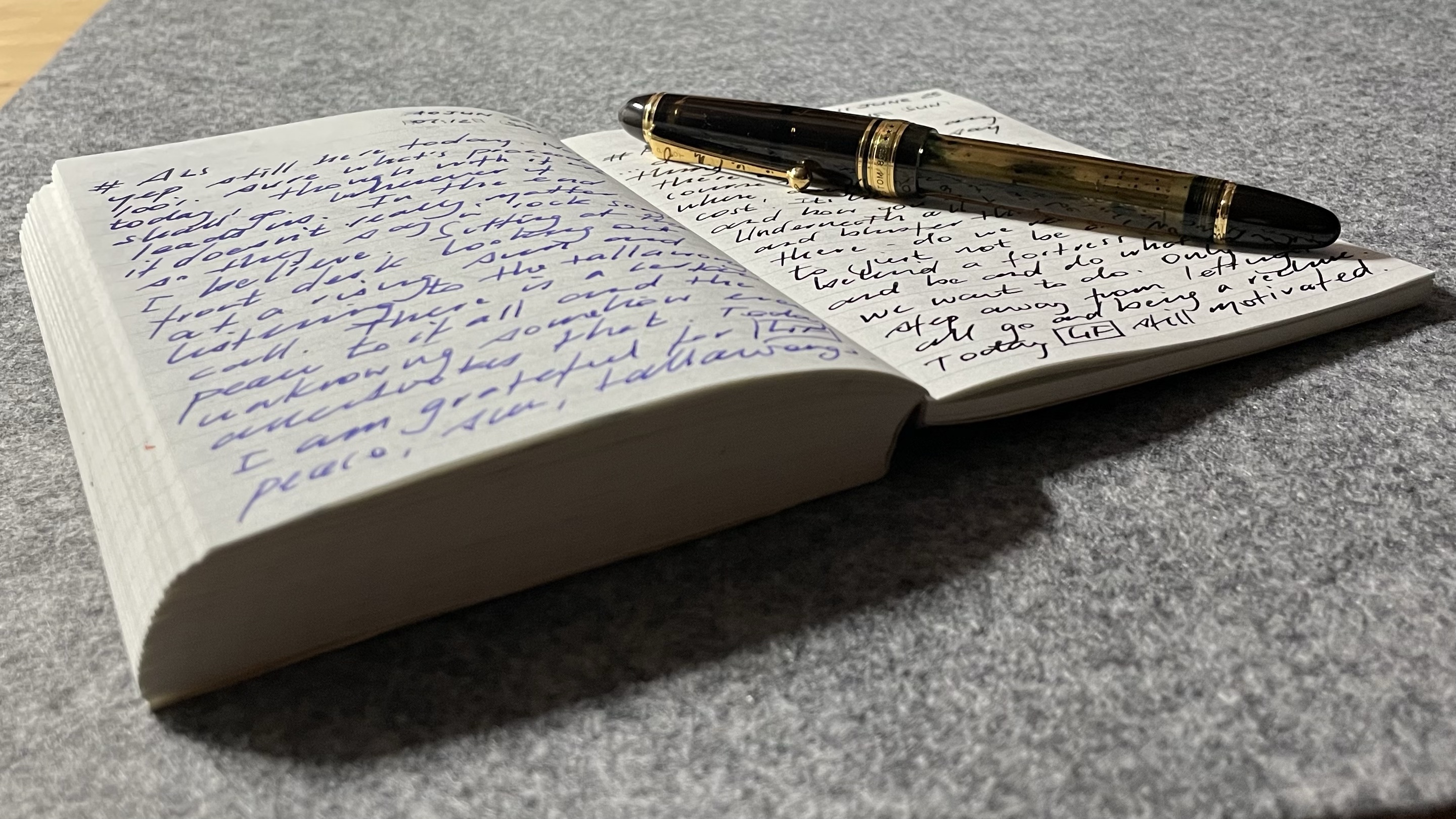
Journalling is the first thing I do every morning and something I certainly see continuing indefinitely, as I find it a great way to ease into the day. Some days I write about everything, others it’s nothing at all. There are days I’ve Googled and rewritten song lyrics for goodness’ sake, and yes, there have been some significant life events mentioned in those pages as well. As you’d expect, there are (brief) tales of challenging and emotional times, however the last sentence of every entry begins with two letters enclosed in a box: GF (grateful for…). Whatever follows in that final line or two is a simple reminder of the good. Of course, this again runs the gamut: overcoming struggles, life events, a great cappuccino, or just how good the nib is on my Pilot Custom 823. The big and the small — it’s all there.

I guess that is where I’m coming from with my thinking on this — hastily scrawling a date and “nothing to see here” (or similar) on days when I’d missed the morning routine (usually when away from home), just doesn’t feel quite right. Of course, it’s not wrong either — if it had a purpose other than to simply fill in the circle on my Streaks app.

In many ways, the streak needed to be broken simply to put my mind at ease and confirm it could be broken without the earth somehow falling off its axis. It didn’t by the way, with the new streak now sitting at 7 days. I do feel quite ridiculous in saying some sort of weight had been lifted, when after missing the morning routine that day, I made a conscious decision to leave it that way as I walked past the journal sitting on my desk that same night. Be real and end it…

I started a daily journalling habit a good few years ago because I thought I should, though I’ll keep going for any number of great reasons. I never have to decide what the first task or activity is in my day; it is a perfect chance to work through a rotation of fountain pens; it gives the coffee machine time to warm up; and I do feel as though I’ve missed something on the few occasions I haven’t done it.

Now though? Well, I’ll happily continue this helpful and calming daily ritual without the overhead of a 1300+ daily streak to maintain. It is indeed ok to “break the chain” Jerry.

So today, I am indeed grateful for: ending a streak, but continuing one of the more valuable habits I’ve managed to form.

Gain, Fail, or Shine – A Less Ultra Black Montblanc M

The Ultra Black finish. My Montblanc M ballpoint. Certainly a love at first sight situation when I first came across it in a display case a few years ago. Admittedly I was not entirely sure what the “ultra” really was at the time. A finish? A colour? The mostest or blackest of blacks? In any event, it was different to the standard shiny black “precious resin” of the Montblanc line.

While Montblanc describes it as ”black precious sandblasted resin”, it’s probably fair to call this one “matte black” if we’re trying to provide some context or perspective. While I do enjoy the lustrous deep black shine that is the standard precious resin finish, something a little different is always nice to have, particularly when it’s not at Montblanc’s Great Characters or Writers Edition prices.

So why the post? Well, really only to mention a change I’ve seen in that Ultra Black finish over time. You see, my Ultra Black M ballpoint, when compared with the standard precious resin of the M fountain pen I own — is decidedly less Ultra than it used to be.

I’ll say up front it doesn’t really bother me, however knowing we are all somewhat different in our tolerance for these sorts of things, thought I’d put down a few words outlining what I’ve seen.

The Pens

I’ve written before of my experience with the Montblanc M Ultra Black ballpoint, and it remains close to the the top of my all time favourite and most used pens (perhaps explaining what follows). When it comes to its fountain pen sibling, well I have to say my fondness for the M design lineage continues. I’ve had the M fountain pen for a shorter period of time (though also a good while now), so its long term position in the “inked” pen pot is still being assessed, though to date it has demonstrated quite a strong showing.

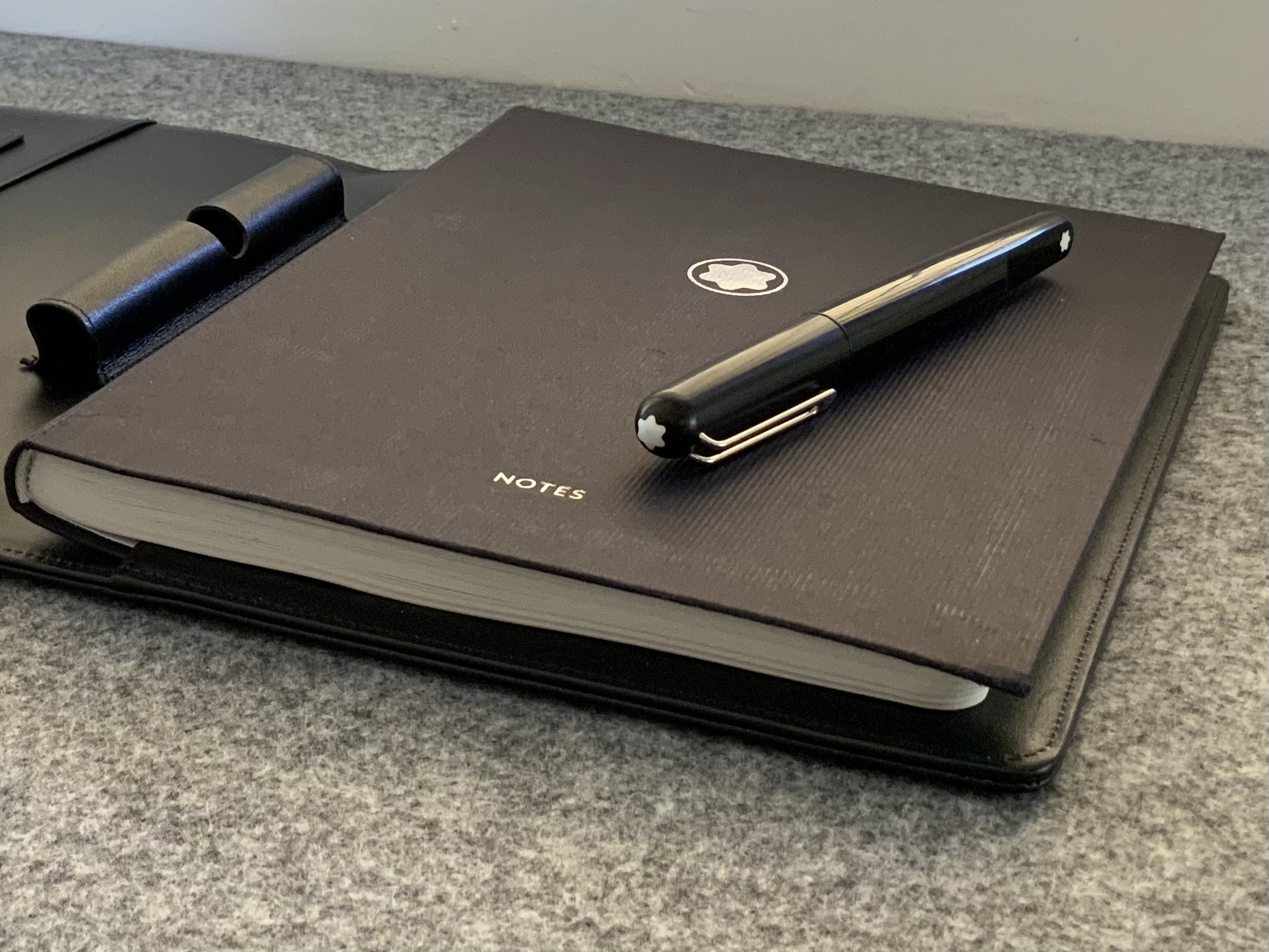
My workhorse Montblanc M ballpoint

After all, fountain pens aren’t necessarily the universal truth compared with a ballpoint are they. With nib placement, angle, and balance, there is a reasonable combination of “getting it right” required before you end up with a decent writing experience. Compare that with the uncap-and-dash world of the ballpoint. In my experience so far, the M fountain pen deserves some kudos, at least in this medium nib version I have in my hand.

So, the pens? All good there — love them. The real question being have they lost some of their “shine” given what follows below. Maybe, maybe not — again, it depends on your perspective I guess.

On Shade

Now, onto matters of shade, hue, finish, or at least the “Ultra” of the equation here. To be honest, had I not had both pens out side by side recently I might not have noticed anything different…

Having the M’s tucked away next to each other in a Nock Co Lookout pen case, it was easy to distinguish between the two by the cap finishes peeking out the top. One, a shiny, lustrous piano black in precious resin. The other, a decidedly matte version of well… black. The point being, its a simple task to tell them apart. Funny thing was, after using both, I accidentally recapped them incorrectly as the barrels looked pretty much the same. Upon comparing a little closer, I was somewhat surprised to see that for all intents and purposes the barrel finishes carried essentially the same sort of gloss finish.

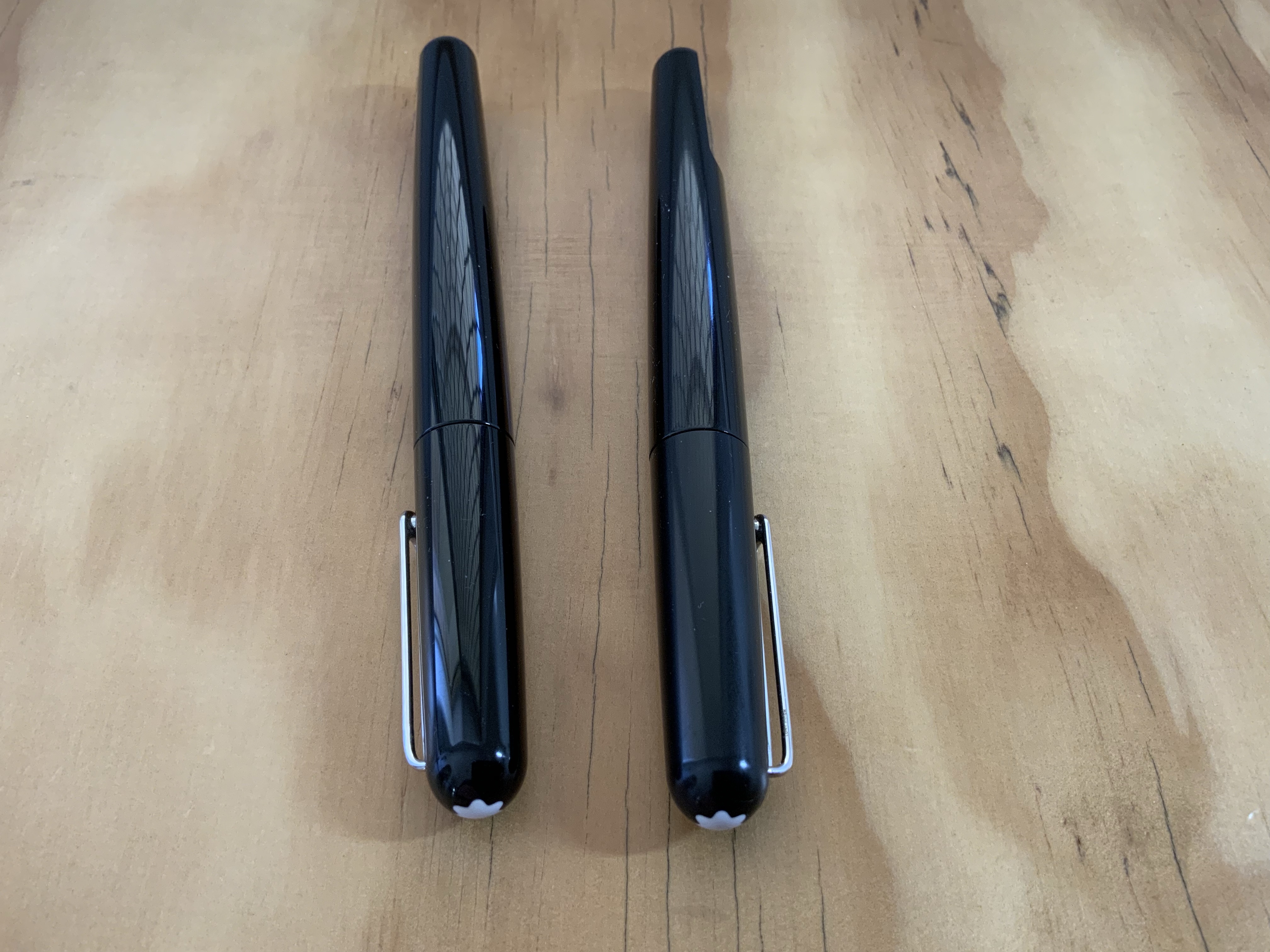
The all gloss standard “precious resin” on the left, the Ultra Black on the right – well the cap at least…

Confused yet? Well I feel as though I’m writing my way around in circles here so I wouldn’t blame you. Where I’d usually refer you to a picture that speaks a thousand words, here I’ve found it incredibly difficult to capture what is clearly visible to the naked eye. In any event, the upshot here is that after a few years heavy use, the barrel of my Ultra Black ballpoint, pretty well matches the barrel of the decidedly non-Ultra Black fountain pen.

Now strictly speaking there is somewhat of a gradient here. That is, the cap remains the truest version of Ultra Black, not having the constant buffing of my hand wrapped around it, unlike the now-glossier barrel does. Another step along the continuum is the actual precious resin of the fountain pen finish. I guess if we liken it to interior house paint, we’d be talking matte (the Ultra Black cap); semi-gloss (the Ultra Black barrel) and gloss (the standard black precious resin). I’ve gotta say though, those barrels are pretty close.

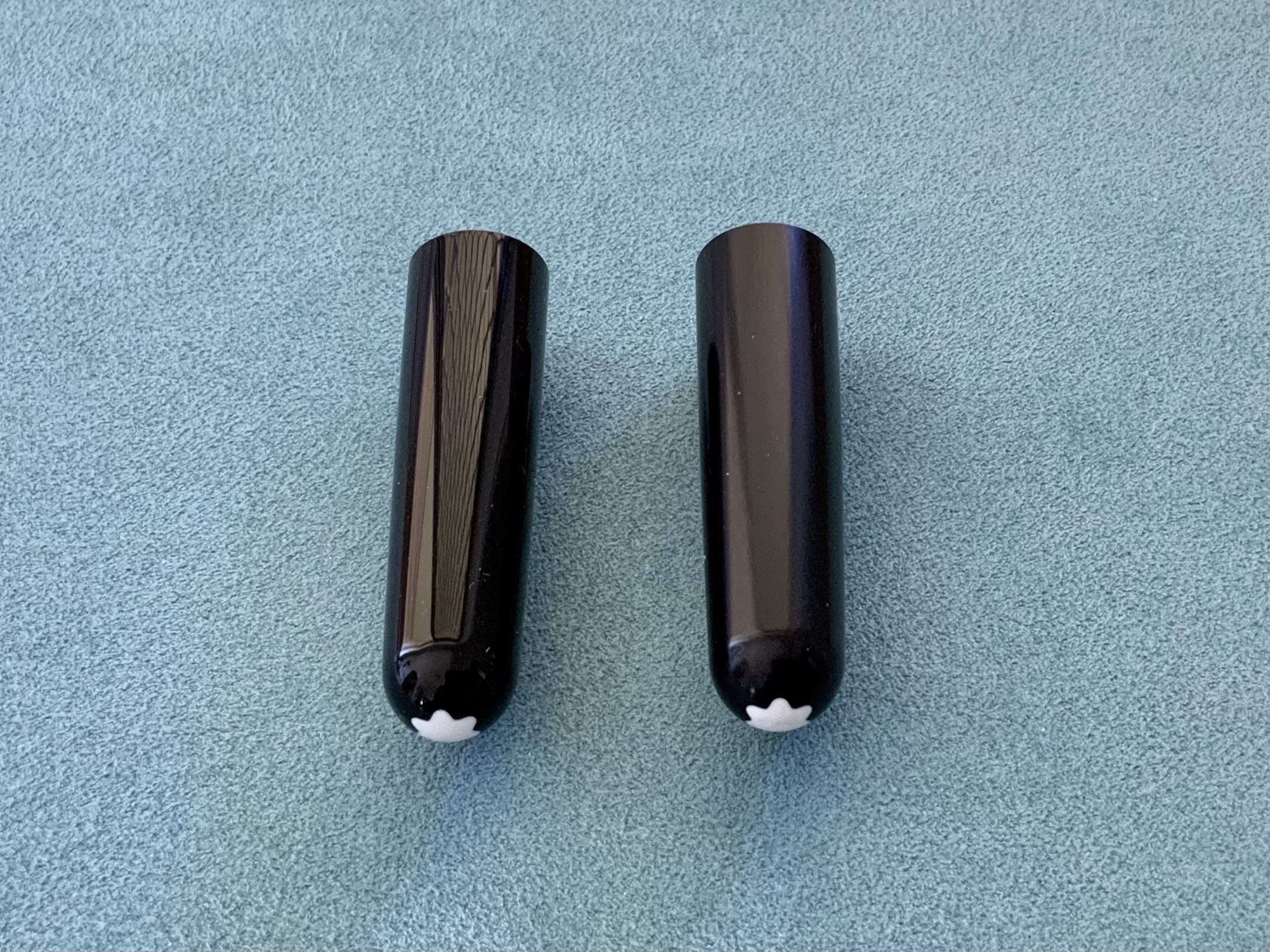
An unordered gradient of sorts – the standard precious resin pen and cap on left; the Ultra Black yet semi-gloss body far right, and Ultra Black cap centre right

Call it patina, shine, wear and tear, or whatever you like, I simply thought it worth putting down in a post should this sort of thing worry you. Of course it may not be a concern at all. It isn’t to me, however I cannot say for certain that would have always been the case. Perhaps it’s age (as in mine), experience, or something else, but I have this underlying feeling I may not have been overly happy early in my pen journey to notice the removal of the Ultra aspect of my Ultra Black pen simply through the friction of use. I guess this may be somewhat moderated by the fact it didn’t come with any premium addition to the price when I bought it (other then the brand premium of course…), although that is perhaps not entirely the point.

The truest form of Ultra Black remains in the cap – on the right here of course.

Signing off

There are times I feel I”ve written a “What??? Who cares about that???” type of post, and this is one of them. But let’s face it, we all write thousands of words about pens and it simply becomes the nature of a blog at times. There will be those posts that are probably irrelevant to many, yet interesting or useful to some. Hopefully this one finds a place.

One final point in the hypothetical and mostly irrelevant (to me at least) bucket: If I wanted to sell this pen, could I really do so as an Ultra Black model? Perhaps not, though technically that is indeed the model you’d be buying. Again, an interesting question, though as I say, decidedly hypothetical given it is certainly not going anywhere.

So there you have it, the Ultra Black Montblanc M that becomes decidedly non-Ultra Black over time. Make of that what you will.

Marked as Read – April 2023

An occasional link post of items current or past I found interesting, insightful or perhaps somewhat infuriating. Some likely warrant further thought and a little more commentary, however you cannot write about them all.


A few peripheral fountain pen accessories – Fountain Pen Blog

Just an initial list of 26 accessories to go with those fountain pens, and depending on your time in this hobby you may have less or indeed more. I’m sure most of us have versions of these, if not the same ones. I too have a Dremel 3000, purchased to modify the drip tray of an espresso machine. At least I’ll be able to turn its attention towards my pens when the time arises. When hobbies indeed collide.


Deep Work, with Cal Newport – Focused Podcast Episode 174

Yes, a podcast episode — not the book, which incidentally is an equally good read. Some thoughts here on the real benefits of AI (the human-computer interface) and what may be a red herring in the supposed impacts on knowledge workers. Also, why we are now worse than ever at organising our workflows in large corporations.

This episode is a great example of the benefits a podcast has in the Q&A style of getting to the heart of a few topics quickly, rather than reading thousands of words in a book or blog posts.


How can specialty coffee roasters use blends to drive brand identity? – Perfect Daily Grind

Blends! Have I told you how much I love blends? I think I have. While a lot of single origin coffees are fantastic at showcasing the story of the producer and origin, I think blends also have the ability to tell the story of a roaster — or at least a glimpse of how they think and what they are about.


AeroPress Releases Flow Control Filter Cap, Other New Products Rumored – Sprudge

It’s great to see Aeropress maintaining the product innovation momentum, and this new Flow Control Filter Cap looks interesting. I’d drifted away from the Aeropress after purchasing a Delter Press a few years ago. Also, did someone mention a larger Aeropress XL? Might be time I became reacquainted…


My Restored Vintage Lever Machine Arrives! – James Hoffmann on You Tube

A very, very dangerous link at best. This is the tail end of a vintage espresso machine restoration, which ended up on the counter at Prufrock in London. Watch part 1 here, though if you just want to see a thing of beauty, watch the main link above. Never thought I wanted one until now…


Boring Can Be Better: In Defence of Standard Stationery – The Gentleman Stationer

I stand with Joe here:

Honestly, the fountain pen internet and social media tends to be driven in large part by people who either don’t actually write with their pens everyday, or use their inks for art and journaling where practical considerations are less relevant. When those creating the content consider the inks “boring,” they don’t get promoted and fall by the wayside

Content creation and practicality don’t always intersect, and even when they do, our individual circumstances and tastes invariably differ. The more we hear about “boring” — read: practical, useful and relevant — the better.

Keyboard Notepads, Cuffs, and Noise

What began as a couple of lines in a link post quickly morphed into something a little longer, the impetus being a review of the new Cortex Sidekick Notepad which appeared on Writing at Large. Listening to the usual podcasts will provide a fair amount of commentary on the latest Cortex product release, and linked above is an actual review to go with it, which I find to be a very well balanced and honest one.

Straight out of the gate, and as much as I’d like it to be, the Sidekick Notepad isn’t for me. Sure, overall cost is a consideration, however this isn’t unique to the Sidekick, notwithstanding the current noise around price, shipping, alternative (read cheaper) options out there – some which are suggested in the review linked above.

Exchange rates and shipping — all day every day

No, the cost considerations are certainly not unique to the product. Living in Australia, the exchange rate and shipping costs always kill you — on everything. Do I buy from overseas? Absolutely, and I’ve been through a couple of Theme System Journals and a Subtle Notebook from Cortex over the past couple of years, however I hold notebooks and paper to a high standard when considering their value proposition, for the simple reason they run out. Once used they are done. It’s a little different when considering something like a new pen, where yes, the same exchange rate and postage are also likely to be significant, though I’m fairly confident I’ll have the pen for life — or at least as long as I want it.

So how good does it have to be to cross the ok I’ll buy threshold? As always, the answer is — it depends. Occasionally it’s curiosity, other times it’s simply part of a rotation of writing paper which isn’t cheap. That is, a life’s to short to use bad paper approach. That being said, there are plenty of cheap options out there which aren’t bad paper either, making the market somewhat tougher on that score.

Hearing all the noise around the pricing and shipping costs of the Sidekick, merely demonstrates the tolerance level on this is very much what you are used to. As I said, living where I do (for which I’m very thankful mind you…), this sort of thing is the norm, and simply becomes a significant factor in any purchase — stationery or not. A quick check of my options at the time of writing: a Baron Fig Mastermind Desk Pad (list price $USD16.00) delivered in $AUD is $51.00; the Sidekick (list $USD39.00) delivered $AUD90.00. Local options include a Rhodia A3 Desk Pad at $AUD32.00 delivered, or my local Officeworks for a no-name brand at $AUD10.00 picked up.

Quality differences in the above random lots – absolutely, and I’ve spent a considerable amount of time on a factor that isn’t really an issue for the product itself — merely my geography. Suffice to say that if I shouted every time shipping and/or exchange rates tipped over a purchase from yeah that looks good into nah… I can’t pay that — I’d spend all my time shouting.

Again, it’s certainly a consideration, however it’s not about the cost or shipping — because everything is. My apologies for adding to the noise.

Utility, privacy, and cuffs

The real kicker here though isn’t related to any of what appears above, but from experience in giving front-of-keyboard notepads a run in the past. Having tried a similar set up before, I can safely say that for me at least, the logistics of resting my forearms across a notepad while typing just don’t bear out.

Why? Well predominantly, it’s the cuffs. No, the double button barrel variety — not the lockable metal kind. Notwithstanding the downward spiral of business attire these days, surely I can’t be the only one who actually wears business shirts to the office these days? Can I? Perhaps I am. At the very least in the cooler months it’s an Oxford Button Down when working from home, aka something that still has cuffs.

Even now in the office I’ll occasionally reach over my notebook to type a few keystrokes and pick up some ink from the pages on the heel of my hand and/or the cuff of my shirt. That’s with using a ballpoint no less. It’s precisely for that reason my office-based pens comprise the arsenal of ballpoints I own. Things tend to get messy and far less practical throwing fountain pens around. In times gone by when my setup did involve a dedicated desk notepad at the keyboard, I’d find myself constantly picking up an ever-increasing shade of ink smudge on my shirt cuff. I wouldn’t have thought I’d be alone in this, though the fact it never comes up in any commentary, perhaps I am? I sometimes think the typical office warrior such as myself is a thing of a bygone era, and independent creator products perhaps just aren’t intended for me. That said, product descriptions and marketing would seem to suggest they are?

Further, meetings. Apparently I could also take this to meetings. Well, sometimes I could, however a lot times that isn’t the case given space constraints in meeting rooms where table real estate can be at a premium and the standard set up is a small A5 sized notebook on my lap for any notes. Again, depends on the meeting, the attendees, and the topic of discussion.

Next, privacy. Well, granted, this would be the same with any form of hard copy notes taken, however in an office environment, anything I’ve written simply sits on my desk, which may be (and on many occasions is…) a note or to do item I don’t necessarily want seen: ”follow up HR about…” for example. It’s just easier to flip closed a notebook than cover up a slightly sensitive piece of information.

Even in this new way of working — office gossip seems to have remained unchanged…

Signing off

Were I in the market for a a notepad of this nature, well, the Sidekick might just as well be absolutely the one, and for some, it clearly is. I just wonder sometimes whether the products from fantastic independent creators (and I’m all about that — don’t get me wrong), just aren’t meant (or at least tested by) those of us anchored in hot-desking, Office 365, and physical office buildings.

Of course the entirety of each and every point above has an equally (likely more) compelling counterpoint or solution which I’d normally acknowledge in the post, however that misses the point a little, in that this is simply how the pro’s/con’s analysis of whether this is for me ended up. Looks like a fantastic product, however given my previous experiences with this type of setup I know what does and doesn’t work for me.

The Cortex Sidekick Notepad — I wish it every success.

In Praise of the Coffee Blend

Photo by Pixabay on Pexels.com

When it comes to my espresso-based coffee consumption these days, I find myself drinking predominantly blends. There are a few main reasons, largely related to the challenges of consistent home espresso, however to be honest, I cannot say I’ve really missed chasing the next great single origin to any great degree.

I do like the inherent optimism in online dictionary definitions of blend, which go beyond the humble to mix:

to form a harmonious combination; to be an unobtrusive or harmonious part of a greater whole…

Sounds good to me, and that really is the key — while not all blends work, the ones that do result in something greater than the sum of its parts.

With every industry entrenched in social media and the internet these days, as coffee consumers we are often guided down the path of new and different. That’s often chasing a single origin, and increasingly these days it is produced using any number of unusual new processing methods.

While niche and interesting are great, and yes, I drink my fair share of those as well, might I suggest a well crafted specialty blend is equally as good, and in many cases better in certain ways than their component single origin parts. As always, flavour and enjoyment in the cup are paramount regardless, of blend or single origin coffee, however I think blends sometimes have an edge in getting there — particularly when brewing espresso at home.

The challenge of home

Brewing espresso at home is met with inherent challenges around consistency, particularly when the same coffee might only be intermittently consumed throughout any given week. It’s not so much the fact that a blend is necessarily more forgiving to dial in (though that indeed may be the case — even more so in a milk drink), rather the pattern of how I consume them.

As an aside, I thought this was a succinct and accurate definition of “dialling in” from Bean Ground:

Dialing in espresso is the act of calibrating your machine and grinder to follow a particular brew recipe. By manipulating the dose, time, yield, and grind size, you can align the parameters needed to pull the perfect shot of espresso with the coffee beans you’re using.

Sounds pretty straightforward right? Well maybe, maybe not…

So what does my typical coffee-day look like? It starts with one or two traditional cappuccinos before work, a pourover brewed into a Fellow Carter travel mug (for the mid-afternoon pick me up), and a trip to the office cafe mid-morning. Generally that’s a four day a week routine. Espresso? Well, apart from sneaking one in after work very occasionally, that leaves the remaining three days: a work from home day and the weekend when espresso itself is firmly on the menu as well. More below as to why this presents a challenge (though I also refer back to my intermittently consumed comment above).

The crux of the matter

Consistency, less waste, and no sacrifice in flavour or enjoyment. Noble aims in any coffee brewing endeavour. Thinking about my typical day above, being a milk is for morning type of drinker, a blend roasted for espresso lends itself well. The main development over the past year or so being I have increasingly used these blends for straight espresso as well.

Again it comes back to consistency, and the ability to tweak the grind and brew settings incrementally from day to day rather than having to dial in a single origin from scratch again on a Friday when I’d last done so the Sunday before. While aging is mostly the enemy here (the coffee, but ok… me as well I guess), other factors like the weather (I’m looking at you Brisbane humidity), and subtle changes in how the grinder might be behaving are at play. Depending on how those factors combine, that Friday can soon end up in the awkward: I’ve used more dialling in here than I’ve consumed scenario. Particularly when it’s taken three shots to dial in only to consume one, and repeat that over two or three weeks and watch that bag of coffee rapidly empty.

Now, although the espresso brew ratios differ for the morning cappuccino (1:1.8) and afternoon espresso (1:3), as the week progresses and tweaks need to be made with grind settings, by the time the weekend rolls around, I have a fair idea where to start once its time for one of those 1:3 lungos to exit the spouts. It’s an incremental adjustment rather than a baseline beginning from where I was a week before.

Consistency and less waste in brewing is one thing, what about quality and flavour? Well you’ll certainly find no arguments from me here. Of course, it depends on what blends and from whom you purchase them, however most specialty roasters are offering a number of blend flavour profiles, and its as easy as sampling each to find what you are looking for. Now although there is a view that a daily driver blend aimed at milk based beverages may not shine as an espresso on its own, I’ve generally found that not to be the case, and I don’t think specialty roasters really approach them that way either. To be honest I hadn’t really explored as many options as I should have prior to this point. There is something out there you’ll really enjoy, trust me.

Also, to acknowledge blends also can have their downsides (hiding cheaper or lower quality coffee, some may be uninteresting, not all coffees work well together) however I think most can be avoided if you purchase well. You know what? Ultimately it comes down to personal preference and your particular taste, as it always does.

So have I moved exclusively to blends as a result of the high praise above? No, not entirely, but I’m certainly drinking more (and more as espresso) than I ever have in the past, and I’m thoroughly enjoying them.

In wrapping this up, all I’d really like to highlight is that a well balanced, rich and complex blend has a lot going for it. While we all like to explore the tastes and styles of single origins and left field coffee processing methods, often times good and consistent over interesting might be exactly what we are after.

Some recent favourites:

Honourable Mentions: