We’ve all read them, and I’ve certainly written them. Words in praise of the gold fountain pen nib. Certainly not without foundation, however a great writing experience — in my opinion at least, is not the exclusive domain of 14k and beyond.
I should note at the outset what this post is not — in part because of my intention in writing it, and in part because I do not possess the knowledge, nor experience to go deeply into the technical aspects of the subject at hand.
This post is certainly not an in-depth look at nib construction and manufacturing, or the development these aspects as modern pens have evolved. I have also not addressed how things might differ if you prefer very broad, wet nibs as opposed to the medium to fine bunch which make up the majority of my collection. Also, none of the pens I own have had any custom nib work done nor been purchased with specialised nibs (i.e. italic, stub and the like).
No — this post essentially came from a curiosity of mine as to how many of each type of nib I did have, and whether, upon more considered thought, a pattern based on that nib material was evident in the pens preferred writing with.
A little background
If it can be suggested there is a “usual” trajectory in nib experience and acquisition, it would most likely begin with steel in the “low end” or “entry level” pens, and progress along to gold as the user experience, desire, and budget expand a little (or a lot).
Of course there are always outliers or exceptions to the rule. The first fountain pen I bought — a Montblanc Meisterstück Classique, with a 14k nib. It is still my most prized pen possession, for many reasons, most of which are outlined here. Thinking back, that purchase was an exercise in naïvety of the most extreme kind, but boy I’m glad it was made. Anyway, that is another story.
Plenty has been written on the topic of gold versus steel nibs, and for a sound basis of what we talking about in this post, I refer you to a piece by Brian Gray of the Edison Pen Company. Written in 2010, it lays out many of the questions (and answers) that arise when discussion is had around gold and stainless steel nibs.
In the post, Brian outlines the biggest difference between modern stainless steel and gold nibs: flex. If we define flex as a causing line width variation due to spreading of the tines in a nib, gold will generally provide a greater degree of this. Irrespective of flex, I personally find most of my gold nibs to be softer, or possessing more “give” as Brian describes in his post.
As far as the actual tip material on the nib, this is often identical in any event, whether gold or steel is used in the construction. Both have a “tipping” material, often referred to as iridium, which is common for either type of nib for either type of nib, and is what comes into direct contact with the page. Here I’d recommend a little further reading on this in another of Brian’s articles:
Please regard iridium as a synonym for tipping material. The tip of a pen nib is rarely iridium, and almost never pure iridium. It is usually plathenium, osmiridium, or a various mixture of metals. So in the pen industry, understand that iridium is a term used to refer to tipping material, even though there is usually no iridium present.
Aside from the above, most specification pages you might care to look up of the pens you see here will also state the nibs are “rhodium plated” gold or steel — hence the silver appearance of many of the gold nibs, or part thereof. You can probably now see why anything other than a cursory mention of these aspects about nib construction is way beyond both the scope of this post and my knowledge and expertise in such matters.
In summary, if we were to grossly over-generalise things, gold nibs you could say, generally provide more flex, have a little more give (independent of flex), and are usually found on more expensive pens. Clearly they also play a role in the overall aesthetics of a pen — particularly if the gold nib is actually gold in colour as well, remembering not all of them are.
My collection
When the idea struck to take a quick inventory of my own collection, I did so and posted an image to Instagram. I’ve also included images of some of my pens below.
Even from that simple Instagram photo, it is fairly evident pens with gold nibs are almost as numerous in my collection as their steel counterparts. Of the eight in that image however, six were kindly passed on from another fountain pen enthusiast’s collection. I’ll be honest — there is simply no way I would have as many in my collection without this generosity — purely and simply from a financial point of view. The pens? I love each and every one of them — the Custom Heritage 92 (FM) an absolute standout favourite, along with the Meisterstück Classique, as I mentioned above.

We struck gold – from (L): 1&4 Pelikan; 2 Lamy; 3&5 Pilot; 6 Montblanc
The steel nib pens? These were where I began to build my collection after owning that sole Meisterstück for around 16 years. Was I disappointed with the Kaweco Ice Sport, Pelikan M205, Pilot Metropolitan, Lamy Safari or even the Pilot Petit1? Not in the slightest. One of my absolute favourites — the Pilot Kakuno I bought for my son’s birthday a couple of years ago. The steel nib on that thing is absolutely amazing, and it cost me all of $AUD14.95. The reason it isn’t in the image below is my habit of forgetting to raid my son’s stationery drawer when I take pen photos!
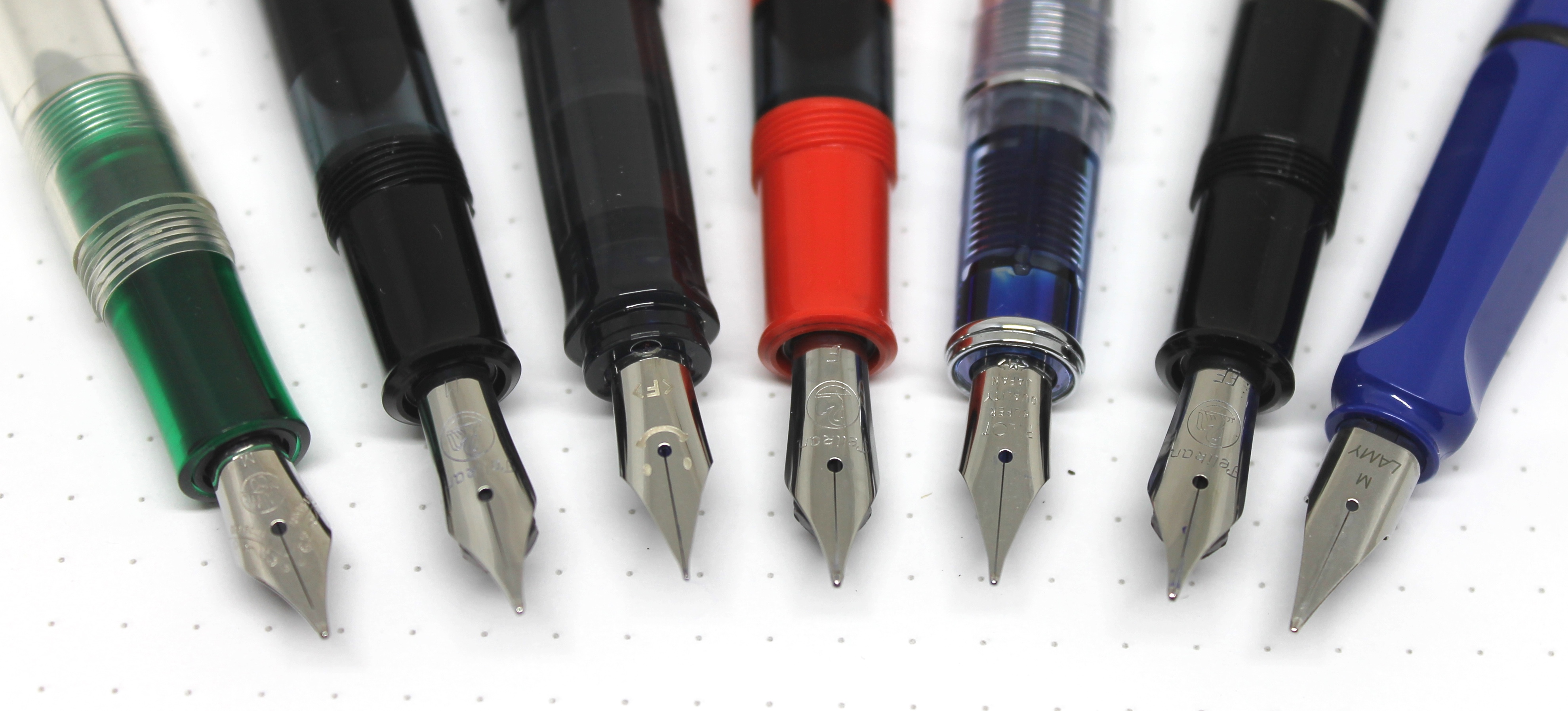
Pen of steel – from (L) 1 Kaweco; 2,4&6 Pelikan; 3&5 Pilot; 7 Lamy.
In conclusion
If you have made it this far, and are still looking for a definitive answer on whether to shell out a few (perhaps quite a few) more dollars for a gold nib on that pen you are considering, I’m probably going to disappoint.
My honest opinion? I would not advise you to spend more money on gold simply for gold’s sake. Will the writing experience be better if you do? Not necessarily, however it will certainly be different. Would I say any of my steel nibs offer a better writing experience than the gold? Probably not. Asking the same question of the gold however — I’d say probably yes — some of my gold nibs do write more smoothly and effortlessly than the steel.
Bear in mind though, if you are talking day-to-day use, posing this question and seeking a somewhat useful answer, relies on so many other factors, a definitive conclusion might be pretty hard to come by. Am I trying to best show off a new ink for an Instagram post, or scrawling a few hundred words of notes in a meeting? Add to this the numerous other situations in which you may find your fountain pen wielding self and you’ll see what I’m talking about.
In wrapping up — did I answer my (selfish I know) original question about whether there is a preference or pattern in the nibs I prefer? Looking back I believe I have — and it is a fairly resounding no. As my collection continues to grow, both steel and gold nibs will be part of any additions. The difference? The almighty dollar will perhaps see the steel side of the ledger increase a little faster.1
So, I certainly have a definitive answer about steel versus gold when reflecting on my collection and preference. Whether or not any of the above has helped you in any way I’d certainly be less certain. That said, if a steel nib pen has a good reputation, and is at a price you are prepared to pay, I’d be fairly certain you won’t be disappointed.
- Of course any arguments around quality versus quantity and saving for a more expensive pen are certainly not irrelevant here. ↩︎
Follow @petedenison
 Pete Denison